Hyundai Ioniq 5 price in Pakistan: a fast-charging SUV in a slow-charging country
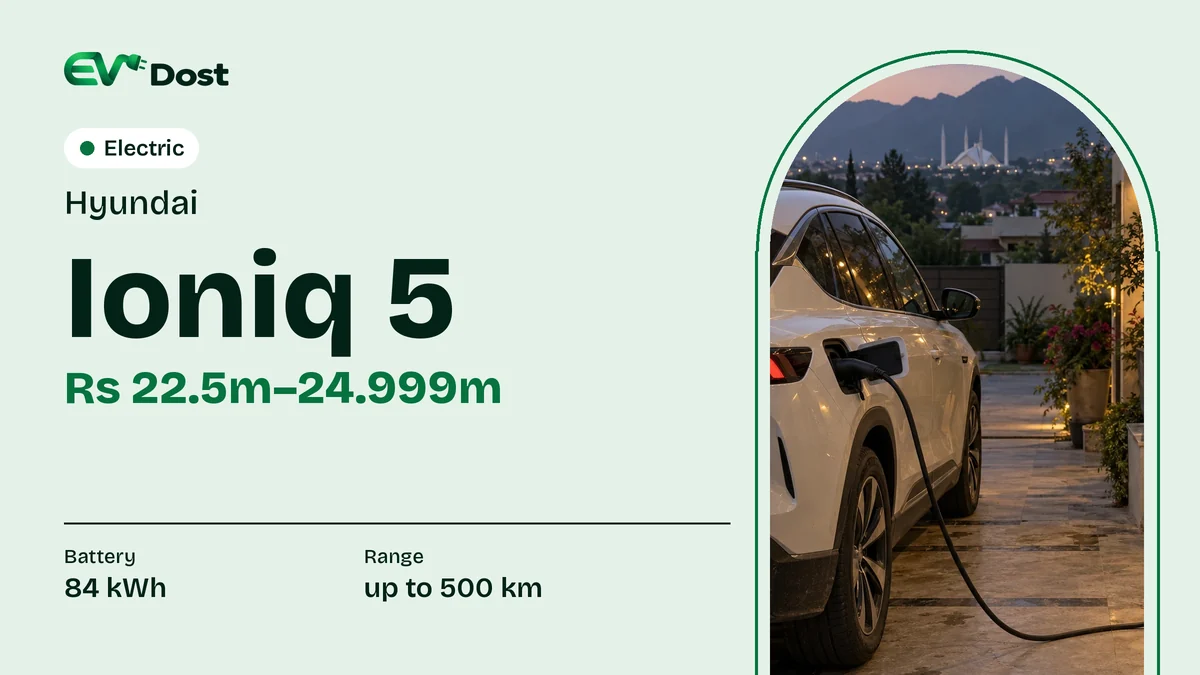
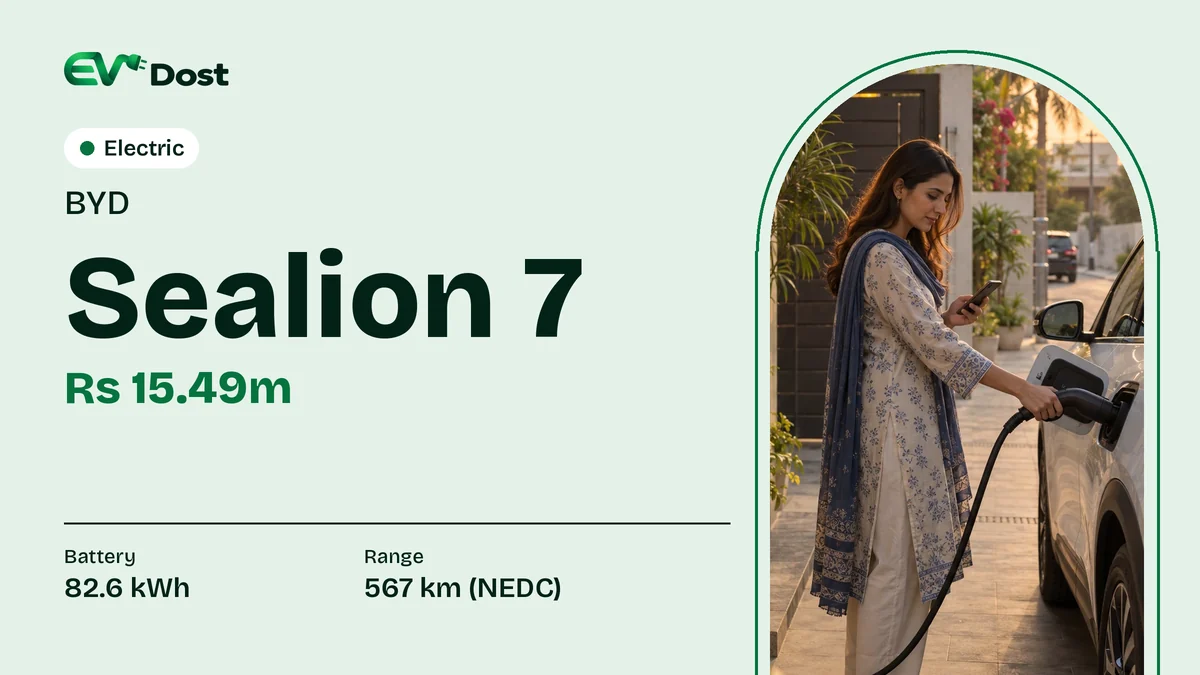
Put a Hyundai Ioniq 5 and a BYD Sealion 7 on the same shortlist and the first thing you'll want explained is the Rs 7 million or so between them. The Hyundai Ioniq 5 price in Pakistan starts at Rs 22,500,000 as of October 2026, from Hyundai Nishat Motor, which sells it as an imported car. It's a large, all-wheel-drive electric crossover with an 84 kWh battery, and it costs more than the BYD Sealion 7 or Xpeng G6.
Part of what you're paying for is charging speed. On a 350 kW charger in Europe, an Ioniq 5 goes from 10 to 80 percent in about 18 minutes. Most public DC chargers in Pakistan deliver a fraction of that power, so here the same top-up takes half an hour to an hour.
That gap between what the car can do and what the plug on the wall can give is the main thing to understand before you spend this much, so it's where we start.
| Hyundai Ioniq 5 | Pakistan figure |
|---|---|
| Price | Smart Rs 22,500,000; Signature Rs 24,999,000 |
| Battery | 84 kWh (about 80 kWh usable on the UK-spec car) |
| Claimed range | up to 500 km (Hyundai Nishat doesn't name the test cycle) |
| Motor and drive | 239 kW, 605 Nm, all-wheel drive |
| AC charging (onboard) | 11 kW on the UK-spec car; Pakistan figure not published |
| DC fast charging | up to 263 kW; 10–80% in about 18 minutes on a 350 kW charger (UK spec) |
| Plug | CCS2 and Type 2 on the UK-spec car; confirm for Pakistan |
| Size | 4,635 mm long, 3,000 mm wheelbase, 170 mm ground clearance, 20-inch wheels |
| Status | Imported; bookings opened March 2024 |
Sources: Hyundai Nishat specifications and price list; UK-spec battery and charging figures from Fleet News; import status from PakWheels.
Built for faster chargers than most in Pakistan
The Ioniq 5's high-voltage (653 V) battery is what lets it accept so much power. On UK-spec figures it peaks at 263 kW, and 10–80 percent takes about 18 minutes on a 350 kW charger. That works out to an average of nearly 190 kW across the session.
Few public chargers in Pakistan come close, so the charger, not the car, usually sets your time. For the 56 kWh that 10–80 percent needs on an 80 kWh usable battery, our estimates are below.
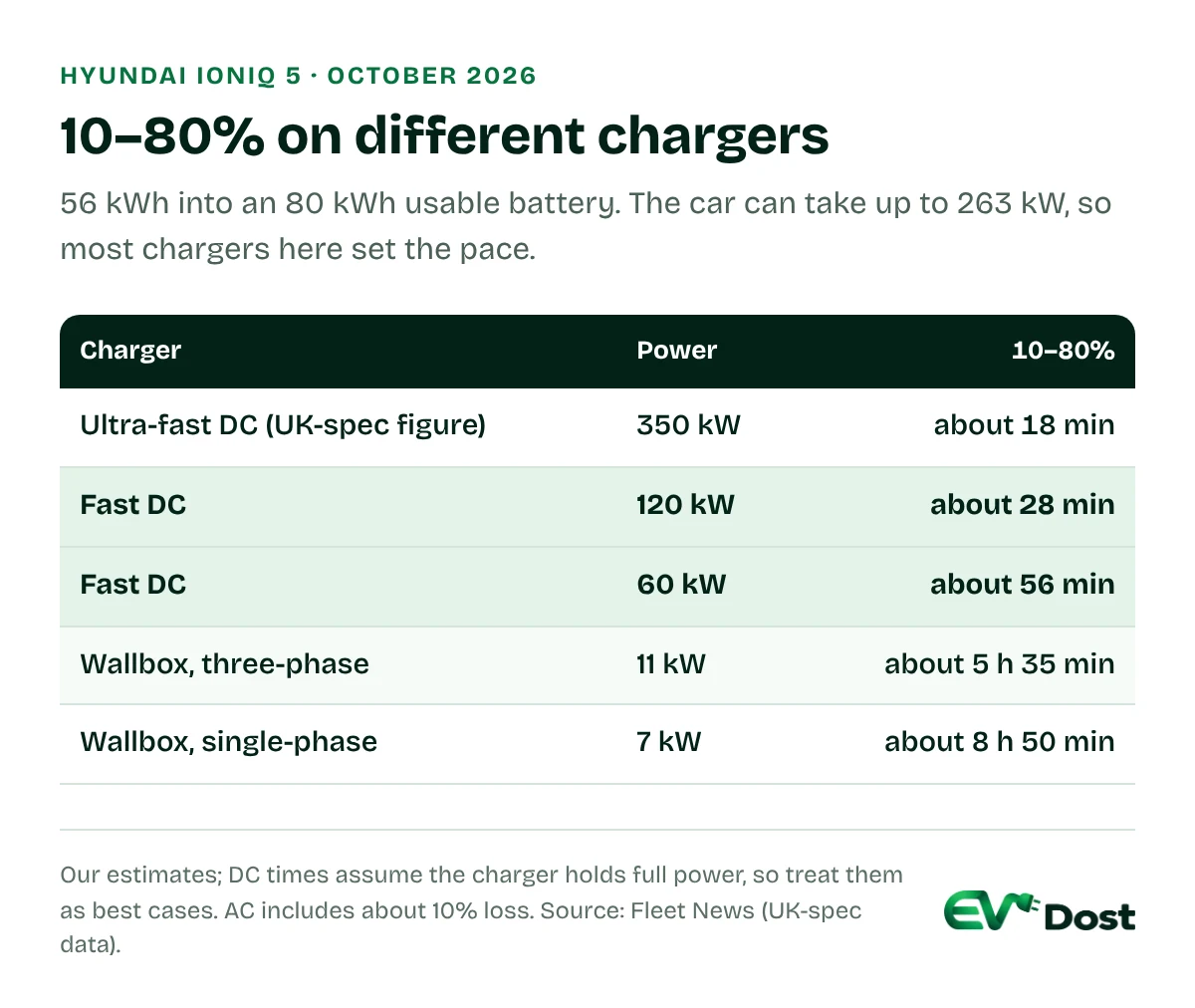
These DC estimates assume the charger holds its rated power, which it often won't near 80 percent or on a hot battery. Treat them as best cases. Before a long trip, check each charger's power, not just its location; our EV road trip guide shows how to plan stops.
On a long trip you'll lean on public chargers and hosts. A host's 7 kW wallbox overnight at your destination adds roughly 250 km over eight hours. EVDost listings show each charger's plug type and power, which matters more with this car than most, and the app works out a cost estimate once you choose the Ioniq 5. Check chargers along your route, from a fast unit on the way to a wallbox for the night.
UK-spec cars use CCS2 for DC and Type 2 for AC, the common standards in Pakistan, but Hyundai Nishat's spec page doesn't state the plug. Confirm before you buy any home charger.
None of this makes the car slow. It means the speed you're paying for arrives in instalments, as faster chargers do.
Hyundai Ioniq 5 price in Pakistan, Smart or Signature
Hyundai Nishat's price list has two Ioniq 5 trims, the Smart at Rs 22,500,000 and the Signature at Rs 24,999,000 (Hyundai Nishat price list). Gari.pk reported the same two prices in January 2026, alongside instalment plans of 18 to 30 months with 30 to 50 percent down (Gari.pk, January 2026). The Ioniq 5 page on Hyundai Nishat's site, last updated in July 2026, still says "from PKR 22,500,000" (Hyundai Nishat).
Hyundai Nishat opened bookings in March 2024 at the same Rs 22.5 million, with half paid at booking and delivery in four to five months (PakWheels, March 2024). So the starting price is where it was at launch. Get the current figure, and the trim it buys, in writing.
The two trims cost about Rs 2.5 million apart, but Hyundai Nishat's spec page lists only one set of figures and doesn't say what the Signature adds. Ask the dealer for a trim-by-trim sheet. In 2025 Hyundai's instalment offer came with a free 7 kW charger (PKRevenue, September 2025), so ask whether a similar deal is running now.
The wallbox decides your mornings
At home the limit is your house. Most Pakistani homes have a single-phase connection, which tops out at about 7 kW. The UK-spec car can take 11 kW on AC, but only from a three-phase supply. These are our estimates for a 7 kW wallbox.
- 20–80 percent takes about 7 hours 30 minutes.
- 10–100 percent takes about 11 hours 20 minutes.
- A day's 40 km takes about 9 units and roughly 1 hour 15 minutes.
You won't fill a big battery overnight from empty, but you rarely need to. If you have three-phase, an 11 kW wallbox cuts 10–100 percent to about 7 hours 10 minutes. Before ordering a wallbox, run through the sanctioned-load and wiring checks.
How far the big battery gets you in the heat
Hyundai Nishat claims up to 500 km but doesn't name the test. That matches the UK-spec 84 kWh all-wheel-drive car's WLTP figure of about 496 km.
For costs and range we use 20 kWh per 100 km on the road for the Ioniq 5, a little more than the 18 we use for compact EVs. It weighs 2,020 to 2,100 kg, drives all four wheels and sits on 20-inch tyres, and on UK-spec figures (about 496 km WLTP from roughly 80 kWh usable) it already uses about 16 to 17 kWh per 100 km before Pakistani heat. At 20 kWh, a full battery gives about 400 km and the usual 10–100 percent about 360 km.
That's just about enough for Lahore to Islamabad on the M-2 without stopping, if you leave full and drive at a steady pace, though at our cautious figure you'd arrive with little to spare. In Jacobabad-level heat with four people and the AC on full, expect less. Our guide to battery care in Pakistan's heat explains why.
The electricity bill next to a Sportage's petrol
At Rs 55 a unit all-in (how we arrive at that rate is worked through separately), 22 units from the wall for 100 km cost about Rs 1,210, or Rs 12 a km. Pay a public DC charger's usual Rs 115 or so per kWh and 100 km costs about Rs 2,300.
For a petrol comparison we used the Kia Sportage AWD, a 2.0-litre SUV that PakWheels lists at 11 km a litre on average (PakWheels). Petrol at Rs 377.71 a litre, the notified price for 24–26 October 2026 (Investify, October 2026), makes that about Rs 3,430 per 100 km. Fuel prices have been revised almost daily, so check the current one.
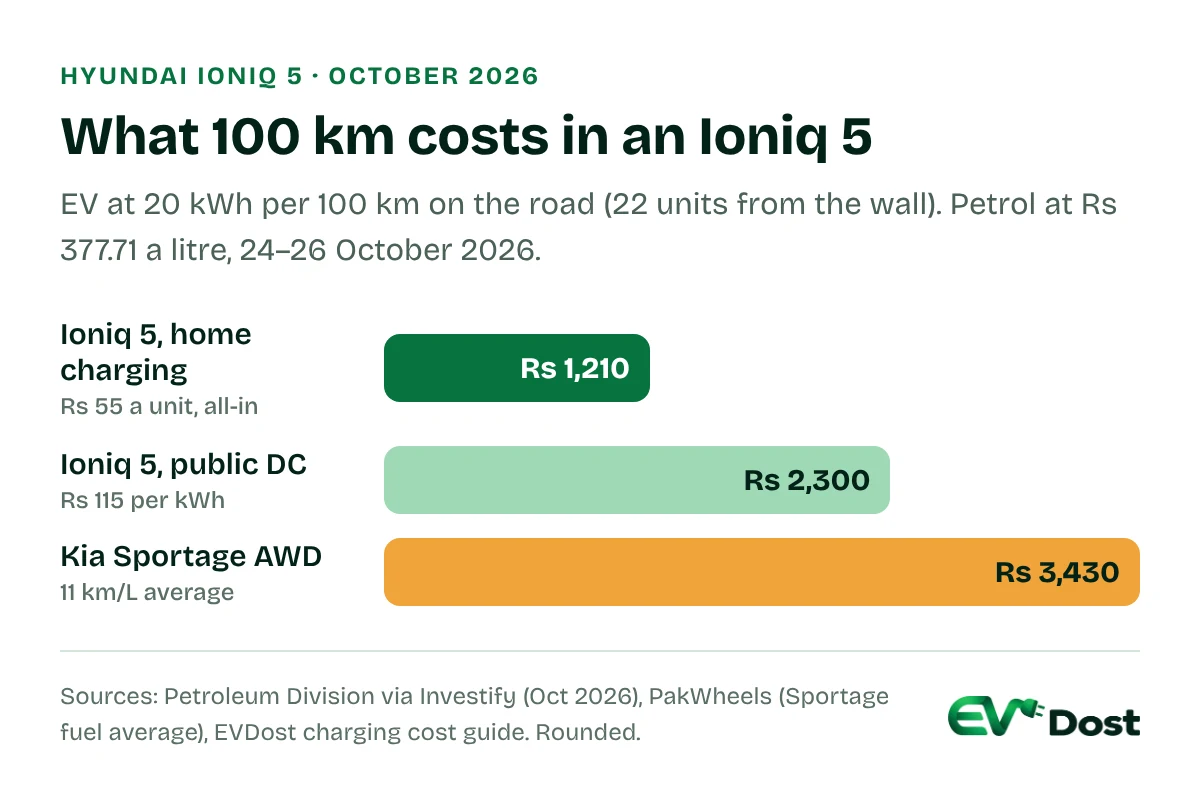
Over 15,000 km a year, that's about Rs 182,000 of home electricity against about Rs 515,000 of petrol, a saving of roughly Rs 334,000 before servicing. It's a real saving, but at this price it won't pay back the gap to a cheaper EV. Budget for your slab as well, since 15,000 km a year adds about 275 units a month to the bill.
Cheaper Chinese rivals, and the Hyundai's reply
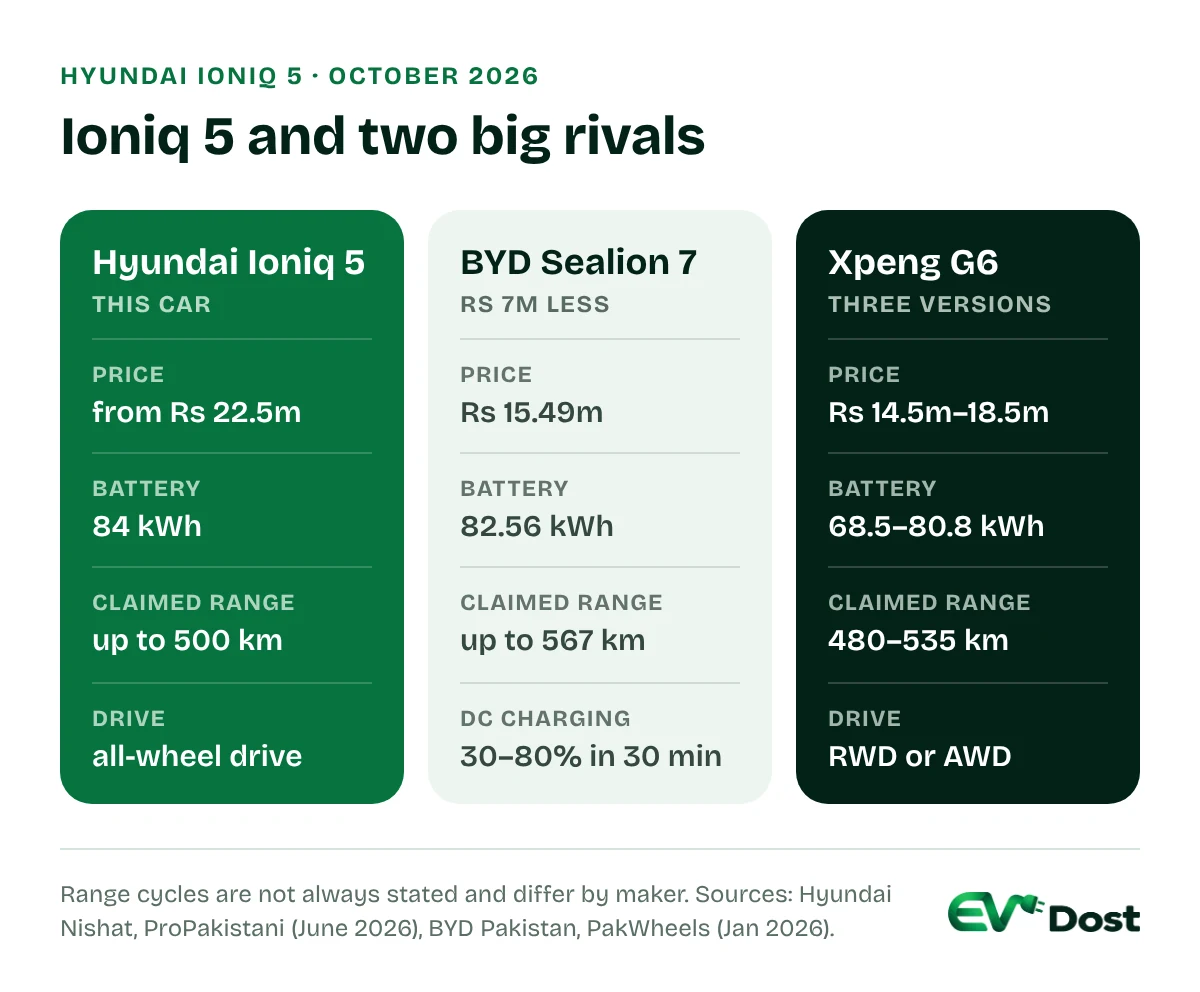
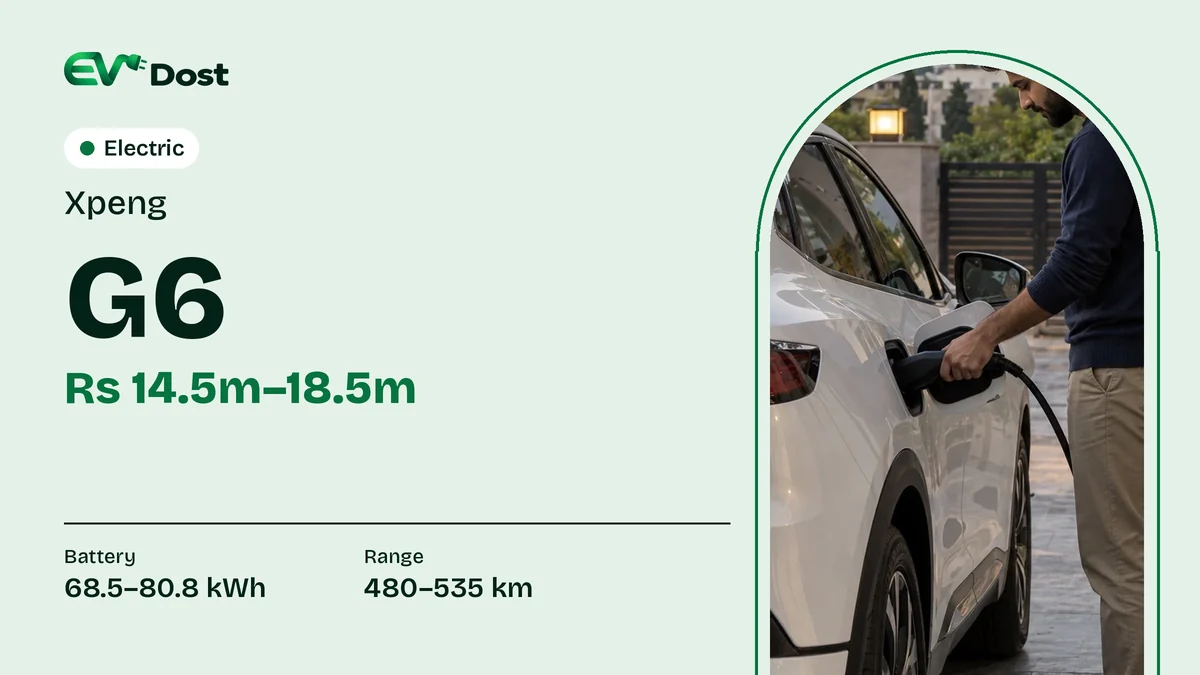
The BYD Sealion 7 costs Rs 15,490,000 (ProPakistani, June 2026), about Rs 7 million less, with a similar 82.56 kWh battery, a claimed 567 km and 30 to 80 percent in about 30 minutes, by BYD's figures (BYD Pakistan). The Xpeng G6 starts at Rs 14,500,000 for the Standard Range RWD, with the Performance AWD at Rs 18,500,000 (PakWheels). The BYD Seal Premium, a sports saloon rather than a crossover, is Rs 16,990,000 in the same June list.
On pure numbers, the Chinese rivals give similar battery and range for millions less. The case for the Hyundai is its charging speed, all-wheel drive on the car Hyundai Nishat lists, the Hyundai badge and dealer network, and a 3-metre wheelbase that gives a roomy cabin. For the rest of the market, all the way down to small city cars, see our electric car price guide.
The strongest card is DC charging at up to 263 kW (UK spec), which leaves the car ready for faster chargers as they arrive. You also get all-wheel drive and 239 kW, a roomy cabin and a 770-litre luggage figure from Hyundai Nishat. At our cautious consumption figure, usable range comes out at around 360 to 400 km.
Against that sits the price, Rs 7 to 8 million more than similar-sized Chinese EVs. It's imported, so that price is exposed to duties and the rupee. A single-phase home can't use its 11 kW AC charging.
The warranty needs a closer look too. Hyundai Nishat's battery warranty page is written for hybrids. It lists 8 years or 160,000 km for the high-voltage battery, but doesn't name the Ioniq 5 (Hyundai Nishat). Get the EV battery terms in writing.
Paying for charging you'll grow into
The Ioniq 5 suits a buyer for whom Rs 22.5 million is comfortable, who wants an EV with a strong brand behind it, and who drives between cities often enough to value its range and charging speed. It makes most sense with a wallbox at home, ideally on three-phase.
If Rs 22.5 million doesn't stretch you, we think the Ioniq 5's charging hardware is something you pay for now and use more each year as faster chargers arrive. If the gap to the Sealion 7 would hurt, we'd lean to the BYD. Drive both on the same day, and ask Hyundai Nishat for the trim sheet and the EV battery warranty before you pay anything.
Frequently asked questions
What is the Hyundai Ioniq 5 price in Pakistan by trim?
The Hyundai Ioniq 5 costs Rs 22,500,000 for the Smart trim and Rs 24,999,000 for the Signature in Pakistan, according to Hyundai Nishat's price list, and the dealer's site still lists it from Rs 22.5 million as of October 2026. It is imported and sold by Hyundai Nishat Motor.
What is the range of the Ioniq 5 in Pakistan?
The Ioniq 5 is claimed at up to 500 km on its 84 kWh battery by Hyundai Nishat, which doesn't name the test cycle; that matches the UK-spec car's WLTP figure of about 496 km. In Pakistani heat and traffic, plan on roughly 360 to 400 km.
How long does the Ioniq 5 take to charge in Pakistan?
On a 7 kW home wallbox, the Ioniq 5 takes about 11 hours 20 minutes from 10 to 100 percent and about 7 hours 30 minutes from 20 to 80 percent, by our estimate as of October 2026. On DC, 10 to 80 percent takes about 18 minutes on a 350 kW charger, but roughly half an hour on a 120 kW unit and about an hour on a 60 kW unit.
Is the Ioniq 5 worth it over the BYD Sealion 7?
The Hyundai Ioniq 5 costs about Rs 7 million more than the BYD Sealion 7 (Rs 15.49 million as of June 2026), which has a similar 82.56 kWh battery and a higher claimed range. The Ioniq 5 offers faster peak charging, all-wheel drive and Hyundai's brand; test both before deciding.
Does the Ioniq 5 work with Pakistani chargers?
The UK-spec Ioniq 5 uses CCS2 for DC and Type 2 for AC, the common plugs on Pakistani chargers, though Hyundai Nishat doesn't state the plug for local cars. Most Pakistani DC chargers are far below the car's 263 kW peak, so charging takes longer than Hyundai's 18-minute figure.
Sources
- Hyundai Nishat, Ioniq 5 page: hyundai-nishat.com
- Hyundai Nishat, Ioniq 5 specifications: hyundai-nishat.com
- Hyundai Nishat, Ioniq 5 and 6 price list: PDF
- Hyundai Nishat, warranty conditions: hyundai-nishat.com
- Gari.pk, Ioniq instalment plans (January 2026): gari.pk
- PakWheels, Ioniq 5 and 6 prices and booking (March 2024): pakwheels.com
- PakWheels, Hyundai Ioniq listing: pakwheels.com
- PKRevenue, Ioniq instalment plans (September 2025): pkrevenue.com
- Fleet News, Ioniq 5 84 kWh AWD data: fleetnews.co.uk
- PakWheels, Kia Sportage fuel average: pakwheels.com
- ProPakistani, BYD prices after the budget (June 2026): propakistani.pk
- BYD Pakistan, Sealion 7: byd-mega.com
- PakWheels, Xpeng G6 listing: pakwheels.com
- Investify, petrol price for 24–26 October 2026: investify.pk