BYD Sealion 7 price in Pakistan, and living with its big battery at home
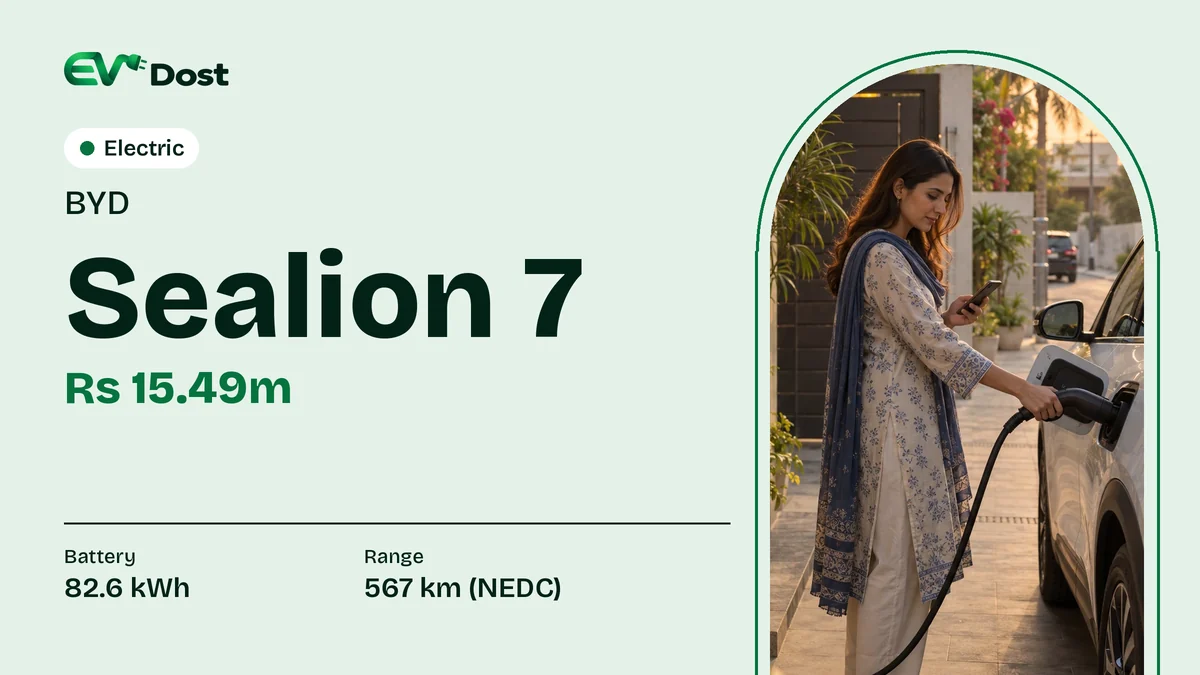
Thirteen hours. That's roughly how long an empty BYD Sealion 7 takes to fill on the 7 kW wallbox most Pakistani homes can run. It isn't a flaw so much as arithmetic — the battery is big, and a single-phase connection is not.
The BYD Sealion 7 price in Pakistan is Rs 15.49 million as of October 2026, for one version, sold as the Advanced (PakWheels; ProPakistani, June 2026). That's about Rs 555,000 more than a petrol Toyota Fortuner 2.7 V, and that comparison is what makes this SUV interesting. The charging deserves just as much attention as the price, because it shapes everything else about owning one.
At the showroom: BYD Sealion 7 price in Pakistan and specs
| BYD Sealion 7 Advanced | |
|---|---|
| Price (October 2026) | Rs 15,490,000 |
| On sale since | January 2026, imported fully built |
| Battery | 82.56 kWh Blade (LFP) |
| Claimed range | 567 km (labelled NEDC by BYD Pakistan) |
| Motor | 230 kW, 380 Nm, rear-wheel drive |
| 0–100 km/h | 6.7 seconds |
| AC charging | 11 kW onboard |
| DC charging | CCS2; 30–80% in about 30 minutes (BYD) |
| Boot | about 500 litres, plus a 58-litre front boot |
| Warranty | vehicle 6 years or 150,000 km; battery 8 years |
Sources: BYD Pakistan's model page and August 2026 brochure for battery, range, motor, acceleration and boot; PakWheels for price, drive, AC limit, plug and warranty. The launch announcement put the booking amount at Rs 3 million and said the price included freight and inland transit insurance (ProPakistani, January 2026), while PakWheels calls it ex-factory. Registration and insurance are extra either way. The free 7 kW wallbox and installation offered with launch bookings ended in February 2026.
Two details don't line up across BYD's own documents. The battery warranty is 8 years, with PakWheels saying 160,000 km and the August brochure 150,000 km. And BYD's website gives 520 litres of boot against 500 in the brochure. Neither is a deal-breaker. Just get the warranty in writing.
For the money you get a rear-drive 230 kW SUV with a big battery, at a price that undercuts the Seal Premium sedan by Rs 1.5 million. The battery warranty runs 8 years. The weak point on the bill of sale is the import status. Since the first BYD to be assembled here will be the Sealion 6 plug-in hybrid (The Nation, September 2026), nothing announced points to a locally built Sealion 7, so for now it is an import, priced at the mercy of the rupee.
An ordinary week on an 82.56 kWh battery
The Sealion 7 has the same 82.56 kWh Blade battery as the top Seal sedan. In daily use you'll rarely see empty. A 60 km day uses about 13 units from the wall, under two hours on a wallbox. The long waits only arrive when you want a full battery for a trip.
The car itself can take more than a home usually gives. PakWheels lists an 11 kW onboard AC charger for the Pakistani car (PakWheels, specifications), but 11 kW needs a three-phase supply. Most houses have single-phase, which tops out around 7 kW. So for most owners the numbers come from 7 kW, with our usual 10 percent added for charging losses.
- The everyday 20–80% top-up on a 7 kW wallbox takes about 7 hours 45 minutes and about 54 units from the meter.
- Empty to full on 7 kW takes about 13 hours.
- On three-phase with an 11 kW wallbox, 20–80% takes about 5 hours, and empty to full about 8 hours 15 minutes.
- The 2.2 kW portable cable needs about 24 hours 45 minutes for 20–80%, so keep it for emergencies.
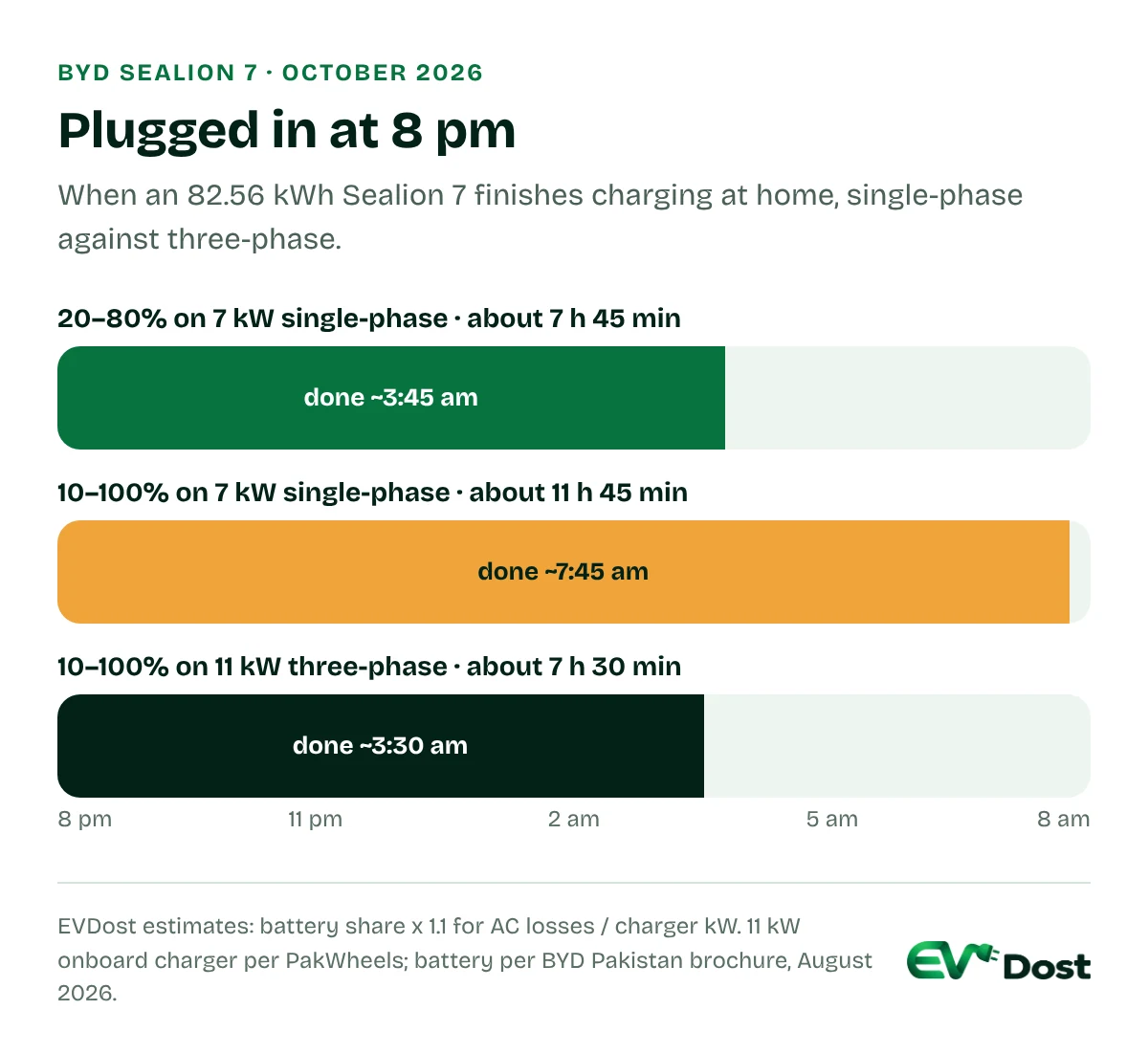
That's where the downsides start, at the wall socket. On single-phase, a full charge takes all night and then some. If your house already has three-phase, ask the installer about an 11 kW unit. The sanctioned-load and wiring questions are in our guide to fitting a home charger. Many owners won't need it. Charging to 80 percent overnight and to 100 only before a trip works well on 7 kW. Owners with rooftop solar can also shift some charging to daytime weekends, which our solar charging guide works through.
The battery earns its keep on bad days too. The 11 kW onboard charger is there if you have three-phase, and V2L, rated up to 3.3 kW in the brochure, can run a fridge and some lights during load-shedding.
The long drive, and where to top up
BYD Pakistan's brochure calls the 567 km figure NEDC. PakWheels notes that launch material put the car at about 482 km on WLTP, which matches the European rating for this same rear-drive 82.5 kWh version (EV Database).
For our running-cost sums we use 20 kWh per 100 km, higher than the 18 we use for compact cars. The justification is that same European WLTP rating, 19.9 kWh per 100 km, for a 2.2-tonne SUV with a tall front. On that basis a full battery gives about 410 km of mixed driving with the AC on. At 120 km/h on the motorway, where we allow a quarter more, plan on about 300 km between full and 10 percent. Islamabad to Lahore on the M-2 becomes a run with one comfortable top-up.
PakWheels lists a CCS2 port, the DC plug Pakistan's public chargers use (WorldStandards). BYD Pakistan doesn't publish a DC peak for this car. The European version of the same specification is rated at 150 kW, with 10–80% in about 32 minutes, and PakWheels lists the same 32 minutes for Pakistan.
You'll rarely see 150 kW here. BYD describes public chargers in Pakistan as 30 to 120 kW (BYD Pakistan), and the motorway site at Magic River on the M-2 that Hubco Green opened with PSO has two 60 kW units (APP, June 2025). At 60 kW, putting 58 kWh into this battery, the 10–80 percent share, takes close to an hour before any slowdown. Plan that stop around a meal.
The night before matters as much as the stop. Without three-phase at home, a host's three-phase charger can give you the car's full 11 kW on the day before a long drive. Every EVDost listing states the plug type and power, so an 11 kW or 22 kW AC unit is easy to spot, and the app works out a cost estimate for the Sealion 7 on each one. Find an 11 kW charger.
The bills, next to a Fortuner's
The Fortuner 2.7 V petrol costs Rs 14.935 million (June 2026) and PakWheels rates it at about 9 km per litre on average (PakWheels, Fortuner; PakWheels, fuel average). They're different kinds of SUV (a body-on-frame off-roader against a road-focused crossover), but plenty of families shop them at the same price. That near-match between the BYD Sealion 7 price in Pakistan and the Fortuner's is why the running costs matter so much.
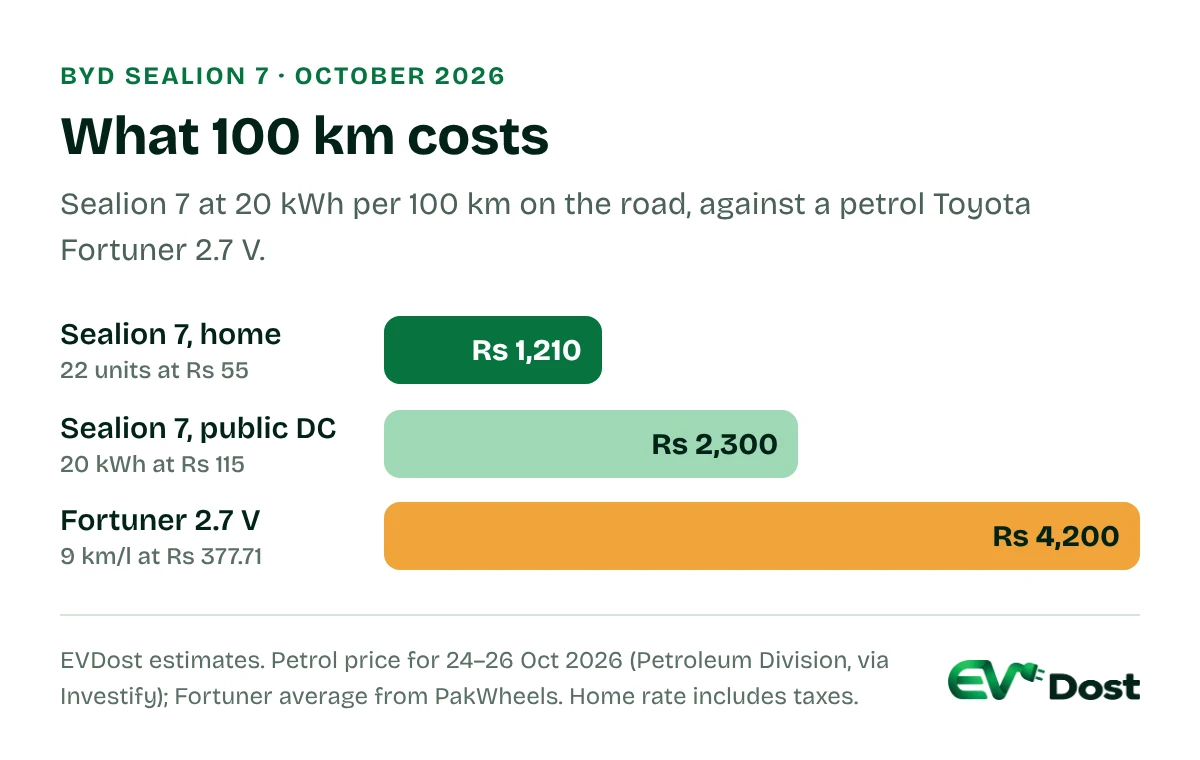
At 20 kWh per 100 km, the Sealion 7 draws 22 units from the wall per 100 km. At about Rs 55 a unit all-in (why Rs 55), that's about Rs 1,210, or Rs 12 a km. Public DC at a typical Rs 115 per kWh comes to about Rs 2,300. The Fortuner burns about Rs 4,200 of petrol per 100 km at Rs 377.71 a litre, the 24–26 October 2026 price (Investify, October 2026). Check today's rate, since it has been changing almost daily.
A 1,500 km month works out to about Rs 18,200 on home charging against about Rs 63,000 of petrol. The difference, roughly Rs 44,800 a month, is the strongest argument for this car.
Our consumption figure is borrowed, though. The car weighs 2,225 kg, per PakWheels, which shows up in consumption. BYD Pakistan doesn't publish a DC peak or, so far, a consumption figure.
Other big electric SUVs to drive first
If we were cross-shopping, the Seal, the G6 and the Ioniq 5 would be on our list. For everything else on sale, from city cars up, see what every electric car costs in Pakistan.
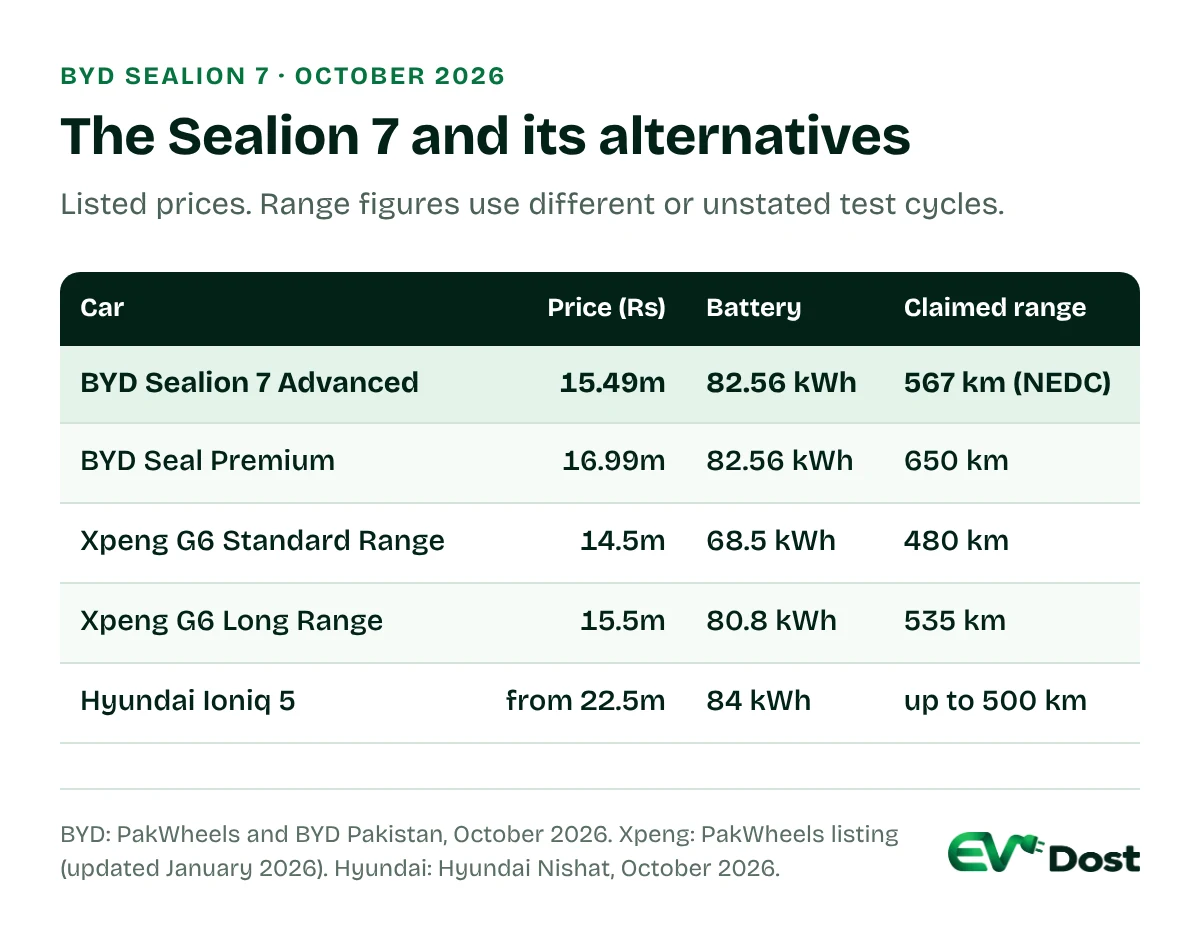
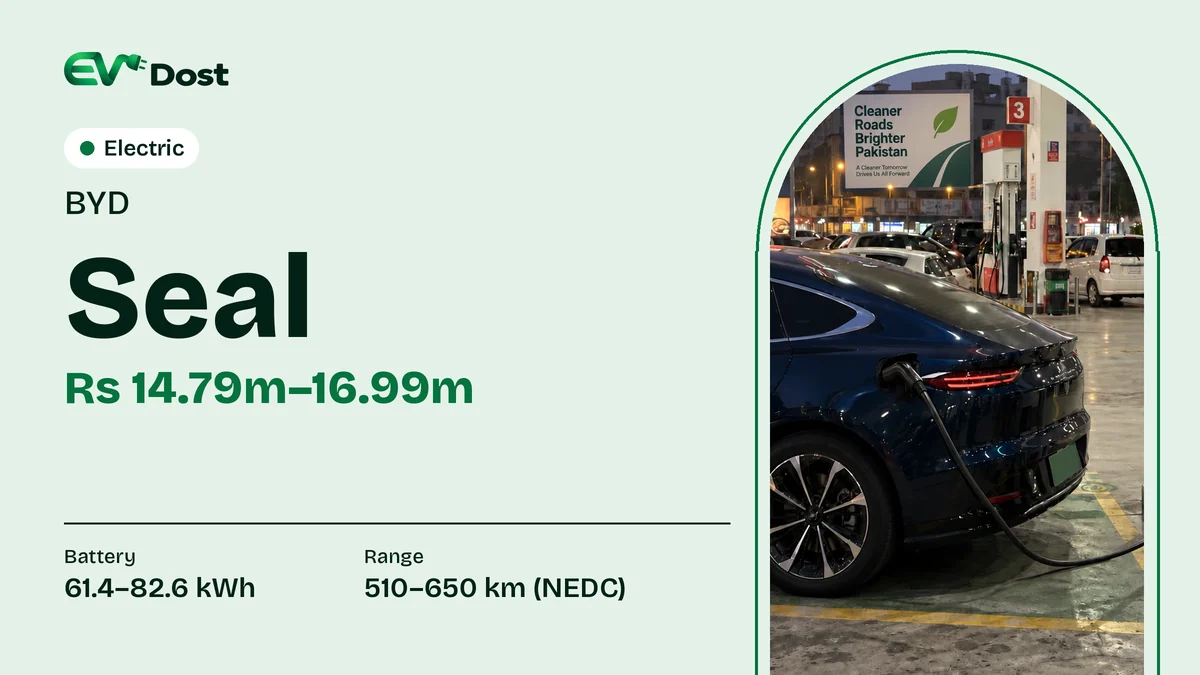
- The BYD Seal Premium puts the same battery in a sedan body for Rs 1.5 million more. It's lower and more efficient, though less practical. Our Seal guide has the details.
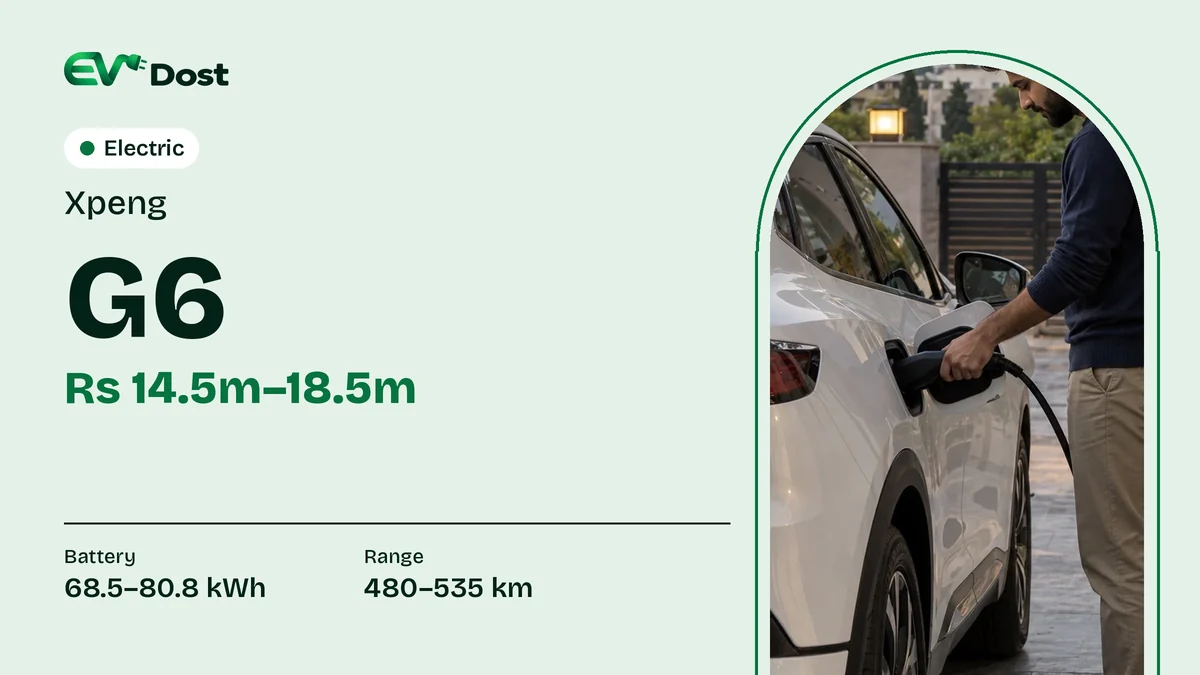
- The Xpeng G6 costs Rs 14.5 to 15.5 million for the rear-drive versions, with 68.5 or 80.8 kWh (PakWheels). It's the one to drive if fast charging matters to you; see our Xpeng G6 guide.
- The Hyundai Ioniq 5 starts from Rs 22.5 million (Hyundai Nishat), a big step up in price. Our Ioniq 5 guide explains what the extra buys.
Is it your family's next SUV?
We'd point a family toward the Sealion 7 if they want a roomy electric SUV, have off-street parking and a wallbox, and drive a few long intercity trips a year alongside daily city use. If you have three-phase, it suits you even better. Before you sign, check your supply phase, your parking spot and the warranty mileage written on the form.
Frequently asked questions
What is the BYD Sealion 7 price in Pakistan?
The BYD Sealion 7 costs Rs 15,490,000 in Pakistan as of October 2026, for the single Advanced version. It launched at that price in January 2026, and ProPakistani reported in June 2026 that BYD's prices would stay the same after the budget. Registration and insurance are extra.
What is the real range of the BYD Sealion 7?
The BYD Sealion 7 is rated at 567 km by BYD Pakistan (NEDC) and about 482 km on WLTP for the equivalent European version. By our estimate at 20 kWh per 100 km, expect about 410 km of mixed driving and about 300 km at 120 km/h between full and 10 percent.
How long does the BYD Sealion 7 take to charge at home?
On a 7 kW single-phase wallbox, the BYD Sealion 7 takes about 7 hours 45 minutes from 20 to 80 percent and about 13 hours from empty to full, by our estimate as of October 2026. On an 11 kW three-phase wallbox, which the car's 11 kW onboard charger can use, 20 to 80 percent takes about 5 hours.
Is the BYD Sealion 7 better than a Toyota Fortuner?
The BYD Sealion 7 costs about Rs 12 per km to run on home charging, against about Rs 42 per km for a petrol Fortuner 2.7 V, as of October 2026. The prices are close: Rs 15.49 million against Rs 14.935 million. The Fortuner is the tougher car for rough roads and long trips without chargers.
Does the BYD Sealion 7 support fast charging in Pakistan?
The BYD Sealion 7 supports fast charging in Pakistan through its CCS2 port, which matches the country's public DC chargers, and BYD quotes 30 to 80 percent in about 30 minutes. On a 60 kW charger, such as the units at the M-2's Magic River stop, 10 to 80 percent takes close to an hour.
Sources
- PakWheels, BYD Sealion 7 listing and specifications (opened October 2026): listing, specifications
- ProPakistani, BYD prices after the budget (June 2026): propakistani.pk
- ProPakistani, Atto 2 and Sealion 7 launch (January 2026, sponsored): propakistani.pk
- BYD Pakistan, Sealion 7 page and brochure (August 2026): page, PDF
- BYD Pakistan, charging page: byd-mega.com
- EV Database, BYD Sealion 7 82.5 kWh RWD (European version): ev-database.org
- WorldStandards, EV connector inlets by country: worldstandards.eu
- APP, M-2 charging station (June 2025): app.com.pk
- PakWheels, Toyota Fortuner price and fuel average: price, fuel average
- Investify, petrol price 24–26 October 2026: investify.pk
- The Nation, BYD Sealion 6 local assembly (September 2026): nation.com.pk
- PakWheels, Xpeng G6 listing: pakwheels.com
- Hyundai Nishat, Ioniq 5: hyundai-nishat.com