Charging your EV with solar in Pakistan: does it add up in 2026?
Pakistan has added solar at a remarkable pace. By December 2025, around 7,000 MW of capacity was on net metering alone, according to figures given to the National Assembly (The News, February 2026), and that doesn't count the many off-grid and hybrid systems on rooftops across the country.
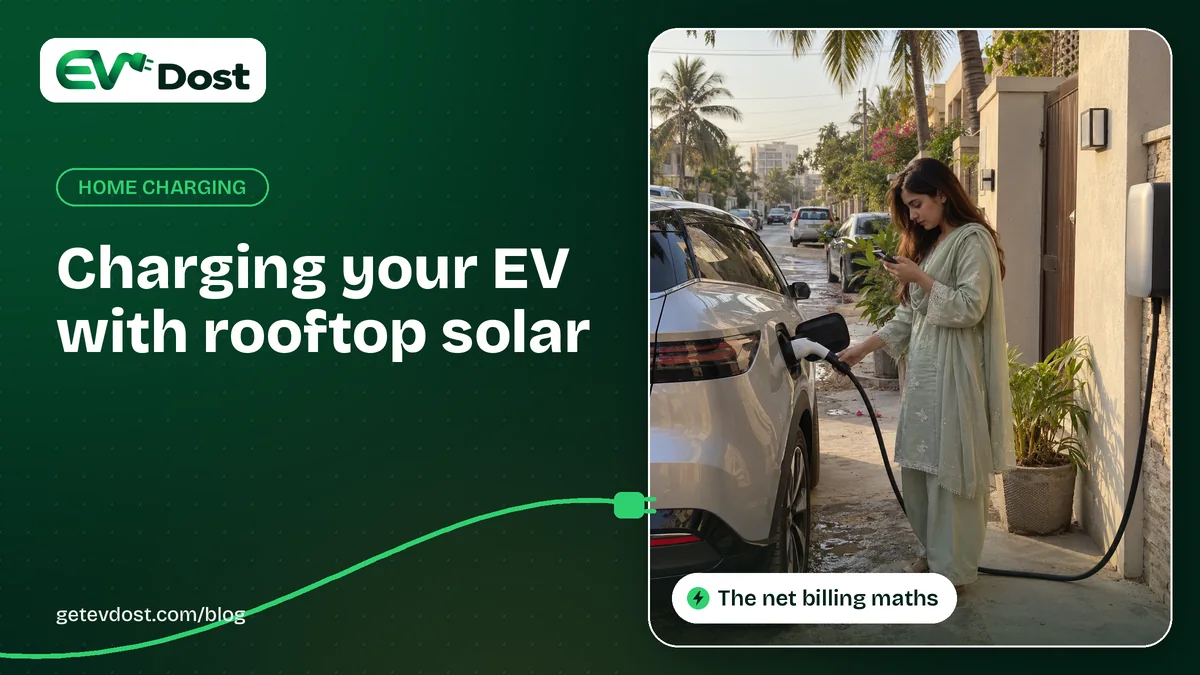
If you're one of those households and you're thinking about an electric car, or you already have one, the question is obvious. Can the panels on the roof run the car in the driveway?
They can, and February's rule change made it a better deal than before. This guide explains why, and how to charge an EV with solar in Pakistan so it works in practice.
What changed with net billing
On 9 February 2026, NEPRA notified new prosumer regulations that replaced net metering with net billing (Nukta; The Standard). Under the new system, the electricity you export is bought at the national average energy purchase price, which press reports put at roughly Rs 10 to 13 a unit. Under the old system, exported units effectively offset units you bought at full price.
After pushback, NEPRA proposed a draft amendment in February (pv magazine, February 2026), and by April the rules had been amended so that existing net-metering customers keep their old terms until their agreements expire. The catch is that if you change your system's capacity, you lose that protection (ARY News, April 2026).
For anyone on net billing, the gap is now stark. A unit you export earns roughly Rs 10 to 13. A unit you buy from the grid typically costs several times that once taxes are included. Every unit you use yourself instead of exporting is worth far more to you, and an EV is one of the biggest, most flexible loads a home can have.
How much can your panels produce?
Real-world output in Pakistan is roughly 3.8 to 4.5 units (kWh) per kilowatt of panels per day, averaged over the year, based on installer yield figures (Voltflow, April 2026). Summer days produce more and winter days less; satellite irradiance data shows a wide seasonal swing across the country (Profile Solar, NASA POWER data).
So a 5 kW system produces something like 19 to 22 units on an average day. A 10 kW system, double that.
How much does the car need?
Most compact electric cars use roughly 15 to 19 kWh per 100 km in everyday driving (our EV charging cost guide explains where those figures come from). If you drive 50 km a day, that's about 8 to 9 units. If you drive 30 km, it's about 5.
Put those two numbers side by side and you can see the appeal. A modest 5 kW system can cover a typical daily commute with energy to spare, provided the car is plugged in while the sun is up.
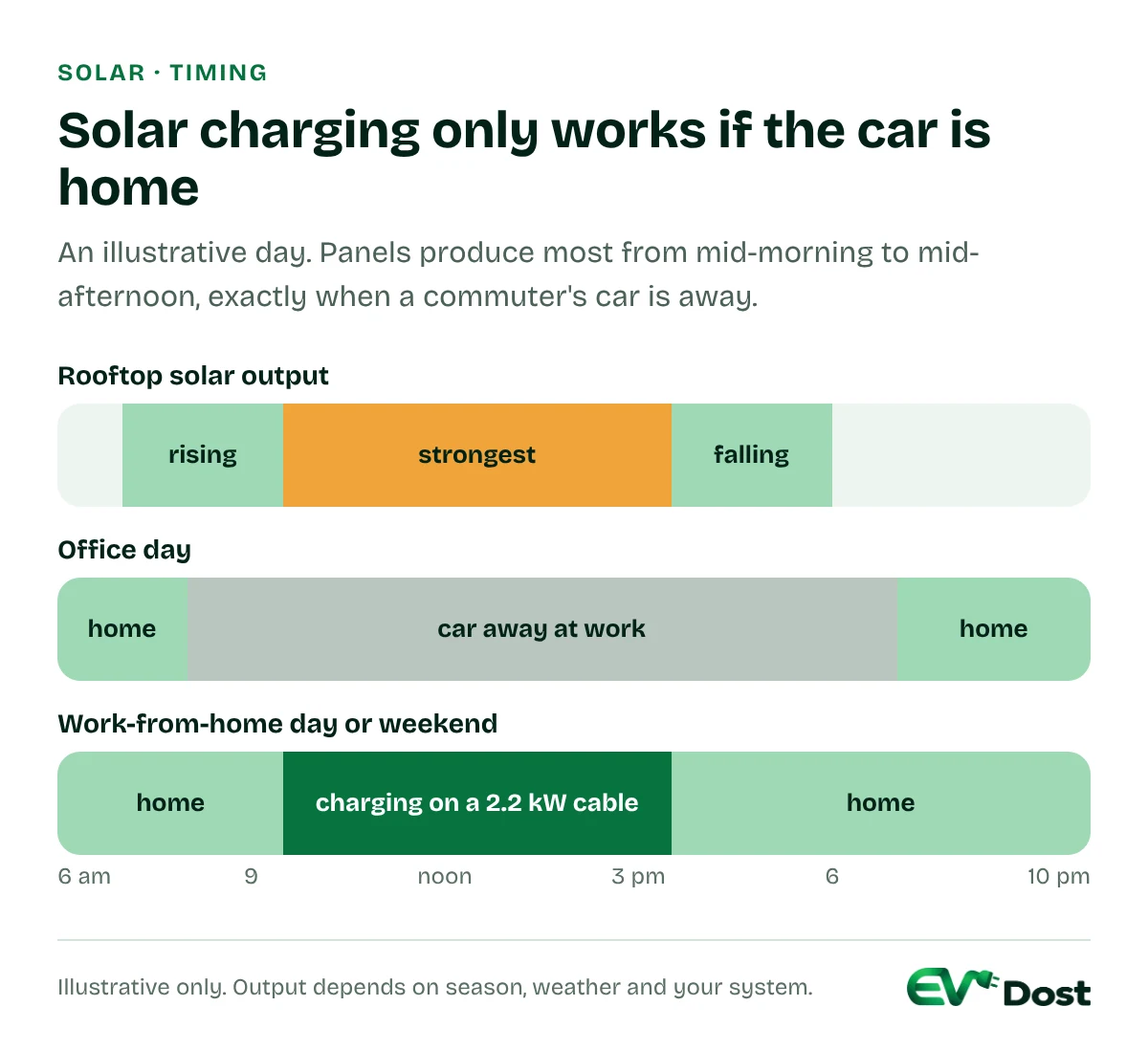
The catch: the car has to be home in daylight
This is where most solar EV plans run into trouble. If you leave for work at 8 and come home at 7, your car is away for exactly the hours your panels are producing.
Solar charging works best for:
- Second cars that stay home most of the day.
- People who work from home, or who work near enough to come back at lunch.
- Weekend top-ups, which can cover much of a week's commuting if your daily distance is moderate.
- Small businesses with their own parking, where cars sit through the day.
If your car is never home in daylight, the other route is storing solar energy in a home battery and charging the car from that in the evening. That's possible, but home batteries are expensive and their capacity is usually needed for the house during load-shedding. For most families it isn't the best use of the battery.
Matching charger speed to your panels
A 7 kW wallbox pulls 7 kW the moment it starts. If your panels are producing 4 kW at that moment, the other 3 kW comes from the grid, which defeats the purpose.
There are two simple ways around this:
Use a slower charger during the day. A 2.2 kW portable cable sits comfortably inside the output of most rooftop systems from mid-morning to mid-afternoon. Over six daylight hours it adds about 13 units, which is more than a typical day's driving.
Use a wallbox with adjustable current or a solar mode. Some wallboxes let you set a lower charging current, or follow your solar output automatically using a sensor on your supply. Ask your installer whether the unit you're considering does this, and whether it works with your inverter.
If you're on a hybrid inverter, check its maximum output too. Common household hybrid units are rated at around 4 to 8 kW (PowerHouse Express listing), and that output is shared with everything else in the house.
What it costs to add solar
As of April 2026, installed systems in Punjab and Islamabad were costing roughly Rs 150,000 to 240,000 per kilowatt, with a 5 kW system around Rs 850,000 to 1.2 million and a 10 kW system around Rs 1.5 to 2.2 million (Voltflow). A 10 kW hybrid system with battery storage was quoted at about Rs 1.6 to 2.2 million in August 2026, depending on battery size (MaxPower, August 2026).
Under the new rules, the system size you can connect is capped at your sanctioned load (The Standard). If you're adding a 7 kW charger and increasing your sanctioned load anyway, it's worth planning the solar and the charger together.
A rough example
Take a household that already has a 5 kW system on net billing and buys an EV. One partner commutes 40 km a day, and works from home two days a week. The car is home in daylight on those two days and at weekends.
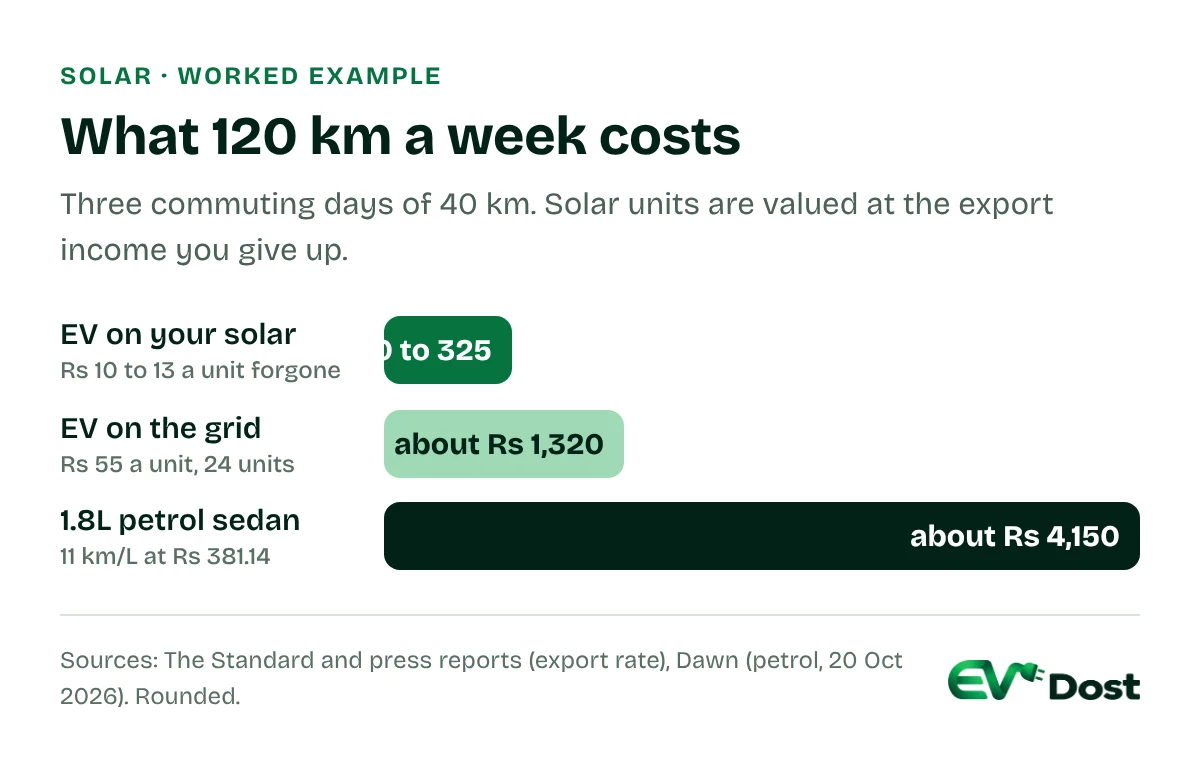
That's three commuting days, about 120 km, or roughly 20 to 25 units a week from the wall. On the days the car is home, it charges from the panels on a 2.2 kW cable, which can add up to about 13 units in six good daylight hours. Two solar days cover the whole week's driving with room to spare. The grid only steps in during cloudy spells or short winter days.
What is that worth? The units going into the car would otherwise have been exported at roughly Rs 10 to 13. So the real cost of those 20 to 25 units is about Rs 200 to 325 a week in lost export income, which works out to roughly Rs 2 to 3 per km. A 1.8L petrol sedan doing the same 120 km would burn about Rs 4,150 of petrol at October's price of Rs 381.14 a litre, assuming 11 km/L. We break down grid-only costs in detail in how much it costs to charge an EV in Pakistan.
Solar owners can also host
If your panels produce more than your own car needs, there's another option. You can list your charger on EVDost, set your own hourly price, and let drivers nearby charge during the daylight hours you choose. Drivers are billed in 10-minute blocks. A charger that would otherwise be idle, powered by units that would otherwise be sold back at Rs 10 to 13, can earn considerably more. See earning from your EV charger for how it works, or list your charger now.
Before you start
- Check whether you're on legacy net metering or the new net billing, and when your agreement ends.
- Look at your inverter's maximum output and your daytime household load.
- Work out how many days a week your car is home in daylight.
- Choose a charger you can slow down, or use your portable cable for solar days.
- If you plan to expand your solar system, understand what that does to any legacy net-metering terms first.
Frequently asked questions
Can I charge an electric car with solar panels in Pakistan?
Yes. Rooftop systems in Pakistan produce roughly 3.8 to 4.5 units per kilowatt of panels per day on average, so a 5 kW system makes about 19 to 22 units a day. That covers a typical daily commute, as long as the car is plugged in while the sun is up.
How big a solar system do I need to charge an EV?
For most commuters in Pakistan, a 5 kW rooftop system is enough on sunny days: it makes about 19 to 22 units a day. At 15 to 19 kWh per 100 km, 50 km a day needs about 8 to 9 units and 30 km about 5. A 5 kW system can cover that with energy to spare on sunny days, but the house uses some of the output too.
Is it better to export solar units or use them for my EV?
Under net billing, notified in February 2026, exported units earn roughly Rs 10 to 13 according to press reports, while grid units typically cost several times that after taxes. Using your own solar for the car is usually worth far more than exporting it. If you're still on a legacy net-metering agreement, exports offset grid units, so the gap is smaller until that agreement ends.
Can I use a 7 kW wallbox with solar?
You can, but it draws 7 kW the moment it starts, so if your panels make less, the rest comes from the grid. A 2.2 kW portable cable fits inside most rooftop output during the day, or choose a wallbox with adjustable current or a solar mode.
Do I need a home battery to charge my EV from solar?
No, if the car is home in daylight. A battery lets you charge in the evening, but home batteries are expensive and their capacity is usually needed for the house during load-shedding.
Sources
- The News, NA told of net-metering capacity and feeder losses (February 2026): thenews.pk
- Nukta, net metering replaced by net billing (February 2026): nukta.com
- The Standard, shift to net billing (February 2026): thestandard.com.pk
- pv magazine, draft amendment to protect existing contracts (February 2026): pv-magazine.com
- ARY News, amendment to prosumer rules (April 2026): arynews.tv
- Voltflow, solar costs and yields in Pakistan (April 2026): voltflow.net
- Profile Solar, irradiance data for Pakistan: profilesolar.com
- MaxPower, hybrid system costs (August 2026): maxpower.com.pk
- PowerHouse Express, hybrid inverter listings: powerhouseexpress.com.pk
- Dawn, petrol price from 20 October 2026: dawn.com