EV charging during load-shedding in Pakistan: a practical plan
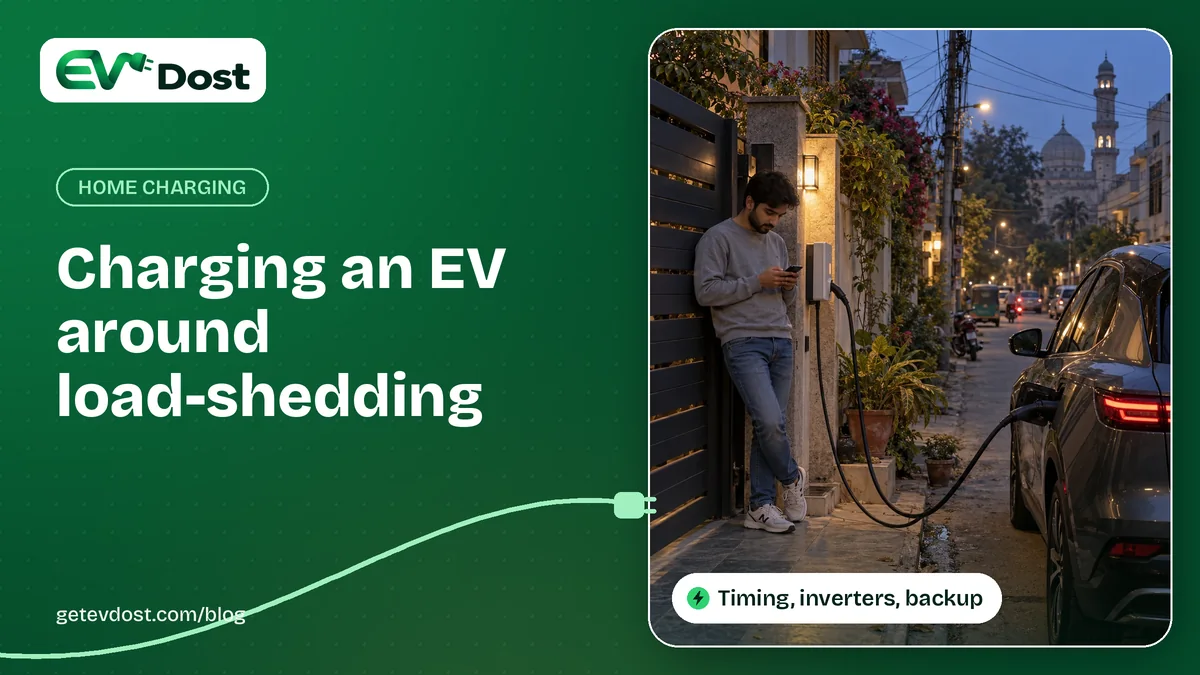
"What happens when the light goes?" is probably the question people in Pakistan ask most about electric cars. It's a fair one. We all plan our evenings around the schedule at some point, and an EV looks like one more thing that depends on the grid.
For most owners, EV charging during load-shedding turns out to be a nuisance rather than a deal-breaker. A car charging overnight only needs power for part of the night, and most people use a fraction of their battery each day. What helps most is knowing your own outage pattern and having a backup for the bad days.
How much load-shedding are we talking about?
It depends hugely on where you live, and even on which feeder your street is on.
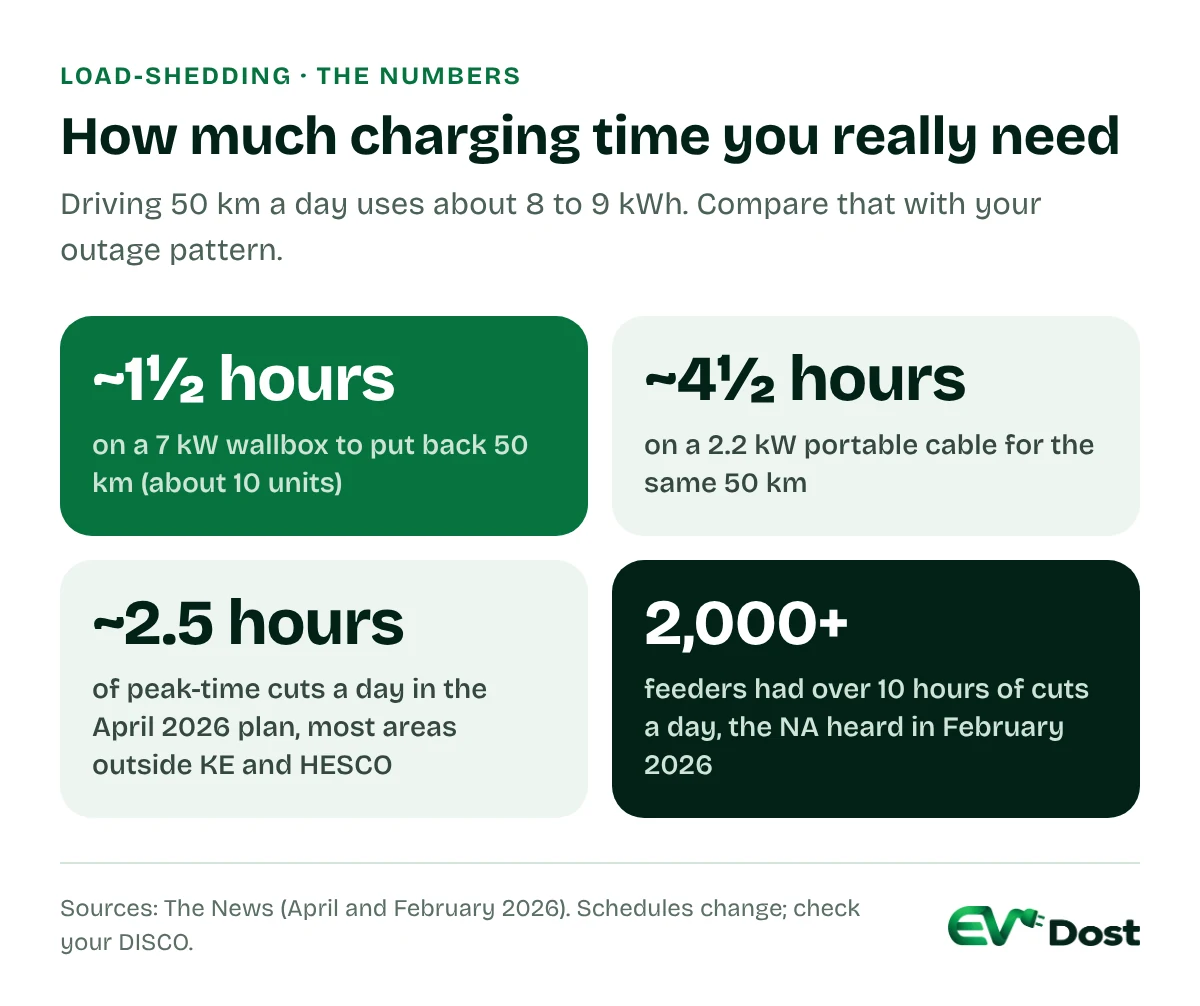
In April 2026, the federal government announced a "peak relief" plan with about two and a half hours of cuts a day during the 5 p.m. to 1 a.m. peak window, across most of the country except K-Electric and HESCO areas (The News, April 2026). Schedules change through the year, so check your DISCO's current one rather than relying on that figure.
High-loss areas see far more. In February 2026, the National Assembly was told that more than 2,000 of the country's 12,665 feeders had over ten hours of load-shedding a day, mostly in QESCO, PESCO and SEPCO territory, while LESCO, IESCO, GEPCO and FESCO had no feeders above ten hours (The News, February 2026). The same month, the power minister told the Senate that outage hours are set by each feeder's losses and recoveries (APP, February 2026).
So a driver in a DHA in Lahore and a driver in a high-loss part of Peshawar are living with very different grids, and their charging plans should look different too.
Start with the maths of your own day
Most electric cars use roughly 15 to 19 kWh per 100 km in mixed driving, more with the AC working hard in summer. Say you drive 50 km a day. That's about 8 to 9 kWh. On a 7 kW home charger, that's a bit over an hour of charging. On a 2.2 kW portable cable, it's around four hours.
Now compare that with your outage pattern. If the power is off for two or three hours in the evening and back on after midnight, you have five or six hours of supply before morning. That's plenty for a daily top-up, even on the slow cable.
The people who struggle are those who let the battery run low and then expect a full charge in one night. Topping up every day is much easier than filling the car from empty.
A sample week
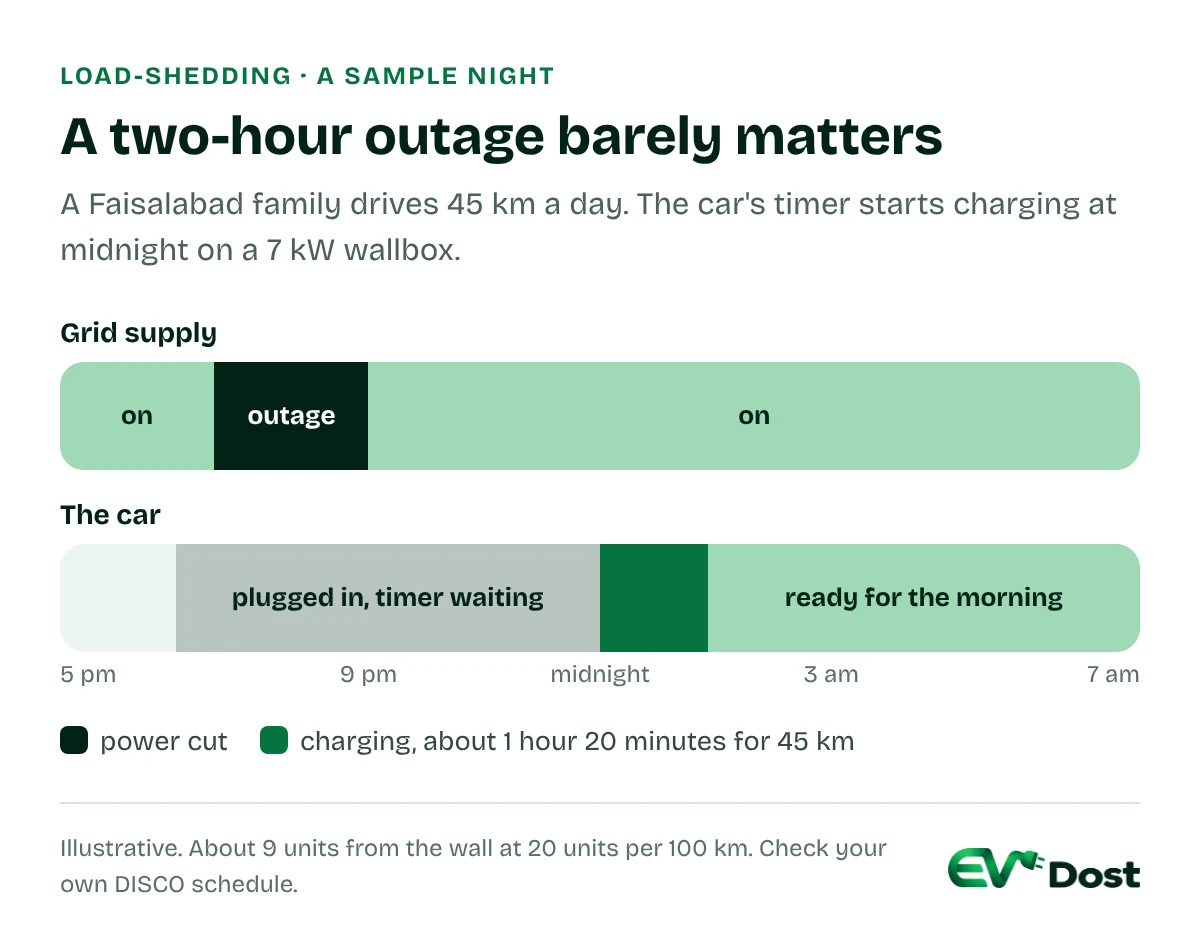
Take a family in Faisalabad who drive about 45 km on weekdays and have two hours of cuts most evenings. They plug in when they get home, with the car's timer set to start at midnight. By 3 a.m. on a 7 kW wallbox, the day's driving is back in the battery. On the one night a week the power stays off until 2 a.m., they still have hours to spare.
Now take a doctor in a high-loss area of Mardan who drives 90 km a day and loses power for much of the night. Home charging alone won't keep up, so her plan needs a second source: a charger near the hospital, or a host on her route.
Use your car's charging timer
Most EVs let you schedule charging from the car's screen or app. Set it to start after your usual evening outage block ends.
That avoids the stop-start of charging through an outage, and if you're on a time-of-use meter, late-night charging falls in off-peak hours, which cost less per unit. Your wallbox may have its own timer too. Use one or the other, not both, or they'll fight.
After an outage, check that charging resumed. Most wallboxes restart on their own when power returns, but some sit waiting for a tap in the app. Find out which kind you have on a quiet day, not on the morning you need to leave at six.
When the power comes back
The moment supply returns is often rough, with voltage swinging before it settles. Good wallboxes have their own protection and will wait for stable voltage before starting. Ask your electrician whether your distribution board has surge protection, and if you use the portable cable, plug it into a properly wired socket rather than a cheap extension board. Our guide to installing a home EV charger covers what a sound setup looks like, Monsoon storms add their own risks; see charging an EV in the rain.
Can I charge from my inverter?
Sometimes, but slowly.
Most home inverters in Pakistan are sized for a house, not a car. Retail listings show common hybrid inverters at around 4 to 8 kW; one shop listed a 6 kW Sungrow at Rs 237,000 and an 8 kW model at Rs 307,000 (PowerHouse Express listing). A 7 kW wallbox on its own would overload most of them, never mind the fans and lights already running.
A 2.2 kW portable cable is a different story. A larger inverter can carry it alongside light household use. The limit then becomes your battery bank. A typical 5 kWh lithium battery running a 2.2 kW load would be drained in a little over two hours, adding maybe 25 to 30 km of range and leaving the house with nothing in reserve. Most nights, the fans matter more.
Inverter charging makes far more sense with solar during the day, which is a very different setup. We cover that in charging your EV with solar in Pakistan.
What about a generator?
Many wallboxes are sensitive to unstable voltage and frequency, and small petrol generators often produce exactly that. Some chargers will refuse to start; others will start and trip. Running a car on generator power also throws away most of the cost advantage you bought the EV for.
If you have a large, good-quality generator and want to try it, check the charger maker's guidance first. Most owners skip it.
Your backup: a charger in another part of town
Some days the schedule just doesn't cooperate. A long outage, a feeder fault, a transformer that's been "being fixed" since lunch.
Grid supply isn't uniform even within one city, and a charger two sectors away may have power when yours doesn't. That's where a public charger or an EVDost host comes in. Hosts list home and business chargers with their own hourly price, and you're billed in 10-minute blocks, so a short top-up to get through the day costs only what you use. It's worth finding one or two near your home and office now, before the day you need them. You can check what's near you in the app.
If you're not sure what a top-up away from home costs compared with charging at home, our breakdown of EV charging costs in Pakistan has the numbers.
A routine that works
- Keep the battery between roughly 30 and 80 percent on normal days, so one bad night doesn't strand you.
- Schedule charging to start after your usual evening outage.
- Check in the morning that the car charged.
- Know two backup options before you need them: a host nearby and a public charger on your usual route.
- Before a long trip, charge the night before rather than the morning of.
Once charging a day ahead becomes a habit, you'll probably spend less time on it than you used to spend in petrol queues.
Frequently asked questions
Can I charge an electric car during load-shedding?
Not while the power is off, unless you have backup that can carry the load. But most owners only need one to four hours of supply a night to replace a day's driving, so a typical evening outage block is a nuisance rather than a problem. Set the car's timer to start after your usual outage.
How long does it take to charge an EV for a day's driving?
About 8 to 9 kWh replaces 50 km for most compact EVs. With charging losses, that's about an hour and a half on a 7 kW wallbox and about four and a half hours on a 2.2 kW portable cable.
Can I charge my EV from a home inverter or UPS?
A 7 kW wallbox will overload most home inverters, which are typically 4 to 8 kW and already running the house. A 2.2 kW portable cable can work on a larger inverter, but a 5 kWh battery would be drained in a little over two hours, adding only about 25 to 30 km and leaving the house with nothing.
Can I charge an electric car from a generator?
It's rarely worth it. Many wallboxes are sensitive to the unstable voltage and frequency small petrol generators produce, and some refuse to start, and generator power wipes out most of an EV's running-cost advantage. Check the charger maker's guidance before trying.
What should I do if the power is out and my car is low?
Find a charger in an area that has power. Supply varies by feeder even within one city, so a public charger or a host's charger a few sectors away may be working. It helps to identify one or two near your home and office in advance.
Sources
- The News, peak-time load-shedding plan (April 2026): thenews.pk
- The News, feeders with over ten hours of load-shedding (February 2026): thenews.pk
- APP, loss-based load-shedding policy (February 2026): app.com.pk
- PowerHouse Express, hybrid inverter listings: powerhouseexpress.com.pk