Is it safe to charge an electric car in the rain? Monsoon tips for Pakistan
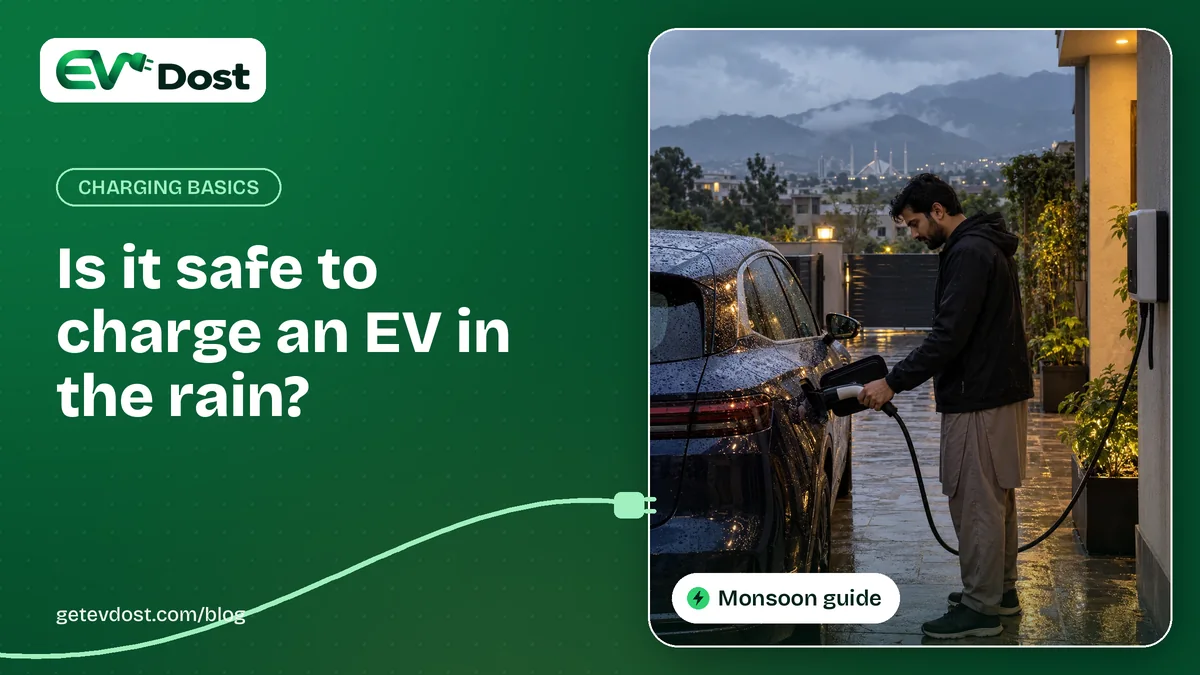
Every monsoon, the same question lands in EV owner groups: can I charge an electric car in the rain, or should I wait until it stops? After the July 2026 downpours, when Lahore airport recorded 263 mm in a single spell and underpasses across the city filled with water (Aaj News, July 2026), plenty of new owners were nervous about plugging in at all.
Charging in ordinary rain is safe, as long as the charger, cable and wiring are in good condition. Chargers and plugs are built for it. What isn't safe is standing water, flooded parking, damaged cables and poor home wiring, and Pakistan has more than its share of all four during the monsoon.
Is it safe to charge an electric car in the rain?
Yes. EV plugs are designed so that their pins carry no power until the car and charger have agreed to start.
When you plug in, the charger and car exchange low-voltage signals over a small "control pilot" pin. Only once the car confirms it's connected and ready does the charger close its internal switches and send power to the main pins. An unplugged connector has no voltage at its pins at all. The pilot pin is also shorter than the others, so when you pull the plug out, it breaks contact first and the charger cuts power before the main pins separate (SAE J1772 overview; Type 2 connector overview). The Type 2 and CCS2 plugs used in Pakistan follow the same signalling scheme.
Chargers also watch for current leaking where it shouldn't, and stop when they detect a fault (EVKX, 2026). The Electric Vehicle Council in Australia, a country that knows about heavy rain, says charge points and cables are made to be weatherproof and that charging in the rain is safe (Electric Vehicle Council, October 2023).
What the IP rating tells you
Outdoor wallboxes carry an IP rating. The first digit covers dust, the second water. Many popular wallboxes are rated IP54, meaning they're protected against dust and against water splashed from any direction, and their makers say they can be mounted outdoors (Wallbox; Zaptec).
An IP rating describes a lab test on undamaged, correctly installed equipment. It doesn't cover a charger sitting in a flooded porch, or a cracked plug housing (EVKX, 2026). Look for the rating in your charger's manual or on its label before you mount it somewhere exposed.
When you should not plug in
Rain itself isn't the problem. These are:
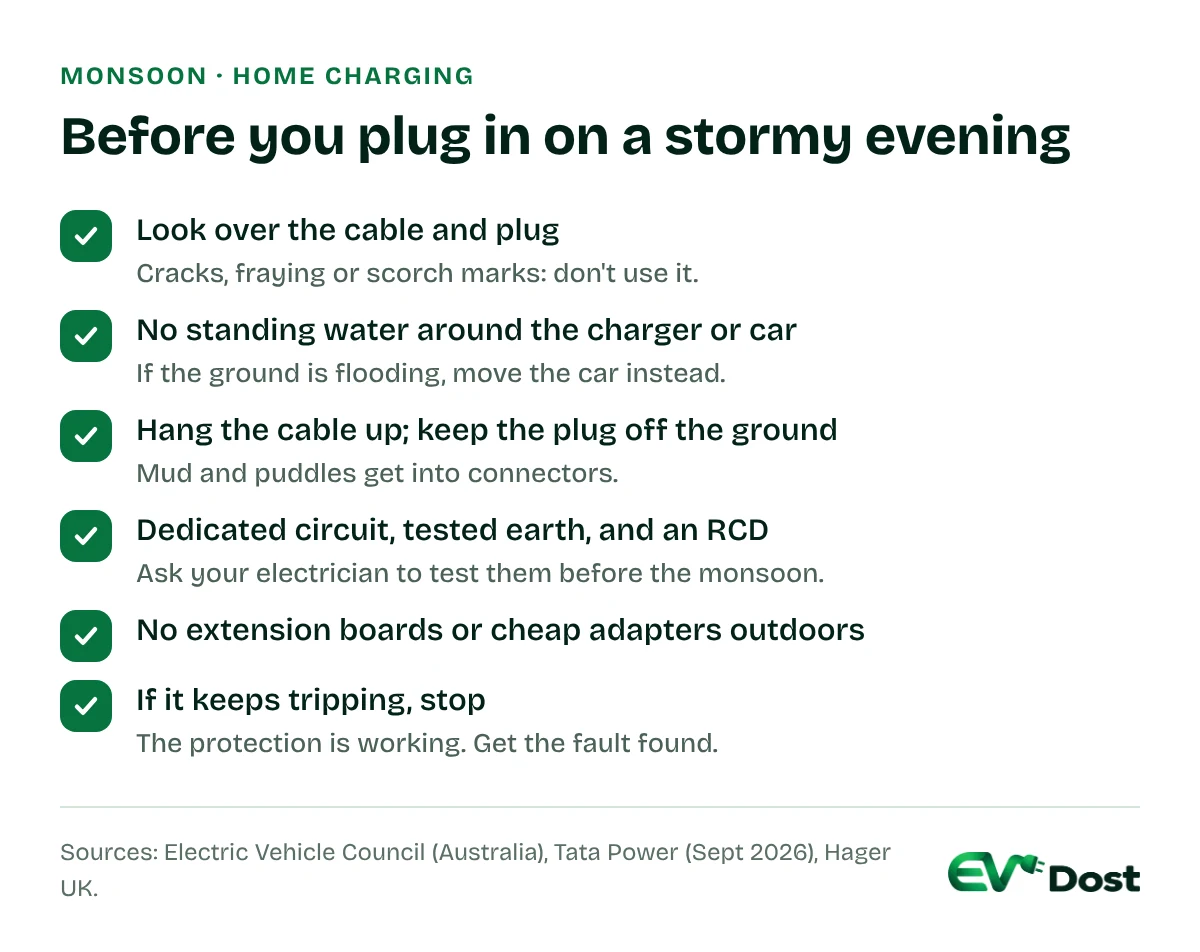
- Water pooling around the charger, the cable or the car's wheels. Don't charge where flash flooding is possible; charge somewhere away from the flood risk instead (Electric Vehicle Council).
- A damaged cable or plug. Cracks, fraying, scorch marks or a loose housing mean the waterproofing can no longer be trusted.
- A charger that keeps tripping. Repeated trips are the protection doing its job. Stop and get an electrician to find the fault.
- Sparks, a burning smell, or lightning close by. India's Tata Power, which runs public chargers through the monsoon, gives the same list of reasons to stop and treats ordinary drizzle as no reason at all (Tata Power, September 2026).
- An extension board or a cheap adapter in the rain. Neither is built for hours of current outdoors, wet or dry.
Your home wiring matters more than the weather
Most of the real risk in a Pakistani monsoon sits behind the charger, in the wiring. In April 2026, pre-monsoon rain in Karachi killed at least five people, four of them by electrocution and two of those inside their own homes (Dawn, April 2026). Wet weather finds every weak spot in an installation.
Three things protect you:
Earthing. A charger needs a proper earth so that a fault goes safely to ground instead of through a person. A cable maker's safety guide for Pakistani homes stresses having a working earth pit and getting the wiring checked in houses more than about ten years old (Pakistan Cables, April 2026). Ask your electrician to test the earth, not just assume it.
A residual current device (RCD or RCCB). We couldn't find a Pakistani rule that specifies one for EV chargers, so the UK wiring rules are a useful benchmark. They require each charge point to have its own RCD of no more than 30 mA. Because a car can leak a small DC current that blinds an ordinary RCD, the UK rules accept a common Type A RCD only if the charger has built-in 6 mA DC detection; otherwise a Type B RCD is needed (Hager UK). Your charger's manual will say which it has.
A dedicated circuit. The charger, or the socket for your portable cable, should be on its own circuit from the distribution board. Our home EV charger installation guide explains what your electrician should check.
Storms also hit the supply. Under NEPRA's performance rules, distribution companies are meant to keep most consumers within 5 percent of the nominal voltage (NEPRA Performance Standards (Distribution) Rules 2005), but storms trip feeders and bring the usual surges when power returns. A good wallbox waits for stable voltage before it restarts. Surge protection in your board is worth asking about too, especially if you also lose power often. We cover outages in charging an EV during load-shedding.
Driving through water in an EV
Electric cars have sealed battery packs, and driving through a wet road is no different from any other car. Deep water is another matter, for every car.
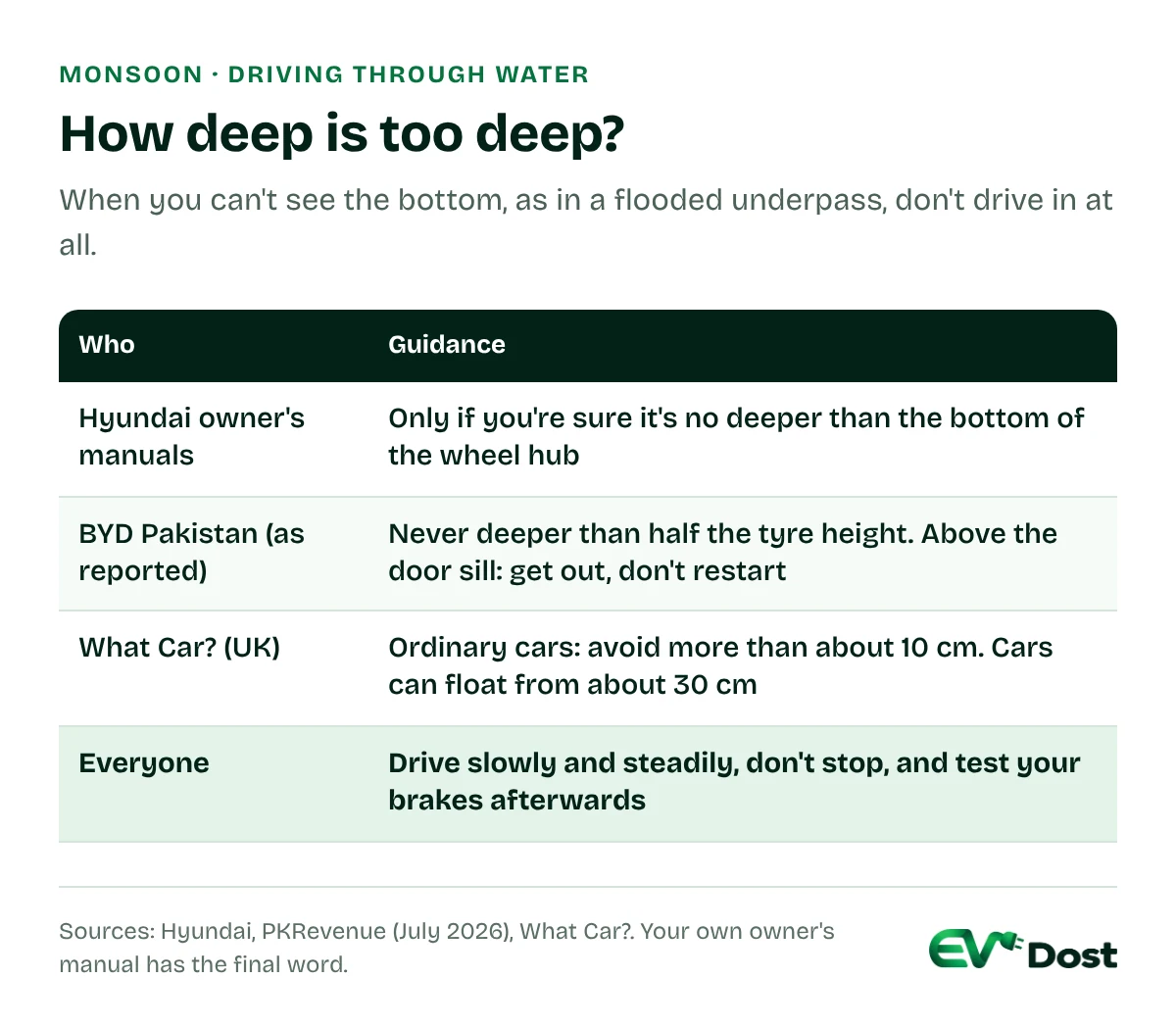
Hyundai's owner's manuals tell drivers to avoid floodwater unless they're sure it's no deeper than the bottom of the wheel hub, and to turn back otherwise (Hyundai owner's manual). BYD Pakistan's advice, as reported in July 2026, uses the door sill as the gauge and says never to drive through water deeper than half the tyre height; if water rises above the sill, get out, move to higher ground and don't restart the car (PKRevenue, July 2026). The UK's What Car? suggests ordinary cars avoid more than about 10 cm of water, notes that cars can start to float at around 30 cm, and says to drive slowly without stopping (What Car?).
In a Lahore underpass after a cloudburst, you often can't see how deep it is. Find another route.
If your car has been in a flood
A car that has been sitting in floodwater needs care, and an EV needs a little more.
- Don't start it or charge it. Have it checked by an authorised workshop first. If water came above the floor, it may well be a write-off (InsideEVs, September 2024).
- Park it away from buildings. Tesla's manual says a submerged car should be towed at least 15 m from buildings, other cars and anything that can burn, and to move away and call for help if you see smoke, hear popping or hissing, or feel heat (Tesla owner's manual).
- Call your insurer, as you would after a crash.
Salt water is the main danger. It conducts electricity, and residue left inside a battery pack can cause a short circuit and a fire long after the floodwater has receded (AP via WABE, September 2024). After Hurricane Ian in Florida in 2022, about 600 EVs were written off and 36 caught fire (InsideEVs, September 2024). Officials noted that similar problems weren't reported after freshwater flooding in California (AP via WABE, September 2024). Most urban flooding in Lahore or Islamabad is rainwater, but in low-lying coastal parts of Karachi, treat a flooded EV with extra caution.
Charging away from home when it's pouring
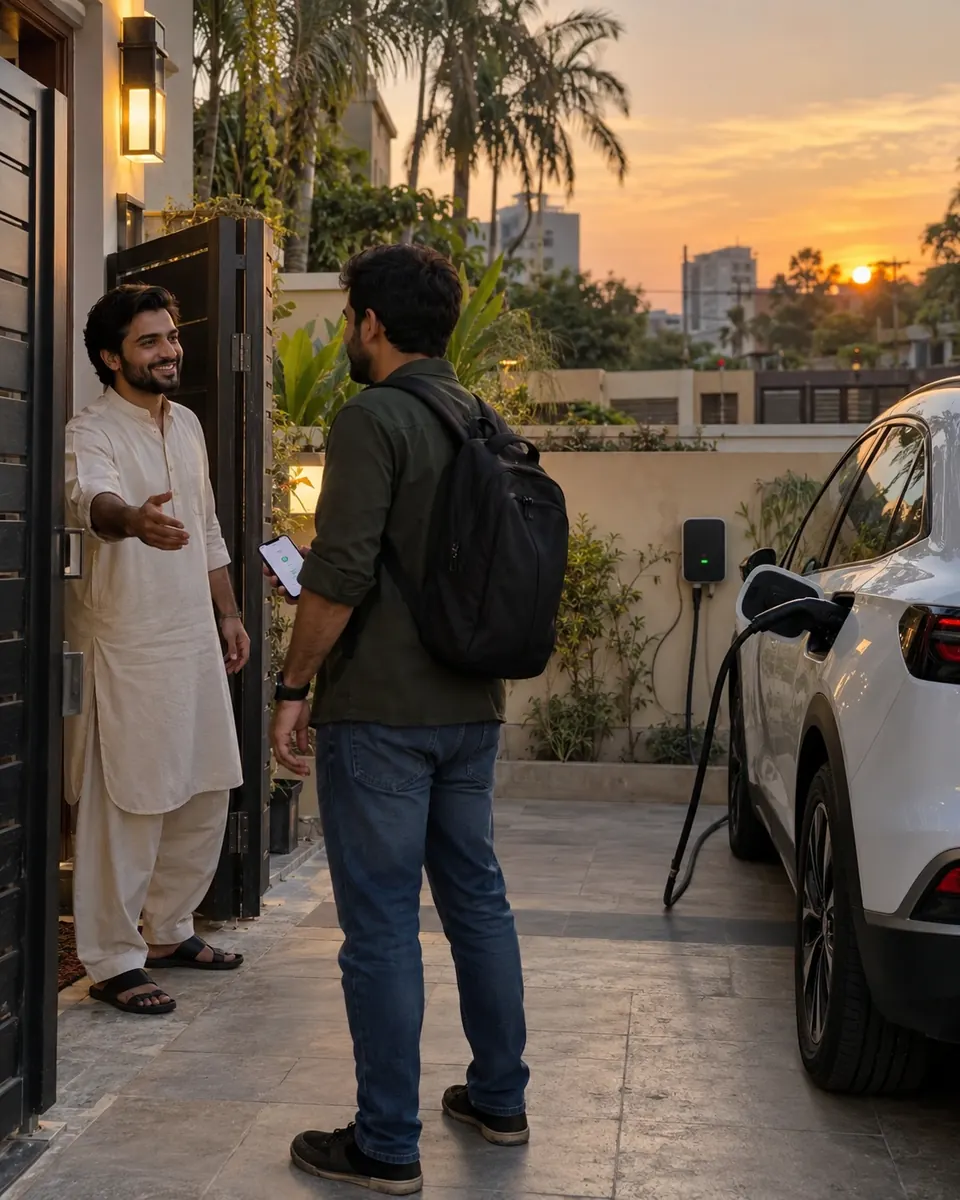
If your own charger is outdoors and exposed, or your area has lost power, a covered charger somewhere else is the easier option. Plenty of hotels, offices and homes have wallboxes under a porch or in a garage. On EVDost, hosts list exactly those, and you can see the plug type, power and price before you go, then find one near you. For public stations, our guide to EV charger types in Pakistan explains which plug you'll need.
Frequently asked questions
Can you charge an electric car in the rain?
Yes. Plugs carry no power until the car and charger complete a signal handshake, chargers stop when they detect a fault, and outdoor wallboxes are typically rated at least IP54 against splashing water. Don't charge if water is pooling around the charger or car, if the cable is damaged, or if the charger keeps tripping.
Is it safe to touch the charging plug in the rain?
Yes, if the plug and cable are undamaged. The pins aren't live until the plug is fully connected and the car has signalled it's ready, and the short pilot pin cuts power first when you unplug. Don't handle a cable with cracks or exposed wires, wet or dry.
Can I charge my EV during a thunderstorm?
Not when lightning is close by. Tata Power, which runs chargers through India's monsoon, lists nearby lightning as a reason to stop charging (September 2026). Ordinary rain is fine. A surge protector in your distribution board adds protection at home.
How deep can an electric car drive through water?
Usually no deeper than the bottom of the wheel hub, which is Hyundai's limit; BYD Pakistan, as reported in July 2026, says never deeper than half the tyre height. If you can't see how deep the water is, as is common in flooded underpasses, don't drive into it, and follow your own owner's manual.
What should I do if my EV was submerged in a flood?
Don't start or charge it. Have it towed at least 15 m from buildings and other cars, call your insurer, and get it inspected by an authorised workshop. Watch for smoke, popping, hissing or heat, which can appear long after the water has gone, especially after salt water.
Sources
- Aaj News, Lahore rainfall (July 2026): english.aaj.tv
- Dawn, Karachi rain deaths (April 2026): dawn.com
- SAE J1772 and Type 2 connector overviews: J1772, Type 2
- EVKX, charging in rain (2026): evkx.net
- Electric Vehicle Council, charging in the rain (October 2023): electricvehiclecouncil.com.au
- Wallbox, protection ratings: wallbox.com
- Zaptec, outdoor installation: help.zaptec.com
- Tata Power, monsoon charging tips (September 2026): tatapower.com
- Pakistan Cables, home electrical safety (April 2026): pakistancables.com
- Hager UK, EV charging and RCDs: hager.com
- NEPRA Performance Standards (Distribution) Rules 2005: PDF
- Hyundai owner's manual, driving in water: ownersmanual.hyundai.com
- PKRevenue, BYD Pakistan water guidance (July 2026): pkrevenue.com
- What Car?, driving through flood water: whatcar.com
- InsideEVs, EV fires after floods (September 2024): insideevs.com
- AP via WABE, saltwater flooding warning (September 2024): wabe.org
- Tesla Model 3 owner's manual, submerged vehicle guidance: tesla.com