EV charger types in Pakistan: Type 2, CCS2 and GB/T explained
The first time you pull up to a charger that doesn't fit your car, you remember it. The cable is right there, the car is right there, and the two simply won't meet.
It happens more than you'd think in Pakistan, because our cars come from several markets at once. A BYD from the official dealer, an MG bought new, a Chinese-market import from a showroom in Lahore and a used Japanese hatchback can all have different sockets. This guide covers the EV charger types you'll meet in Pakistan, which cars use them, and the few numbers worth understanding before you plug in anywhere.
What most cars in Pakistan use
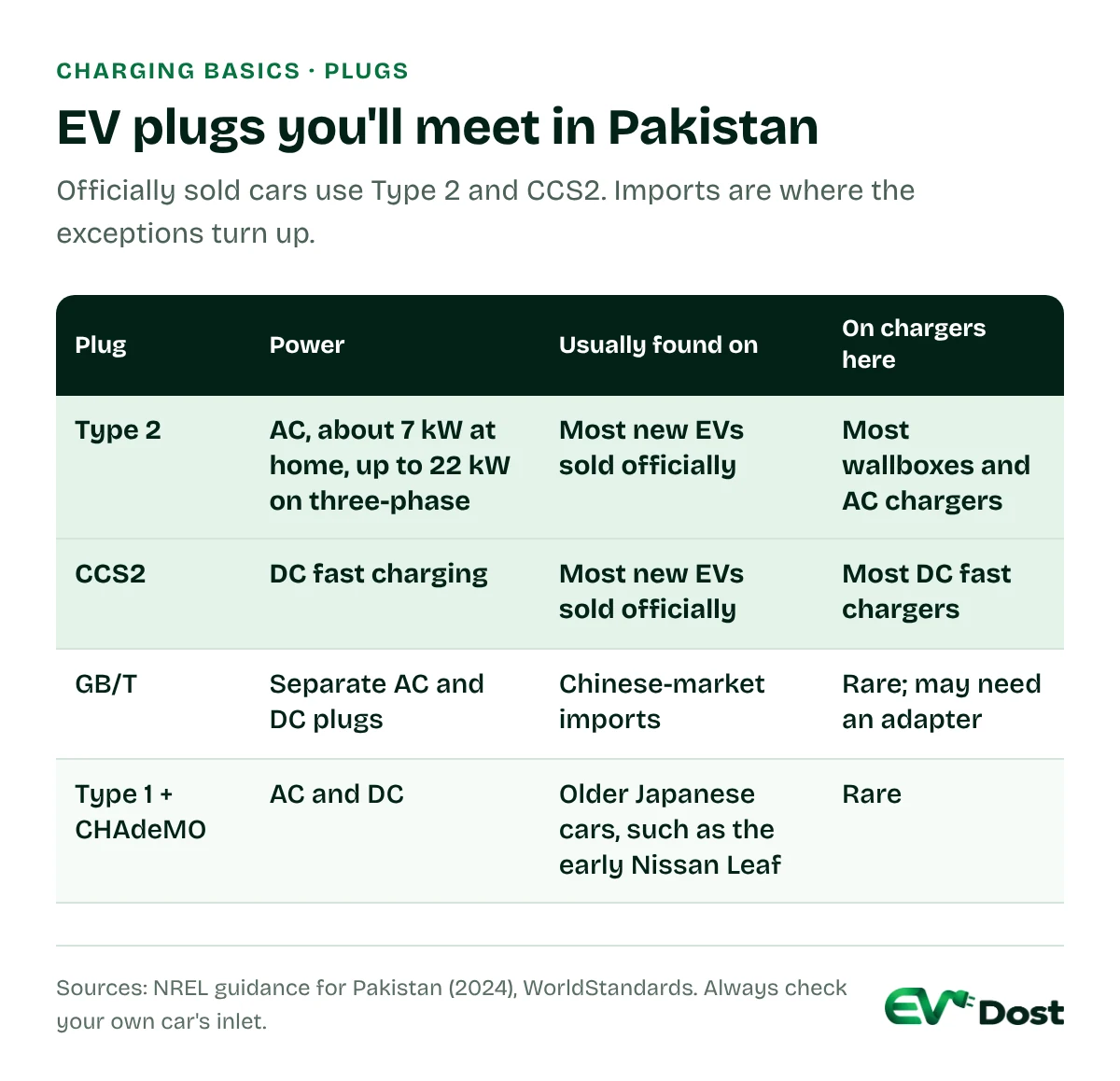
Most new electric cars sold officially in Pakistan use Type 2 for everyday AC charging and CCS2 for DC fast charging. That's the European-style setup, and it's the one Pakistan has chosen to follow.
The country decided in 2021 to follow IEC standards for charging, and NEPRA's 2021 manual on public charging stations says connectors must comply with IEC 62196, according to a 2024 NREL standards guidance report for Pakistan. IEC 62196 is the family that includes Type 2 and CCS2. Reference sites that track inlets by country list Pakistan the same way: Type 2 for AC, CCS2 for DC.
The exceptions are imports. Cars built for the Chinese domestic market usually have GB/T sockets, and older Japanese cars often use CHAdeMO for fast charging. More on both below.
AC and DC charger types, briefly
Your battery stores DC power. The grid supplies AC. Something has to convert one to the other.
With AC charging, the converter sits inside your car (the "onboard charger"), so the speed is capped by that part, usually somewhere between 3 and 11 kW. Home wallboxes and most chargers at hotels and offices are AC. With DC fast charging, a big converter sits inside the charging station and feeds the battery directly, which is why motorway chargers can deliver 60 kW or more.
That difference explains a lot of confusion. A 22 kW AC charger won't charge a car any faster than its onboard charger allows. If your car accepts 7 kW on AC, a 22 kW unit gives you 7 kW.
Type 2: the everyday plug
Type 2 is the seven-pin, flat-topped round plug you see on most wallboxes. It handles AC only.
On a normal single-phase home connection, a Type 2 charger usually runs at up to 32 amps, which works out to about 7 kW. On three-phase supply it can reach 22 kW, and the standard allows up to 43 kW, though few cars accept that much (Type 2 overview).
Some public chargers have a Type 2 socket but no cable attached. In that case you bring your own Type 2 to Type 2 cable, which some cars include and others sell as an extra. Check before your first trip; it's an annoying thing to discover at 9 p.m. in an empty car park.
CCS2: Type 2 with two extra pins
CCS2 (Combined Charging System 2) takes the Type 2 shape and adds two large DC pins underneath. The socket on the car has both parts, so the same inlet accepts a normal Type 2 plug for AC and the bigger CCS2 plug for DC.
This is how a few cars sold in Pakistan line up, using the manufacturers' own spec sheets:
| Car | AC (Type 2) | DC (CCS2) | Battery |
|---|---|---|---|
| BYD Atto 3 | 7 kW | 70 kW | 49.92 kWh |
| MG4 EV (Urban) | 6.6 kW | 82 kW | 43 kWh |
Sources: BYD Atto 3 spec sheet, MG4 EV brochure. Local variants and model years can differ, so your own manual has the final word.
GB/T: the Chinese-market plug
GB/T is China's national standard, and it has separate plugs for AC and DC. Cars sold new in China use it, so a vehicle imported from there privately, rather than through an official Pakistani distributor, may well have GB/T sockets.
The GB/T AC plug looks a lot like Type 2, which is where people get caught out. The plug and socket genders are reversed and the signalling is different, so the two don't fit each other without an adapter (GB/T overview). The DC plug is a separate, larger connector on its own flap.
If your car came through an official dealer here, it's very likely CCS2. If it came through a grey importer, open the charging flap and look before you assume.
Adapters exist, but quality varies a lot. A cheap adapter carrying 7 kW for six hours in June heat is not where you want to save money. Buy from a seller who can tell you the current rating and what safety approvals the adapter has, and ask your installer if you're unsure.
CHAdeMO and Type 1: the Japanese pair
Japanese-market cars, including the older Nissan Leaf, typically use a Type 1 plug for AC and CHAdeMO for DC. Both are rare on Pakistani public chargers. If you own one of these cars, you'll mostly charge at home or at a host who has a matching unit.
Reading a charger listing
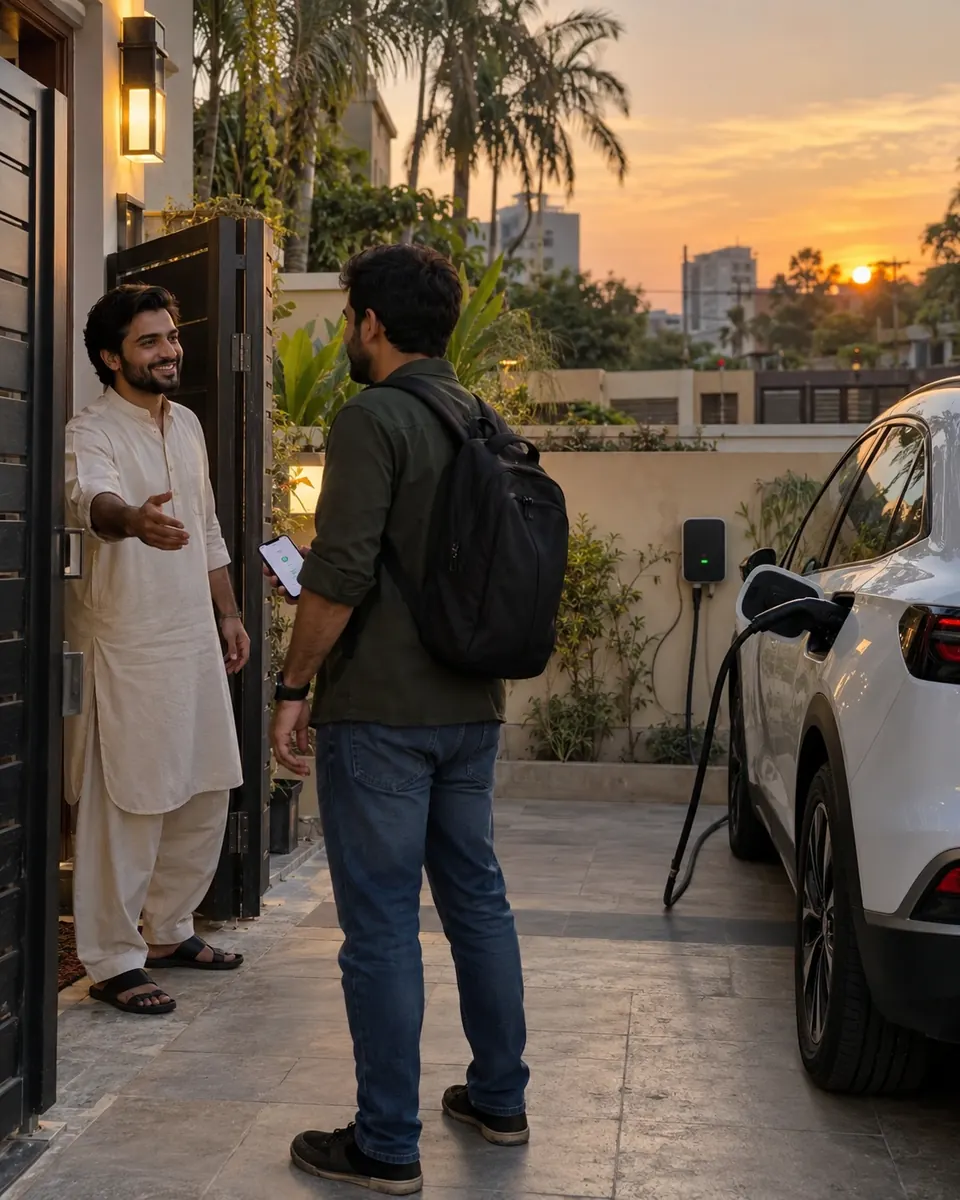
When you look at a charger, whether it's on a motorway, at a hotel or listed by a host on EVDost, four details matter:
- Plug type. Type 2, CCS2, GB/T or something else. This decides whether you can use it at all.
- AC or DC. Tells you roughly how fast it can go.
- Power in kW. The charger's maximum. Your car's own limit still applies.
- Tethered or socket. A tethered charger has its own cable. A socket means you bring yours.
EVDost listings show the plug type and power for each charger. There's no car registration; you pick your model when you search, and the app estimates what the charge will cost. You can try it here. For public networks, our guide to EV charging stations in Pakistan explains who runs them and how to check one before you drive over.
How long will it take?
To estimate, divide the energy you need by the power your car can accept, then add about 10 percent for losses.
Say you drive a car with a 50 kWh battery and want to go from 20 to 80 percent. That's about 30 kWh. On a 7 kW AC charger, that's about four and three-quarter hours. On a 60 kW DC charger, assuming the car can take that rate, it's closer to 35 minutes, though charging slows as the battery fills, so the last stretch takes longer than the first.
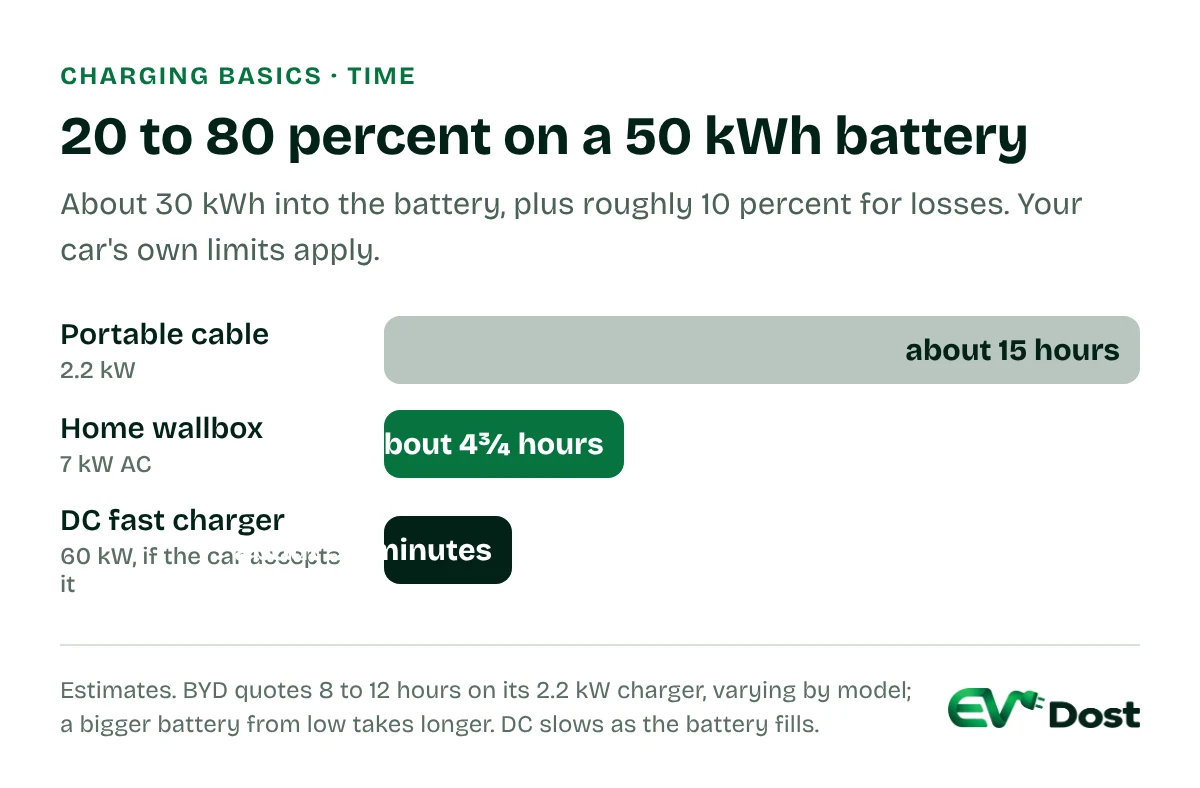
BYD's own guidance for Pakistan, which varies by model, quotes 8 to 12 hours on its 2.2 kW portable charger, 4 to 6 hours on a 7 kW wall charger, and much faster on public DC units of 30 to 120 kW (BYD Pakistan charging page). Our guide to EV charging time in Pakistan works out the times for popular models.
A few habits that save trouble
Keep a photo of your charging flap and both sockets on your phone. When you're asking a host or a station attendant whether their charger fits, a photo answers in seconds.
Keep your portable charger (the "granny cable") in the car. If a fast charger is busy or broken, a regular socket at a host's home can still add roughly 10 to 15 km of range an hour, which is often enough to reach the next stop.
And don't force a plug. If it doesn't slide in cleanly, it isn't the right one.
Where to go next
If you're setting up charging at home, our guide to installing a home EV charger in Pakistan covers sizing, wiring and what it costs. If you're wondering what a full charge costs you, read how much it costs to charge an EV in Pakistan.
Frequently asked questions
What EV charger plug is used in Pakistan?
Most new electric cars sold officially in Pakistan use Type 2 for AC charging and CCS2 for DC fast charging, in line with the IEC standards Pakistan chose to follow. Chinese-market imports often have GB/T sockets, and older Japanese cars use Type 1 and CHAdeMO.
Will a 22 kW charger charge my car faster than a 7 kW one?
Only if your car's onboard charger accepts more than 7 kW and the charger is on a three-phase supply. On AC, the car sets the limit, so a car that accepts 7 kW charges at 7 kW on a 22 kW unit. Single-phase home connections usually cap a wallbox at about 7 kW anyway.
Can a GB/T car use a Type 2 charger?
Not directly. The GB/T AC plug looks similar to Type 2, but the genders are reversed and the signalling differs, so you need an adapter. Buy one with a stated current rating and safety approvals, since it may carry 7 kW for hours in the heat.
How long does it take to charge an EV on a 7 kW home charger?
Divide the energy you need by 7 and add about 10 percent. Going from 20 to 80 percent on a 50 kWh battery takes about 4 hours 45 minutes. BYD's guidance for Pakistan quotes 4 to 6 hours on a 7 kW wall charger, depending on the model.
Do I need my own cable at a public charger?
Only at untethered chargers, which have a Type 2 socket but no cable. In that case you bring a Type 2 to Type 2 cable. DC fast chargers always have their own cable.
Sources
- NREL, Standards Guidance for Electric Two- and Three-Wheelers and Charging Infrastructure in Pakistan (February 2024): nrel.gov
- WorldStandards, EV connector inlets by country (updated January 2026): worldstandards.eu
- BYD Atto 3 spec sheet, BYD Mega Motor: byd-mega.com
- BYD Pakistan charging guide: byd-mega.com
- MG4 EV Urban brochure, MG Motors Pakistan: mgmotors.com.pk
- Type 2 connector and GB/T standard overviews: Wikipedia, Wikipedia