Buying a used electric car in Pakistan: how to check the battery
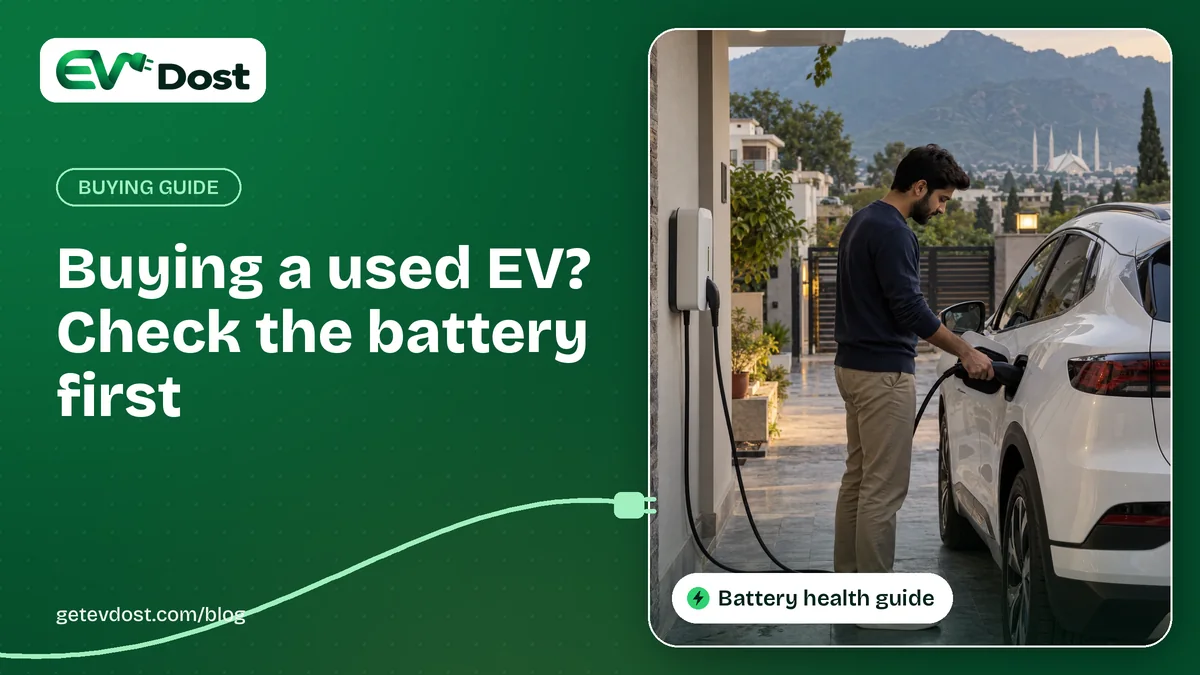
Used electric cars are turning up in Pakistani classifieds more often: early BYDs and MGs traded in for newer models, Japanese Nissan Leafs, and Chinese-market imports from grey dealers. Some are bargains. Some are expensive lessons.
When you buy a used electric car in Pakistan, the battery is most of what you're paying for. It decides the range, much of the resale value, and whether you'll face a large bill later. Below: how to check it, what's normal for its age, and the other things to look at before you hand over money.
Where used EVs in Pakistan come from
There are three main sources, and each carries different risks.
Local resale of cars first sold through official dealers, such as BYD or MG. These are usually the safest: the car was built for Pakistan, it uses the local plug standard, and the dealer network has its service history.
Commercial imports of used cars, allowed since September 2025. The rules at launch limited these to vehicles under five years old until June 2026, with certification by the Engineering Development Board (PakWheels, September 2025). The extra regulatory duty on commercial used imports was cut from 40 to 30 percent from 1 July 2026 (The News, July 2026). We couldn't find a separate duty rate for used EVs, so if you're importing one, get a written duty estimate from a customs agent.
Overseas Pakistanis' schemes. The personal baggage route has been abolished, and the gift and transfer-of-residence schemes now allow used vehicles up to three years old, with tighter conditions (Dawn, August 2026; Profit, January 2026).
No one publishes how many EVs on Pakistani roads are used imports, so we can't say how common each route is.
Battery health in plain words
A battery's state of health, or SOH, is how much energy it can hold today compared with when it was new. A pack at 90 percent SOH that held 50 kWh new now holds about 45 kWh, and the car's range shrinks by about the same share.
Batteries don't wear out evenly. Research firm Recurrent describes an early small dip, then a long, slow plateau, with sudden failure rare. In its data, fewer than 4 percent of EVs had needed a battery replacement outside recalls, and newer models far fewer than early ones (Recurrent, November 2025).
How fast a battery ages depends a lot on how it was used. Geotab's study of more than 22,700 EVs found an average loss of 2.3 percent of capacity a year. Cars that were rarely fast charged lost about 1.5 percent a year, cars that used high-power fast charging heavily lost about 3.0 percent, and hot climates added about 0.4 points a year (Geotab, April 2026). That last point matters in Pakistan; our guide to EV battery care in the heat explains why.
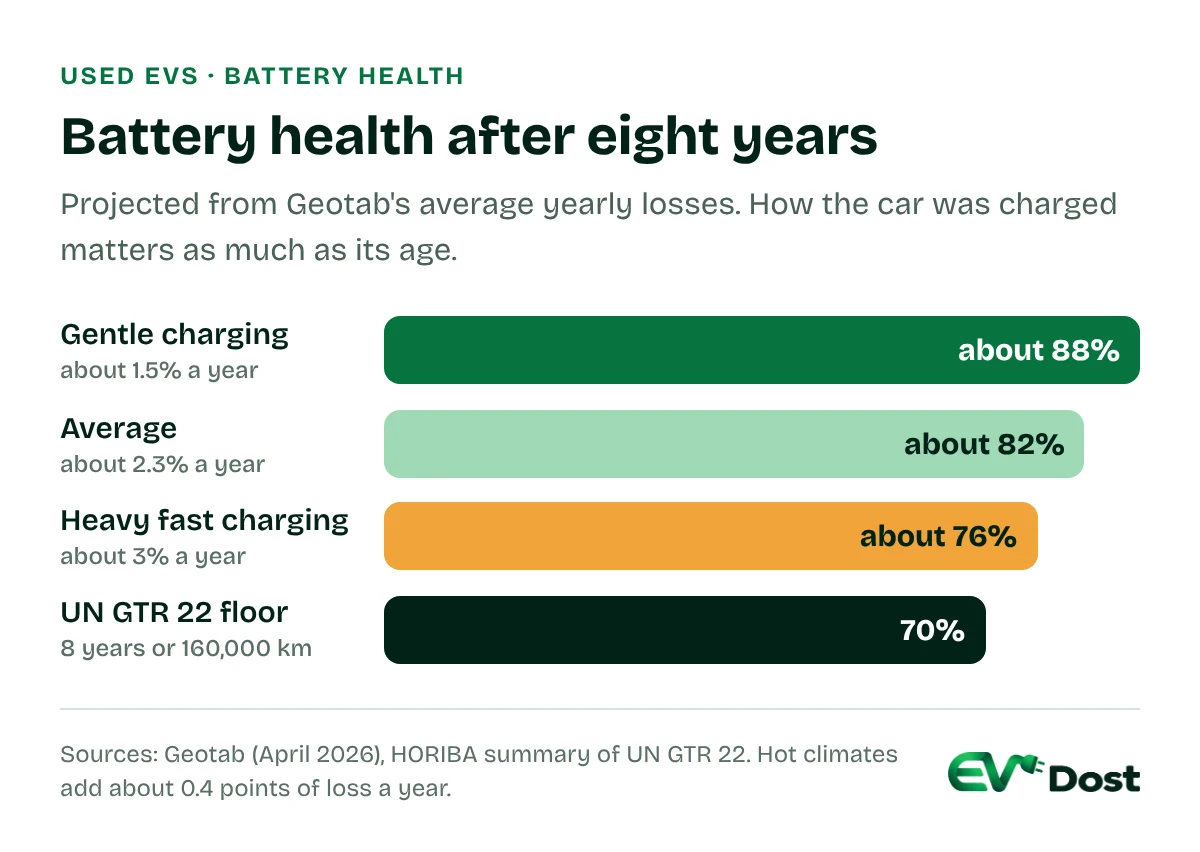
As a rough guide, using Geotab's averages, a three-year-old EV would typically be somewhere around 91 to 96 percent, and a five-year-old one around 85 to 93 percent. A car well below that range deserves questions, or a lower price.
There's also an international benchmark. UN Global Technical Regulation No. 22 expects a car's battery to keep at least 80 percent of its certified energy after 5 years or 100,000 km, and 70 percent after 8 years or 160,000 km, and requires the car to report a battery health reading (HORIBA). It isn't Pakistani law, but it's a useful yardstick.
How to check the battery on a used electric car
The method depends on the car. In every case, ask the seller for a battery report and check it yourself where you can.
Nissan Leaf
The Leaf shows battery capacity as a row of 12 bars beside the charge gauge. A 2013 Nissan warranty letter treats dropping below nine bars as roughly the point where capacity falls under 70 percent (Nissan via NHTSA). For a precise reading, the LeafSpy phone app with a Bluetooth OBD-II adapter shows SOH directly (Recharged). Leafs from hot climates have a history of early bar losses, so be cautious with high-mileage imports.
Hyundai and Kia
An OBD-II adapter with an EV-aware app shows SOH, usable kWh and cell voltages, and a dealer may be able to check SOH with factory tools (Recharged).
BYD and MG
The car's battery management system records SOH, and independent tools can read and verify it. In one published Australian test, an Atto 3 with about 40,000 km scored 95.1 percent on an independent battery test, against 95 percent reported by the car itself (Carma battery report, August 2026). MG owners report reading SOH with an OBD-II adapter and an app, but there's no confirmed on-screen reading for every model, so ask an authorised dealer for a battery report.
Any EV
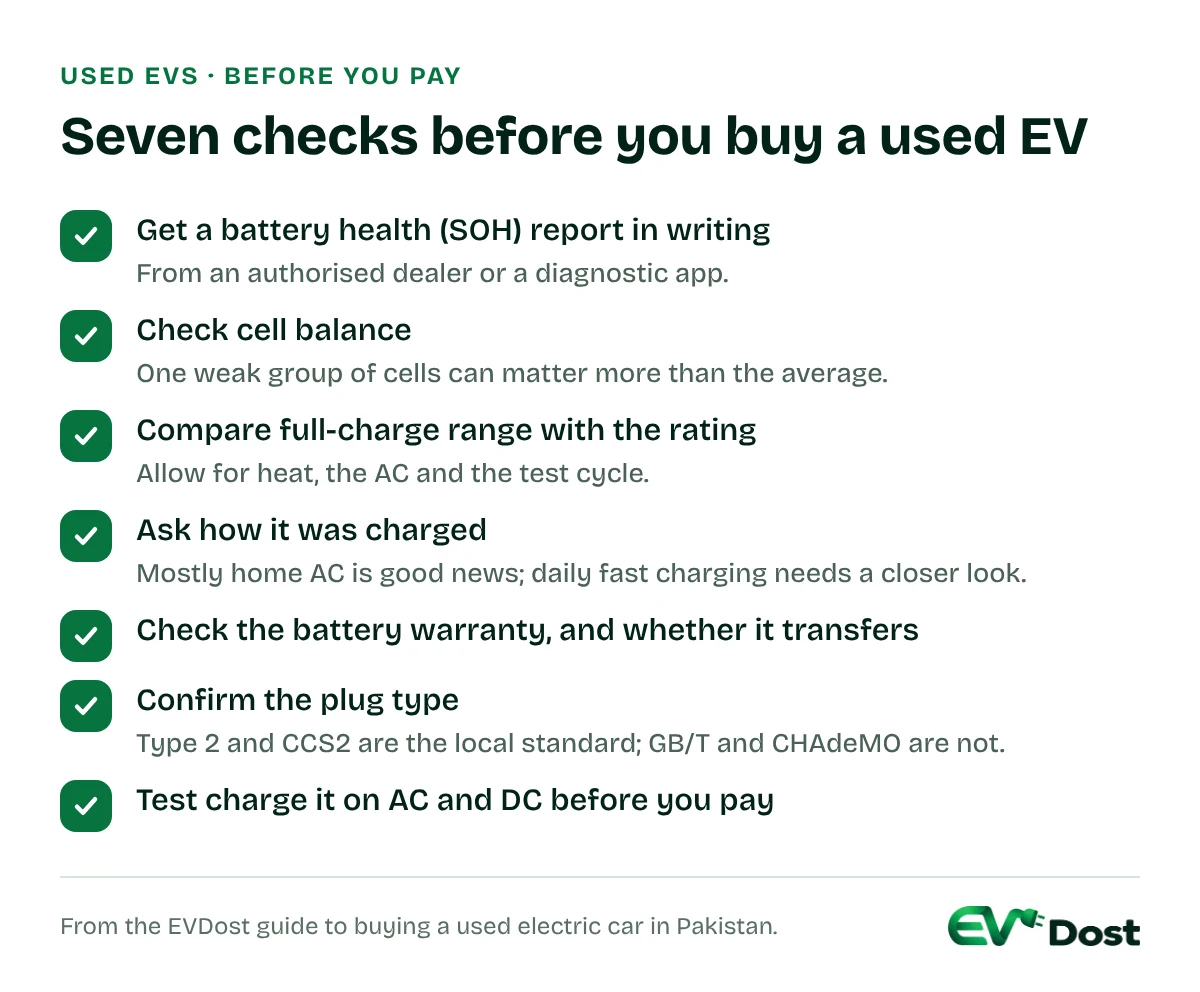
- Ask for the battery report in writing, from the dealer or the seller's diagnostic tool.
- Look for big differences between cell voltages in the app; one weak group of cells can matter more than the average.
- Compare the range shown at a full charge with the car's rated range, keeping in mind that heat, the AC and the test cycle all affect it.
- Ask how the car was charged. Mostly at home on AC is what you want to hear; daily fast charging is a reason to check more carefully.
Warranties: who covers the battery?
New EVs sold officially in Pakistan carry long battery warranties. BYD's Pakistan flyer lists 8 years or 150,000 km for the battery (BYD Atto 2 flyer, January 2026), and the MG4 Urban's battery warranty is reported at 8 years or 150,000 km (Gari.pk, May 2026).
What we couldn't find is whether those warranties pass to a second owner in Pakistan. In the UK, BYD says its warranty transfers to a new owner in most cases (BYD UK), but local terms can differ. Before you buy, ask the official dealer, in writing, whether the remaining battery warranty transfers to you and what the car's service record needs to show.
Grey imports carry more risk. Dewan Motors, BMW's distributor in Pakistan, has warned that unofficially imported BMW EVs aren't eligible for its warranty (South Asia magazine, August 2024), and brands with no local network, such as Tesla, offer no official service here. Price that risk in.
Check the plug before you check the paint
Official cars in Pakistan use Type 2 for AC and CCS2 for DC, but imports may not. Chinese-market cars often have GB/T sockets, and older Japanese cars such as the Leaf use CHAdeMO for fast charging, which is rare at Pakistani stations.
Adapters exist but aren't a simple fix. GB/T and CCS differ in communication and safety logic as well as shape (EVKX), and the CHAdeMO Association has said it can't vouch for third-party CCS-to-CHAdeMO adapters (InsideEVs, February 2024). One such adapter was listed on PakWheels in Lahore for Rs 425,000 (PakWheels listing), a big cost to add to a cheap used car. Our guide to EV charger types in Pakistan explains the plugs.
Test charge it before you pay
The simplest test is to charge the car. Plug it into an AC charger and, if it supports it, a DC fast charger, and confirm it starts, holds a steady rate, and doesn't throw warnings. A car that won't charge reliably is a problem no discount fixes.
If the seller has no charger, find one nearby. On EVDost you can pick the car's model, see chargers near the seller's location with their plug type and power, and get a cost estimate before you go. Find a charger for a test charge. For pricing context, compare the asking price with the new price in our list of electric car prices in Pakistan.
Frequently asked questions
Is it safe to buy a used electric car in Pakistan?
It can be, if you check the battery and the paperwork. Cars first sold through official dealers are the lowest risk, because they use local plugs and have a service history. Grey imports may have no local warranty, foreign plugs and limited service support.
How do I check the battery health of a used EV?
Ask for a battery health (SOH) report from an authorised dealer or the seller's diagnostic tool, and check it yourself with an OBD-II adapter and an EV app where the car supports it. On a Nissan Leaf, the 12 capacity bars give a rough guide. Also compare the range at full charge with the rated range, and test charge the car before paying.
How much battery degradation is normal for a used EV?
About 2.3 percent of capacity a year on average, according to Geotab's April 2026 study of more than 22,700 EVs: about 1.5 percent with gentle charging and about 3 percent with heavy fast charging, plus about 0.4 points a year in hot climates. A three-year-old EV would typically be around 91 to 96 percent and a five-year-old one around 85 to 93 percent.
Does the battery warranty transfer to the second owner in Pakistan?
Not confirmed. As of October 2026, we couldn't find BYD or MG Pakistan terms on transferring their 8-year or 150,000 km battery warranties to a second owner, so ask the official dealer in writing before you buy.
Can I import a used electric car into Pakistan?
Commercial imports of used vehicles have been allowed since September 2025, initially for vehicles under five years old, and the extra regulatory duty on them fell from 40 to 30 percent from July 2026. Overseas Pakistanis can use the gift or transfer-of-residence schemes for vehicles up to three years old. Get a written duty estimate before you commit.
Sources
- PakWheels, commercial import of used cars (September 2025): pakwheels.com
- The News, duty on commercial used imports (July 2026): thenews.pk
- Dawn, overseas Pakistanis' vehicle schemes (August 2026): dawn.com
- Profit, revised vehicle import policy (January 2026): profit.pakistantoday.com.pk
- Recurrent, how long EV batteries last (November 2025): recurrentauto.com
- Geotab, EV battery health (April 2026): geotab.com
- HORIBA, UN GTR No. 22 summary: horiba.com
- Nissan warranty letter (2013) via NHTSA: PDF
- Recharged, battery health checks: Nissan Leaf, Hyundai Kona Electric
- Carma, BYD Atto 3 battery report (August 2026): PDF
- BYD Pakistan, Atto 2 flyer (January 2026): PDF
- Gari.pk, MG4 EV Urban launch (May 2026): gari.pk
- BYD UK, warranty policy: byd.com
- South Asia magazine, Dewan Motors on grey imports (August 2024): southasia.com.pk
- EVKX, GB/T charging standard: evkx.net
- InsideEVs, CHAdeMO adapter safety (February 2024): insideevs.com
- PakWheels, CCS2 to CHAdeMO adapter listing: pakwheels.com