Looking after your EV battery in Pakistan's summer heat
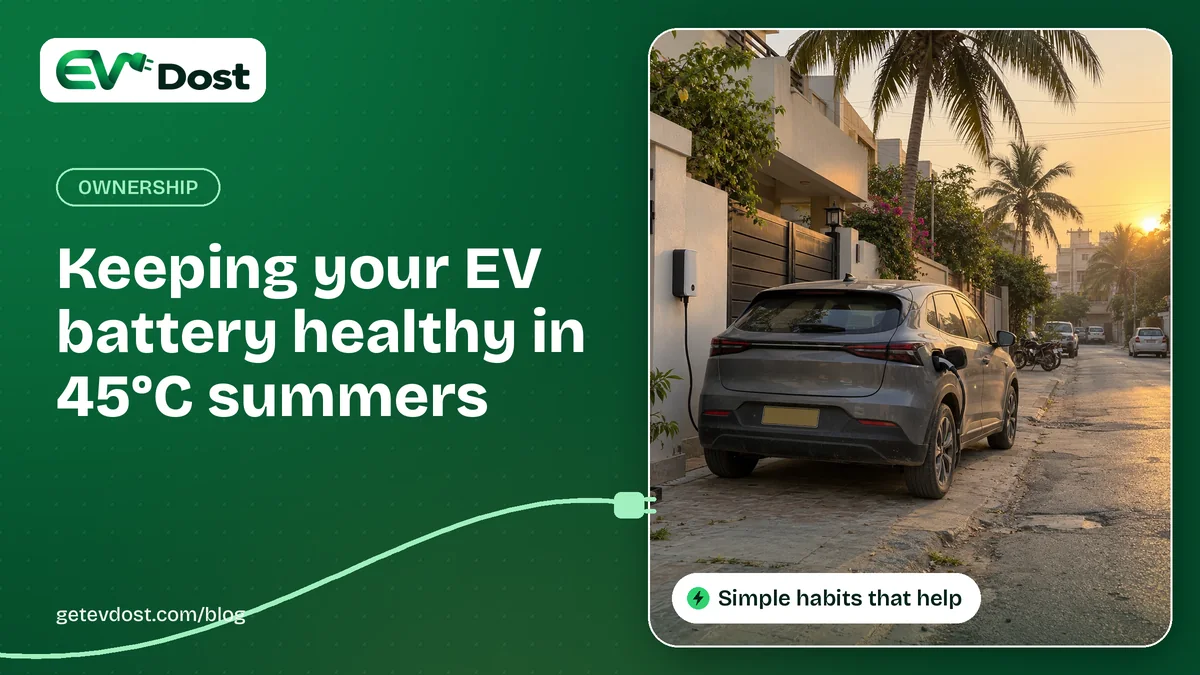
In late May 2026, Dadu recorded 51.5°C, breaking its own record, with Jacobabad and Larkana close behind at 50.5°C (ProPakistani, May 2026). In Lahore, summer afternoons in the 40s are common, and even humid Karachi regularly sits in the high 30s.
So heat is one of the first things people here ask about when they consider an EV. Will the battery cope with a Pakistani summer? Will it wear out in a few years?
Heat does affect EV batteries, both in daily range and in long-term ageing, but the effect is smaller than most people fear, and it's mostly within your control.
Two different effects
It helps to separate them.
Range on a hot day. This is temporary. On a very hot day, a chunk of your battery's energy goes into cooling the cabin and the battery itself, so you get fewer kilometres from the same charge. When the weather cools, the range comes back.
Battery ageing. This is permanent. All lithium batteries slowly lose capacity over the years, and heat speeds up the chemical reactions behind that loss. A battery that spends years sitting hot and full will age faster than one kept cooler and in the middle of its charge range.
How much range do you lose in the heat?
Research by Recurrent, which tracked thousands of EVs in the United States, found that range loss was small up to about 32°C but grew sharply above 35°C, with some cars losing 20 to 30 percent of their normal range (CBT News, June 2024). An earlier AAA test found a 17 percent drop at 35°C with the air conditioning running (AAA, 2019).
The air conditioner is the main reason. According to the Recurrent study, cooling a hot cabin draws 3 to 5 kW at first, then settles to around 1 kW to hold the temperature. That's a lot of power when the car itself might average only 5 kW or so in city traffic, and 15 to 20 kW on the motorway.
In practice, if your car normally manages 350 km, plan on something closer to 250 to 280 km on a 45°C day with the AC working hard. For daily driving in a city, that rarely matters. For a long trip in June, it changes where you stop to charge.
How much faster does Pakistan's heat age an EV battery?
Less than you might think, at least according to the largest dataset we could find.
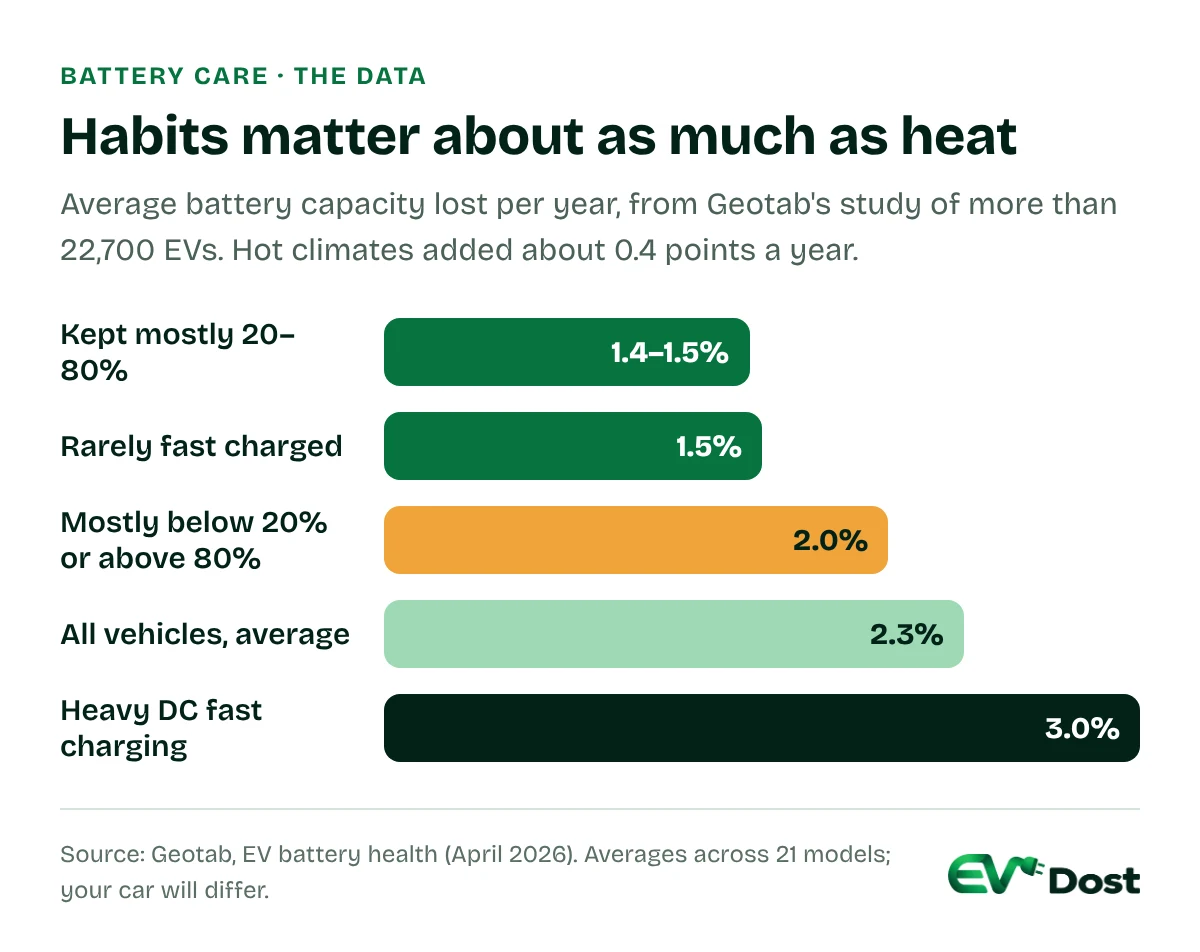
Geotab, which analysed more than 22,700 vehicles across 21 models, found that EV batteries lost an average of 2.3 percent of capacity a year. Vehicles in hot climates aged about 0.4 percentage points a year faster, which Geotab described as a moderate effect (Geotab, April 2026).
The same study found two habits mattered at least as much as climate:
- Cars that relied heavily on high-power DC fast charging lost about 3.0 percent a year, compared with 1.5 percent for cars that rarely fast charged.
- Cars that spent more than 80 percent of their time below 20 percent or above 80 percent charge lost about 2.0 percent a year, against roughly 1.4 to 1.5 percent for cars kept in the middle.
So your charging habits count for about as much as the climate, and those you can change.
LFP batteries are more forgiving
Many of the electric cars sold in Pakistan use lithium iron phosphate (LFP) batteries. BYD's Blade battery is LFP (BYD Australia), and the MG4's Pakistan brochure lists an LFP pack too (MG Pakistan).
LFP cells generally last more charge cycles than the nickel-based (NMC) cells used in many other EVs, and they're more tolerant of being charged to 100 percent. Some owner advice for LFP cars says regular charging to 100 percent is fine (Electrifying.com). Your owner's manual is the authority here; follow what it says for your specific car.
We couldn't find solid research comparing how LFP and NMC packs age specifically in extreme heat, so we won't pretend to know the exact difference.
Habits that help
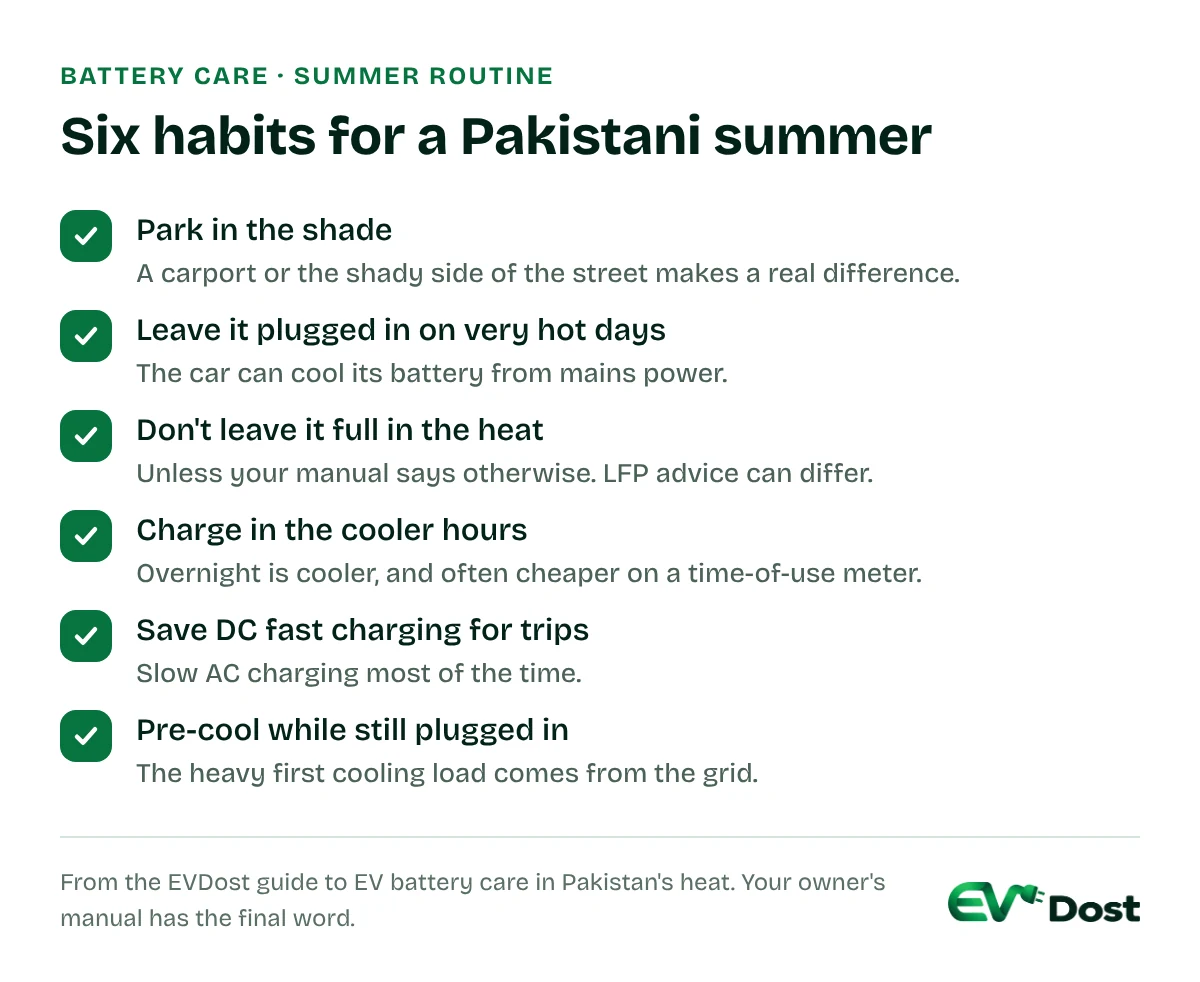
Park in the shade
This is the simplest and probably the most effective step. Nissan's owner manual for the Leaf tells drivers to park in cool places out of direct sunlight (Nissan). Volvo goes further and advises against leaving the car parked for more than 24 hours anywhere it might reach 55°C (Volvo support). A car parked in direct sun on a Multan afternoon gets very hot, so this is worth taking seriously.
A carport, a covered parking spot at work, or even the shady side of the street makes a real difference.
Leave it plugged in on very hot days
This one surprises people. Volvo's guidance is to keep the car plugged in during hot weather, so it can cool the battery using mains power rather than draining the battery itself. Many EVs do this automatically when the pack gets too warm.
Don't sit at 100 percent in the heat (unless your manual says otherwise)
For NMC batteries especially, a full battery sitting in high heat is about the worst combination. Several makers, Hyundai among them, suggest a lower everyday limit and charging to full mainly before long trips (Guide Auto on Hyundai's advice). If your car has an LFP battery, check the manual, since the advice can differ.
Charge in the cooler hours
Charging generates some heat of its own. Overnight charging is cooler for the battery, gentler on your wiring and usually cheaper if you're on a time-of-use meter. Nissan also suggests letting a hot battery cool before charging.
Save fast charging for trips
DC fast chargers are wonderful on the motorway. Using them as your everyday option is harder on the battery, as the Geotab data shows. Charge slowly at home or at a nearby host most of the time, and fast charge when you need to cover distance.
Pre-cool while plugged in
Most EVs let you start the air conditioning from an app. Do it ten minutes before you leave, while the car is still on the charger. The heavy initial cooling load then comes from the grid, not your battery, and you set off with a cool cabin and a full charge.
What about the warranty?
Battery warranties are typically much longer than the car's general warranty. BYD's UK warranty, for example, covers the battery for 8 years or 125,000 miles, with repair or replacement if health falls below 70 percent (Electrifying.com). Pakistani warranty terms can differ from European ones, so ask your dealer for the battery warranty in writing and keep your service records. Buying second-hand? Our guide to checking a used EV's battery covers what to look for.
A summer routine
A Pakistani summer will cost you some range on the hottest days and some extra battery wear over the years. Parking in shade, avoiding a full battery in high heat, charging at night and saving fast charging for trips will keep that wear modest.
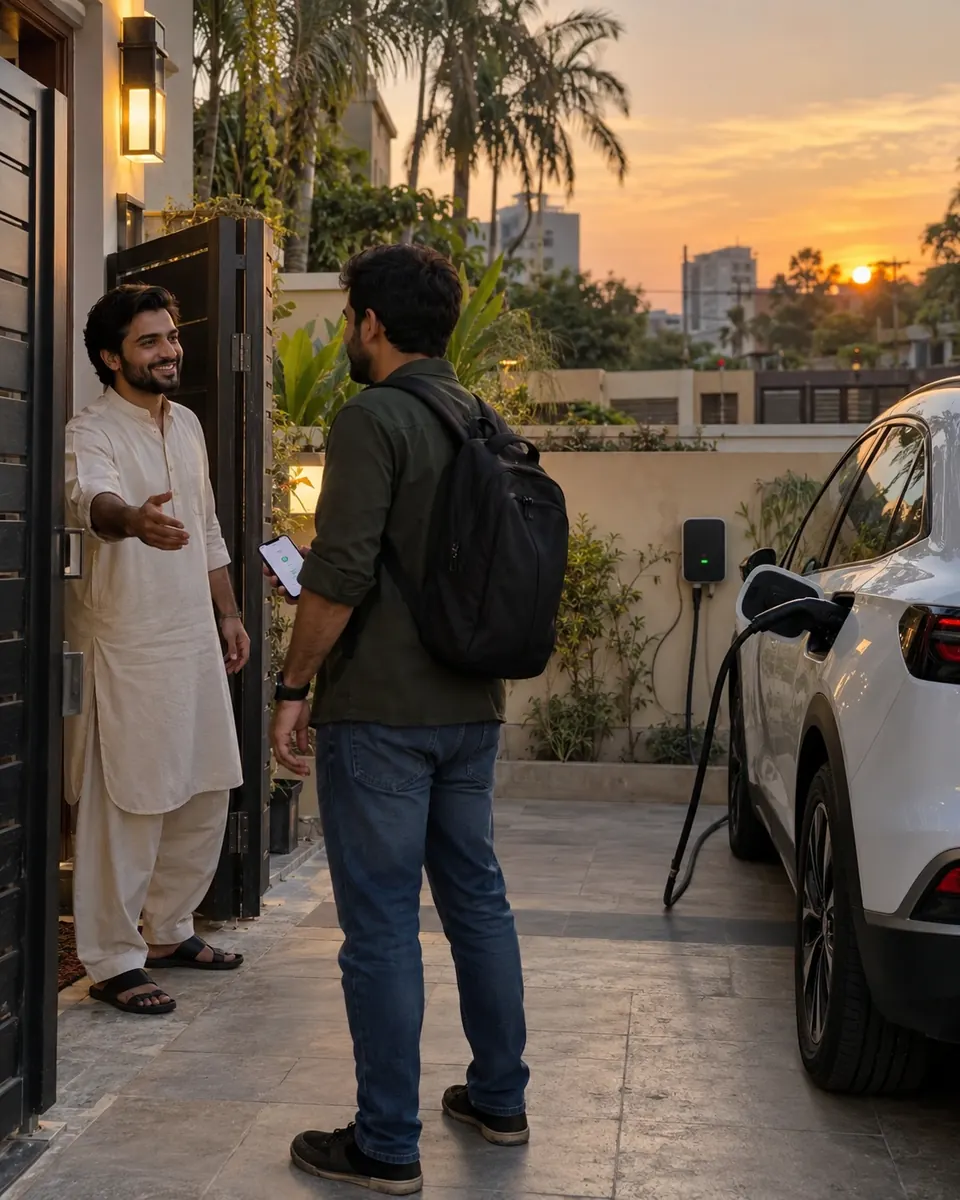
If you need a top-up during a hot day away from home, a slower AC charger in the shade is kinder to the battery than a DC fast charger in the afternoon sun. A host's wallbox in a covered porch or garage is one option, and you can look for one near you.
For the next step, read how much it costs to charge an EV in Pakistan or our guide to planning an EV road trip in Pakistan.
Frequently asked questions
Does Pakistan's heat damage electric car batteries?
Heat speeds up battery ageing, but less than most people fear. Geotab's study of more than 22,700 EVs found an average loss of 2.3 percent of capacity a year, with hot climates adding about 0.4 percentage points a year. Heavy DC fast charging made a bigger difference than climate.
How much range does an EV lose in 45°C heat?
Recurrent's US data showed range loss grows sharply above 35°C, with some cars losing 20 to 30 percent, mostly because of the air conditioning. As a rough guide, a car that normally does 350 km may manage 250 to 280 km on a 45°C day with the AC working hard. The range comes back when it cools.
Can I charge an LFP battery to 100 percent?
Usually yes. LFP batteries, used by BYD's Blade battery and the MG4 sold in Pakistan, are generally more tolerant of full charges than nickel-based batteries, and some owner advice says regular charging to 100 percent is fine. Follow your own owner's manual.
Should I leave my electric car plugged in on hot days?
Yes, if you can. Volvo, for one, advises keeping the car plugged in during hot weather so it can cool the battery using mains power rather than its own charge.
Does fast charging damage an EV battery?
Occasional fast charging is fine, but relying on it wears the battery faster. In Geotab's data, cars that used high-power DC charging heavily lost about 3.0 percent of capacity a year, against 1.5 percent for cars that rarely did.
Sources
- ProPakistani, record heat in Sindh (May 2026): propakistani.pk
- CBT News, Recurrent study on extreme heat and EVs (June 2024): cbtnews.com
- AAA, temperature and EV range (2019): aaa.com
- Geotab, EV battery health study (April 2026): geotab.com
- BYD Australia, Atto 3 battery: bydautomotive.com.au
- MG Pakistan, MG4 EV brochure: mgmotors.com.pk
- Nissan, Leaf battery care: nissan.com.mt
- Volvo support, hot weather and the high-voltage battery: volvocars.com
- Guide Auto, Hyundai's battery tips (2020): guideautoweb.com
- Electrifying.com, BYD battery longevity: electrifying.com