Planning an EV road trip in Pakistan: motorways, hills and where to charge
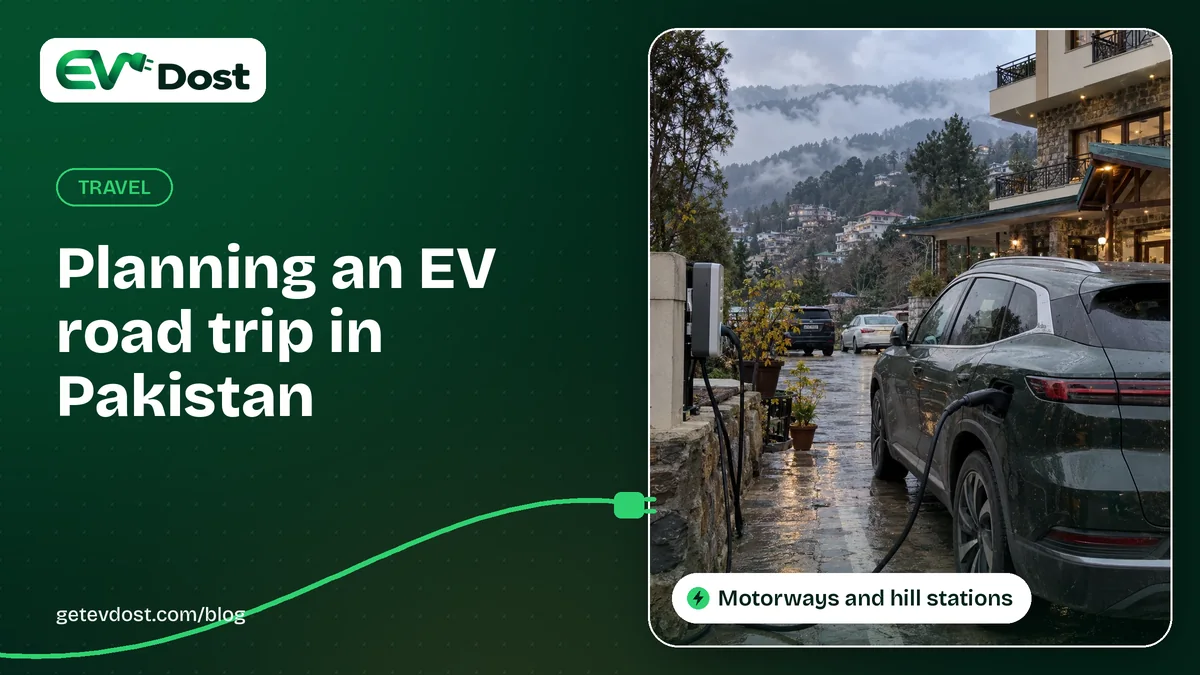
A year or two ago, driving an electric car from Lahore to Islamabad took planning, patience and a bit of faith. In 2026 it's a normal trip. The M-2 now has fast chargers at several rest areas, and more routes are being added.
Beyond the M-2, things are patchier. An EV road trip in Pakistan is very doable, but it rewards some homework before you leave. This guide covers how to plan one.
EV road trip charging on Pakistan's motorways
The M-2 between Lahore and Islamabad is the best-served route. In July 2026, ultra-fast chargers rated at 360 kVA were reported at Chakri, Kallar Kahar, Bhera and Sial Mor, each able to charge four cars at once, with typical stops of 15 to 20 minutes (ProPakistani, July 2026). HUBCO Green, PSO and BYD Pakistan also opened a station with two 60 kW chargers at Magic River in 2025 (APP, June 2025).
Elsewhere, plans are bigger than what's built. NEECA has listed planned sites along the M-4, M-5, M-9, M-11, M-14 and M-15 (NEECA presentation, 2026). The government has also proposed 40 Level 3 fast-charging stations along the motorways, about 120 km apart, backed by Rs 2.25 billion in viability-gap funding (ProPakistani, May 2026). Separately, HUBCO Green and BYD have announced 128 DC fast chargers over three years (Profit, May 2025).
How many of those planned sites are working today is hard to pin down; even official lists mix planned and live sites. Before any trip off the M-2, check the specific chargers on your route, and check again the day before you leave.
Plan around 80 percent, not 100
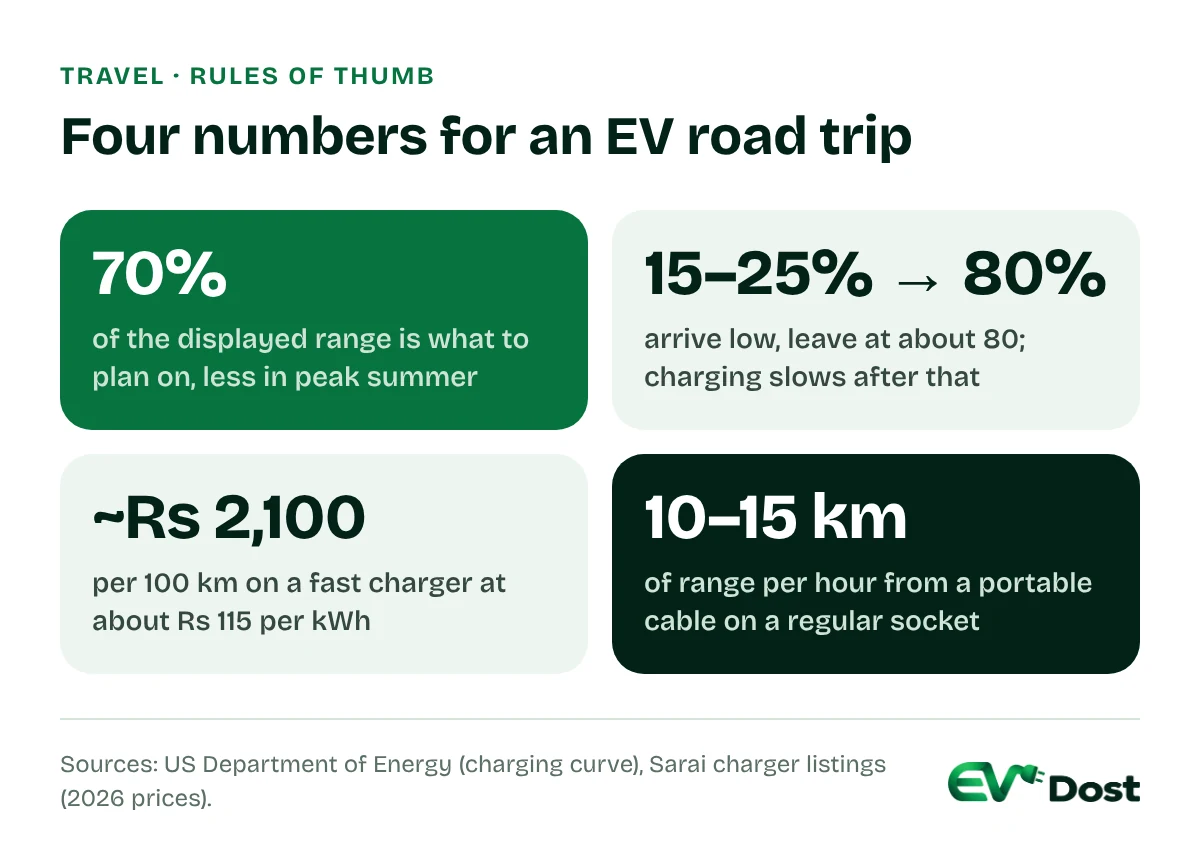
On a fast charger, an EV charges quickly at first and then slows down noticeably once the battery passes about 80 percent (US Department of Energy). Depending on the car, the last stretch to full can take almost as long as everything before it.
So the efficient way to road trip is several shorter stops rather than a few long ones. Arrive at a charger with 15 to 25 percent left, charge to around 80, and move on. You'll usually spend less total time charging, and the stops line up nicely with tea, namaz and a stretch. Our guide to EV charging time explains the charging curve in more detail.
Adjust your range for the conditions
The range on your dashboard assumes average conditions. Pakistan rarely offers those.
Heat. With the AC working hard above 35°C, tests and fleet data suggest losing somewhere between about 17 and 30 percent of your normal range (AAA, 2019; CBT News on the Recurrent study, June 2024). We go into this in more detail in EV battery care in Pakistan's heat.
Speed. Energy use climbs steeply with speed. Cruising at 120 km/h uses noticeably more than 100 km/h. If you're stretching to the next charger, slowing down is the most reliable way to get there.
Hills. Climbing to Murree, Nathia Gali or Swat uses a lot of energy. EVs win some of it back on the way down through regenerative braking, and descending in an EV is calmer on the brakes than in a petrol car. Just make sure you have enough charge for the climb, plus a buffer, before you start up.
For planning, assume you have about 70 percent of the range the car shows, and less in peak summer.
A sample trip: Lahore to Islamabad
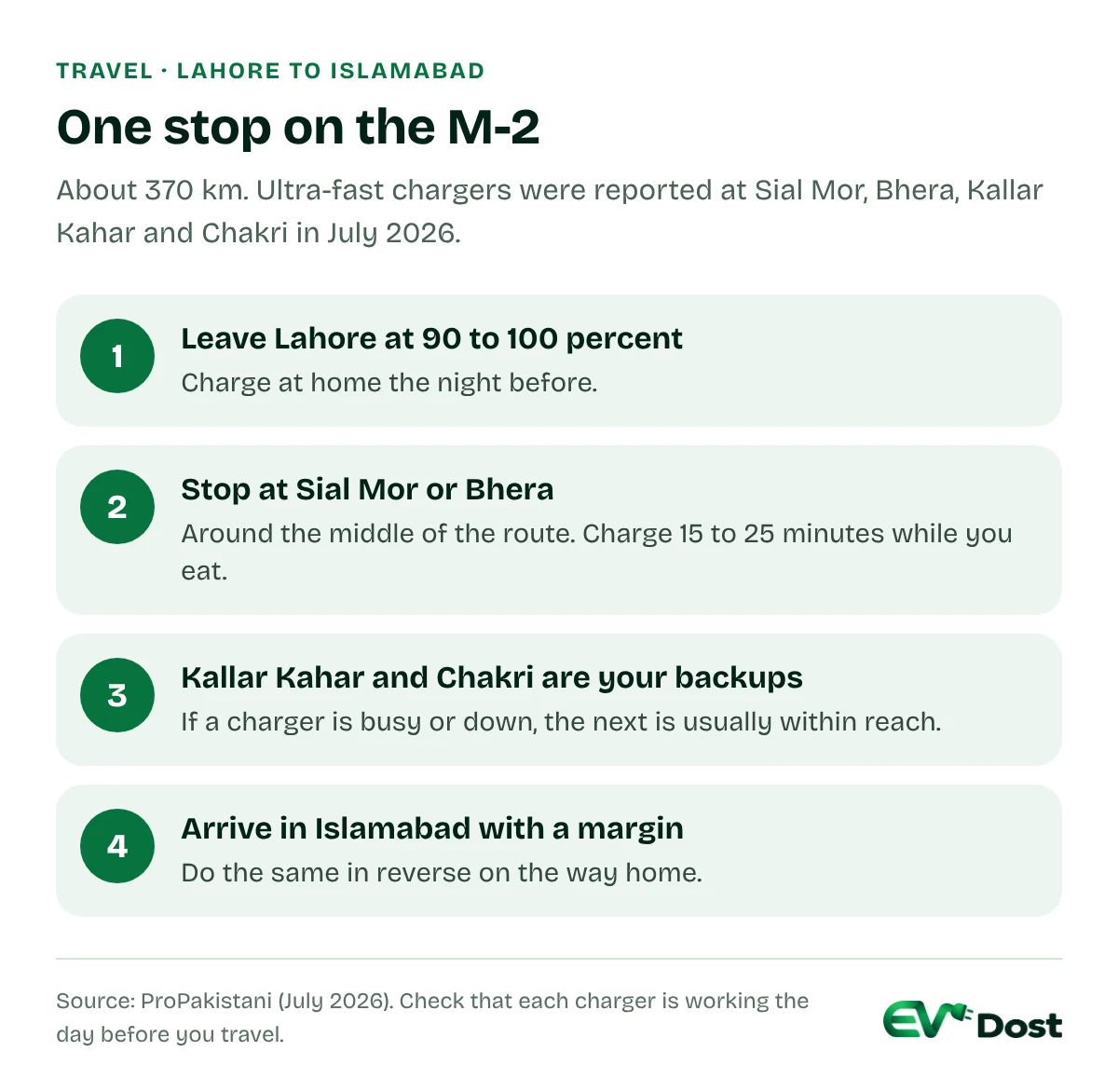
The M-2 is about 370 km. Even a car with 400 km of claimed range, which could in theory do it in one go, is far more comfortable stopping once in summer heat at motorway speed.
A typical plan:
- Leave Lahore at 90 to 100 percent, charged at home overnight.
- Stop at Bhera or Sial Mor, around the middle of the route. Charge for 15 to 25 minutes while you eat.
- Arrive in Islamabad with a comfortable margin.
On the way back, do the same in reverse. If one charger is busy or down, the next is usually within reach on this route, which is what makes the M-2 relaxing in an EV.
Heading north
The hill routes are where planning matters most. Fast chargers thin out once you leave the motorway network, and the climbs eat into your battery.
A simple approach is to treat Islamabad as your last reliable fast-charging point. Leave it at around 80 to 90 percent, keep your speed sensible on the climb, and make sure your hotel or a host near your destination can charge the car overnight before you commit to the trip. On the way back down, regenerative braking will put some energy back, so the return leg often needs less than you'd expect.
Weather matters too. Rain and cold mornings in the hills reduce range a little, and running the heater uses energy just as the AC does in the plains.
What it costs on the road
Motorway fast charging costs more than charging at home. Directory listings in 2026 put typical DC prices at around Rs 115 per kWh (Sarai charger listings), which works out to roughly Rs 2,100 per 100 km for a compact EV. That's still well below a large petrol car. Our EV charging cost guide has the full comparison, and the same numbers are why charging overnight at a hotel or host, wherever you can, keeps a trip cheap.
Charging where you sleep
On a road trip, the best charging happens overnight while you sleep. It's slower than a fast charger, but it costs less, it's gentler on the battery, and you wake up full.
Some hotels now have chargers for guests. When you reserve a room, ask specifically: what kind of plug, how many kW, is it free for guests or charged separately, and can you reserve it. "We have EV charging" sometimes turns out to be a single socket behind the kitchen.
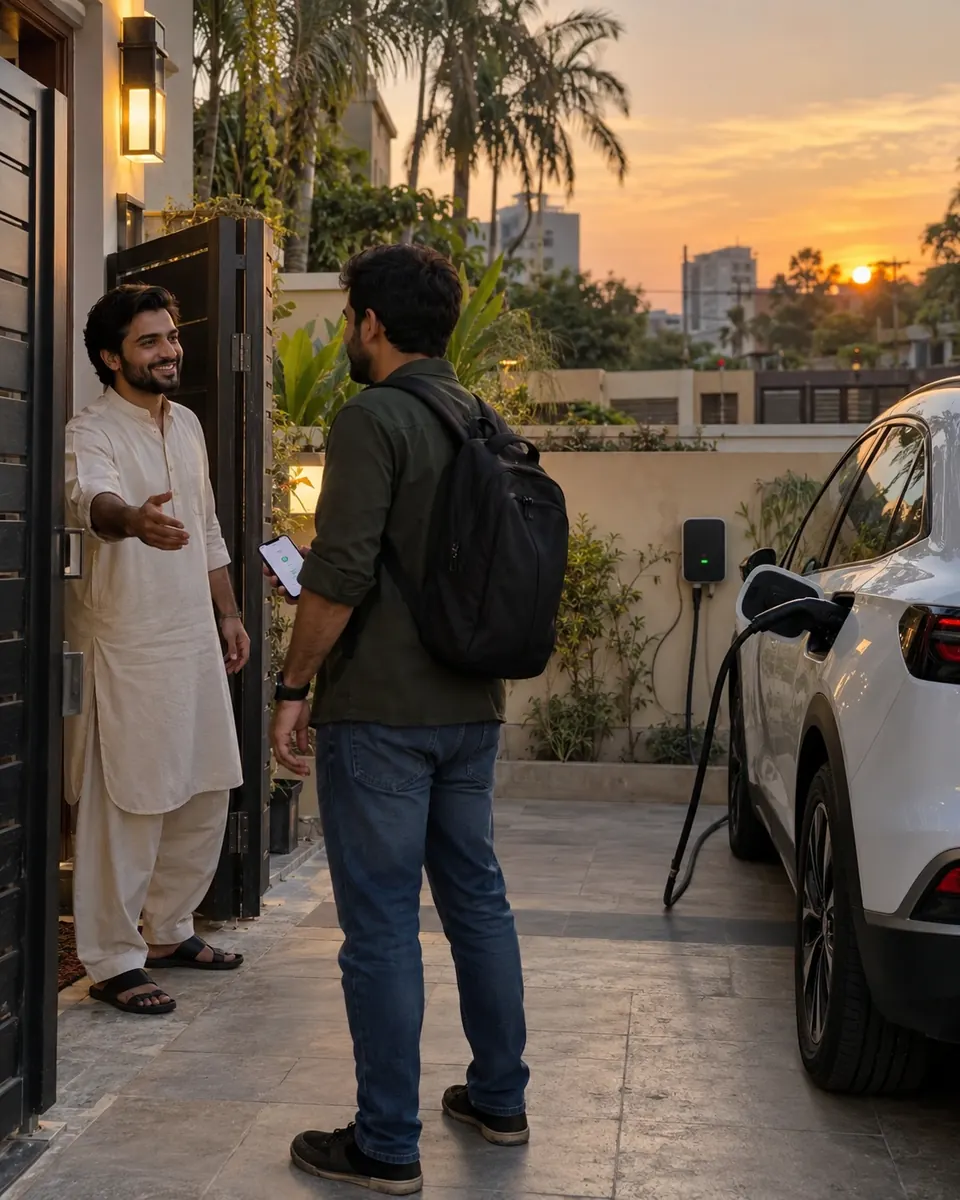
In a town without a public fast charger, an EVDost host can fill the gap. Hosts list chargers at homes, guest houses, hotels and offices, and a 7 kW wallbox can refill most compact EVs overnight. It's worth checking the app for hosts near your destination before you set off, and our guide to EV charging stations in Pakistan covers the public networks.
Bring the right kit
- Your portable charger. If everything else fails, a regular heavy-duty socket at a host's home or a hotel can add 10 to 15 km an hour. That's slow, but overnight it's enough to get you to the next fast charger.
- Your Type 2 cable, if your car came with one. Some AC chargers are socket-only.
- The charging apps or cards for the networks on your route, set up and tested at home.
- A photo of your car's charging port, to show station staff or hosts if there's any doubt.
Our trip checklist
- Check the chargers on your route the day before, not just the week before.
- Plan legs at 70 percent of displayed range, or less in summer.
- Arrive at fast chargers with 15 to 25 percent and leave at about 80.
- Choose accommodation with charging, or find a host near your stop.
- Pre-cool the car while it's still plugged in before each leg.
- Keep the portable charger in the boot.
Your first long trip in an EV will feel like an adventure. By the third, it's just driving, with quieter stops and a smaller fuel bill.
Frequently asked questions
Can you drive an electric car from Lahore to Islamabad?
Yes. The M-2 is about 370 km and, as of July 2026, has ultra-fast chargers at the Sial Mor, Bhera, Kallar Kahar and Chakri rest areas. Leave Lahore well charged and plan one stop of 15 to 25 minutes around the middle of the route.
How far can an EV go on the motorway in summer?
Less than the dashboard says. Heat with the AC running can cut range by roughly 17 to 30 percent, and speeds of 120 km/h use noticeably more than 100 km/h. Plan legs on about 70 percent of the displayed range, and less in peak summer.
Can I take an electric car to Murree or the northern areas?
Yes, with planning. Treat Islamabad as your last reliable fast charger, leave at 80 to 90 percent, and confirm your hotel or a host near your destination can charge overnight. Regenerative braking returns some energy on the way down.
How much does it cost to charge an EV on a road trip in Pakistan?
Fast chargers typically cost around Rs 115 per kWh in 2026 listings, about Rs 2,100 per 100 km for a compact EV. Charging overnight at a hotel or host wherever you can keeps the cost down.
Should I charge to 100 percent at a motorway fast charger?
Usually not. Charging slows noticeably once the battery passes about 80 percent, so several shorter stops from about 20 to 80 percent are usually quicker overall than charging to full.
Sources
- ProPakistani, ultra-fast chargers on the M-2 (July 2026): propakistani.pk
- APP, HUBCO Green, PSO and BYD station at Magic River (June 2025): app.com.pk
- NEECA, presentation on EV charging stations (2026): saarcenergy.org
- ProPakistani, proposed motorway charging stations (May 2026): propakistani.pk
- Profit, HUBCO Green and BYD charging network (May 2025): profit.pakistantoday.com.pk
- US Department of Energy, how fast charging slows near full: energy.gov
- AAA, temperature and EV range (2019): aaa.com
- CBT News, Recurrent study on extreme heat (June 2024): cbtnews.com
- Sarai, public charger listings: saraicharge.com