How long does it take to charge an electric car in Pakistan?
"How long does it take to charge?" is usually the second question people ask about an electric car in Pakistan, right after "how far does it go?". Anything from half an hour to a full day, and that isn't a dodge. EV charging time in Pakistan depends on three things: how much energy you're putting in, how fast the charger can supply it, and how fast your car will accept it.
Once you know those three numbers, the sum is simple. We work it through below for the cars people are buying.
The simple sum
Charging time is roughly the energy you need divided by the charging power, plus a little for losses.
Time (hours) ≈ energy needed (kWh) ÷ charging power (kW) × 1.1
The 1.1 accounts for about 10 percent lost as heat during AC charging, the same assumption we use in our EV charging cost guide. So putting 30 kWh into a car on a 7 kW charger takes about 30 ÷ 7 × 1.1, or roughly 4 hours 45 minutes.
"Power" here means the lowest of three limits: what the charger can deliver, what your electricity supply can carry, and what the car itself can take.
Charging speeds you'll meet
| Charger | Power | Range added per hour (approx.) |
|---|---|---|
| Portable cable on a home socket | about 2.2 to 3.3 kW | about 11 to 16 km |
| Wallbox, single-phase supply | about 7 to 7.4 kW | about 35 km |
| Wallbox, three-phase supply | 11 or 22 kW, if the car accepts it | about 55 km at 11 kW |
| DC fast charger | 30 to 120 kW and up | a few hundred km an hour, early in the charge |
Range per hour assumes about 20 units per 100 km from the wall, the figure we use across our guides. A single-phase supply at 230 volts and 32 amps gives about 7.4 kW, and a three-phase supply supports 11 kW at 16 amps or 22 kW at 32 amps (MSI; Teltonika Energy).
Why a bigger AC charger often doesn't help
On AC, the car's own onboard charger converts the power, and it sets the ceiling. The BYD Atto 2's Pakistan flyer, for example, rates its AC inlet at 7 kW (BYD Pakistan flyer, January 2026). Plug it into a 22 kW unit and it still charges at 7 kW. Many popular EVs here, such as the Atto 2, Atto 3 and Honri VE, accept 6.6 to 7 kW on AC, which happens to match what a single-phase home can supply. Our guide to EV charger types in Pakistan explains the AC and DC difference in more detail.
Charging times for popular EVs in Pakistan
The table shows how long popular EVs take to charge from 20 to 80 percent, the everyday top-up, using our sum and each car's AC limit, alongside the makers' own fast-charging figures.
| Car | Battery | 20–80% on a 7 kW wallbox | 20–80% on a 2.2 kW cable | DC fast charging (maker's figure) |
|---|---|---|---|---|
| Honri VE 3.0 | 29.9 kWh | about 3 h | about 9 h | 10–80% in about 30 min (check the variant) |
| MG4 EV Urban | 43 kWh | about 4 h 15 min | about 13 h | 10–80% in about 28 min |
| BYD Atto 2 | 45.12 kWh | about 4 h 15 min | about 13 h 30 min | 30–80% in about 30 min |
| BYD Atto 3 | 49.92 kWh | about 4 h 45 min | about 15 h | 30–80% in about 30 min |
| BYD Sealion 7 | 82.56 kWh | about 7 h 45 min | about 24 h 45 min | 30–80% in about 30 min |
Home times are our estimates, rounded to 15 minutes, using the cars' AC limits on a 7 kW wallbox: 6.6 kW for the Honri and the MG4 (MG4 Urban brochure) and 7 kW for the BYDs (Atto 3 spec sheet). A car that accepts more than 7 kW is still limited to 7 kW by the wallbox. Battery sizes and fast-charging figures come from BYD Pakistan (Atto 2, Atto 3, Sealion 7), ProPakistani for the MG4 (ProPakistani, June 2026) and PakWheels for the Honri (PakWheels). PakWheels' spec page lists a 30-minute 10–80% DC charge for the VE 3.0, but its September 2026 buying guide lists only AC home charging, so check the variant before you count on fast charging (PakWheels, September 2026).
A full charge from 10 percent takes longer: roughly 6 hours 30 minutes for an Atto 2 or MG4 on a 7 kW wallbox, and nearly 12 hours for a Sealion 7. So big-battery owners tend to top up a little each night rather than fill from empty.
Why fast charging slows down after 80 percent
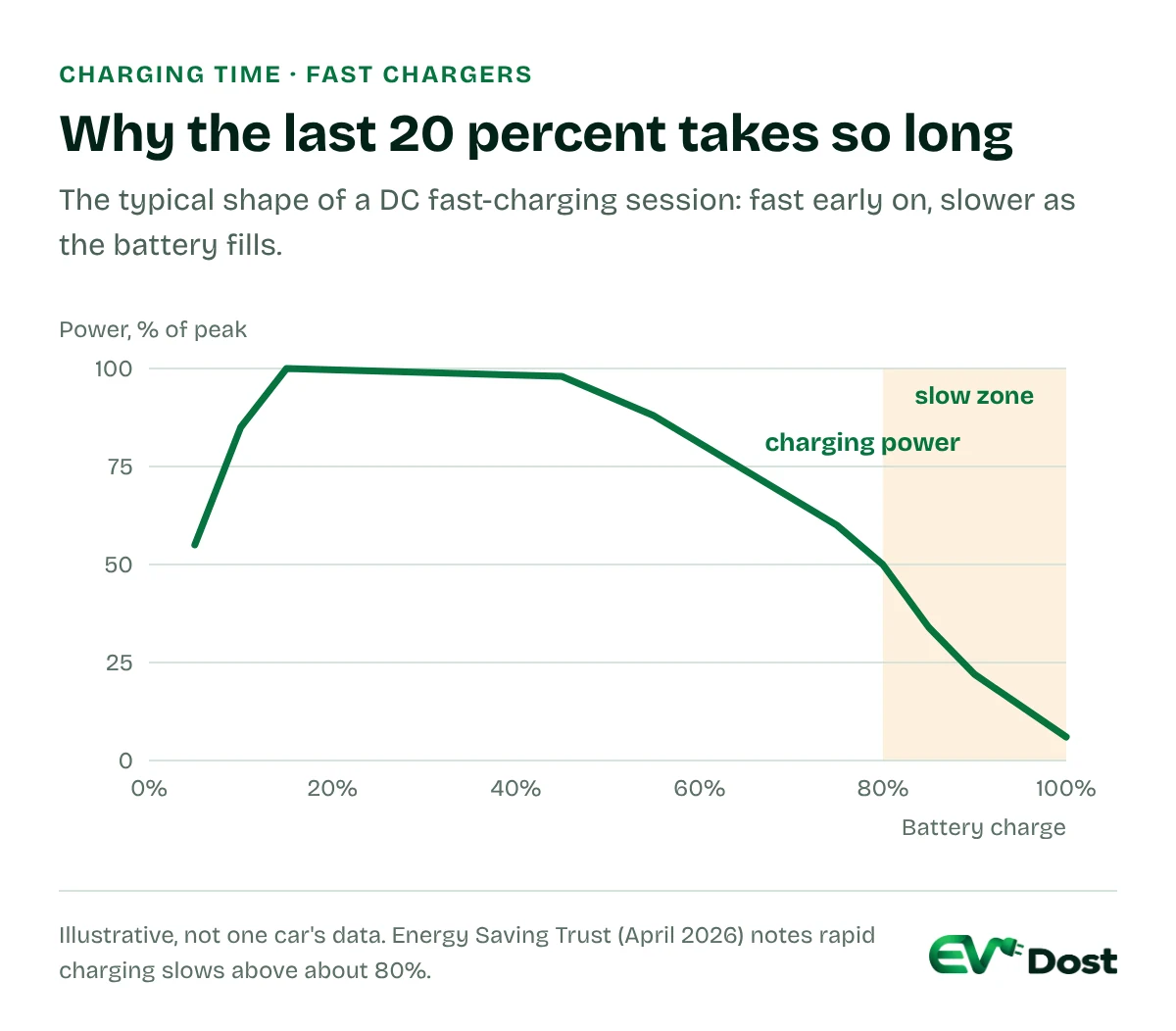
On a DC fast charger, the car takes power quickly when the battery is low, then slows down as it fills to protect the cells. The UK's Energy Saving Trust notes that charging is slower below 20 percent and above 80 percent, and that rapid charging can slow down above 80 percent (Energy Saving Trust, April 2026).
So makers quote 10–80 or 30–80 percent times rather than 0–100. The last 20 percent can take almost as long as everything before it. On a road trip, stopping more often and leaving at around 80 percent is quicker overall; our EV road trip guide shows how to plan stops that way.
Other things that change charging time
Heat. Batteries charge best at moderate temperatures. On a 45°C afternoon, the car may spend some energy cooling the battery and can charge more slowly. Charging in the evening or overnight helps, and our guide to EV battery care in Pakistan's heat covers why.
Your supply. A wallbox can only draw what your connection allows. If your sanctioned load is low, an installer may set the charger to a lower current, which slows it down. Our home charger installation guide explains how to check.
Load-shedding. An outage pauses charging. Most daily top-ups still fit easily into a night with a two-hour cut, as our guide to charging during load-shedding shows.
Sharing a charger. Some public sites split power between two cars plugged in at once. If speed matters, check whether the other connector is in use.
What this means day to day
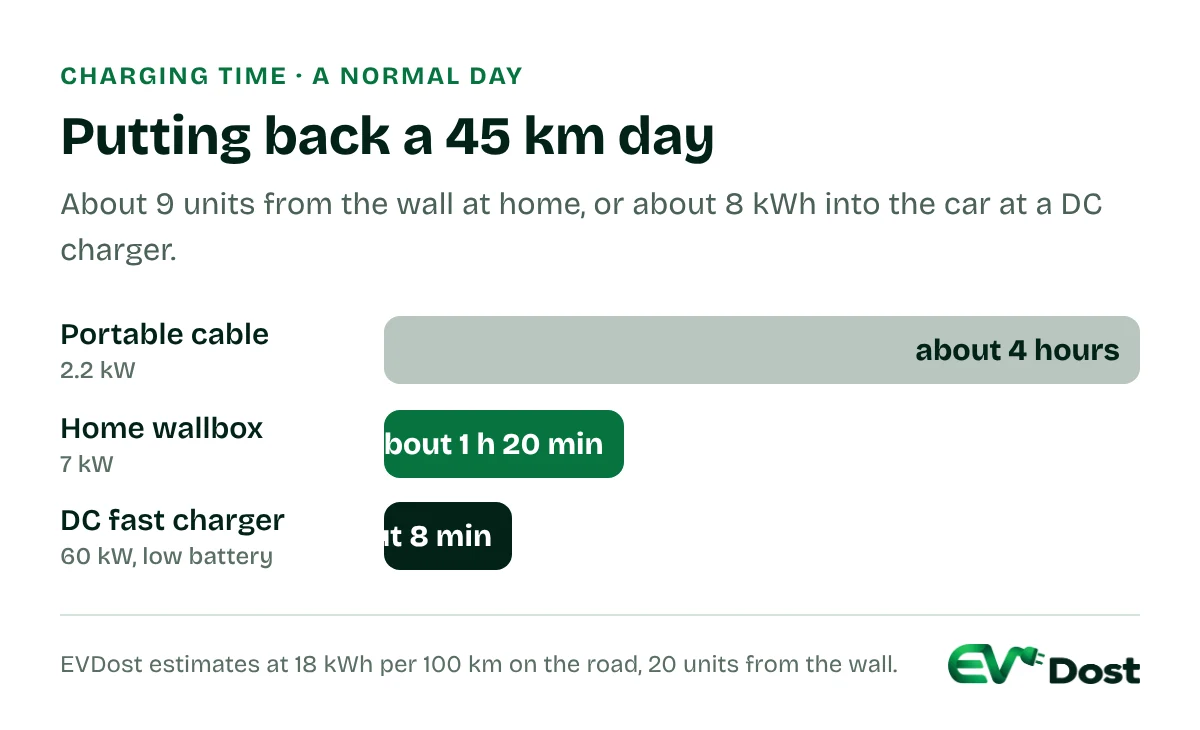
Most people don't wait for their car to charge. They plug in at home and it's ready by morning. A typical day of 40 to 50 km needs about 8 to 10 units from the wall, which is about an hour and a quarter on a 7 kW wallbox, or about four hours on the portable cable.
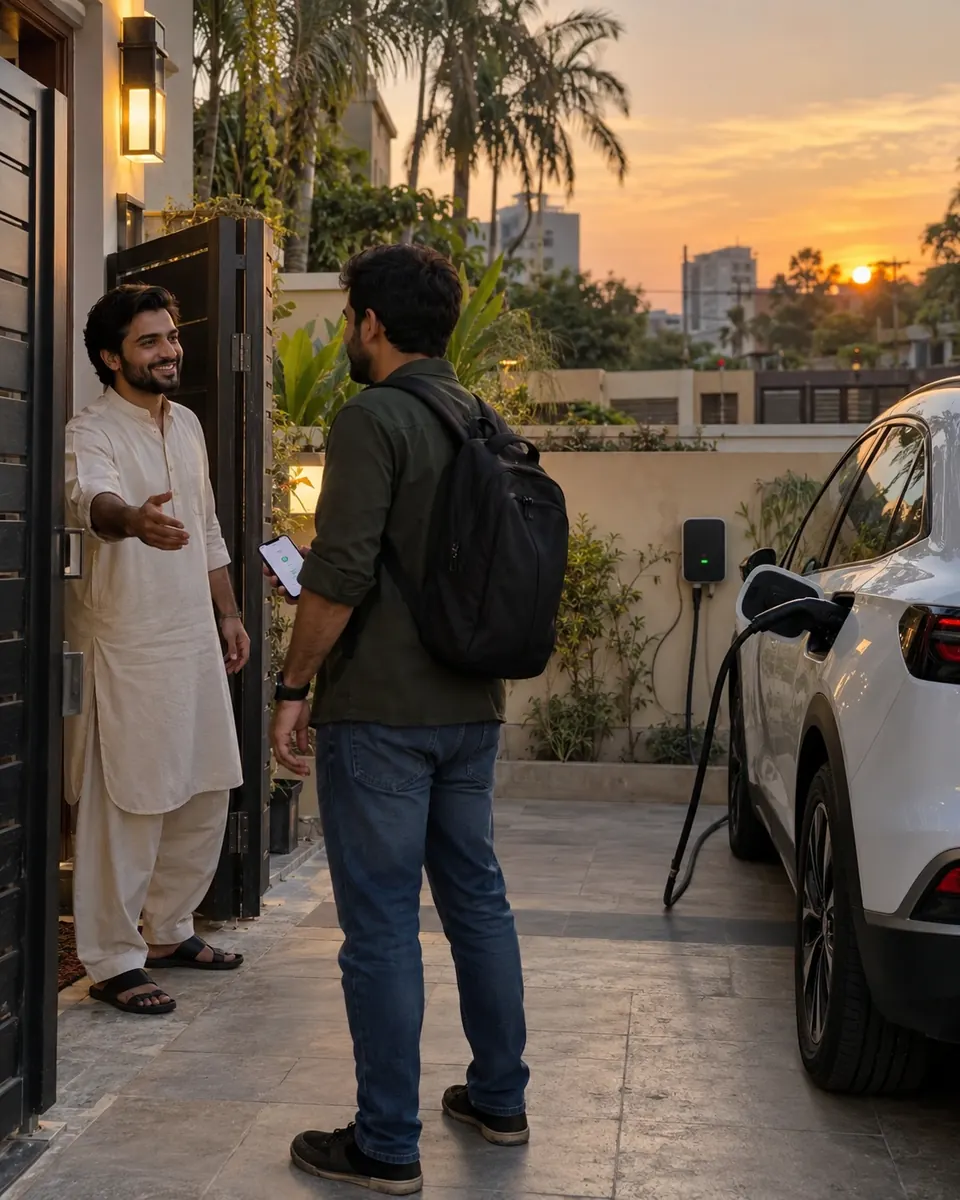
If you can't charge at home, the times above help you plan a top-up elsewhere. Two hours on a host's 7 kW wallbox while you're at work or out to dinner adds about 70 km. On EVDost, you can pick your car, see chargers nearby with their power and plug type, and get a cost estimate for your car before you go. Find a charger near you.
Frequently asked questions
How long does it take to charge an electric car at home in Pakistan?
As of October 2026, on a 7 kW wallbox, a typical compact EV in Pakistan takes about 4 to 5 hours to go from 20 to 80 percent and about 6 to 7 hours from 10 to 100 percent. On the portable cable that comes with the car, at about 2.2 kW, allow 13 to 15 hours for the same 20 to 80 percent. A big-battery car such as the BYD Sealion 7 takes longer.
How long does a fast charger take in Pakistan?
About 30 minutes to reach 80 percent for popular EVs in Pakistan, as of 2026: BYD quotes 30 minutes from 30 to 80 percent for the Atto 2, Atto 3 and Sealion 7, and the MG4 EV Urban is quoted at about 28 minutes from 10 to 80 percent. Times depend on the charger's power, the battery's temperature and how full it is.
How many km does an EV gain per hour of charging?
Roughly 35 km an hour on a 7 kW wallbox and about 11 to 16 km an hour on a portable cable, assuming about 20 units per 100 km from the wall. On a DC fast charger, the rate is much higher early in the charge and slows after 80 percent.
How long does it take to fully charge a BYD Atto 3 at home?
About 7 hours from 10 to 100 percent on a 7 kW wallbox, by our estimate as of October 2026, and about 4 hours 45 minutes for the everyday 20 to 80 percent. On the 2.2 kW portable cable, 20 to 80 percent takes about 15 hours.
Why does charging slow down after 80 percent?
To protect the battery, cars reduce charging power as the battery fills, and DC charging can slow down above about 80 percent. That's why makers quote 10–80 or 30–80 percent times, and why stopping at 80 percent on a trip saves time.
Sources
- MSI, single-phase vs three-phase charging: msi.com
- Teltonika Energy, wallbox electrical specifications: teltonika-energy.com
- BYD Pakistan, Atto 2 flyer (January 2026): PDF
- BYD Pakistan model pages: Atto 2, Atto 3, Sealion 7
- ProPakistani, MG4 EV Urban (June 2026): propakistani.pk
- MG Pakistan, MG4 EV Urban brochure: PDF
- BYD, Atto 3 spec sheet: PDF
- PakWheels, Honri VE 3.0 specifications: pakwheels.com
- PakWheels, electric cars under Rs 60 lakh (September 2026): pakwheels.com
- Energy Saving Trust, charging electric vehicles (April 2026): energysavingtrust.org.uk