How much does it cost to charge an electric car in Pakistan?
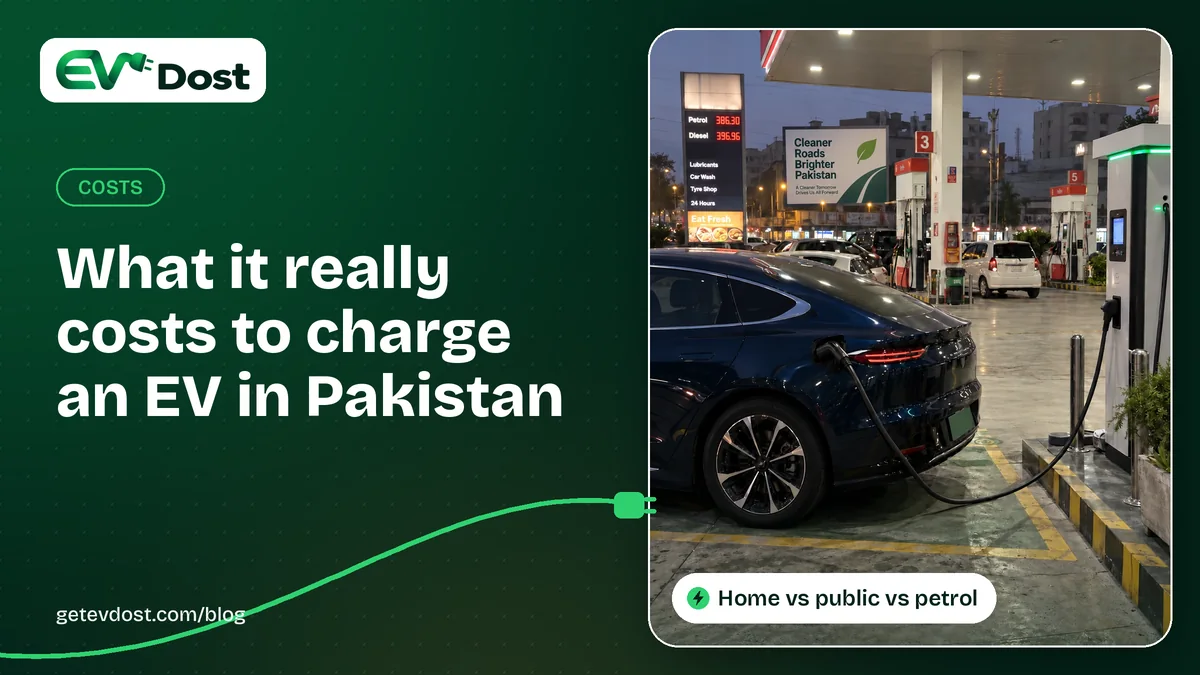
Petrol went up by about half this year. It was Rs 253.17 a litre in mid-January, peaked at Rs 458.41 in April, and from 20 October it's Rs 381.14 (Daily Pakistan, January 2026; Dawn, October 2026). Prices are now revised daily, so by the time you read this the number will have moved again.
No wonder so many people are doing the sums on electric cars. The trouble is that "charging is cheap" and "electricity is expensive" are both things you hear, and both are partly true. It depends on where you charge, when, and how much electricity your home already uses.
Here is the EV charging cost in Pakistan worked out properly, at October 2026 prices.
The one number to know: kWh per 100 km
Electric cars are measured in kilowatt-hours (kWh, or "units" on your bill) per 100 km. It's the EV version of fuel average.
Most compact electric SUVs and hatchbacks sold in Pakistan use roughly 15 to 19 kWh per 100 km in real driving. EV Database estimates about 18.3 kWh per 100 km in real-world use for the larger-battery BYD Atto 3 (EV Database), and Germany's ADAC lists the MG4 Urban at 15.5 kWh per 100 km on the WLTP test (ADAC). Hot weather with the AC on full pushes that up; gentle city driving brings it down.
Some energy is also lost while charging, roughly 10 percent on AC as a rule of thumb. So for the examples below we'll use 18 kWh per 100 km on the road, about 20 units from the wall. That's on the cautious side for most small EVs.
EV charging cost at home
What a unit costs you at home depends on your slab, your sanctioned load and taxes. For 2026, NEPRA's base rates for non-protected residential customers start at Rs 22.44 for the first 100 units and rise with each slab (NEPRA, January 2026; The Nation, January 2026). Then come taxes, fuel adjustments and, under changes NEPRA approved in February 2026, a fixed monthly charge of Rs 200 to 675 per kW of sanctioned load (The News, February 2026).
Before taxes and surcharges, grid tariffs for households run roughly Rs 37 to 55 per unit (The Standard, February 2026). General sales tax alone adds 18 percent on top, so the all-in cost is higher. Your own bill tells you exactly where you sit: divide the total amount by the units used.
Using Rs 55 a unit as a realistic all-in figure for a household using a few hundred units a month:
- 100 km at 20 units from the wall costs about Rs 1,100, or Rs 11 per km.
- A fuller charge of a 50 kWh battery, from 10 to 90 percent, takes about 44 units from the wall: roughly Rs 2,400.
Watch your slabs
This is the bit people miss. If you drive 1,500 km a month, that's about 300 extra units. Added on top of your normal household use, that can move you into a higher slab. Protected customers get the benefit of one previous slab; non-protected customers don't, so once you cross into a higher slab, far more of your units are billed at the higher rate, not just the extra ones (IESCO tariff guide). It can also increase your fixed charge.
If your home is a "protected" customer, a status that depends on keeping consumption at or under 200 units a month, adding an EV will almost certainly end that, and protected status is valuable. Before you buy, look at your last few bills and work out where an extra 200 to 400 units would land you.
For homes with a sanctioned load of 5 kW or more, a time-of-use tariff applies (IESCO tariff guide), and off-peak units are cheaper than peak ones. Set your car to charge after the peak window ends (K-Electric's peak runs 6:30 to 10:30 p.m. from April to October, for example) (K-Electric).
Charging at public fast chargers
Public chargers set their own prices. In May 2025, NEPRA set a base tariff of Rs 23.57 a unit for charging stations, expected to come to about Rs 39.70 after taxes, and stations add their own margin on top (Express Tribune, May 2025).
What drivers actually pay varies a lot. Listings compiled by one independent charger directory in 2026 show DC fast charging from about Rs 70 to Rs 200 per kWh, with around Rs 115 being typical, and AC chargers at hotels and malls ranging even more widely (Sarai charger listings). Treat those as a guide; prices change and each operator sets its own.
At Rs 115 per kWh:
- 100 km costs about Rs 2,070, or around Rs 21 per km.
That's nearly double home charging. Fast chargers are expensive to build and run, and you're paying for speed. They're the right choice on a motorway, not for everyday use.
Petrol, for comparison
At Rs 381.14 a litre:
| Car | Fuel use | Cost per 100 km | Per km |
|---|---|---|---|
| Small 660cc hatchback | ~18 km/L | ~Rs 2,120 | ~Rs 21 |
| 1.8L sedan, city driving | ~11 km/L | ~Rs 3,465 | ~Rs 35 |
| EV charged at home (Rs 55/unit) | 20 kWh | ~Rs 1,100 | ~Rs 11 |
| EV at a public DC charger (Rs 115/kWh) | 18 kWh | ~Rs 2,070 | ~Rs 21 |
Public chargers bill the energy delivered to the car, so the DC row uses 18 kWh; home charging is measured at your meter, so it includes losses. Fuel averages are typical city figures listed by PakWheels (PakWheels, April 2026; PakWheels, Corolla) and vary a lot with traffic and driving style.
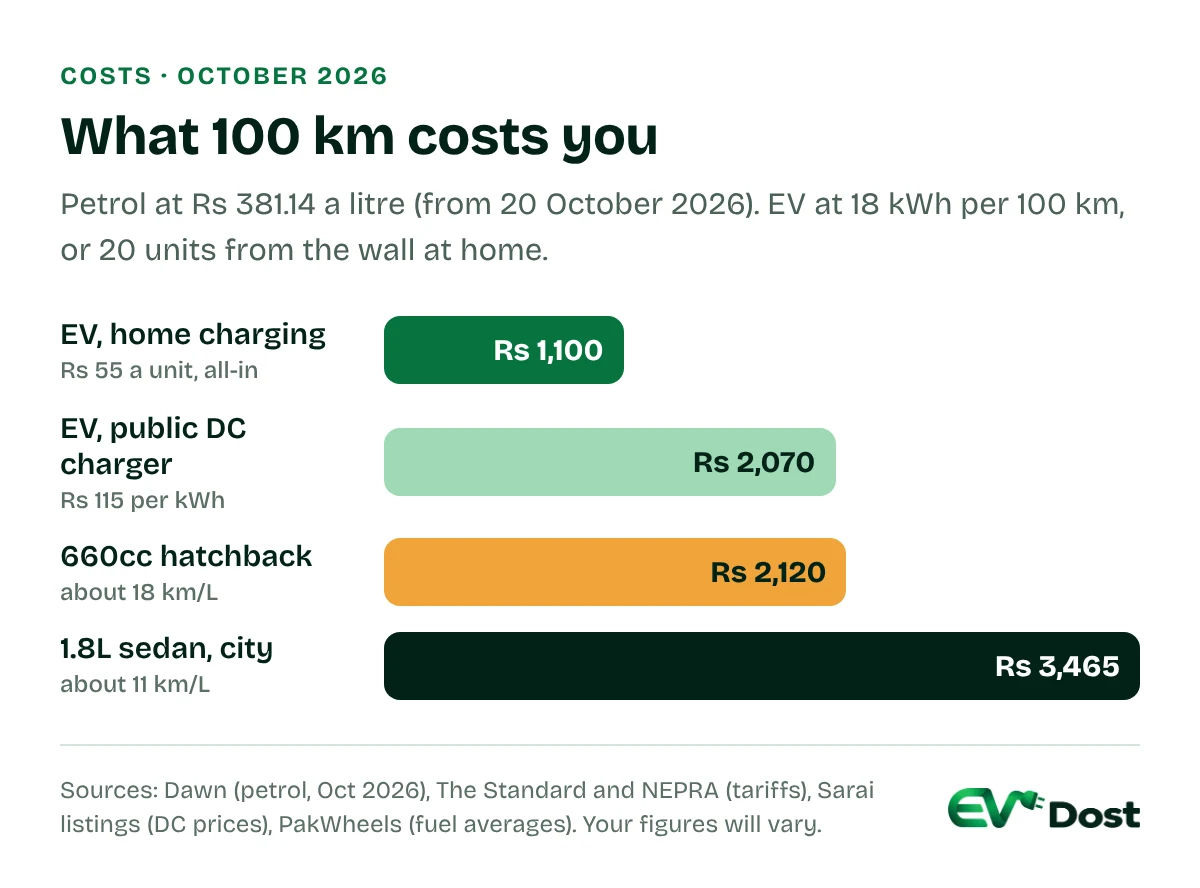
The table shows two things. First, an EV charged at home costs about half as much per kilometre as a small petrol car, and under a third of a 1.8L sedan. Second, an EV that only ever uses public fast chargers costs about the same per kilometre as a 660cc hatchback. The savings come from doing most of your charging away from fast chargers.
Charging at a host on EVDost
There's a middle option between your own garage and a motorway fast charger: someone else's charger, nearby.
On EVDost, hosts list their home and business chargers and set their own hourly price. You're billed in 10-minute blocks, so a 40-minute top-up costs four blocks, not a full hour. Because hosts set prices themselves, they vary, so you can sort by best price or nearest and see an estimated cost for your car before you go.
As an example, if a host with a 7 kW charger sets Rs 500 an hour, you'd get roughly 7 units an hour for about Rs 71 a unit. That's more than home charging and less than most fast chargers. You can compare hosts near you in the app.
What this means in a year
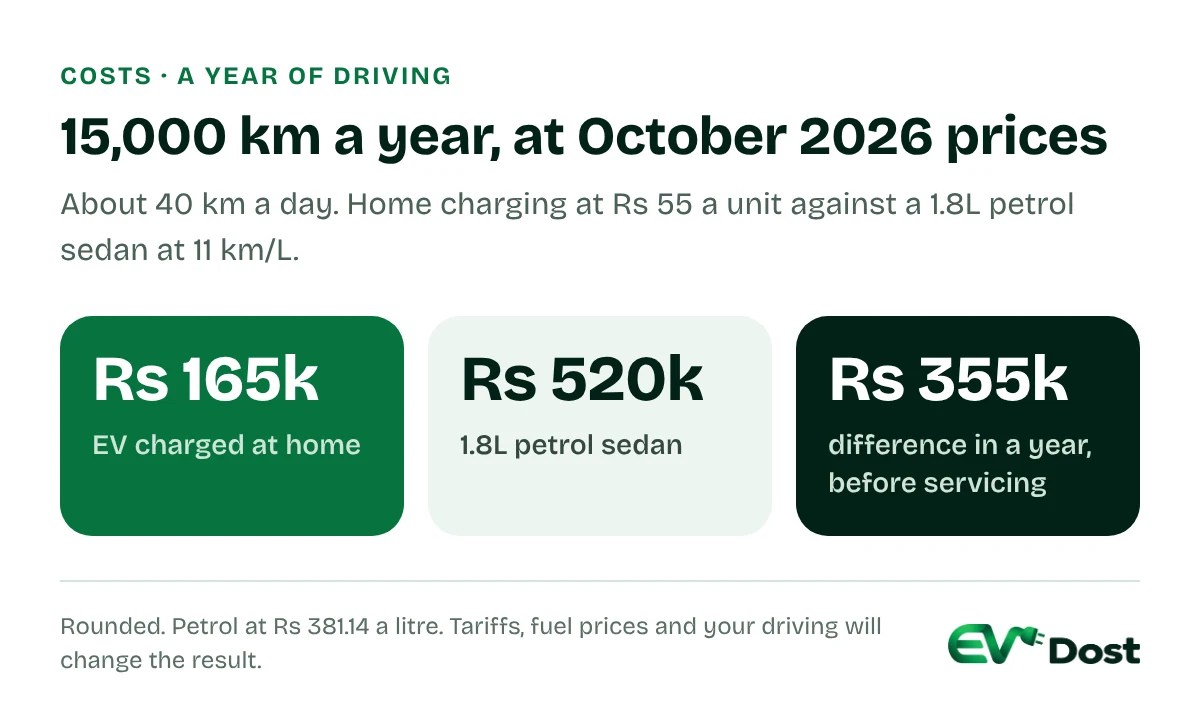
Say you drive 15,000 km a year, roughly 40 km a day.
- Charging at home at Rs 55 a unit: about Rs 165,000 a year.
- The same distance in a 1.8L petrol sedan at today's price: about Rs 520,000.
The difference is about Rs 355,000 a year, before any savings on oil changes and servicing. Your figure will depend on your tariff, your car and petrol prices, which as this year showed can move very quickly. For the full picture, including purchase price, see our five-year electric vs petrol comparison.
Quick tips to keep costs down
- Do most charging at home, overnight. If you're setting that up, read our home charger installation guide.
- Check your slab before and after you get the car, and consider a time-of-use meter if you qualify.
- No home charger? Our guide to charging an EV in an apartment covers the options.
- Use DC fast chargers on trips, not daily. Our EV road trip guide covers when they make sense.
- Keep tyres properly inflated and pre-cool the cabin while plugged in; both reduce consumption.
- If you have solar, charge from it on days the car is home. Our guide to charging your EV with solar explains why that's become a better deal in 2026.
Frequently asked questions
How much does it cost to fully charge an electric car in Pakistan?
At home, charging a 50 kWh battery from 10 to 90 percent takes about 44 units from the wall. At about Rs 55 a unit all-in, that's roughly Rs 2,400 as of October 2026. At a public DC charger at around Rs 115 per kWh, the same 40 kWh would cost about Rs 4,600.
Is charging an electric car cheaper than petrol in Pakistan?
Yes, if you charge mostly at home. At Rs 55 a unit, an EV costs about Rs 11 per km, against about Rs 21 for a 660cc hatchback and Rs 35 for a 1.8L sedan with petrol at Rs 381.14 a litre (from 20 October 2026). If you only use public fast chargers, the cost per km is about the same as a small petrol car.
What is NEPRA's tariff for EV charging stations?
In May 2025 NEPRA set a base tariff of Rs 23.57 a unit for EV charging stations, expected to come to about Rs 39.70 after taxes. Stations add their own margin, so drivers pay more: directory listings in 2026 show DC fast charging at roughly Rs 70 to Rs 200 per kWh, with about Rs 115 typical.
Will charging an EV at home push my bill into a higher slab?
It can. Driving 1,500 km a month adds roughly 300 units. On top of normal household use, that can move a home into a higher slab, and a protected customer (200 units a month or less) will almost certainly lose that status. Check your last few bills before you buy.
What is the cheapest time to charge an EV at home?
If your connection is on a time-of-use tariff (sanctioned load of 5 kW or more), charge after the evening peak ends, when units are cheaper. K-Electric's peak, for example, runs from 6:30 to 10:30 p.m. between April and October. Most EVs let you set a charging start time.
Sources
- Dawn, petrol price from 20 October 2026: dawn.com
- Daily Pakistan, petrol price from 16 January 2026: dailypakistan.com.pk
- NEPRA, residential tariff decision (January 2026): nepra.org.pk
- The Nation, 2026 base tariff (January 2026): nation.com.pk
- The News, NEPRA fixed charges for domestic consumers (February 2026): thenews.pk
- IESCO, tariff guide: iesco.com.pk
- The Standard, grid price range (February 2026): thestandard.com.pk
- K-Electric, tariff structure and peak hours: ke.com.pk
- Express Tribune, EV charging station tariff (May 2025): tribune.com.pk
- Sarai, public charger listings: saraicharge.com
- EV Database, BYD Atto 3: ev-database.org
- ADAC, MG4 Urban: adac.de
- PakWheels, fuel averages: fuel-efficient cars 2026, Corolla