Electric car vs petrol car in Pakistan: what you really pay over five years
The sticker price is the number everyone compares, and it's the one that misleads most. An electric car often costs more to buy than a petrol car of the same size, then costs far less to run. Whether it comes out ahead depends on how far you drive, where you charge, and how long you keep the car.
We've put an electric car and a petrol car side by side over five years, using October 2026 prices, so you can see the full cost rather than just the first one. We've shown every assumption, so you can swap in your own numbers.
The cars we compared
To keep it fair, we picked cars of similar size and price that buyers here weigh against each other:
| Car | Type | Price (Rs) | Fuel economy used |
|---|---|---|---|
| BYD Atto 3 | Electric | 8.99m | 20 units per 100 km from the wall |
| Toyota Corolla Cross 1.8 X | Petrol | 7.94m | about 13.5 km/L |
| Toyota Corolla Cross 1.8 HEV | Hybrid | 9.30m | about 17 km/L |
| MG4 EV Urban | Electric | 6.95m | 20 units per 100 km from the wall |
| Honda HR-V VTi-S | Petrol | 7.30m | about 12.5 km/L |
Prices are from ProPakistani (June 2026) for the Atto 3, Daily Pakistan (May 2026) for the MG4, and PakWheels for the Corolla Cross and HR-V (September 2026). Fuel averages are PakWheels' figures for the Corolla Cross and HR-V, averaging the city and highway numbers; they aren't lab tests, and your own will vary with traffic and driving style.
For the EVs, we use the same consumption figure as our other guides: 20 units from the wall per 100 km, which covers charging losses and is on the cautious side for these cars. Our EV charging cost guide explains where it comes from.
Fuel vs electricity: the biggest difference
Petrol has been anything but stable this year. It started 2026 at Rs 253.17 a litre and peaked at about Rs 458 in April (Pakistan Observer, June 2026). Since July, prices have been reset almost daily (Profit, July 2026). We use Rs 381.14 a litre, the price from 20 October 2026 (Dawn, October 2026), and home electricity at about Rs 55 a unit all-in.
At 15,000 km a year, about 40 km a day:
- Electric car, charged at home: about Rs 11 per km, or Rs 165,000 a year.
- Corolla Cross petrol: about Rs 28 per km, or Rs 423,000 a year.
- Corolla Cross hybrid: about Rs 22 per km, or Rs 336,000 a year.
- HR-V petrol: about Rs 30 per km, or Rs 457,000 a year.
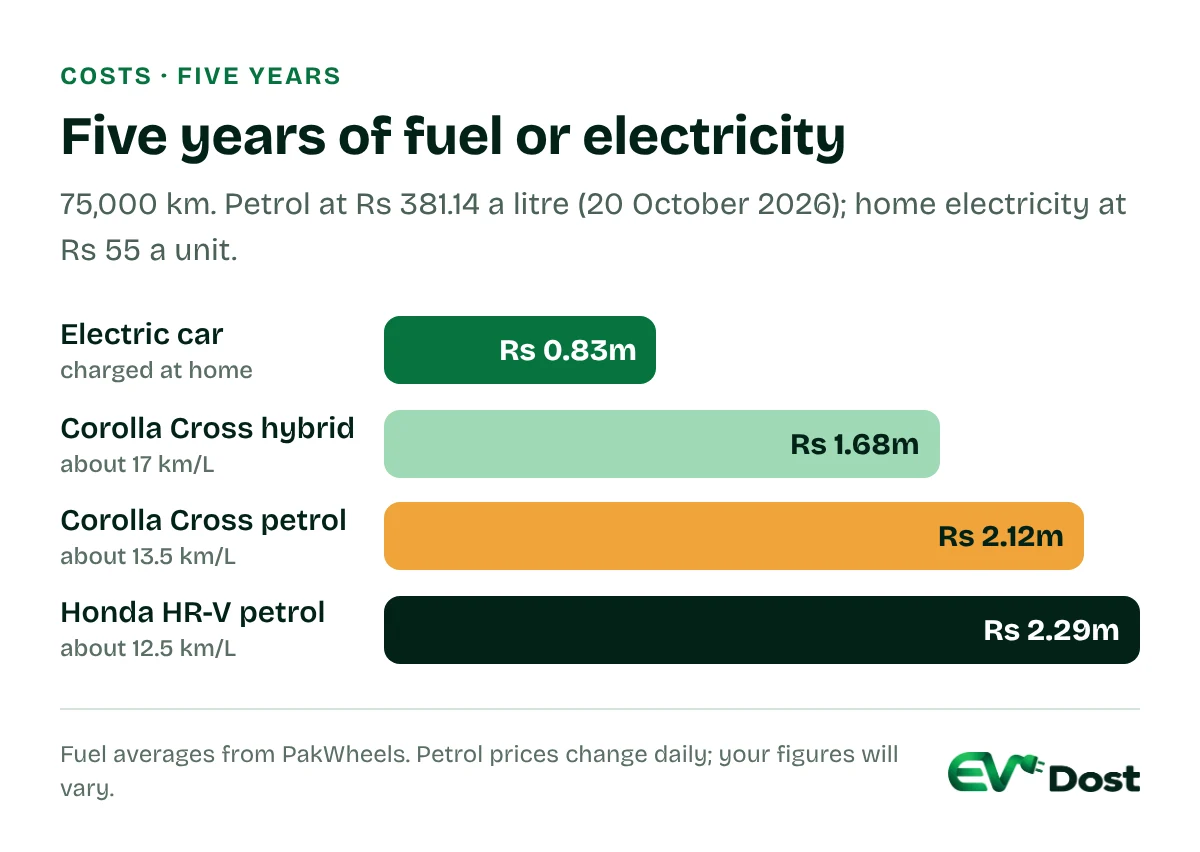
Over five years, that's roughly Rs 825,000 to run the EV against Rs 2.1 million for the petrol Corolla Cross. Even if a fifth of your driving uses public fast chargers at about Rs 115 per kWh, the EV's five-year bill only rises to about Rs 970,000.
Electric car vs petrol car: five-year cost in Pakistan
The table adds purchase price and fuel or electricity, with insurance as a separate line.
| Over 5 years (75,000 km) | Atto 3 (EV) | Corolla Cross petrol | Corolla Cross hybrid |
|---|---|---|---|
| Purchase price | Rs 8.99m | Rs 7.94m | Rs 9.30m |
| Fuel or electricity | Rs 0.83m | Rs 2.12m | Rs 1.68m |
| Subtotal | Rs 9.82m | Rs 10.05m | Rs 10.98m |
| Insurance at 2.5% of price a year | Rs 1.12m | Rs 0.99m | Rs 1.16m |
| Total | Rs 10.94m | Rs 11.04m | Rs 12.14m |
The insurance line is an assumption. One insurer's guide says most companies charge about 2 to 4 percent of the insured value a year (United Insurance, September 2025), and we've used 2.5 percent of the purchase price for every car. In practice premiums fall as the car's value drops, so this overstates all three a little.
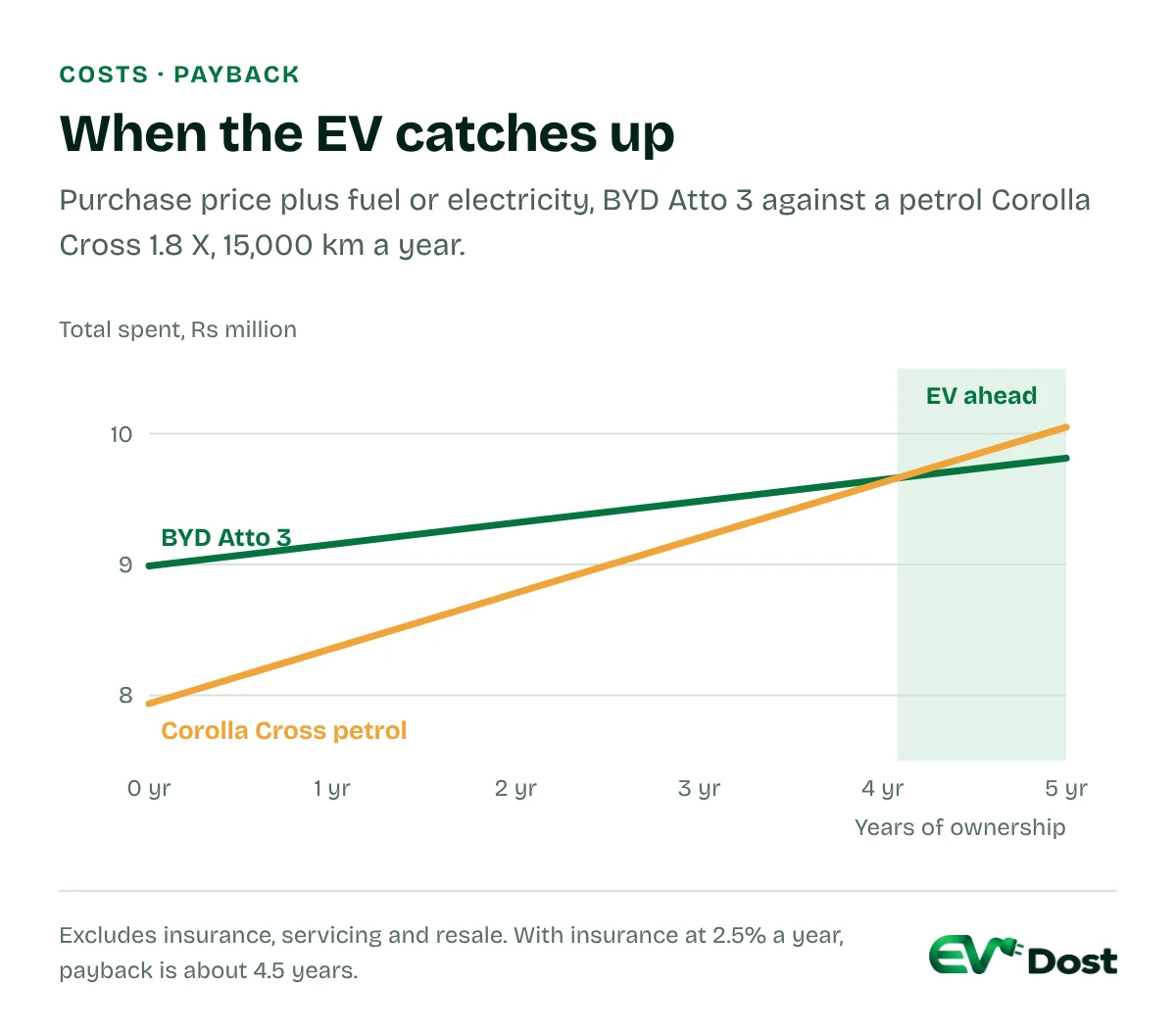
The Atto 3 costs about Rs 1.06 million more than the petrol Corolla Cross at the start, but saves about Rs 258,000 a year on fuel. At 15,000 km a year it catches up in a little over four years, or about four and a half once the higher insurance is counted. Drive more and it catches up sooner; drive less and it takes longer.
Against the hybrid, the EV is cheaper to buy as well as to run, so it's ahead from the first day.
The smaller pair is even clearer. The MG4 EV Urban costs less than a petrol HR-V VTi-S and about Rs 292,000 a year less to run, so over five years it comes out roughly Rs 1.8 million ahead before insurance, which also favours the cheaper car.
Servicing and repairs
Electric cars have far fewer parts that wear out: no engine oil, spark plugs, timing belt or exhaust, and regenerative braking eases the load on the brakes. A US Department of Energy analysis put scheduled maintenance at 6.1 US cents a mile for battery-electric cars against 10.1 cents for petrol cars (US DOE, June 2021), and Consumer Reports found EV owners spending about half as much on maintenance and repairs (Consumer Reports, September 2020).
We couldn't find published rupee service schedules for BYD or MG in Pakistan, so we haven't added a number to the table. Expect savings, but ask the dealer for the service costs for the first five years, and note that EV tyres can wear faster because the cars are heavy. Parts can be expensive: one MG ZS EV owner in Pakistan found them easy to get through MG's dealers but pricey (PakWheels, January 2023).
Tax and registration
Several taxes now favour electric cars:
- At purchase. The Finance Act 2026 kept the reduced 1 percent sales tax on locally assembled EVs (VATupdate, August 2026), and new combustion-engine cars pay a 1 to 3 percent New Energy Vehicle levy by engine size (The News). Both feed into the showroom prices you pay.
- Every year. Sindh charges EVs a Rs 1,000 registration fee and Rs 500 a year in motor vehicle tax until May 2028 (ProPakistani, September 2026). Punjab's IT board says the EV discount on annual token tax rose to 99 percent in 2026 (PITB, July 2026). Free registration for EVs in Islamabad has been proposed, but we couldn't confirm it's in force (PakWheels, May 2026).
The wider tax picture is in our NEV policy explainer.
The battery question
The worry people raise most is the battery. Both main brands give long battery warranties in Pakistan: BYD's Atto 2 flyer lists 8 years or 150,000 km for the battery (BYD Atto 2 flyer, January 2026), and the MG4 Urban's battery warranty is also reported at 8 years or 150,000 km (Gari.pk, May 2026). Our five-year comparison sits well inside both.
Real-world data is reassuring too. Geotab's study of more than 22,700 EVs found batteries lost about 2.3 percent of capacity a year on average (Geotab, April 2026). Our guide to EV battery care in Pakistan's heat covers how to keep that low.
What we can't tell you is resale value. There isn't enough Pakistani data yet to say how EVs hold their price against petrol cars, so we've left resale out of the sums. If you're buying second-hand, our guide to buying a used EV in Pakistan covers what to check.
When a petrol car still makes sense
An EV doesn't win every case.
- You drive very little. At 5,000 km a year, the fuel saving is a third as large and the higher price takes far longer to pay back.
- You can't charge at home or nearby. If every kilometre comes from public fast chargers, the running cost is about Rs 21 per km, not Rs 11, and the gap narrows a lot.
- You regularly drive far from chargers. Long trips north are easier in a petrol or plug-in hybrid car for now. Our PHEV vs EV guide covers the middle ground.
If home charging is the problem, look at what's near you before you decide. You can price your own running cost with real chargers near you on EVDost, which shows an estimate for the car you pick. Check your area.
Frequently asked questions
Is an electric car cheaper than a petrol car in Pakistan?
Over several years, usually yes, if you charge mostly at home. At October 2026 prices an EV costs about Rs 11 per km to run against Rs 28 to 30 for a comparable petrol SUV. A BYD Atto 3 costs about Rs 1.06 million more than a petrol Corolla Cross but catches up in a little over four years at 15,000 km a year.
How much can I save per year with an electric car in Pakistan?
An electric car charged at home saves roughly Rs 258,000 a year against a petrol Corolla Cross at 15,000 km a year, at October 2026 prices, Rs 171,000 against a Corolla Cross hybrid, and Rs 292,000 against a petrol Honda HR-V, with petrol at Rs 381.14 a litre and home electricity at Rs 55 a unit.
How long does it take for an EV to pay for itself in Pakistan?
It depends on the price gap and your mileage. In our example, the Atto 3 pays back its extra cost over a petrol Corolla Cross in about four to four and a half years at 15,000 km a year. Where the EV costs less to buy, such as the MG4 EV Urban against a petrol Honda HR-V, it's ahead from day one.
Is an electric car cheaper to maintain?
Yes, in general. A US Department of Energy analysis put scheduled maintenance at 6.1 cents a mile for EVs against 10.1 cents for petrol cars, because EVs have no oil changes, spark plugs or exhaust. Pakistani service costs aren't published yet, so ask the dealer.
Do electric cars pay less tax in Pakistan?
Yes, as of October 2026. Locally assembled EVs pay a reduced 1 percent sales tax, combustion-engine cars pay a 1 to 3 percent levy that EVs don't, and Sindh and Punjab give large discounts on registration and annual tax for EVs.
Sources
- ProPakistani, BYD prices after the budget (June 2026): propakistani.pk
- Daily Pakistan, MG prices (May 2026): dailypakistan.com.pk
- PakWheels, Corolla Cross price and fuel average: price, fuel average
- PakWheels, Honda HR-V price and fuel average: price, fuel average
- Pakistan Observer, petrol prices in 2026 (June 2026): pakobserver.net
- Profit, daily fuel pricing (July 2026): profit.pakistantoday.com.pk
- Dawn, petrol price from 20 October 2026: dawn.com
- United Insurance, car insurance rates (September 2025): theunitedinsurance.com
- US Department of Energy, EV maintenance costs (June 2021): energy.gov
- Consumer Reports, EV maintenance (September 2020): consumerreports.org
- PakWheels, MG ZS EV owner review (January 2023): pakwheels.com
- VATupdate, Finance Act 2026 (August 2026): vatupdate.com
- The News, NEV levy notified: thenews.com.pk
- ProPakistani, Sindh EV tax incentives (September 2026): propakistani.pk
- PITB, Punjab EV token tax (July 2026): pitb.gov.pk
- PakWheels, proposed NEV registration and toll exemptions (May 2026): pakwheels.com
- BYD Pakistan, Atto 2 flyer (January 2026): PDF
- Gari.pk, MG4 EV Urban launch (May 2026): gari.pk
- Geotab, EV battery health (April 2026): geotab.com