PHEV vs EV in Pakistan: plug-in hybrid or full electric?
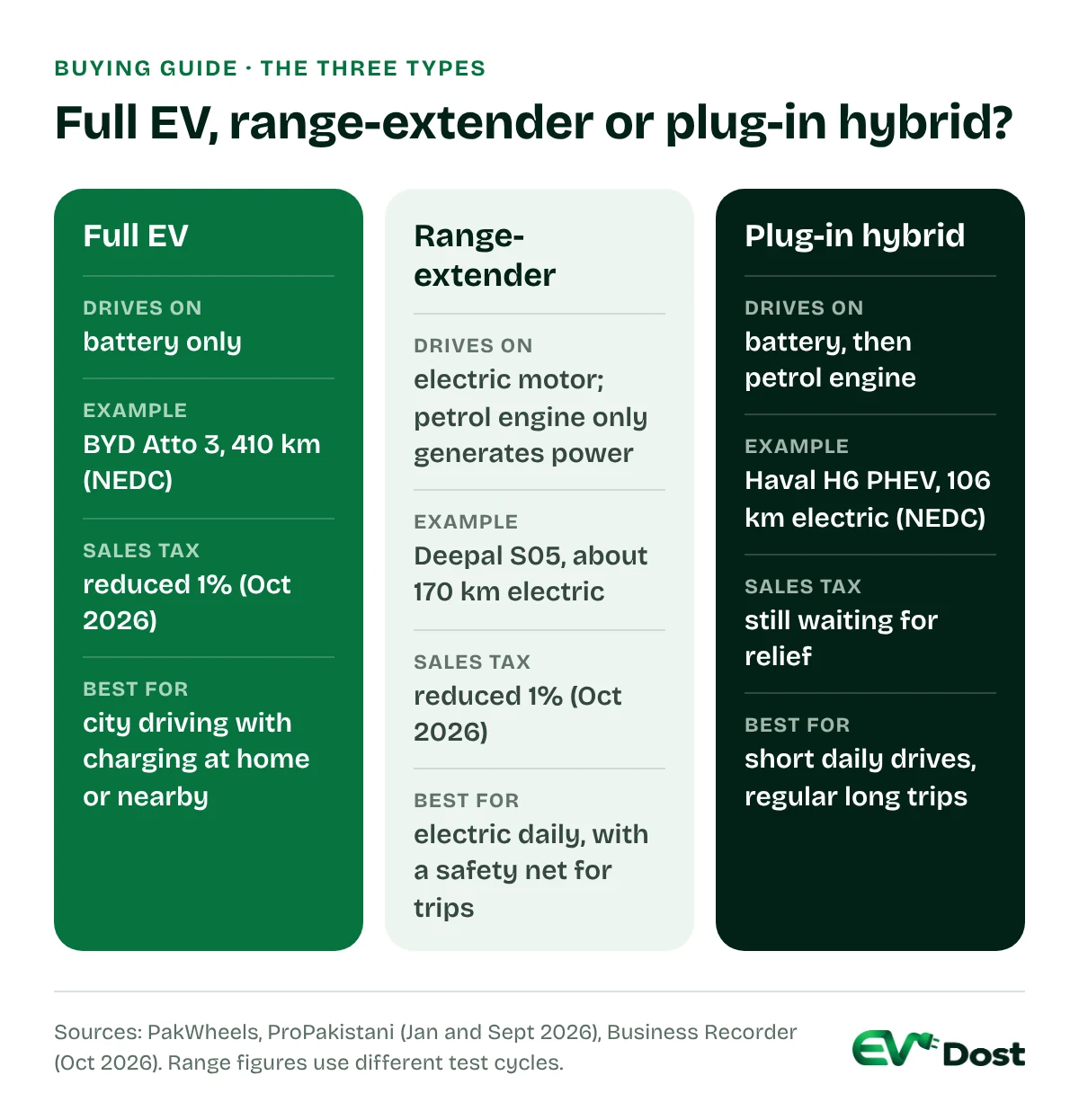
Walk into a car showroom in Pakistan in 2026 and you'll find plug-in cars in three flavours. Fully electric cars run only on a battery. Plug-in hybrids (PHEVs) have a battery you charge from the wall plus a petrol engine. Range-extenders (often called EREVs or REEVs) are driven by an electric motor, with a small petrol engine that only works as a generator when the battery runs low.
All three can cut your fuel bill. In the PHEV vs EV question, what decides it for most people in Pakistan is how they drive, not the spec sheet.
PHEV vs EV sales in Pakistan so far
Plug-in cars took off this year, helped along by the fuel price shock. Imports of plug-in hybrids and EVs from China rose roughly tenfold in the first half of 2026, according to Chinese customs data reported by APP (APP, August 2026). For the July to September quarter, Business Recorder's research team estimated around 6,000 battery-electric and range-extender cars sold, roughly half of them range-extenders, plus about 3,500 plug-in hybrids (Business Recorder, October 2026).
All three are selling in real numbers, so none of them is an odd choice.
The cars, side by side
A selection of plug-in cars on sale in Pakistan, with figures from 2026 reports:
| Car | Type | Price | Electric range |
|---|---|---|---|
| Honri VE | Full EV | Rs 3.6–4.4m | 200–300 km (CLTC), about 165–245 km WLTP |
| MG4 EV Urban | Full EV | Rs 6.95m | 316 km (WLTP) |
| BYD Atto 3 | Full EV | Rs 8.99m | 410 km (NEDC) |
| Deepal S05 | Range-extender | Rs 10.0m (Jan 2026 launch price) | about 170 km |
| Jaecoo J7 PHEV | Plug-in hybrid | Rs 10.5m | about 90 km |
| Haval H6 PHEV | Plug-in hybrid | Rs 10.85m | 106 km (NEDC) |
| BYD Shark 6 | Plug-in hybrid pickup | Rs 19.95m | about 85 km |
Sources: PakWheels on cars under Rs 60 lakh, PakWheels on the MG4 Urban, PakWheels on the Atto 3, ProPakistani on the Deepal S05, PakWheels PHEV guide, ProPakistani on the Haval H6 PHEV. Prices change often; check with dealers before you decide. Our guide to electric car prices in Pakistan lists more models.
A word on range figures: they come from different test cycles (WLTP, NEDC, China's more generous CLTC, or the maker's own claim), and real-world range in Pakistani summer heat with the AC on is usually lower. Treat them as a comparison, not a promise.
Start with your daily distance
Ask one question before anything else: how far do you drive on an ordinary day?
If it's under 60 or 70 km, a PHEV with 90 to 100 km of electric range can do almost all your weekday driving on electricity, as long as you charge it every night. You'd only use petrol on longer trips.
If it's 100 km or more, a PHEV will be running on petrol for part of most days. That's where a full EV or a range-extender pulls ahead.
Then ask: where will you charge?
A plug-in hybrid only saves money if you plug it in. Without regular charging, it's just a heavy petrol car carrying a battery around. Its fuel economy on petrol is often worse than a similar-sized hybrid's because of that extra weight.
A full EV needs reliable charging even more. If you can charge at home or at work, ownership is easy. If you can't, you'll need a charger nearby you can count on. Public charging in Pakistan is still thin. In June 2026, officials told a National Assembly committee that just over 100 charging stations had been licensed across the whole country (APP, June 2026).
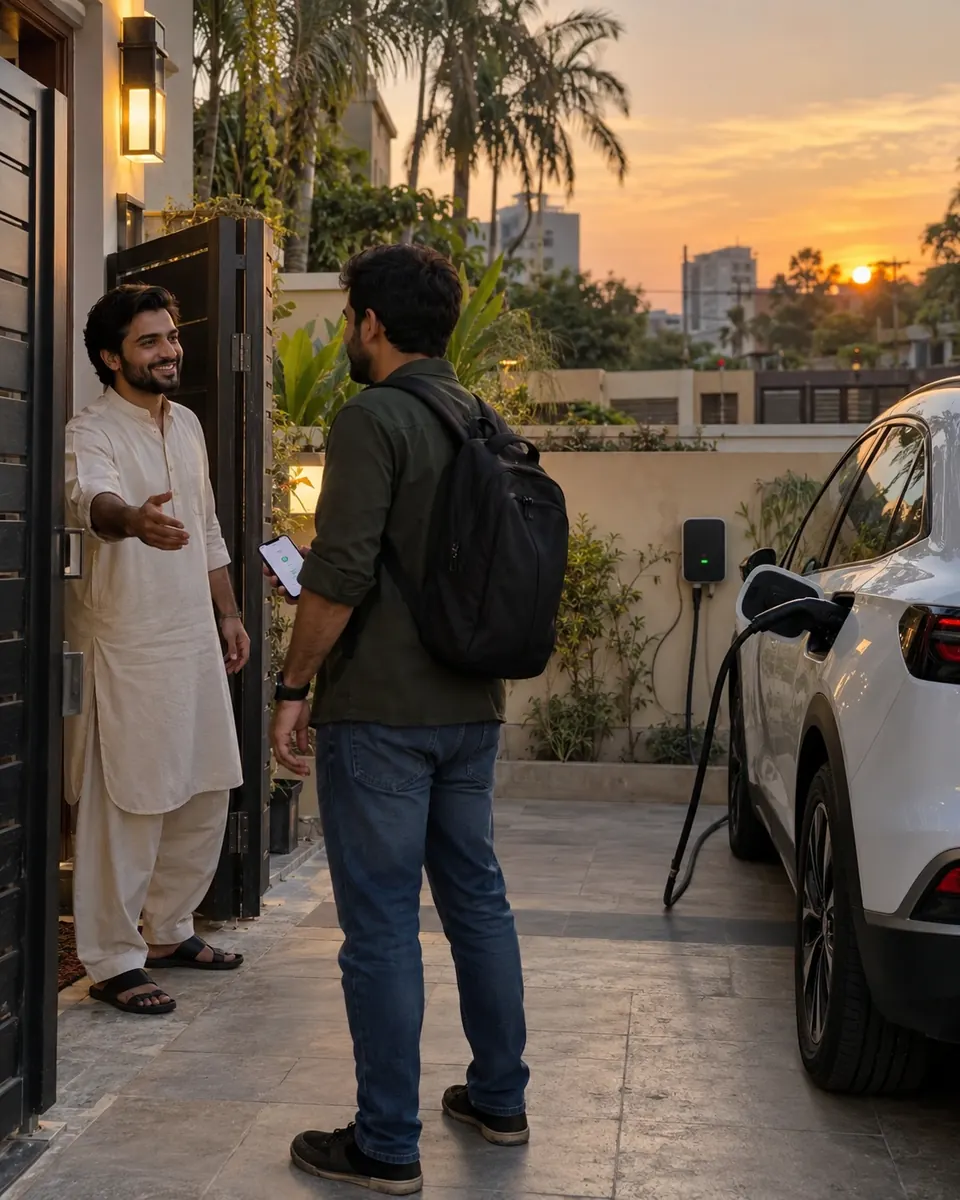
If you don't have a charger where you sleep, look at what's around your office or your parents' place. On EVDost, hosts nearby share their wallboxes at a price they set, which can turn an EV from impractical into easy. Our guide to EV charging stations in Pakistan covers the public options too.
Long trips and the north
Here PHEVs and range-extenders have a clear advantage today. A drive to Swat, Hunza or interior Sindh can take you far from any fast charger, and a petrol engine removes that worry completely.
A full EV handles the M-2 between Lahore and Islamabad comfortably thanks to new fast chargers there (ProPakistani, July 2026), but trips further afield need careful planning. We cover how in planning an EV road trip in Pakistan.
Think about how often you really make those trips. If it's twice a year, it may be cheaper to own a full EV and borrow or rent a petrol car for those two trips than to carry an engine around every day.
Running costs
On electricity, all three types cost about the same per kilometre. At a typical all-in home rate of around Rs 55 a unit, that's roughly Rs 9 to 11 per km for a compact car (we show the maths in how much it costs to charge an EV).
On petrol, things change. A heavy plug-in SUV that averages, say, 14 km/L in hybrid mode costs about Rs 27 per km at October's price of Rs 381.14 a litre (Dawn, October 2026). So the share of your driving done on electricity decides how much you save.
A worked example
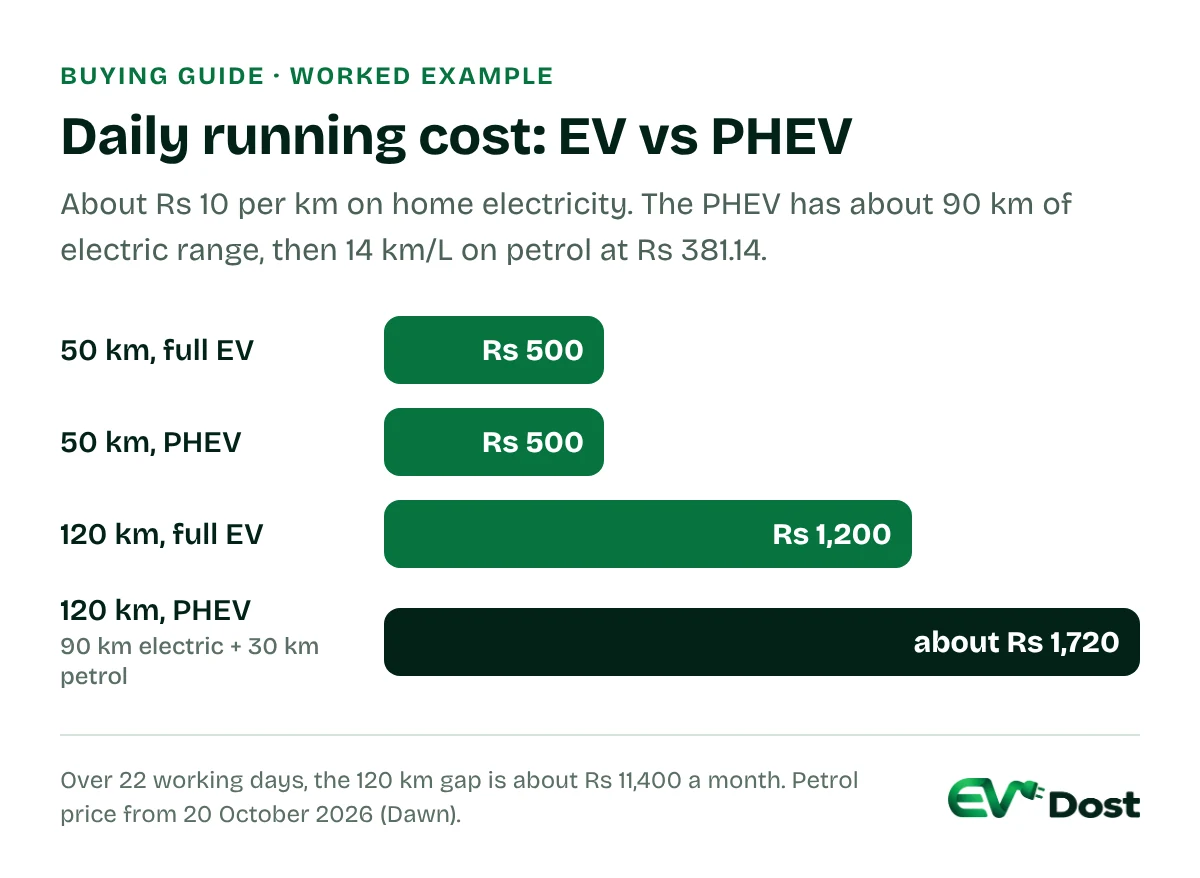
Take two commuters, each comparing a PHEV with about 90 km of electric range against a full EV, and assume about Rs 10 per km on home electricity.
The first drives 50 km a day. The PHEV covers all of it on electricity, so on weekdays both cars cost about Rs 500 a day to run. The PHEV only burns petrol on long trips.
The second drives 120 km a day. The full EV costs about Rs 1,200 a day. The PHEV does 90 km on electricity (about Rs 900) and the last 30 km on petrol (about Rs 820 at 14 km/L), roughly Rs 1,720 in total. Over 22 working days, that gap comes to around Rs 11,400 a month.
Maintenance also differs. A full EV has no engine oil, spark plugs, timing belts or exhaust. PHEVs and range-extenders still have an engine that needs servicing, even if it runs less often.
Tax
Tax currently favours full EVs and range-extenders, a point covered in our explainer on the NEV Policy 2025–30. Eligible battery-electric cars and range-extenders keep a reduced 1 percent sales tax for another year, while plug-in hybrid buyers are still waiting for similar relief (Business Recorder, October 2026). Tax rules have been changing quickly in 2026, so check what applies on the day you buy.
So which one?
A full EV makes the most sense if you drive mostly in and around one city, you can charge at home or nearby, and long trips off the main motorways are rare.
Pick a range-extender if you want to drive electric almost all the time but need a safety net for long trips, and you'd rather the car always be driven by its electric motor.
A plug-in hybrid fits if your daily driving fits within its electric range, you'll charge it every night, and you regularly take long trips where charging is scarce.
None of them is right if you have no way to charge at all. A conventional hybrid may serve you better until charging reaches your area. Before you decide that, though, check the app for hosts near your home and work.
Frequently asked questions
Is a plug-in hybrid or an electric car better in Pakistan?
A full EV is usually better if you drive 100 km or more a day; a plug-in hybrid suits shorter daily drives. If you drive under 60 to 70 km a day and charge every night, a PHEV can run almost entirely on electricity. If you drive 100 km or more a day, a full EV or range-extender usually costs less to run.
Does a plug-in hybrid need to be charged?
To save money, yes. A PHEV that isn't plugged in runs on petrol while carrying a heavy battery, and its fuel economy is often worse than a similar-sized conventional hybrid's.
What is a range-extender electric car?
A range-extender (EREV or REEV) is always driven by its electric motor. It has a small petrol engine that only works as a generator when the battery runs low. The Deepal S05, assembled in Pakistan, is one example.
Do plug-in hybrids get the same tax break as EVs in Pakistan?
Not as of October 2026. Eligible battery-electric cars and range-extenders keep a reduced 1 percent sales tax for another year, while plug-in hybrid buyers are still waiting for similar relief, according to Business Recorder.
How much does a PHEV cost to run on petrol?
A heavy plug-in SUV averaging about 14 km/L in hybrid mode costs roughly Rs 27 per km with petrol at Rs 381.14 a litre (from 20 October 2026), against about Rs 9 to 11 per km on home electricity.
Sources
- APP, plug-in imports from China (August 2026): app.com.pk
- Business Recorder, Q1 FY27 sales estimates and sales tax (October 2026): brecorder.com
- PakWheels, EVs under Rs 60 lakh (September 2026): pakwheels.com
- PakWheels, MG4 EV Urban launch (May 2026): pakwheels.com
- PakWheels, BYD Atto 3 Advance: pakwheels.com
- ProPakistani, Deepal S05 (January 2026): propakistani.pk
- PakWheels, plug-in hybrid guide (April 2026): pakwheels.com
- ProPakistani, Haval H6 PHEV (September 2026): propakistani.pk
- APP, licensed charging stations (June 2026): app.com.pk
- ProPakistani, M-2 fast chargers (July 2026): propakistani.pk
- Dawn, petrol price (October 2026): dawn.com