Pakistan's NEV Policy 2025–30, explained for car buyers
Pakistan's New Energy Vehicle (NEV) Policy 2025–30 was launched in June 2025, and a lot of what's written about it mixes up three different things: what the policy promised, what was only in an early draft, and what has actually happened since. If you're deciding whether to buy an electric car, the difference matters.
This summary of the NEV policy in Pakistan is current to October 2026.
The headline target
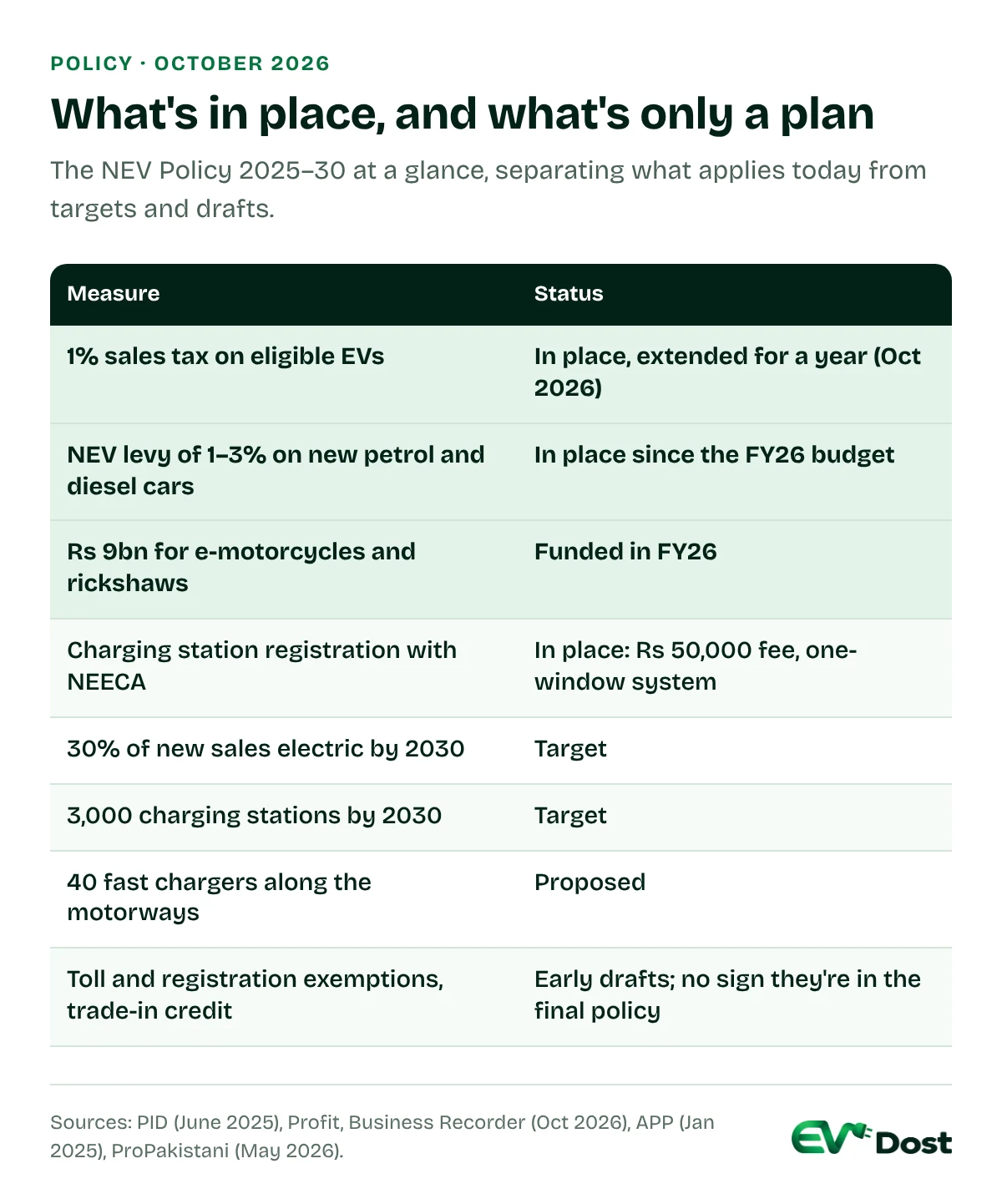
The policy aims for 30 percent of new vehicle sales to be electric by 2030. It was announced by Haroon Akhtar Khan, the Prime Minister's Special Assistant on Industries and Production, on 19 June 2025 (PID, June 2025).
The government's stated reasons were saving fuel imports and cutting emissions. It estimated savings of about 2.07 billion litres of fuel a year, worth roughly $1 billion, and a cut of 4.5 million tonnes of CO2.
Where the early money went: bikes and rickshaws
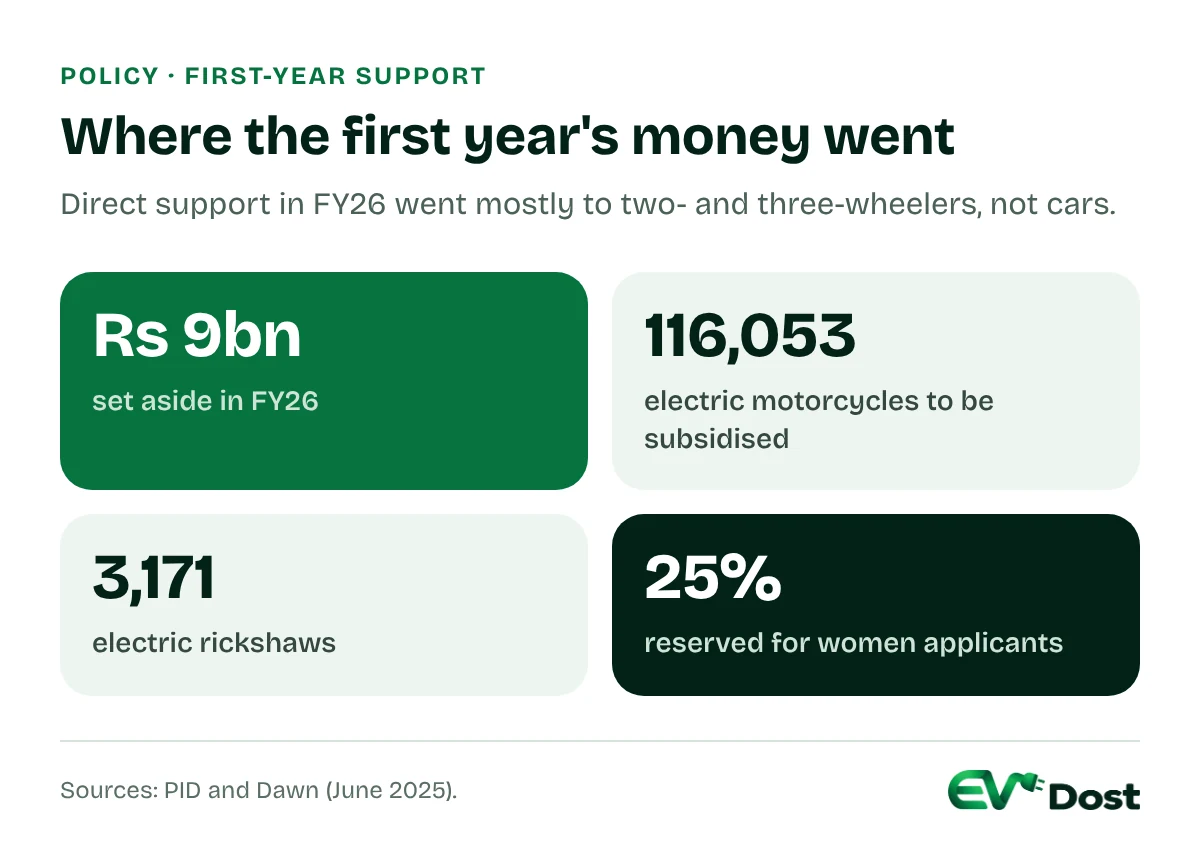
Most of the first year's direct support went to two- and three-wheelers, not cars. The policy set aside Rs 9 billion in FY26 to subsidise about 116,053 electric motorcycles and 3,171 electric rickshaws, with 25 percent reserved for women, through an online application system (PID; Dawn, June 2025).
That makes sense for Pakistan. Motorcycles carry far more people than cars here, and over 90 percent of electric two- and three-wheeler parts were said to be made locally already. If you're weighing up an electric bike, our guide to electric bike charging costs does the sums.
It also made a difference when petrol spiked in 2026. Demand for electric motorcycles jumped sharply, with an executive at one maker saying monthly demand had nearly doubled, to about 29,600 units (Business Recorder, April 2026). By October, ProPakistani, citing Bloomberg, reported that electric motorcycle and scooter sales had tripled from a year earlier and electric car sales had doubled, while petrol was up 54 percent since the Middle East war began in February (ProPakistani, October 2026).
A levy on petrol and diesel cars
To help pay for the transition, the FY26 budget introduced a New Energy Vehicle levy on new petrol and diesel cars: 1 percent under 1300cc, 2 percent from 1300 to 1800cc, and 3 percent above 1800cc (Profit).
Sales tax on EVs
For electric car buyers, the most important tax in the short term is sales tax. Eligible battery-electric cars and range-extender EVs continue to attract a reduced 1 percent sales tax for another year, according to Business Recorder in October 2026. Hybrids are taxed more heavily, and plug-in hybrid buyers are still waiting for relief (Business Recorder, October 2026).
Import duties on fully built EVs changed in the 2026–27 budget, but reports of the final rates differ, and the figures in the proposal and those reported after the budget passed don't match (ProPakistani, June 2026; The News, June 2026). If you're importing a car yourself, check the current Finance Act and customs schedule rather than any summary, including this one.
What the NEV policy says about charging
Charging is where the plans are most ambitious:
- A national target of 3,000 charging stations by 2030, with 240 planned in FY26 (Arab News, January 2026).
- Motorway chargers, initially described as 40 stations about 105 km apart (PID), later proposed as 40 Level 3 fast-charging stations along the motorways, about 120 km apart (ProPakistani, May 2026).
- EV charging points in new building codes, battery swapping and vehicle-to-grid technology, all mentioned in the launch.
- Petrol stations in Islamabad: all new ones must install EV charging, according to a June 2026 report (APP, June 2026).
Charging also got a big price cut. In May 2025, NEPRA approved a rate of Rs 23.57 per kWh plus a market-set margin for charging EVs at stations, with the effective rate after taxes expected to fall to about Rs 39.70 per kWh from Rs 71.10 (Express Tribune, May 2025).
Registering a charging station
NEECA's charging and battery-swapping regulations had been notified in the official gazette by January 2025. They set up an online one-window system and a registration fee of Rs 50,000 (APP, January 2025), with licences issued within 15 days of a complete application (ProPakistani, July 2025). If you're a business thinking about public charging, that's the route to look at. If you just want to share a home wallbox, read our guide to earning from your EV charger, which covers the questions to ask first.
How far along is it?
Not very far yet. Briefings in mid-2026 put the figure at "more than 72" licences issued for charging stations (Arab News, July 2026) or "more than 100" stations licensed (APP, June 2026), depending on the meeting. NEECA has said 363 chargers are installed across the 12 distribution companies (NEECA presentation, 2026). Either way, it's a long way from 3,000.
That gap is a big part of why EVDost exists. Many chargers already sit in homes, offices and hotels across Pakistan, and letting their owners share them with nearby drivers adds capacity without waiting for new stations. Our guide to EV charging stations in Pakistan covers what's available publicly, and you can find a host near you in the app.
Draft ideas you may have read about
Early drafts of the policy, reported in the press, included ideas such as toll and registration fee exemptions for EVs, a 20 percent trade-in credit, interest-free loans for government employees, and a requirement for fast chargers at 10 percent of fuel stations (Profit). There's no sign yet that these made it into the final policy, so don't count on them when you budget for a car.
What about the new auto policy?
The 2021–26 auto policy expired on 30 June 2026 (Arab News, August 2026). A new 2026–31 policy has been in the works, with disagreement over how fast to cut import tariffs (Express Tribune, August 2026). In October 2026, it was reported to be close to reaching the cabinet, with EV tax incentives under consideration (ProPakistani, October 2026). We'll update this post when it's approved.
What it means if you're buying now
- The low sales tax on EVs is the main tax advantage in place today. It was extended for a year, so it's worth checking whether it still applies when you buy.
- Don't plan around incentives that were only in drafts. For current prices, see our list of electric car prices in Pakistan.
- Public charging is growing but still thin. Home charging, or regular access to a charger nearby, is what makes EV ownership easy right now. Our home charger installation guide covers the practical side.
- Running costs are where EVs win most clearly. See how much it costs to charge an EV in Pakistan.
- Choosing between a plug-in hybrid and a full EV? Tax treatment is one of the differences; our PHEV vs EV guide covers the rest.
Frequently asked questions
What is Pakistan's NEV policy?
The New Energy Vehicle Policy 2025–30, launched in June 2025, aims for 30 percent of new vehicle sales to be electric by 2030. It funded subsidies for electric motorcycles and rickshaws and set a target of 3,000 charging stations by 2030. The FY26 budget added a levy on new petrol and diesel cars to help pay for the transition.
How much tax do electric cars pay in Pakistan?
Eligible battery-electric and range-extender cars pay a reduced 1 percent sales tax, extended for another year according to Business Recorder in October 2026. Import duties on fully built EVs changed in the 2026–27 budget and reports of the final rates differ, so check the current Finance Act and customs schedule.
What is the NEV levy in Pakistan?
A levy introduced in the FY26 budget on new petrol and diesel cars: 1 percent under 1300cc, 2 percent from 1300 to 1800cc, and 3 percent above 1800cc. It helps fund the shift to electric vehicles.
Is there a government subsidy for electric cars in Pakistan?
Not a direct one so far. The first year's subsidies went to electric motorcycles and rickshaws. Ideas such as toll and registration exemptions and a trade-in credit appeared in early drafts but there's no sign they made it into the final policy.
How do I register an EV charging station in Pakistan?
Through NEECA's online one-window system, set up under charging regulations notified by January 2025. The registration fee is Rs 50,000, and NEECA is given 15 working days to check that an application is complete.
Sources
- PID, NEV Policy launch (June 2025): pid.gov.pk
- Dawn, NEV policy subsidies (June 2025): dawn.com
- Business Recorder, electric motorcycle demand (April 2026): brecorder.com
- Profit, NEV levy: profit.pakistantoday.com.pk
- Business Recorder, EV and hybrid sales tax (October 2026): brecorder.com
- ProPakistani, EV import duty proposal (June 2026): propakistani.pk
- The News, budget 2026–27 as passed (June 2026): thenews.pk
- Arab News, 3,000-station target (January 2026): arabnews.pk
- ProPakistani, proposed motorway charging stations (May 2026): propakistani.pk
- APP, licences and Islamabad fuel stations (June 2026): app.com.pk
- APP, NEECA charging regulations and station tariff (January 2025): app.com.pk
- ProPakistani, charging station licensing (July 2025): propakistani.pk
- Express Tribune, charging station tariff (May 2025): tribune.com.pk
- Arab News, licensed stations (July 2026): arabnews.pk
- NEECA, presentation on EV charging (2026): saarcenergy.org
- Profit, draft NEV policy: profit.pakistantoday.com.pk
- Arab News, auto policy status (August 2026): arabnews.pk
- Express Tribune, auto policy tariff dispute (August 2026): tribune.com.pk
- ProPakistani, auto policy update (October 2026): propakistani.pk