Electric bikes in Pakistan: charging cost, charging time and battery care
Pakistan's electric vehicle boom is happening on two wheels first. When petrol shot up this year, monthly demand for electric motorcycles nearly doubled, according to an executive at the maker Evee (Business Recorder, April 2026), and Punjab's student e-bike scheme drew more than a million registrations for 100,000 bikes (ProPakistani, October 2026).
The first thing most riders want to know is simple: what does electric bike charging cost in Pakistan, compared with filling up a 70cc? Very little, as long as you pick the right battery and look after it.
Electric bike charging cost in Pakistan, worked out
An electric bike's battery is small. Most popular models hold between about 1.2 and 2.3 kWh, roughly one to two units of electricity. A car battery, by comparison, holds 40 to 60 units.
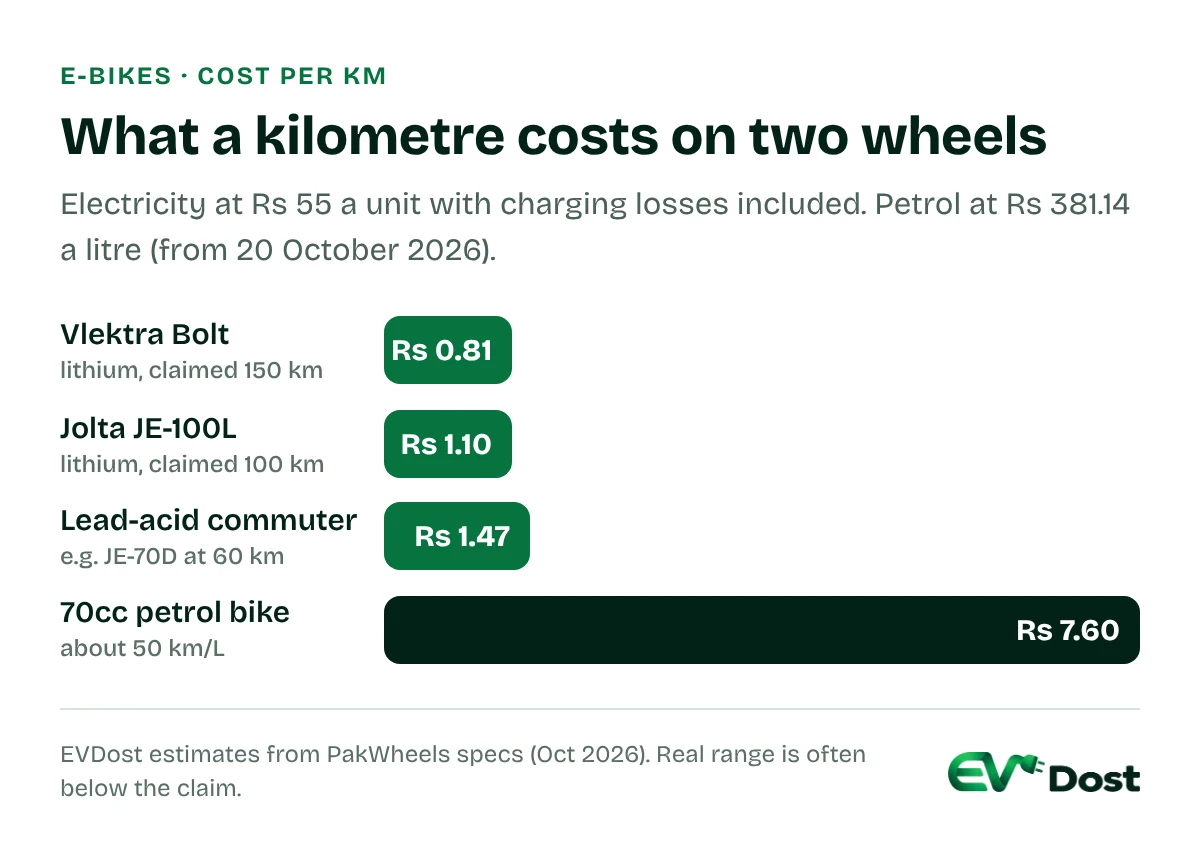
Some energy is lost while charging. Lead-acid batteries, including the ones sold as "graphene", lose more than lithium ones; a PakWheels explainer puts their charging efficiency at about 70 to 80 percent (PakWheels, March 2025). For the examples below we assume about 75 percent for lead-acid and 90 percent for lithium, and electricity at about Rs 55 a unit all-in, the figure we use across our guides.
| Bike (PakWheels listing, Oct 2026) | Battery | Units from the wall | Full charge | Per km |
|---|---|---|---|---|
| Jolta JE-70D, Rs 149,900 | 1.2 kWh lead-acid type | about 1.6 | about Rs 88 | Rs 1.10 (claimed 80 km), Rs 1.47 (60 km) |
| Jolta JE-100L, Rs 239,900 | 1.8 kWh lithium (LFP) | about 2.0 | about Rs 110 | Rs 1.10 (claimed 100 km) |
| Metro T9 Pro, Rs 279,000 | 2.3 kWh "graphene" | about 3.1 | about Rs 169 | Rs 1.20 (claimed 140 km) |
| Vlektra Bolt, Rs 549,000 | 2.0 kWh lithium (LFP) | about 2.2 | about Rs 122 | Rs 0.81 (claimed 150 km) |
Specs and prices are from PakWheels model pages (JE-70D, JE-100L, T9 Pro, Bolt), which disagree with themselves in a few places, so check with the dealer. Claimed ranges are optimistic. A Daily Pakistan round-up of practical ranges in August 2026 gave about 50 to 65 km for the JE-70D, well below its claimed 80 km (Daily Pakistan, August 2026).
So a sensible planning figure is about Rs 1 to 1.5 per km (a little less for efficient lithium bikes), and Rs 90 to 170 for a full charge.
Against a 70cc petrol bike
Honda advertises 70 km a litre for the CD 70, but PakWheels reckons a well-kept bike with one rider gets about 50 to 53 km/L in real life (PakWheels, May 2026). With petrol at Rs 381.14 a litre from 20 October 2026 (Dawn, October 2026), 50 km/L works out to about Rs 7.60 per km.
Say you ride 40 km a day, about 1,200 km a month:
- Electric, at Rs 1.50 a km: about Rs 1,800 a month.
- 70cc petrol, at 50 km/L: about Rs 9,150 a month.
That's a difference of roughly Rs 7,300 a month, before the savings on oil changes. The gap shrinks if petrol falls, and petrol prices moved almost daily this October.
Will it raise my electricity bill?
A little. Riding 40 km a day adds roughly 20 to 35 units a month, depending on the bike and its battery. That's small next to an air conditioner, but if your home sits just under a slab boundary, those extra units can move you into the next slab or end protected status, which applies at 200 units a month or less. Look at your last few bills before you assume it's free. Our guide to EV charging costs explains how slabs work.
How long does an electric bike take to charge?
It depends mostly on the battery chemistry and the charger that comes with the bike.
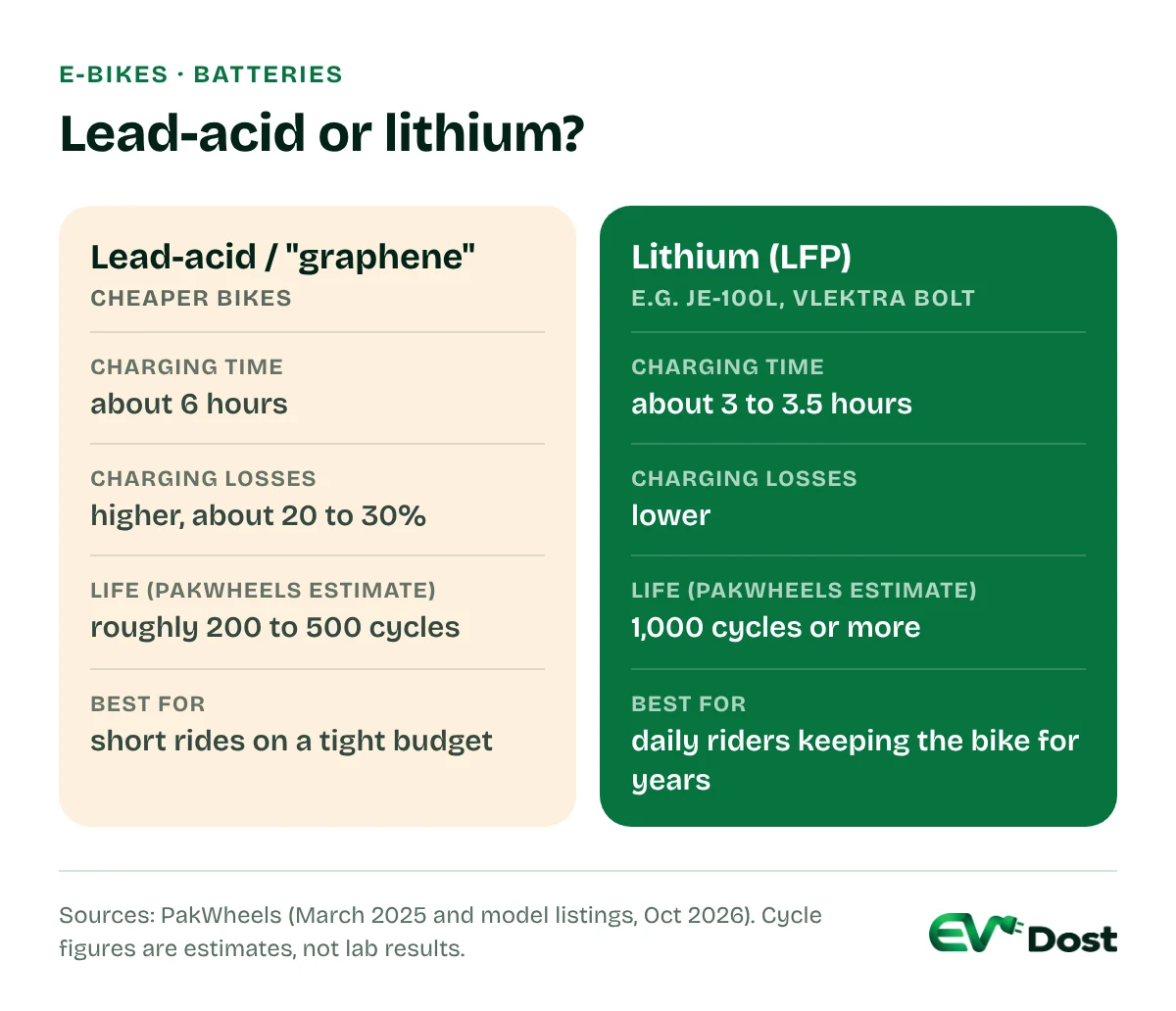
- Lead-acid and "graphene" batteries typically take about 6 hours, as listed for the Jolta JE-70D and the Metro T9 Pro.
- Lithium batteries are faster, about 3 to 3.5 hours on the JE-100L and the Vlektra Bolt.
Most riders simply plug in overnight. A normal 3-pin socket is enough, since these chargers draw a few hundred watts, but use the charger that came with the bike rather than a cheap replacement, and plug straight into a wall socket, not a long extension board.
Lead-acid, "graphene" or lithium?
This is the decision that matters most, and the labels are confusing.
Many cheaper scooters are sold with "graphene" batteries. PakWheels argues these are essentially lead-acid batteries with a graphene additive, and estimates their life at roughly 200 to 500 charge cycles, with a noticeable loss of capacity within the first year, against 1,000 cycles or more for lithium (PakWheels, March 2025). Those are one outlet's estimates rather than lab results, but they match what riders commonly report: lead-acid packs are cheaper up front and need replacing much sooner.
Lithium iron phosphate (LFP), found on bikes like the JE-100L and the Bolt, costs more at the start but charges faster, weighs less and lasts longer. If you ride every day and plan to keep the bike for years, lithium usually works out cheaper per kilometre over its life. If budget is tight and your ride is short, lead-acid will do the job, as long as you budget for a replacement.
Battery care that pays off
For lead-acid batteries, recharge after each day's riding rather than running the battery down over several days. Lead-acid batteries left partly discharged build up sulphate on their plates, which slowly reduces capacity (Battery University). If the bike will sit unused for weeks, keep it charged.
For every battery, heat is the enemy. Battery University notes that high temperatures shorten battery life and advises against charging lead-acid batteries above about 49°C (Battery University). A bike parked in direct sun in Multan in June can get hot, so charge it in the shade or indoors, and let it cool for a while after a long ride before plugging in. The same logic applies to car batteries; our guide to EV battery care in Pakistan's heat goes into more detail.
Load-shedding is less of a problem for bikes than for cars. A charge of about 6 hours usually fits around an evening outage, and a home inverter can often carry a bike charger's few hundred watts. Our guide to charging during load-shedding covers timing.
E-bike schemes in 2026
Two schemes have been in the news.
Punjab's student e-bike scheme opened applications in September 2026 for 100,000 bikes for students in Punjab. According to ProPakistani, the bike is priced at Rs 199,000, of which the student pays Rs 109,000 in 36 monthly instalments of about Rs 3,028 (ProPakistani, September 2026). Registration closed on 4 October, and distribution was due to start in early November (ProPakistani, October 2026).
The federal scheme under the NEV policy offers a fixed Rs 80,000 subsidy per e-bike, paid to manufacturers, under rules the ECC approved in May 2026 (ProPakistani, May 2026). Uptake has been slow: banks approved only about 9 percent of loan applications under the earlier phase (TechJuice, May 2026). We couldn't find a clear update on deliveries after June, so check the official portal before you count on it. The wider rules are in our NEV policy explainer.
Battery swapping
Swapping a flat battery for a charged one takes a minute instead of hours, which suits delivery riders. It's still small in Pakistan. Faisalabad launched a public-sector swapping pilot in August 2026 with two cabinets and a subscription app, aiming for 50 cabinets in the city by December (Express Tribune, August 2026). In Lahore, Zyp Technologies raised funding in 2024 to build swap stations for its bikes (ProPakistani, July 2024). If you ride for a living in one of those cities, it's worth a look. And if your household also has an electric car, EVDost shows car chargers near you with a cost estimate for your model: find one here.
Frequently asked questions
How much does it cost to charge an electric bike in Pakistan?
At about Rs 55 a unit, a full charge costs roughly Rs 90 to 170 for popular models with 1.2 to 2.3 kWh batteries, as of October 2026. That works out to about Rs 1 to 1.5 per km, against about Rs 7.60 per km for a 70cc petrol bike at 50 km/L with petrol at Rs 381.14.
How many units does an electric bike use?
A full charge takes roughly 1.6 to 3.1 units from the wall for common models, including charging losses. Riding 40 km a day for a month typically adds about 20 to 35 units to your bill, depending on the bike.
How long does it take to charge an electric bike?
An electric bike in Pakistan takes about 6 hours to charge on a lead-acid or "graphene" battery and about 3 to 3.5 hours on lithium, based on PakWheels listings in October 2026. Most riders charge overnight from a normal socket.
Are graphene batteries better than lithium?
Usually not. PakWheels argues that "graphene" scooter batteries are essentially lead-acid with an additive, lasting roughly 200 to 500 cycles against 1,000 or more for lithium. They cost less up front but typically need replacing sooner.
Can I charge an electric bike on a UPS or inverter?
Often, yes. A bike charger draws only a few hundred watts, which most home inverters can carry alongside light household use. The limit is how much your inverter's batteries can spare during an outage.
Sources
- Business Recorder, electric motorcycle demand (April 2026): brecorder.com
- ProPakistani, Punjab e-bike scheme (September and October 2026): applications open, distribution date
- PakWheels, model listings (October 2026): Jolta JE-70D, Jolta JE-100L, Metro T9 Pro, Vlektra Bolt
- PakWheels, graphene batteries (March 2025): pakwheels.com
- PakWheels, CD 70 fuel average (May 2026): pakwheels.com
- Daily Pakistan, e-bike prices and ranges (August 2026): dailypakistan.com.pk
- Dawn, petrol price from 20 October 2026: dawn.com
- Battery University, charging lead-acid: batteryuniversity.com
- ProPakistani, federal e-bike subsidy plan (May 2026): propakistani.pk
- TechJuice, e-bike loan approvals (May 2026): techjuice.pk
- Express Tribune, Faisalabad battery swapping (August 2026): tribune.com.pk
- ProPakistani, Zyp Technologies funding (July 2024): propakistani.pk