Should a hotel, restaurant or office in Pakistan install an EV charger?
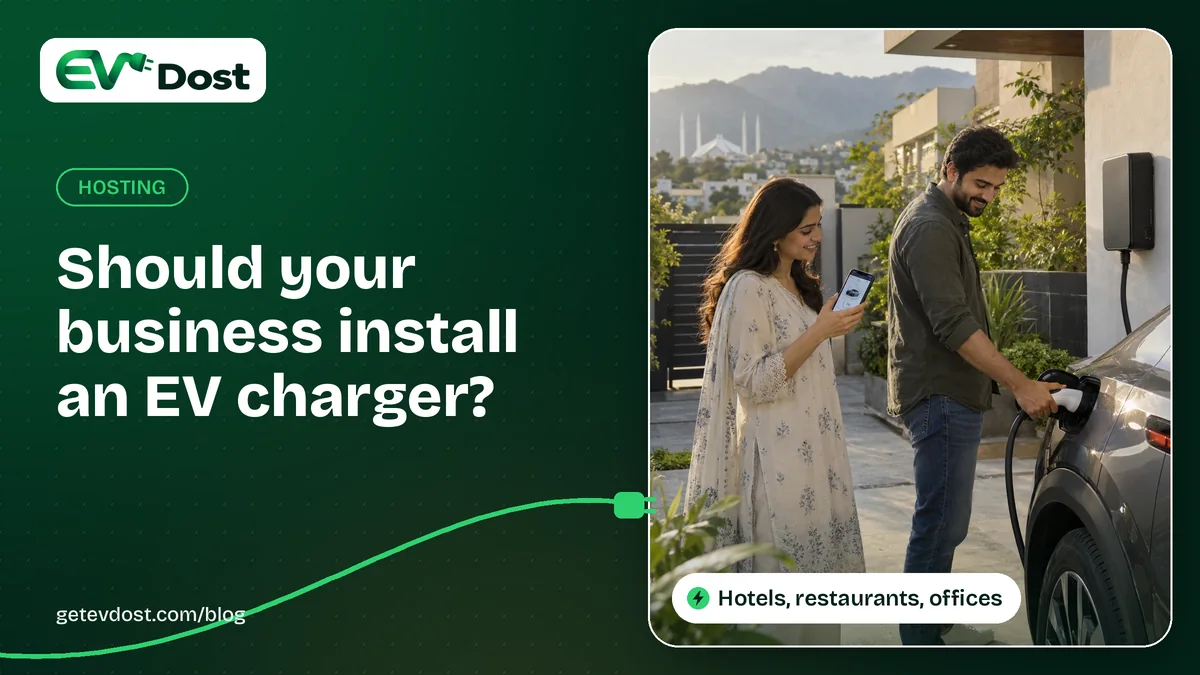
If you run a hotel on the road north, a restaurant in a busy market or an office with its own car park, you've probably been asked by now whether you have an EV charger. Electric car sales in Pakistan roughly doubled in 2026, according to Bloomberg, though no one publishes a complete national total (ProPakistani citing Bloomberg, October 2026), and analysts counted about 23 new car models due between June and December, most of them electrified (Express Tribune, 2026).
For many hotels, restaurants and offices in Pakistan, an EV charger for business use is worth it if it's a modest AC unit. A big DC fast charger is a different and much riskier investment. Below: what each costs, the electricity tariff, the registration rules, and what the evidence says about customers.
Why long-stay businesses suit EV charging
The oil industry has been frank about fast charging at petrol pumps. In a letter to the petroleum minister reported by The News in March 2026, the Oil Companies Advisory Council said that only around 15 oil-company charging stations existed, that few had broken even, and pointed to places where cars stay a long time, such as homes, malls and hospitals, as where EV charging happens (The News, March 2026).
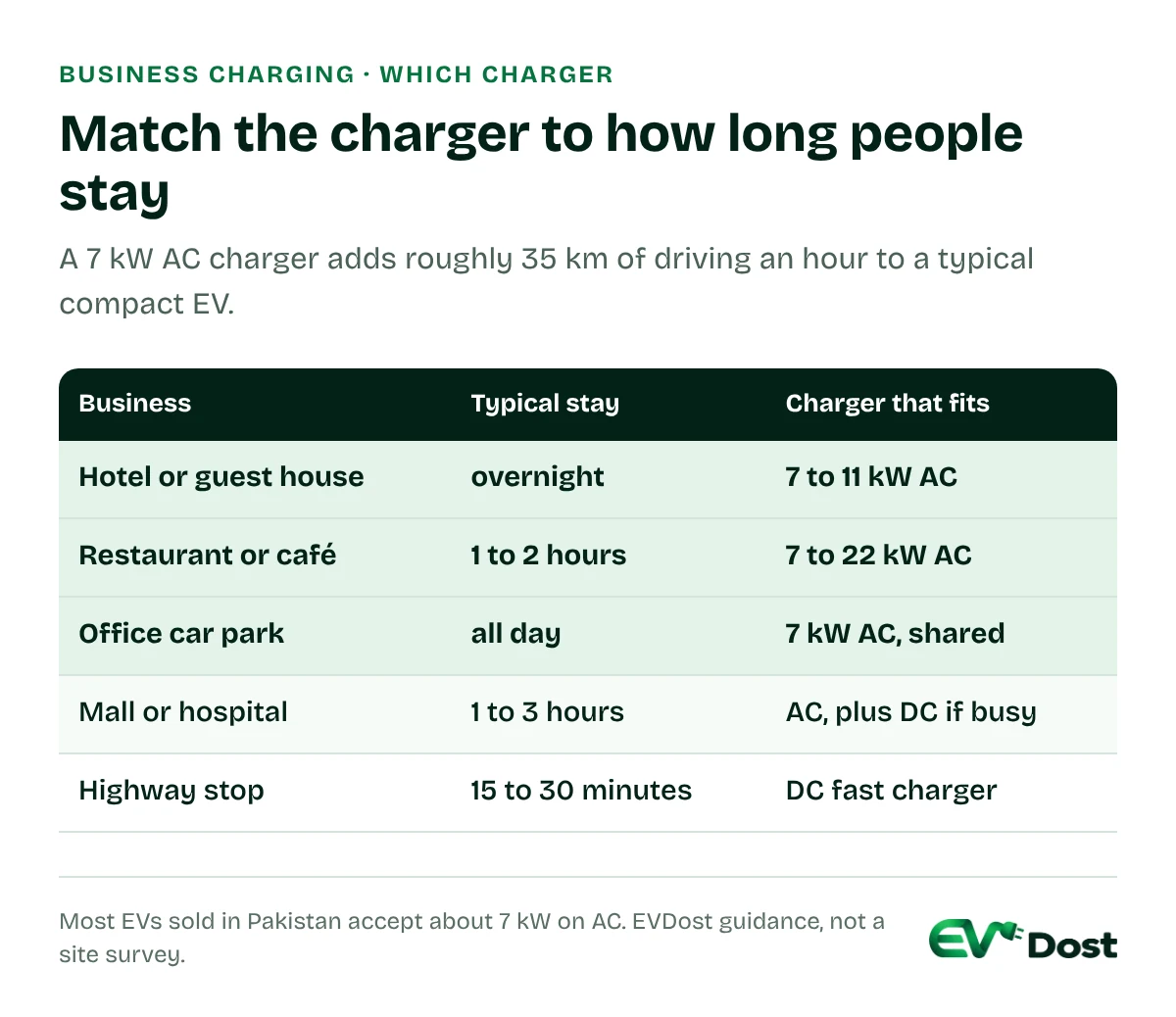
Hotels, restaurants and offices have exactly that: time. A 7 kW AC charger adds roughly 35 km of driving an hour to a typical compact EV. That's a meaningful top-up over a two-hour dinner, a full battery overnight at a hotel, and a week's commuting during an office day.
What an EV charger costs a business in Pakistan
Prices vary widely by brand, and there are few independent figures, so treat these as a guide:
| Charger | Typical price (hardware) | Source type |
|---|---|---|
| 7.4 kW AC, single phase | about Rs 108,000 | retailer listing, 2026 |
| 22 kW AC, three phase | about Rs 144,000 | retailer listing, 2026 |
| 11 kW AC, branded | about Rs 250,000 to 400,000 | buyer's guide, 2025 |
| 30 kW DC, two CCS2 guns | about Rs 1.08 million | retailer listing, 2026 |
| 60 kW DC, two CCS2 guns | about Rs 2.7 million | retailer listing, 2026 |
| Full DC fast-charging station | about Rs 15 to 20 million, before transformer and cabling | oil industry estimate, March 2026 |
Sources: W11Stop AC listings, W11Stop 30 kW DC, W11Stop 60 kW DC, Bloom Pakistan, August 2025, The News, March 2026.
Installation comes on top. One buyer's guide puts professional installation of a wallbox at about Rs 100,000 to 150,000, and a DC charger usually needs a much larger supply, sometimes a new transformer. The oil industry's Rs 15 to 20 million estimate for a fast-charging station isn't broken down, and it excludes the transformer and cabling, so budget for those on top.
Before you choose, check your car park's supply. Most electric cars sold in Pakistan accept around 7 kW on AC, so a 22 kW AC unit won't charge most of them faster; our guide to EV charger types in Pakistan explains why.
Electricity: the commercial tariff and the EV charging tariff
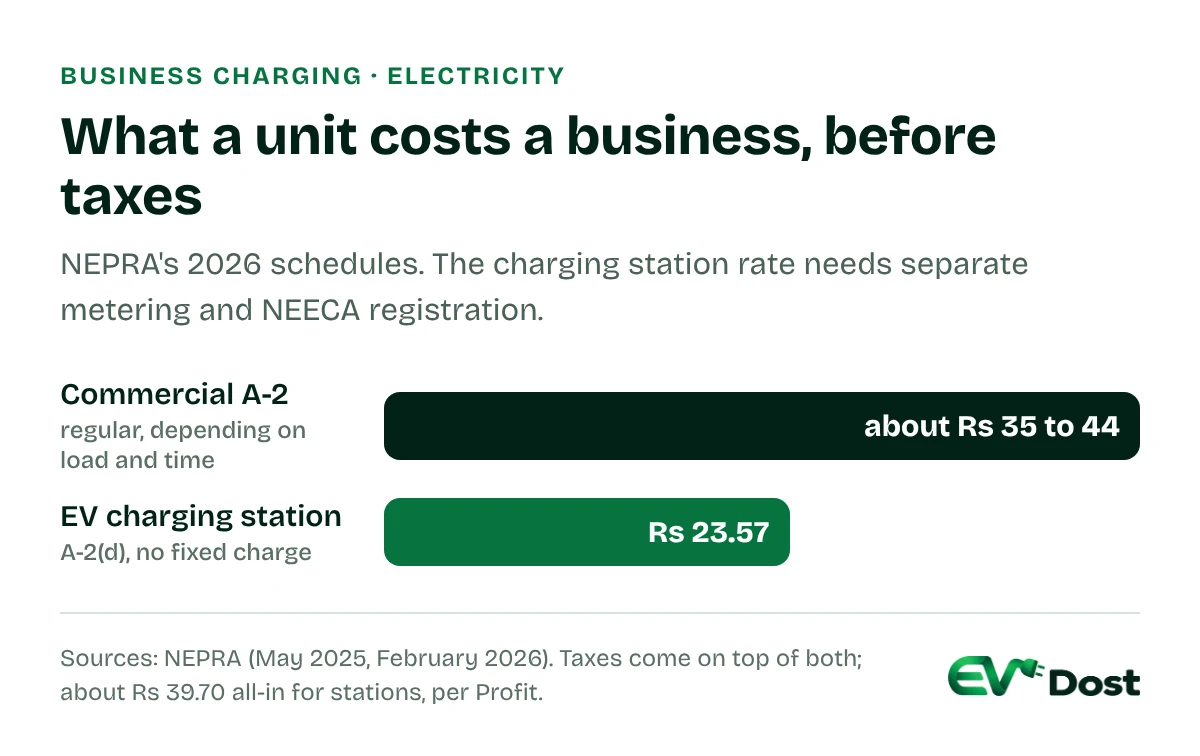
A business on a normal commercial (A-2) connection pays roughly Rs 35 to 44 per unit before taxes in NEPRA's 2026 schedules, depending on load and time of use (NEPRA, February 2026).
EV charging stations have their own category. In 2025, NEPRA cut the base rate for charging stations to Rs 23.57 per unit, removed the cap on the station's margin, and ruled that DISCOs bill stations under tariff A-2(d) without monthly fuel adjustments (NEPRA review decision, May 2025). After taxes, that was expected to come to about Rs 39.70 per unit (Profit, May 2025). NEPRA's 2026 tariff decisions keep the Rs 23.57 rate with no fixed charge.
To use that rate, charging needs its own metering, separate from your lighting, kitchen and other loads, under NEECA's regulations (NEECA regulations, 2024). For a single wallbox used now and then, the paperwork may not be worth it. For a business planning to sell charging regularly, it usually is.
Do you need a licence? Registering with NEECA
You won't find a separate NEPRA licence for charging stations; NEPRA sets the tariff. The registration that matters is with NEECA, under the Pakistan Electric Vehicle Charging Infrastructure and Battery Swapping Regulations 2024 (NEECA regulations, 2024). Press reports often call this a "licence".
The main points of the regulations:
- No charging station may be installed without registering with NEECA. Individuals and companies can both register.
- Fees: Rs 50,000 to register each station, plus an annual registration and inspection fee from Rs 35,000 for an AC (Level 2) charger to Rs 80,000 for the most powerful DC units.
- Process: an online application with no-objection certificates from your DISCO and other relevant authorities. NEECA checks completeness within 15 working days.
- Public stations must display their price, be findable through an app or web portal, connect to a management system over mobile data, and keep uptime above 90 percent.
- Portable sockets and adaptors are not allowed for charging at a station, and there are rules on earthing and residual current protection.
- Penalties start at Rs 100,000 for a first violation found on inspection.
Plenty of chargers haven't been registered. Citing an official report, TechJuice said in August 2026 that only 47 of 222 chargers were registered with NEECA (TechJuice, August 2026). That isn't a reason to skip it. If you're selling charging to the public, register.
The regulations describe a "private captive" charger as one for the owner's own vehicles, and say it must not be used commercially to charge other vehicles. They don't say clearly how free charging for guests, or charging included in a room rate, should be treated. If that's your plan, ask NEECA directly and keep the answer. The NEV policy sets the wider targets.
Does an EV charger bring in customers?
There's no Pakistani research on this yet, so the evidence comes from abroad.
- An MIT study of more than 4,000 chargers in California found that a new charger raised annual spending at businesses within 500 metres by about 1.4 percent in 2019 (MIT Climate Portal, September 2024).
- A UC Davis survey of 3,350 California EV drivers found that about 45 percent bought something while charging, spending about $40 on average on things other than the charge (UC Davis ITS, April 2026).
- In a UK survey commissioned by an energy company, 48 percent of EV drivers said they wouldn't stay at a hotel without on-site charging (Travolution, September 2023).
Pakistan's EV owners are still few, so the effect here will be smaller for now. Where it's likely to matter first is with travellers. A hotel in Murree, Swat or on the M-2 that can promise overnight charging has something many competitors don't, and EV drivers plan their trips around exactly that. Our EV road trip guide tells drivers to ask hotels about charging before they book.
Free, bundled or paid?
You have three broad choices:
- Free for customers. Simple, and a strong marketing point. The electricity cost of a few sessions a week is modest on an AC charger, but check the registration question above.
- Included in the price. Some hotels add charging to the room rate or offer it as part of a package.
- Charged by time. You set a price per hour. This suits offices sharing chargers after hours and restaurants with regular charging demand.
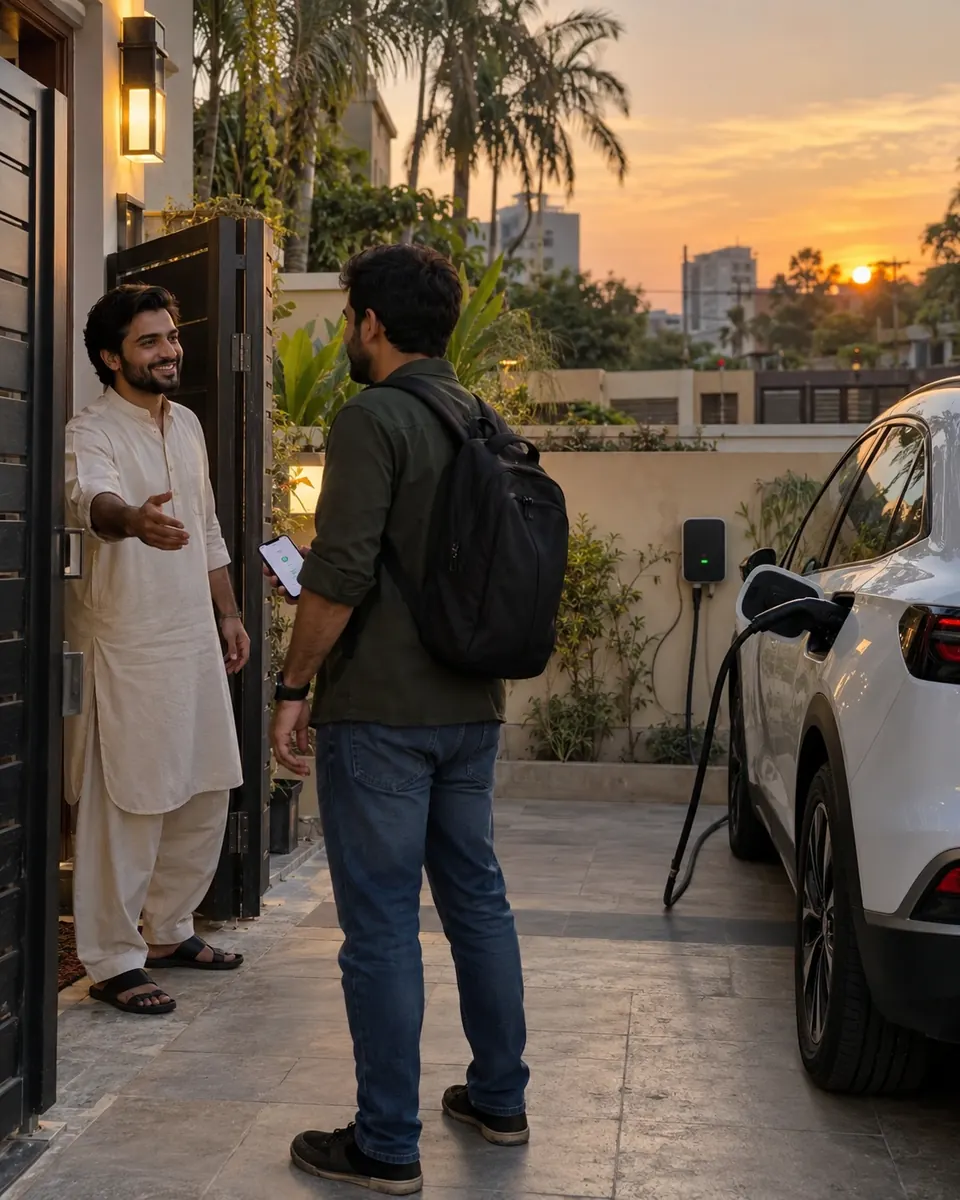
If you choose to charge by time, you can list your charger on EVDost. You set an hourly price and opening hours, drivers nearby see your charger with an estimated cost for their car, and they're billed in 10-minute blocks and pay you directly. You can list a charger here, and our guide to earning from an EV charger covers pricing.
A quick checklist for business owners
- How long do your customers stay? Under 30 minutes points to DC; an hour or more points to AC.
- What's your car park's spare capacity, and would a charger need a load extension or a new connection?
- Will you sell charging? If so, plan for separate metering and NEECA registration.
- Where will the charger go? Near the entrance, visible, and away from standing water.
- Who handles faults and payment questions, and how will drivers find you?
Frequently asked questions
How much does an EV charger cost for a business in Pakistan?
As of 2026, retailer listings show 7.4 kW AC chargers from about Rs 108,000 and 22 kW AC from about Rs 144,000, hardware only, with installation often Rs 100,000 to 150,000 more. A 60 kW DC charger was listed at about Rs 2.7 million, and the oil industry estimates a full fast-charging station at Rs 15 to 20 million before transformer and cabling.
Do I need a licence to sell EV charging in Pakistan?
You need to register the charging station with NEECA under the 2024 EV charging regulations. Registration costs Rs 50,000 per station plus an annual fee from Rs 35,000, and needs no-objection certificates including one from your DISCO. NEPRA sets the tariff but we found no separate NEPRA licence for charging stations.
What electricity tariff applies to EV charging stations in Pakistan?
NEPRA's charging station tariff is a base rate of Rs 23.57 per unit, billed under A-2(d) with no fixed charge and no monthly fuel adjustments, plus the station's own margin. After taxes, that was expected to be about Rs 39.70 per unit. Regular commercial connections pay roughly Rs 35 to 44 per unit before taxes.
Is an AC or DC charger better for a hotel or restaurant?
Usually AC. Guests stay for hours, and a 7 kW AC charger adds roughly 35 km of range an hour at a small fraction of the cost of DC. DC fast charging suits highway stops where drivers stay 15 to 30 minutes, and the oil industry says few such stations in Pakistan have broken even so far.
Does installing an EV charger bring in more customers?
International studies suggest a modest boost: about 1.4 percent more spending at nearby businesses in one MIT study, and about 45 percent of drivers buying something while charging in a UC Davis survey. There's no Pakistani data yet, and the effect will be smaller while EVs are still few, but hotels on travel routes are likely to benefit first.
Sources
- ProPakistani citing Bloomberg, EV sales in 2026 (October 2026): propakistani.pk
- Express Tribune, new model launches (2026): tribune.com.pk
- The News, oil industry on chargers at petrol stations (March 2026): thenews.pk
- W11Stop, charger listings (2026): AC chargers, 30 kW DC, 60 kW DC
- Bloom Pakistan, charger buyer's guide (August 2025): bloompakistan.com
- NEPRA, uniform tariff decision (February 2026): nepra.org.pk
- NEPRA, EV charging tariff review decision (May 2025): nepra.org.pk
- Profit, EV charging tariff (May 2025): profit.pakistantoday.com.pk
- NEECA, EV Charging Infrastructure and Battery Swapping Regulations 2024: neeca.pk
- TechJuice, registered chargers (August 2026): techjuice.pk
- MIT Climate Portal, chargers and nearby spending (September 2024): climate.mit.edu
- UC Davis ITS, EV driver spending while charging (April 2026): escholarship.org
- Travolution, UK hotel charging survey (September 2023): travolution.com