EV charging stations in Pakistan: how to find one near you in 2026
Ask ten EV owners in Pakistan where they charge and most will say "at home". Ask them where they'd charge if they couldn't, and you'll get a pause.
Public charging here is growing quickly, but from a small base. Knowing who runs the stations, where they tend to be and how to check one before you drive there saves a lot of frustration. And there's a growing alternative to public stations that many drivers haven't tried yet.
How many public chargers are there?
It depends on what you count, and official figures vary.
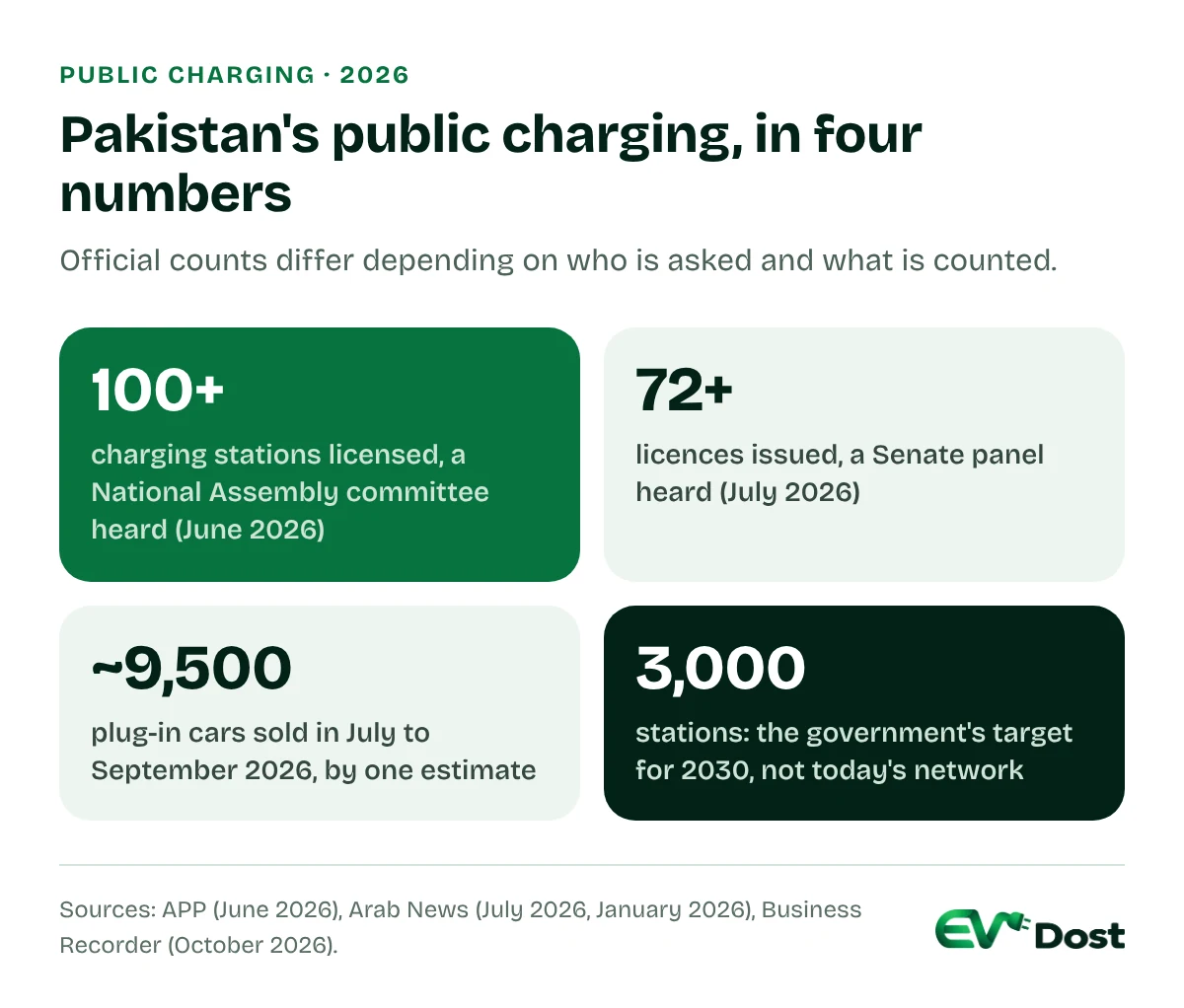
- In June 2026, a National Assembly committee was told more than 100 charging stations had been licensed (APP, June 2026). A Senate panel the following month heard that more than 72 licences had been issued (Arab News, July 2026).
- A NEECA presentation from 2026 lists 363 chargers installed across the 12 power distribution companies (NEECA presentation, 2026). A station can have several chargers, which partly explains the different numbers.
- One independent directory lists 122 public charging stations across 34 cities, 82 of them with DC fast chargers, as viewed in October 2026 (Sarai).
Compare that with the government's target of 3,000 stations by 2030 (Arab News, January 2026) and with plug-in car sales that, by one estimate, reached around 9,500 in the July to September quarter alone (Business Recorder, October 2026). Demand is running well ahead of public supply.
Who runs EV charging stations in Pakistan?
A handful of names account for most public fast charging:
- HUBCO Green has the most chargers in independent directory listings (Sarai charger listings). It has partnered with PSO on motorway sites, starting with Magic River on the M-2, opened with BYD Pakistan (APP, June 2025), and with BYD on a plan for 128 DC fast chargers over three years (Profit, May 2025).
- Fuel companies including PSO, Attock Petroleum and Shell appear in charger directories with chargers at some of their forecourts (Sarai charger listings). Attock has partnered with HUBCO Green (Profit, April 2025) and signed an MoU with Huawei (Profit, October 2025).
- New entrants keep arriving. Solcraft and ORKO, for example, announced plans for 500 chargers within two years (The News, March 2026).
- Car brands such as BYD have chargers at some dealerships, and many hotels and malls have added a charger or two. If you run one, see our guide to installing an EV charger at a business.
Where you'll find them
Public chargers cluster in predictable places:
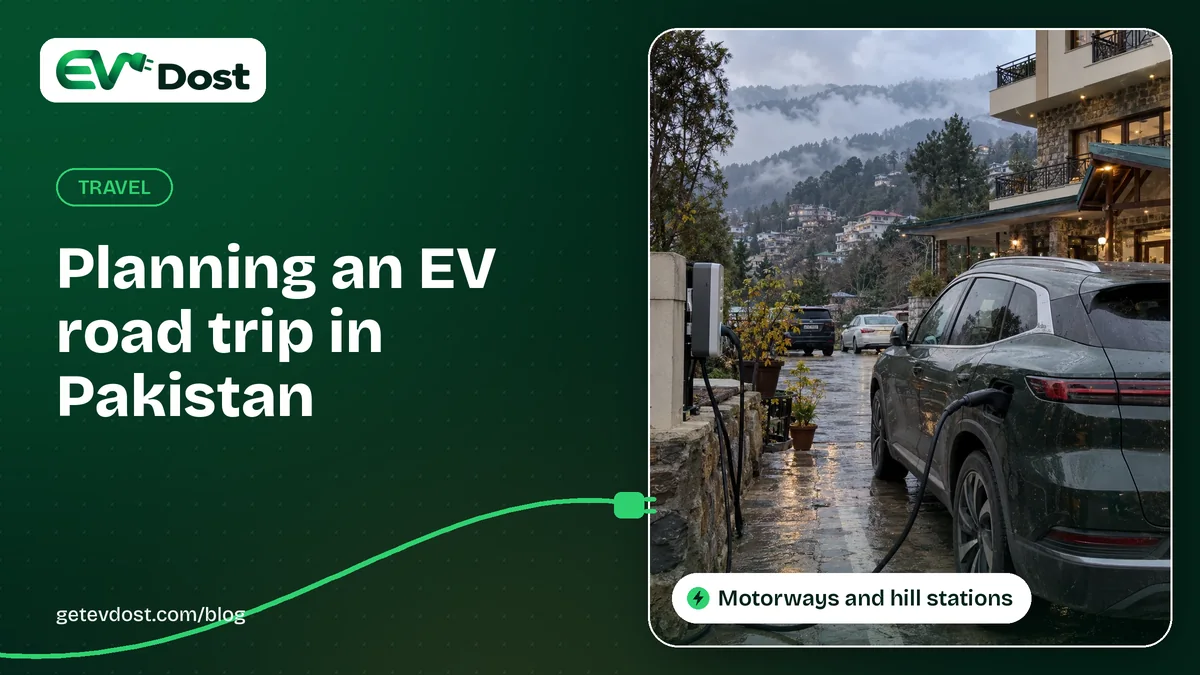
- Motorway rest areas, especially the M-2 between Lahore and Islamabad, which now has ultra-fast chargers at Chakri, Kallar Kahar, Bhera and Sial Mor (ProPakistani, July 2026).
- Fuel stations on main city roads. Officials told a National Assembly committee in June 2026 that new petrol stations in Islamabad will be required to include EV charging (APP, June 2026).
- Malls, hotels and dealerships in Karachi, Lahore and Islamabad.
Smaller cities have far fewer. If you live outside the big three, home charging or a nearby host is likely to be your main option for a while.
What public charging costs
Each operator sets its own price. Directory listings in 2026 show DC fast charging from roughly Rs 70 to Rs 200 per kWh, with around Rs 115 typical, and AC chargers at hotels ranging even more widely (Sarai charger listings). Some places charge per session or per hour instead of per kWh, so compare on the same basis before you choose.
For context, the electricity tariff NEPRA set for charging stations works out at roughly Rs 39.70 a unit all-in for the operator (Express Tribune, May 2025). The difference covers expensive equipment, site rent, staff and profit. We go through the full comparison with home charging and petrol in how much it costs to charge an EV in Pakistan.
Charging etiquette at public stations
Public charging works better when everyone follows a few unwritten rules, and with so few chargers in most cities, they matter more here than elsewhere.
- Move the car when you're done. A fully charged car parked at a fast charger blocks the next driver.
- Charge to what you need on a fast charger. Charging slows sharply above about 80 percent, so the last stretch ties up the charger for a long time for little range.
- Don't unplug someone else's car, even if it looks finished. Leave a note or ask staff.
- Report faults to the operator or station staff, so the next driver doesn't arrive at a broken unit.
- Keep cables off the ground and coiled when you leave, especially in the rain.
Before you drive to a charger
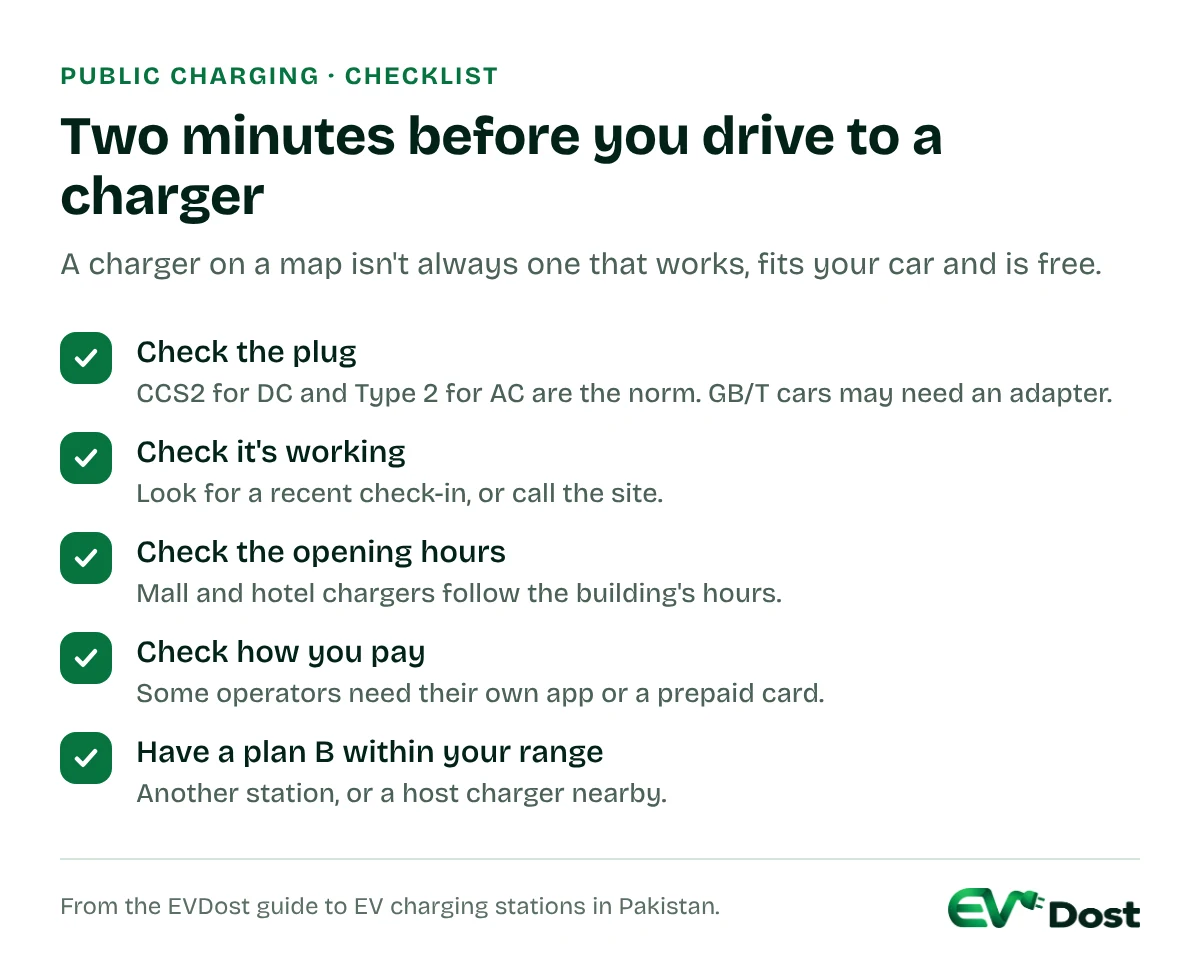
A charger on a map isn't the same as a charger that works, has your plug, and is free when you arrive. A two-minute check saves a wasted trip:
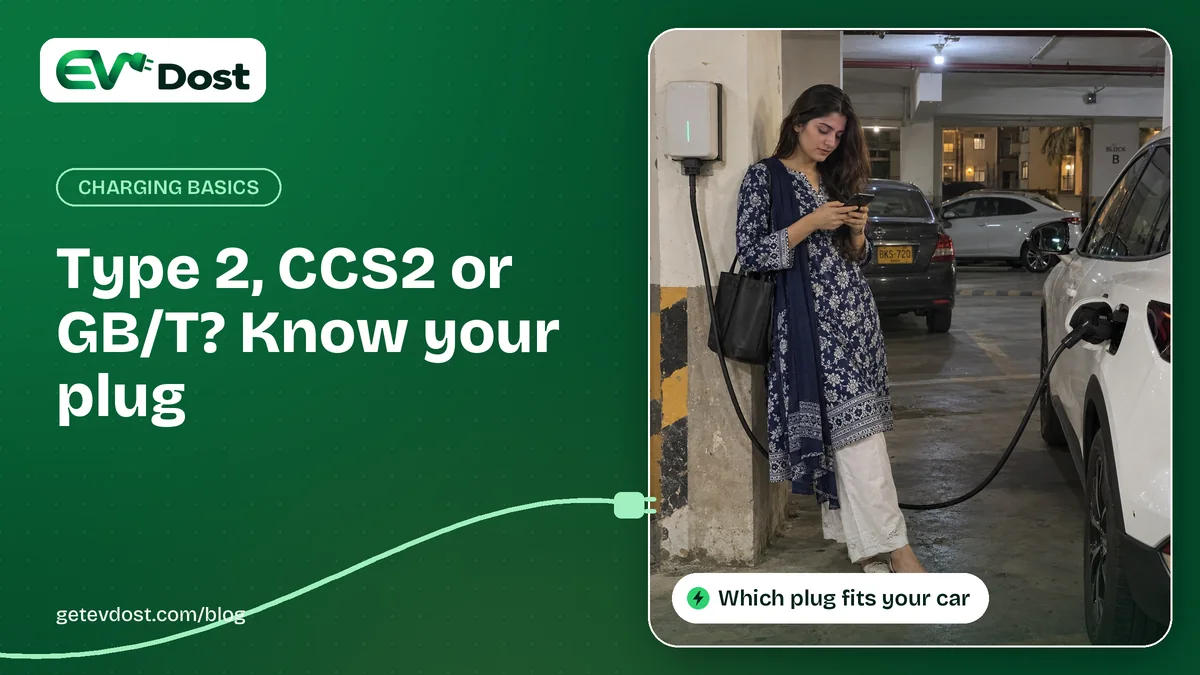
- Check the plug. Most public chargers in Pakistan use CCS2 for DC and Type 2 for AC (WorldStandards). If your car is a Chinese-market import with GB/T sockets, you may need an adapter. Our guide to EV charger types in Pakistan explains the differences.
- Check it's working. Look for a recent update or check-in, or call the site. Chargers do go out of service.
- Check access hours. Mall and hotel chargers follow the building's hours.
- Check how you pay. Some operators need their own app or a prepaid card set up in advance.
- Have a plan B within your remaining range.
The chargers that aren't on the map
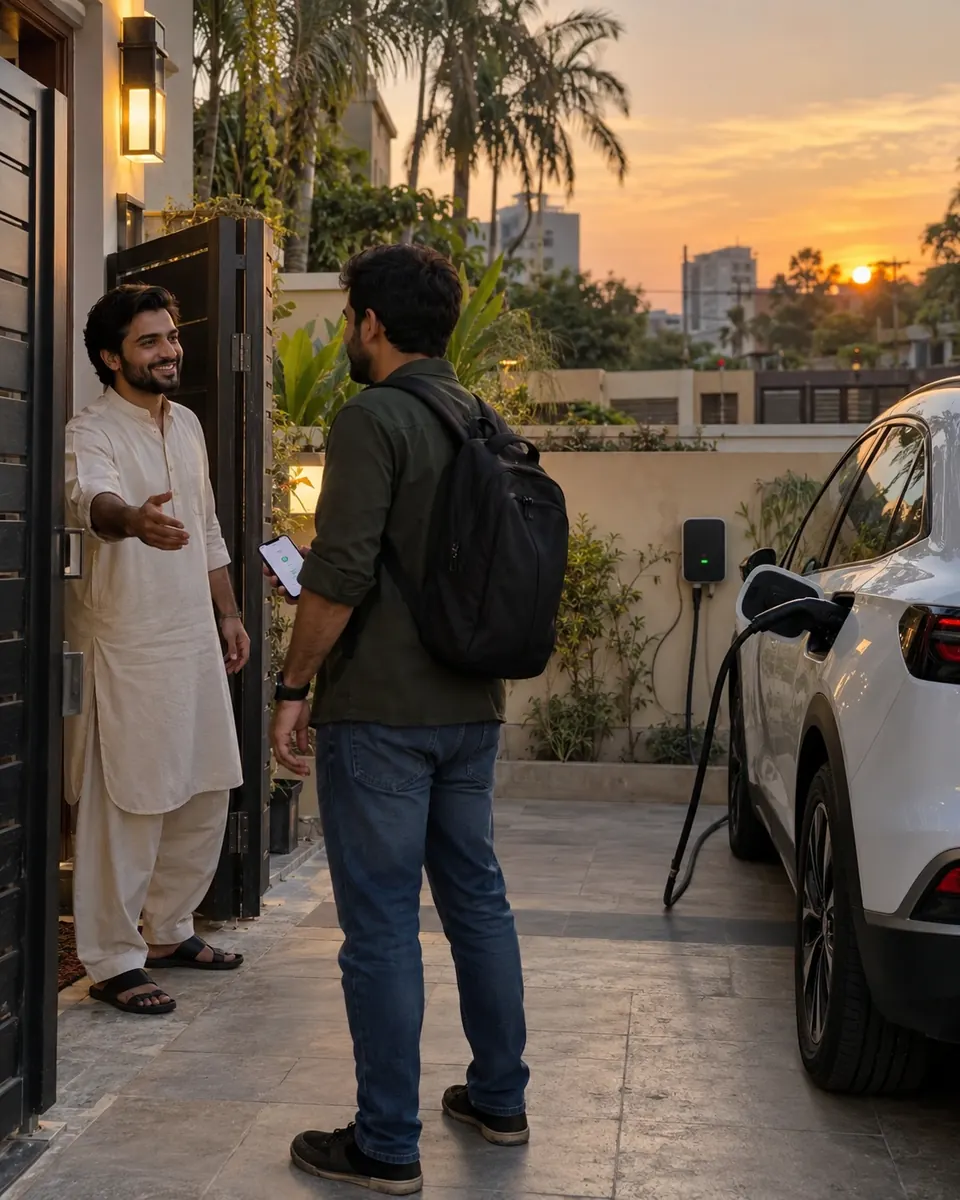
Most guides stop at public stations, but Pakistan already has a large number of chargers that aren't public stations at all: wallboxes in homes, at offices, in clinic car parks and outside small hotels. BYD, for one, offered a free 7 kW home charger with every car booked in August 2026 (The News, August 2026). Most of these sit idle for most of the day.
That's the idea behind EVDost. Hosts list their chargers, choose when they're available, and set their own hourly price. Drivers open the app, pick their car, and see chargers nearby that fit it, sorted by nearest or best price, with an estimate of what the charge will cost. You're billed in 10-minute blocks, so you pay for what you use.
It works anywhere in Pakistan where someone has a charger to share, including towns with no public station at all. And it often means charging at a cheaper AC charger near where you're already going, rather than driving across town to a fast charger. Slower AC charging is also easier on the battery, as our guide to EV battery care in the heat explains.
If you own a charger yourself, you can list it on EVDost and help another driver nearby. If you're looking for one, open the app and see what's around you.
Frequently asked questions
How many EV charging stations are there in Pakistan?
There's no single official count. In June 2026 a National Assembly committee was told more than 100 charging stations had been licensed, and in July 2026 a Senate panel heard that more than 72 licences had been issued. The government's target is 3,000 stations by 2030.
Who runs EV charging stations in Pakistan?
HUBCO Green has the most chargers in independent directory listings and works with PSO and BYD. Fuel companies including PSO, Attock Petroleum and Shell have chargers at some forecourts, and car brands, hotels and malls have added their own. New companies such as Solcraft and ORKO have announced plans for more.
Are there EV chargers on the M-2 motorway?
Yes. As of July 2026 the M-2 between Lahore and Islamabad has ultra-fast chargers at the Chakri, Kallar Kahar, Bhera and Sial Mor rest areas. Check that a charger is working before you rely on it.
How much does public EV charging cost in Pakistan?
Each operator sets its own price. Directory listings in 2026 show DC fast charging at roughly Rs 70 to Rs 200 per kWh, with about Rs 115 typical. That works out to about Rs 21 per km for a car using 18 kWh per 100 km.
What plug do public chargers in Pakistan use?
Most DC fast chargers use CCS2 and most AC chargers use Type 2. Some cars imported from China have GB/T sockets and need an adapter or a compatible charger.
Sources
- APP, licensed stations and Islamabad fuel stations (June 2026): app.com.pk
- Arab News, Senate panel on charging licences (July 2026): arabnews.pk
- NEECA, presentation on EV charging stations (2026): saarcenergy.org
- Sarai, charger directory and listings: saraicharge.com, chargers
- Arab News, 3,000-station target (January 2026): arabnews.pk
- APP, HUBCO Green, PSO and BYD at Magic River (June 2025): app.com.pk
- Profit, HUBCO Green and BYD network (May 2025): profit.pakistantoday.com.pk
- Profit, Attock Petroleum and HUBCO Green (April 2025): profit.pakistantoday.com.pk
- Profit, Attock Petroleum and Huawei (October 2025): profit.pakistantoday.com.pk
- The News, Solcraft and ORKO chargers (March 2026): thenews.pk
- ProPakistani, M-2 ultra-fast chargers (July 2026): propakistani.pk
- Express Tribune, charging station tariff (May 2025): tribune.com.pk
- The News, BYD free home charger offer (August 2026): thenews.pk
- Business Recorder, plug-in car sales estimates (October 2026): brecorder.com
- WorldStandards, EV connector inlets by country: worldstandards.eu