How to charge an electric car if you live in an apartment in Pakistan
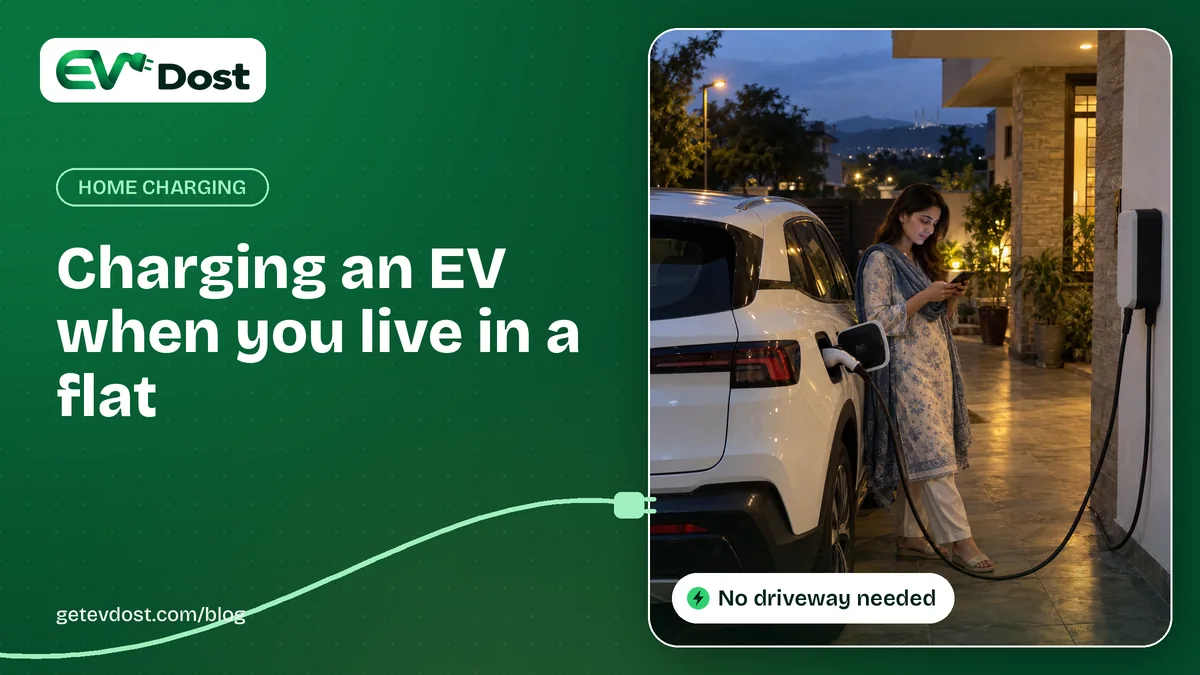
Almost every guide to owning an electric car starts with "plug in at home overnight". That's easy advice if you have a porch and a gate. It's much harder in a Clifton high-rise, a block of flats in Gulberg or an apartment tower in Islamabad, where your meter is on the ground floor, your parking spot is in the basement, and the building has a committee.
Charging an EV from an apartment in Pakistan takes more work than in a house, but it can be done. Below are the realistic options, what the rules say about EV-ready buildings, and how to manage if you can't charge where you park.
Can you install an EV charger in an apartment in Pakistan?
Often, yes, if three things line up: you have an assigned parking spot, the building's management agrees, and there's a safe way to get power from your own meter (or a new one) to that spot.
The management committee is usually the first and biggest hurdle. PakWheels rates apartment charging as hardest in Karachi, where approval from the building's union is often the first real obstacle (PakWheels, August 2026). Committees worry about fire safety, about who pays for the electricity, and about cables running through shared spaces. Those are fair worries, and the way through is to answer them before they're asked.
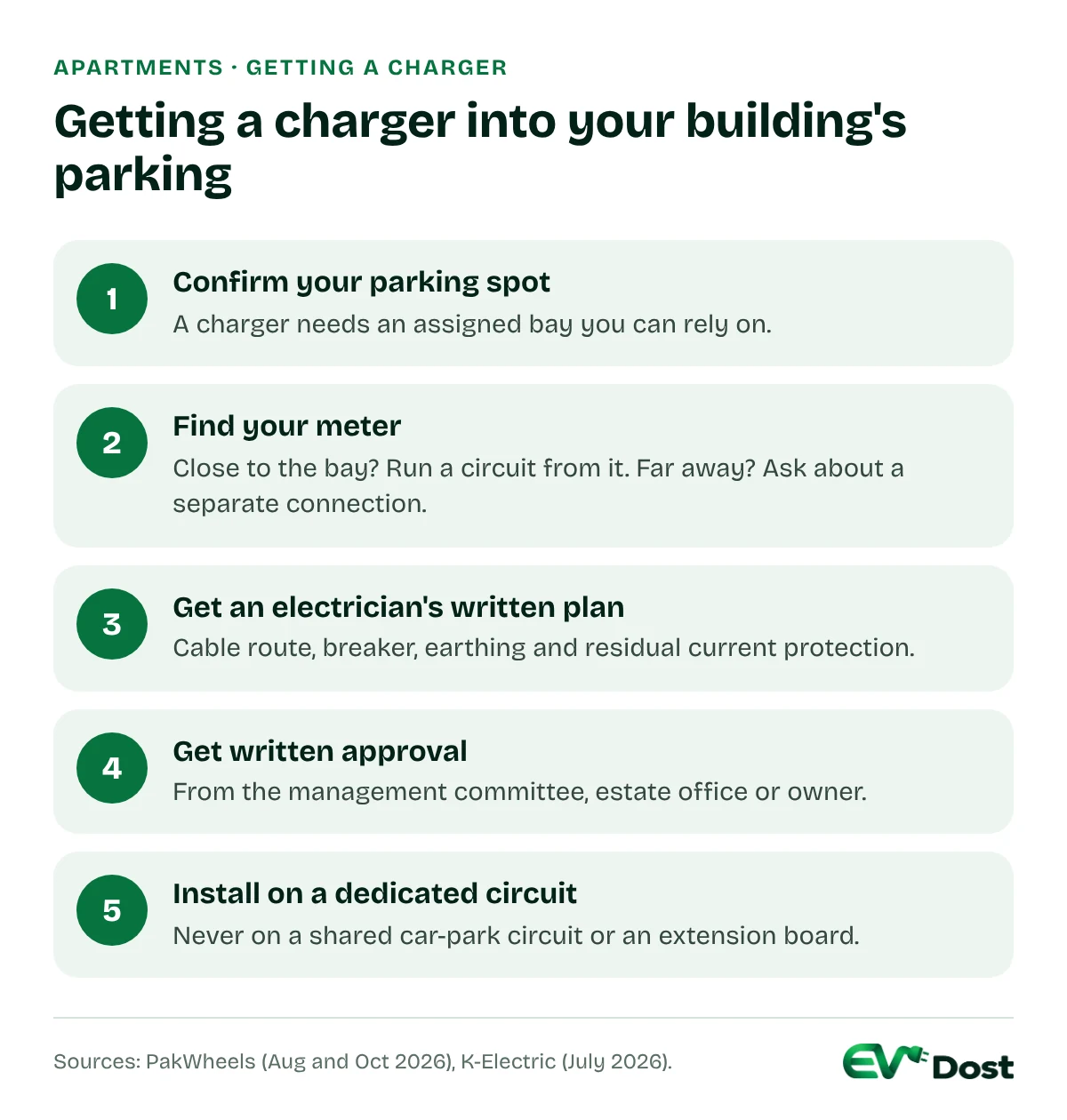
Talk to the committee with a plan, not a question
Go to the committee with an electrician's written proposal: where the cable will run, how it's protected, which breaker and earth it uses, and confirmation that it's on your own meter so no one else pays for your charging. A safety guide from PakWheels advises agreeing any installation with building management first, never connecting a personal charger to a shared circuit that hasn't been assessed, and keeping charging away from stairs, corridors and exits (PakWheels, October 2026).
If the parking is in a basement that floods in the monsoon, raise that too. A wallbox mounted well above the floor, on a dedicated circuit with proper protection, is part of the answer. Our guide to charging in the rain covers the wiring side.
Option 1: a circuit from your own meter
If your meter is reasonably close to your parking spot, the simplest route is a dedicated cable from your own distribution board to a wallbox at your bay. You pay for the electricity on your normal bill, and the committee only has to approve the cable route.
The challenge is distance. In a large building, the run from a meter room to a basement bay can be long, and longer runs need thicker cable to stay cool and avoid voltage drop. Installers also note that basement cable runs are hard to do without the management's help (Linkers, July 2026). Get a quote that includes the full run, not just the charger.
The charger itself costs the same as in a house. A Pakistani retailer listed a 7.4 kW single-phase wallbox at Rs 108,000 in 2026, hardware only (W11Stop listing). Dealers sometimes include one: BYD offered a free home charger with bookings made in August 2026 (The News, August 2026), so ask about current offers. Our home charger installation guide covers sizing, sanctioned load and what a good installation looks like.
Option 2: a separate connection for your parking
If your meter is too far away, or the building wants charging kept separate, you can ask for a new connection near the parking. With K-Electric, connections under 80 kW are applied for online; you upload ownership papers and CNICs, K-Electric surveys the site and sends an estimate, and after the wiring test the supply is energised. K-Electric's own guide gives about 30 days for loads up to 15 kW (K-Electric, July 2026). The other distribution companies take new-connection applications through the online ENC portal (MEPCO).
K-Electric's guide asks for the owner's ownership papers and CNIC, so tenants will need the owner's help. We couldn't find a DISCO procedure written specifically for an "EV meter" in an apartment car park, so call K-Electric (118) or your DISCO and describe exactly what you want before you apply.
What the rules say about EV-ready buildings
Pakistan's 2024 EV charging regulations, issued under NEECA, include a table of how many EV parking spaces new car parks should have: 5 to 10 percent of spaces in high-rise residential buildings, 3 percent for offices and 2 percent for shops and restaurants, for new or rebuilt car parks with more than 10 spaces (NEECA regulations, 2024). The wording ties this to the Energy Conservation Building Code, and it isn't clear how strictly it's enforced on developers.
Islamabad has gone furthest. In September 2025, the CDA and NEECA decided at a meeting that the building code would be made mandatory for all new construction in the capital (CDA, September 2025). In Lahore, a 2022 rule tied EV charging to environmental approval for new commercial and industrial buildings; a fact-check later rated claims that it covered all new buildings as misleading (Soch Fact Check, January 2023).
We couldn't find any published policy from DHA, Bahria Town or the big apartment developers on residents installing chargers. If you live in one, write to the estate office and ask for the answer in writing.
Why not just use a socket in the parking?
It's tempting to plug the portable cable that came with the car into the nearest socket in the car park. Be careful.
Sockets in shared areas are often on circuits that also feed lights and pumps, the wiring may not be rated for hours of continuous current, and long extension leads get hot. NEECA's charging regulations ban portable socket-outlets and adaptors for EV charging outright (NEECA regulations, 2024). The regulations don't spell out how this applies to a private charger at home, but it shows how seriously the regulator takes the risk. In the UK, lab tests reported by Fleet News found three plug-in charging cables unsafe, with failed safety-cut-out tests and plugs that risked overheating (Fleet News).
If you do use a portable cable, use it on a dedicated, properly earthed socket that an electrician has checked, and never through an extension board.
Living without home charging
Plenty of people own an EV without charging where they live. It takes a routine.
Charge at work. Some offices now have chargers, and the NEECA table suggests new office car parks should set aside about 3 percent of spaces for EVs. Ask your employer; a car parked for eight hours on a 7 kW charger can pick up a week's commuting.
Use a charger near home. A host on EVDost with a wallbox a few streets away can be your regular weekly top-up. Hosts set their own hourly price and you're billed in 10-minute blocks, so you can compare chargers near you on price and distance.
Use public chargers for the rest. Malls and fuel stations in the big cities have chargers, and our guide to EV charging stations in Pakistan explains who runs them and how to check one before you go.
For a week of 40 km a day, 280 km in total, the three options compare like this:
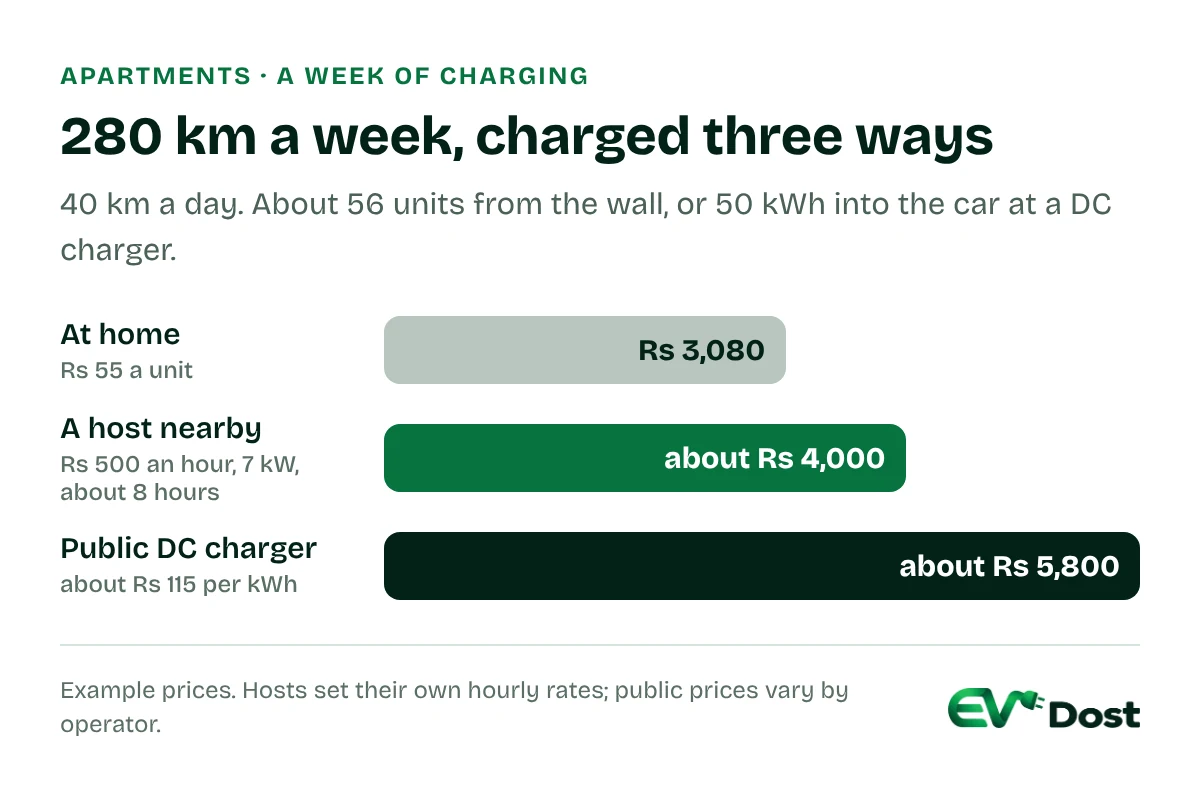
At home, 56 units at Rs 55 comes to about Rs 3,080. At a host charging Rs 500 an hour on a 7 kW charger, the same 56 units take about eight hours and cost about Rs 4,000. On public DC chargers at around Rs 115 per kWh, it's about Rs 5,800. All three are well below petrol for the same distance, as our EV charging cost guide shows.
A plan for flat owners and tenants
- Confirm you have an assigned parking spot, and where your meter is.
- Get an electrician's written plan, including the full cable run and protection.
- Take it to the management committee or estate office and ask for approval in writing.
- If your meter is too far, ask K-Electric or your DISCO about a separate connection.
- Until then, line up a regular charger nearby: at work, a host, or a public station on your route.
Frequently asked questions
Can I install an EV charger in my apartment's parking in Pakistan?
Usually, if you have an assigned parking spot, the building's management approves, and power can be brought safely to your bay, either from your own meter or through a new connection. Expect the management committee's approval to be the main hurdle, especially in Karachi.
Do I need permission from the building to install an EV charger?
Yes. Cables through shared areas and work in the car park need the management committee's or owner's approval, and a new connection needs the owner's ownership papers and CNIC. Get approval in writing before you buy a charger.
Can I get a separate electricity meter for EV charging in my building?
You can apply for a new connection near your parking. K-Electric's guide gives about 30 days for loads up to 15 kW, and other DISCOs take applications through the ENC portal. We couldn't find a procedure written specifically for EV meters in apartment parking, so describe your plan to K-Electric or your DISCO first.
Do new apartment buildings in Pakistan have to provide EV charging?
NEECA's 2024 regulations suggest 5 to 10 percent of spaces in new high-rise residential car parks should be for EVs, linked to the Energy Conservation Building Code. In Islamabad, the CDA and NEECA decided in 2025 to make that code mandatory for new construction. Elsewhere, enforcement for residential buildings is unclear.
How can I own an EV if I can't charge at home?
Combine workplace charging, a regular charger near home such as a host's wallbox, and public chargers for the rest. At October 2026 prices, 280 km a week at a host charging Rs 500 an hour on a 7 kW charger would cost about Rs 4,000, against about Rs 3,080 at home and about Rs 5,800 on public DC chargers.
Sources
- PakWheels, EV charging in Lahore, Karachi and Islamabad (August 2026): pakwheels.com
- PakWheels, EV charging safety in heat and monsoon (October 2026): pakwheels.com
- Linkers, installing EV charging at home (July 2026): linkers.com.pk
- W11Stop, home EV charger listings (2026): w11stop.com
- The News, BYD free home charger offer (August 2026): thenews.pk
- K-Electric, new connection process below 80 kW (July 2026): ke.com.pk
- MEPCO, online new connections: mepco.com.pk
- NEECA, EV Charging Infrastructure and Battery Swapping Regulations 2024: neeca.pk
- CDA, building code and EV charging in Islamabad (September 2025): cda.gov.pk
- Soch Fact Check, Lahore EV charging rule (January 2023): sochfactcheck.com
- Fleet News, charging cable safety tests: fleetnews.co.uk