How to work out an electric car's running cost in Pakistan, and the method behind our numbers
Ask two electric car owners in the same street what their car costs per kilometre and you can get two different answers — Rs 11 from one, Rs 8 from the other. Both can be right. The figure depends on what you pay for a unit, how you drive and where you charge.
So this is how to calculate EV running cost in Pakistan for yourself, with your own bill and your own car. It's also the exact method behind every per-km figure in our car guides, written down in one place so you can check our working.
You need three numbers. Everything else is multiplication.
The three numbers you need
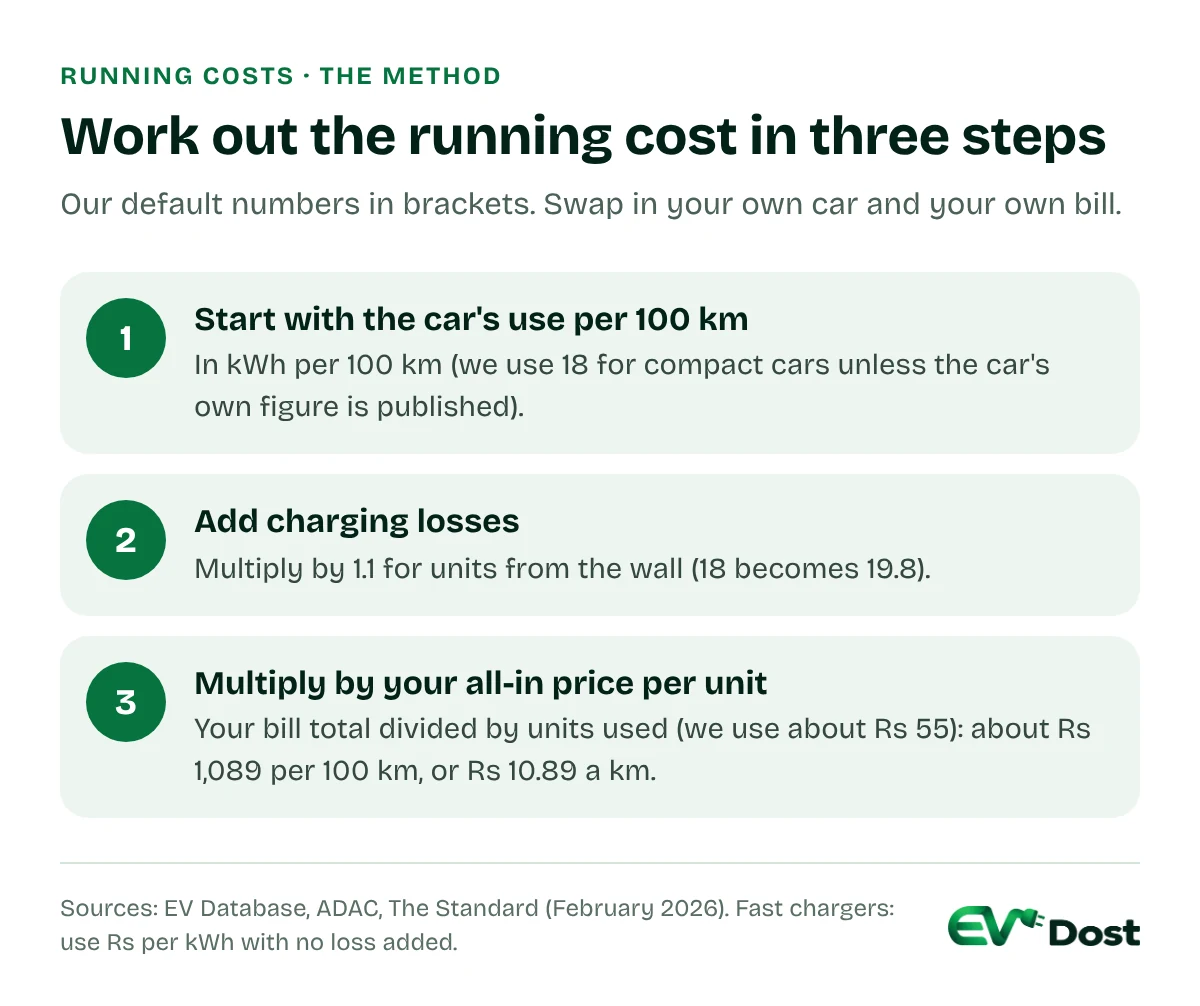
What the car uses, in kWh per 100 km. This is the electric car's version of fuel average. Most compact electric SUVs and hatchbacks sold here use roughly 15 to 19 kWh per 100 km in real driving. EV Database estimates about 18.3 kWh per 100 km in real-world use for the larger-battery BYD Atto 3 (EV Database), and Germany's ADAC lists the MG4 Urban at 15.5 kWh per 100 km on the WLTP test (ADAC). Unless a car's own figure is published, our guides use 18 kWh per 100 km for compact cars, and say so. Bigger, heavier SUVs get a higher figure, which each guide explains.
What you pay for a unit, all in. Not the base tariff. Before taxes and surcharges, household grid tariffs run roughly Rs 37 to 55 a unit (The Standard, February 2026), and general sales tax alone adds 18 percent on top. Your own bill is the honest source: divide the total amount by the units used. Our guides use about Rs 55 a unit as a realistic all-in figure for a household using a few hundred units a month.
How much is lost while charging. Some electricity turns to heat in the cable, the charger and the car. On AC charging, roughly 10 percent is a fair rule of thumb, so we multiply the car's consumption by 1.1 to get units from the meter.
Working out the cost at home
Put the three together. At 18 kWh per 100 km, the car draws 18 × 1.1 = 19.8 units from the wall for every 100 km. At Rs 55 a unit, that's about Rs 1,089 per 100 km, or about Rs 10.89 a kilometre. Our guides round this to "about Rs 11 per km".
Now swap in your own numbers. If your bill works out at Rs 45 a unit and your car's real figure is 16 kWh per 100 km, it's 16 × 1.1 × 45 ÷ 100, which is about Rs 7.92 a kilometre. The method doesn't change; only the inputs do.
One thing your calculator won't show is the slab. Adding a few hundred units a month can push a household into a higher slab, and that raises the price of every unit on the bill, not just the car's. Our guide to EV charging costs walks through slabs, protected status and time-of-use tariffs in detail. Read it before you trust any per-km number, ours included.
Fast chargers are a different sum
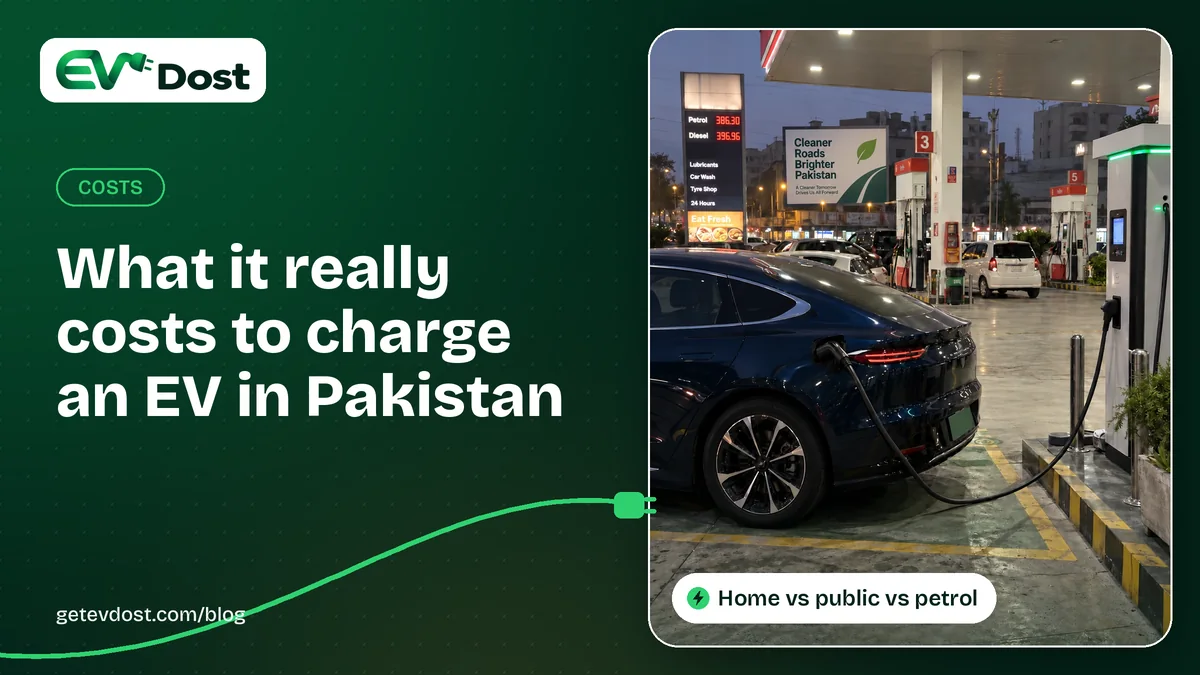
Public DC chargers sell energy by the kWh straight into the battery, so we don't add the 10 percent charging loss for them, and neither do the guides. Prices are set by each operator. In 2026 listings compiled by one independent charger directory, DC fast charging ranged from about Rs 70 to Rs 200 per kWh, with around Rs 115 typical.
At 18 kWh per 100 km and Rs 115 per kWh, 100 km costs about Rs 2,070, or about Rs 20.70 a kilometre. That's nearly double home charging, which is why the guides treat fast charging as a motorway tool rather than an everyday habit.
Comparing it with petrol
For the petrol side you need the car's real fuel average and today's petrol price. Our car guides compare each EV with a real petrol or diesel rival, usually starting from that car's PakWheels fuel average, and petrol at Rs 377.71 a litre, the price for 24 to 26 October 2026 (Investify, October 2026). Petrol now changes almost daily, so check the price on the day you do the sum.
Take a petrol crossover averaging 13.5 km per litre, the figure we use for the Corolla Cross 1.8 (PakWheels, Corolla Cross fuel average). At Rs 377.71 a litre that's about Rs 28 a kilometre. Over 15,000 km a year, the petrol bill is about Rs 420,000 against about Rs 163,000 for an EV charged at home and about Rs 310,500 if every kilometre came from fast chargers.
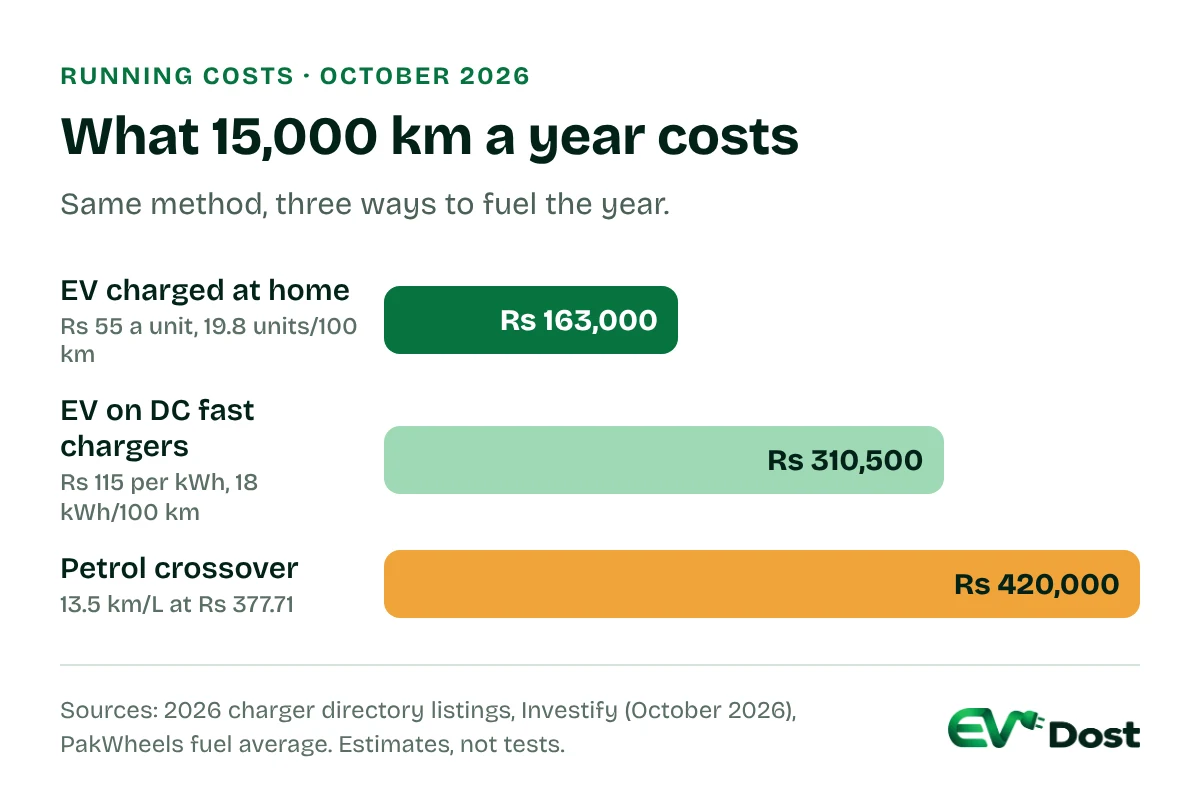
Most owners mix the two, mostly home with the odd fast charge on a trip, so the real answer sits between the first two bars. Our electric vs petrol cost comparison adds purchase price, insurance and servicing over five years.
Charging time uses the same numbers
The guides work out home charging time the same way: energy needed × 1.1, divided by the slower of the charger's power and the car's onboard AC limit. Most Pakistani homes are single-phase, so about 7 kW is the realistic home maximum; 11 kW needs a three-phase connection.
Topping up a 50 kWh battery from 10 to 90 percent needs 40 kWh, or 44 units from the wall. On a 7 kW wallbox that's about 6 hours 17 minutes and, at Rs 55 a unit, about Rs 2,420. The same full battery on a 2.2 kW portable cable, from empty, takes about 25 hours, which is why we describe those cables as top-up tools. Our charging time guide has the figures for the main cars on sale.
Range figures, and why ours are lower
Range claims come from three test cycles. China's CLTC is the most generous, the older NEDC sits in the middle and Europe's WLTP is the most realistic of the three, and Pakistani dealers quote all three, sometimes without saying which. Our guides always name the cycle. Where we estimate real range, we divide usable battery by our consumption figure and say clearly that it's our estimate, not a test. A Lahore June with the AC on full will cut it further, as our battery care guide explains.
How we check the numbers
The prices and specs in our guides link to sources we opened on the day we wrote them, and each guide says "as of" the month for anything that changes. Before a guide goes up, a separate reviewer who didn't write it opens every link, compares each figure with its source and reruns the sums. When we learn that a figure has changed, we update the guide and its date.
If you spot something wrong, or your own bills tell a different story, we'd like to hear it through the contact page. Real owners' numbers are the best check there is. And if you're working out what a charge away from home would cost, the EVDost app shows an estimate for the car model you pick before you send a host a request.
Frequently asked questions
How do you calculate an electric car's running cost per km in Pakistan?
Multiply the car's consumption in kWh per 100 km by 1.1 for charging losses, then by your all-in price per unit, and divide by 100. At 18 kWh per 100 km and Rs 55 a unit, that's about Rs 10.89 a kilometre at home.
What price per unit should I use for EV charging at home?
Use your own all-in price: the total of your electricity bill divided by the units used. EVDost's guides use about Rs 55 a unit as of October 2026, because household tariffs of roughly Rs 37 to 55 a unit are before taxes and surcharges.
How much does fast charging an EV cost per km in Pakistan?
At a typical Rs 115 per kWh in 2026 directory listings and 18 kWh per 100 km, DC fast charging costs about Rs 20.70 a kilometre, nearly double home charging. Operators set their own prices, which ranged from about Rs 70 to Rs 200 per kWh.
Why do EV running cost figures differ between sources?
They use different electricity prices (base tariff or all-in), different consumption figures and different test cycles, and some leave out charging losses. Check what each source assumed; EVDost's guides state all three numbers so you can redo the sum with your own.
Sources
- EV Database, BYD Atto 3: ev-database.org
- ADAC, MG4 Urban: adac.de
- The Standard, household tariffs and net billing (February 2026): thestandard.com.pk
- Investify, petrol price from 24 October 2026: investify.pk
- PakWheels, Corolla Cross fuel average: pakwheels.com