BYD Seal price in Pakistan, and whether the Premium is worth Rs 2.2 million more
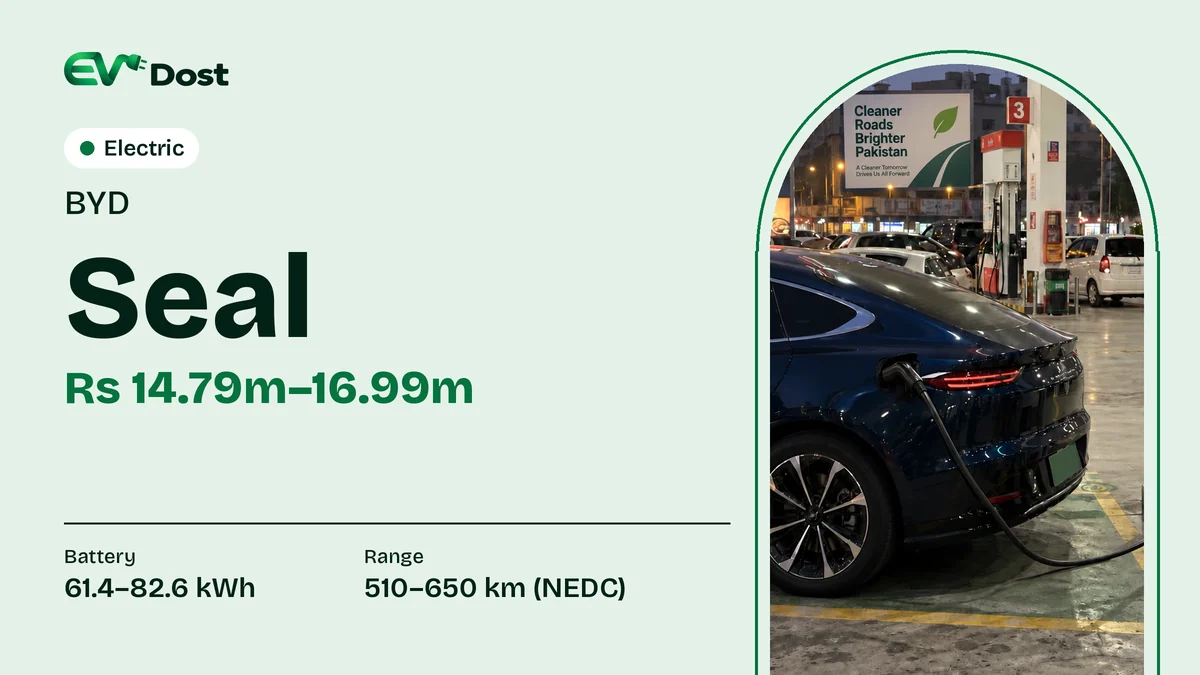
Park the two BYD Seals side by side at the kerb and you'd struggle to tell them apart. On the price list they're Rs 2.2 million apart, and most of that money buys battery. The BYD Seal price in Pakistan is Rs 14.79 million for the Dynamic and Rs 16.99 million for the Premium as of October 2026, the same as when the car went on sale here in October 2024 (Mettis Global, October 2024; Profit, 2024; ProPakistani, June 2026).
Both are rear-wheel drive and both are imported fully built by BYD Pakistan and Mega Motor Company. The real choice is between about 340 km and about 460 km of everyday range, and whether you'll use the difference.
BYD Seal price in Pakistan, version by version
| Seal Dynamic | Seal Premium | |
|---|---|---|
| Price (October 2026) | Rs 14,790,000 | Rs 16,990,000 |
| Battery | 61.44 kWh Blade (LFP) | 82.56 kWh Blade (LFP) |
| Claimed range | 510 km | 650 km |
| Motor | 150 kW, 310 Nm, rear-wheel drive | 230 kW, 360 Nm, rear-wheel drive |
| AC charging | 7 kW, Type 2 | 7 kW, Type 2 |
| DC charging | 110 kW, CCS2 | 150 kW, CCS2 |
| Battery warranty | 8 years or 160,000 km | 8 years or 160,000 km |
Prices, batteries, ranges, AC limit, plug and warranty are from PakWheels' Pakistani listings (Dynamic, variant specs), opened October 2026. BYD Pakistan's own Seal page lists only the bigger battery and "up to 650 km", and we couldn't open its brochure, so the motor and DC figures come from the same two-battery line-up as launched in Thailand (WapCar), where both ranges are on the NEDC cycle. PakWheels' power figures, 201 hp and 308 hp, match. Pakistani cars could still differ in detail, so check the spec sheet at the dealer.
Prices on PakWheels are ex-factory, so add freight, registration and insurance. ProPakistani reported in June 2026 that BYD's prices would hold after the 2026–27 budget, since every model sat below the proposed Rs 20 million duty-free limit for imported EVs.
What both versions share
Some things don't change with the badge, so they're worth settling before you pick a battery.
Range, on our own sums
The claimed figures, 510 and 650 km, are best-case. They're NEDC numbers in Thailand; PakWheels labels the 650 km as CLTC, another lenient cycle. For our own sums we use 18 kWh per 100 km, the same figure we use for compact cars, even though the Seal is much bigger. It's a slippery shape — its European WLTP rating for the 82.5 kWh rear-drive version is 16.6 kWh per 100 km, and EV Database estimates 17.2 in real use (EV Database). We round up to cover Pakistani heat and constant AC.
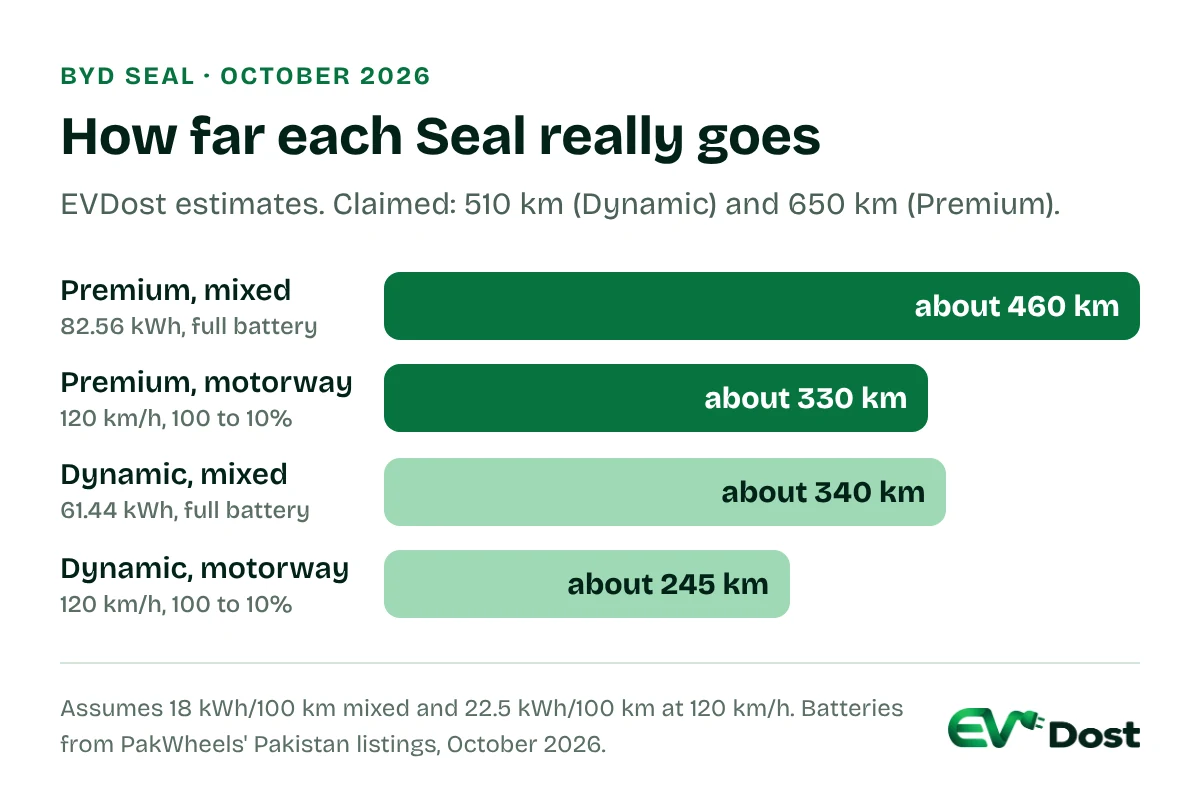
At a steady 120 km/h, allow about a quarter more energy. On a Lahore to Karachi run, both will stop more than once. Our EV road trip guide has the planning method, and why leaving each charger at about 80 percent saves time.
A 7 kW ceiling at the wall
Both Seals accept 7 kW on AC, the most a single-phase home wallbox gives. In daily use that hardly matters. A 50 km day puts back about 10 units, under an hour and a half on the wallbox.
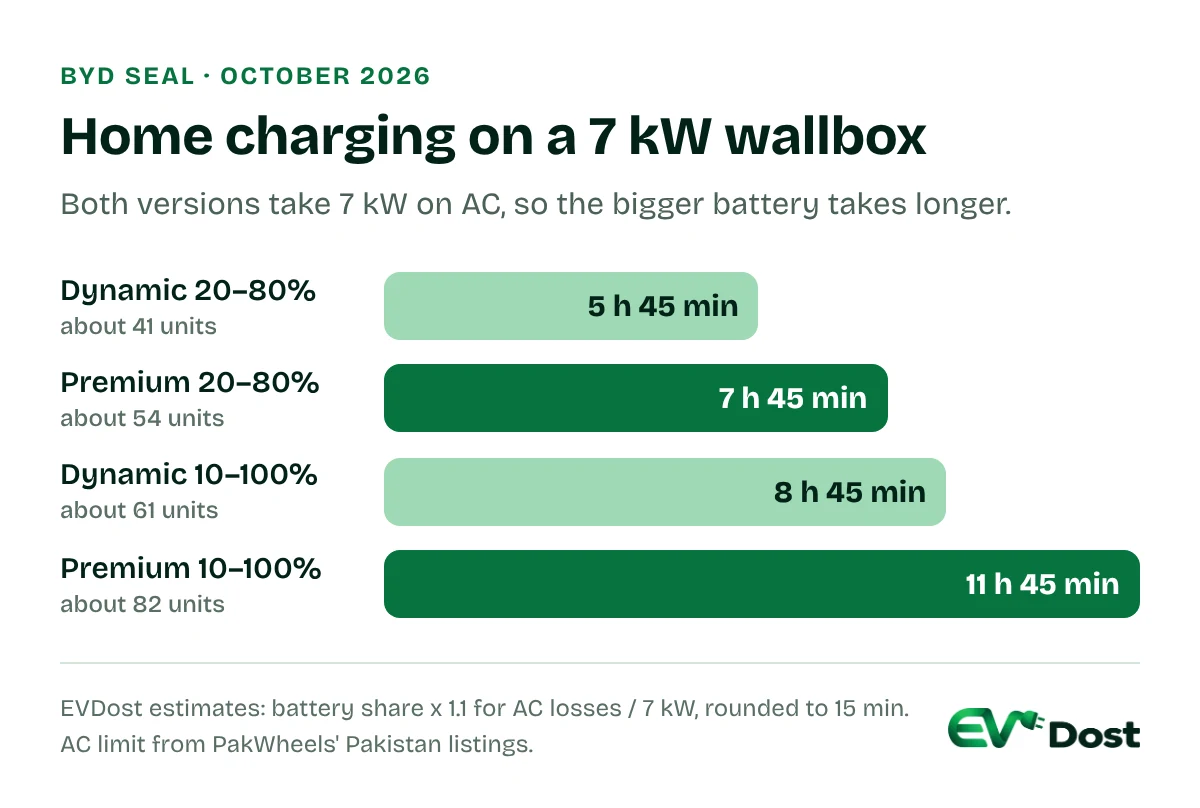
Those are our estimates, with 10 percent added for charging losses.
At a public fast charger
The CCS2 inlet works with the public chargers used in Pakistan, which follow the Type 2 and CCS2 pairing (WorldStandards). BYD Pakistan quotes 30–80% in about 30 minutes, and PakWheels lists 10–80% in about 37. Those times assume a charger that can keep up. BYD describes public chargers here as 30 to 120 kW (BYD Pakistan), and the first motorway site Hubco Green opened with PSO, at Magic River on the M-2, has two 60 kW units (APP, June 2025).
For and against, on either version
In its favour, it's one of the few electric sedans on sale here, alongside the Deepal L07. The battery warranty, at 8 years, outlasts most people's ownership. The price has held for two years. Against it, the 149 mm ground clearance PakWheels lists means care over speed breakers and flooded underpasses in a Karachi monsoon. Home charging is capped at 7 kW on both versions. And with BYD's local assembly starting with a plug-in hybrid, the Sealion 6 (The Nation, September 2026), there's no sign of a cheaper local Seal.
Running either one against a Civic
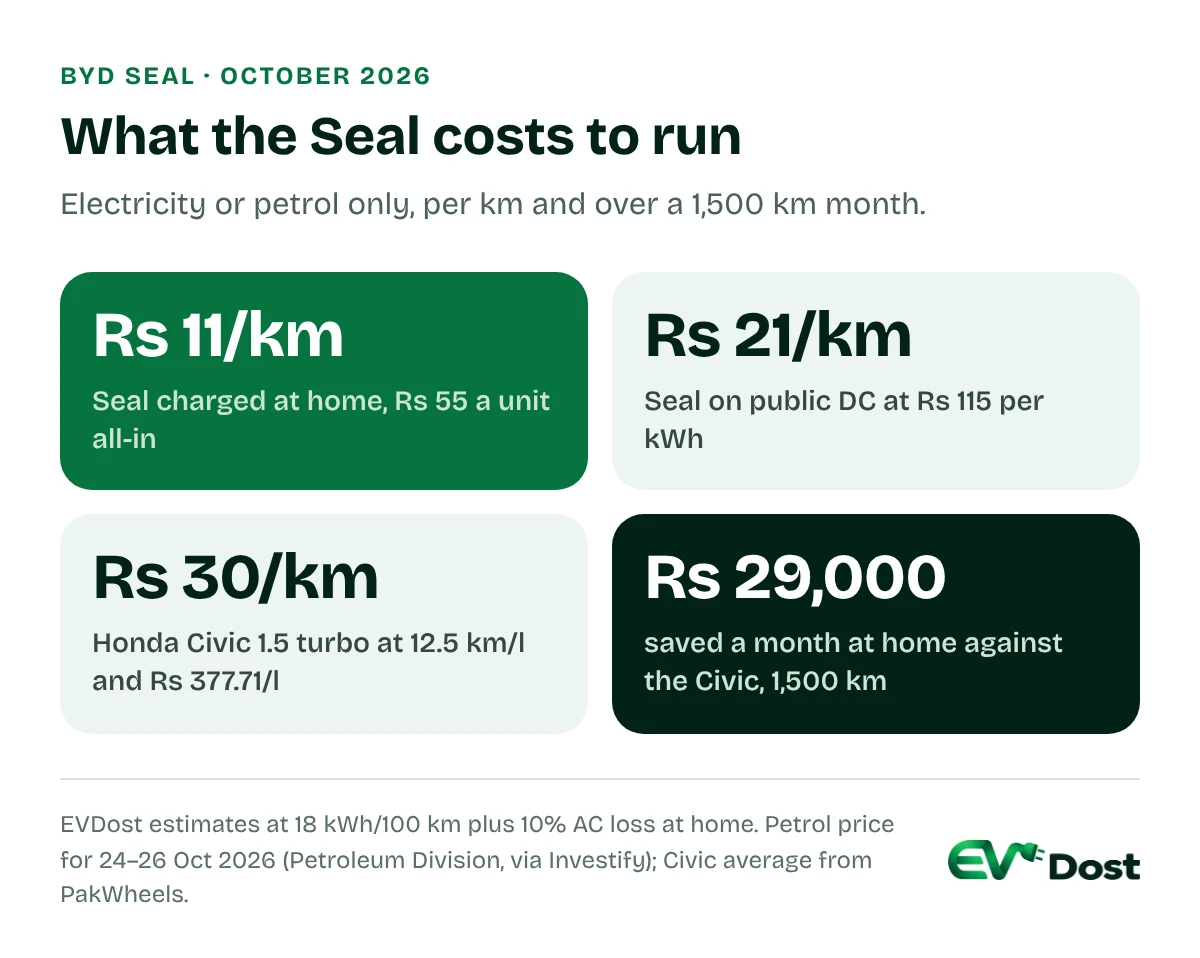
For a petrol comparison we've picked the Honda Civic, a familiar petrol sedan at the price tier below. The top 1.5-litre turbo Civic RS lists at Rs 10.1 million (January 2026) and PakWheels rates the Civic at about 12.5 km per litre (PakWheels, Civic; PakWheels, fuel average). Petrol sold at Rs 377.71 a litre over 24–26 October 2026 (Investify, October 2026), which puts the Civic at about Rs 3,020 per 100 km until the next revision.
The Seal at home uses about 19.8 units per 100 km at about Rs 55 a unit all-in, or roughly Rs 1,090 per 100 km. Public DC, which typically runs about Rs 115 per kWh, puts it near Rs 2,070. Over 1,500 km a month, home charging saves about Rs 29,000 against the Civic; DC-only charging saves about Rs 14,300. Where the Rs 55 comes from is set out in what it costs to charge at home. Since our sums use the same consumption for both, those figures hold whichever version you buy, and the running costs are those of a small hatchback, in a sedan 4.8 metres long.
The Dynamic, for life inside one city
The Dynamic is the cheaper car, and not by a little. The case against it starts with money. Even with the BYD Seal price in Pakistan unchanged for two years, Rs 14.79 million is a lot for a car that covers roughly 245 km of motorway, from a full battery down to 10 percent, by our estimate.
For Lahore to Islamabad, the Dynamic needs a proper stop. At home, the smaller battery is the quicker one to refill, as the charging chart above shows.
PakWheels lists the Dynamic at 7.5 seconds to 100 km/h (PakWheels), and BYD Pakistan's page quotes 5.9 seconds for the Seal without naming the version, most likely the Premium. Both are quick by Pakistani standards, and the Dynamic is not a slow car.
The Premium, and what the extra Rs 2.2 million buys
Mostly, battery. The Premium carries 21 kWh more, which is about a third more range on any road. On the same basis, the Premium manages roughly 330 km of motorway. For Lahore to Islamabad, the Premium gets most of the way, so a short top-up or a gentler pace covers the rest.
It's also the quicker car, with 230 kW against 150 kW. The DC peak goes up from 110 kW to 150 kW. That's useful on the rare charger that can deliver it, and less so on 60 kW units like those at the M-2's Magic River stop. At 60 kW, putting 10–80% into a Premium takes close to an hour even before the charging curve slows, so plan stops around a meal.
Beyond that, there isn't much. PakWheels lists bigger 19-inch wheels on the Premium, and it's a slightly heavier car. Neither version charges faster at home. That makes the Premium's bigger battery slower to refill at home, not faster. It matters the night before a long trip, when a full charge on the Premium needs you to plug in by early evening. A two-hour cut doesn't spoil that, but three in one night might. The load-shedding charging guide shows how to plan around the schedule.
A long drive is easier if you know where you'll charge. If you're breaking the Karachi run with a night in Multan or Sukkur, search EVDost there with the Seal selected. Sort by nearest, check each listing's plug and power, and send the host a request once you've chosen. Look for hosts along the route.
Sedans and SUVs at the same money
At this money the Seal's rivals are as likely to be SUVs as sedans. Our guide to electric car prices across Pakistan has the wider spread, and these are the three we'd compare first.
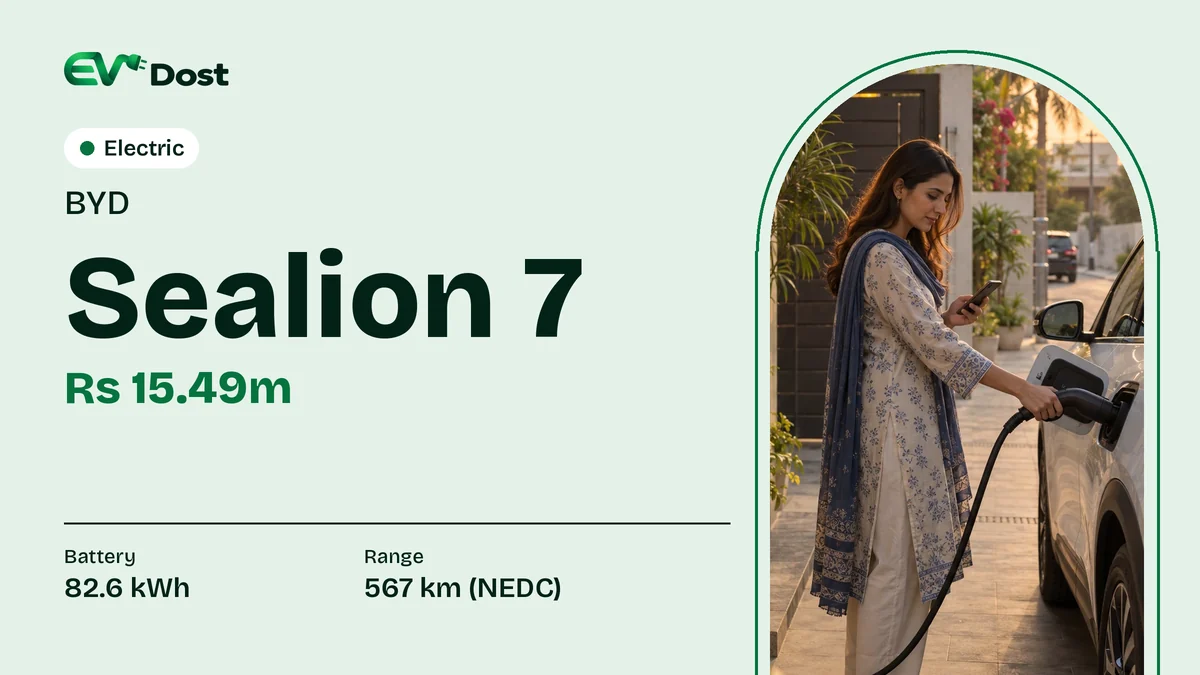
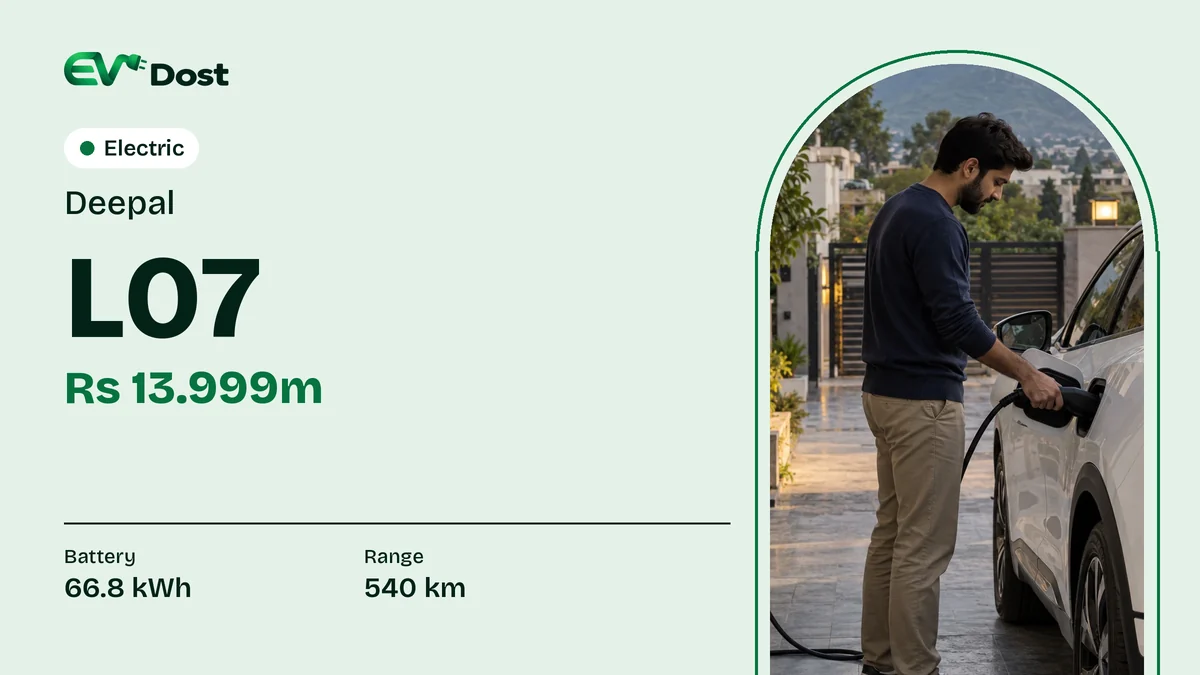
The other electric sedan is the Deepal L07, listed at about Rs 14 million with a 66.8 kWh battery and a claimed 540 km (PakWheels); our Deepal L07 guide runs the same sums for it. If you'd take an SUV, BYD's own Sealion 7 has the Premium's 82.56 kWh battery and 230 kW for Rs 15.49 million, Rs 1.5 million less than a Seal Premium, and the Sealion 7 guide covers living with it. The Xpeng G6 starts at Rs 14.5 million for a 68.5 kWh SUV (PakWheels); see the Xpeng G6 guide.
Our pick between the pair
Buy the Premium if you make regular intercity runs, or if you want the quicker car and fewer top-ups. Buy the Dynamic if most of your driving is inside one city and you'll fly or take the other car for the long trips. For most single-city families, that's the one we'd pick, and we'd keep the Rs 2.2 million.
Frequently asked questions
What is the BYD Seal price in Pakistan?
The BYD Seal costs Rs 14,790,000 for the Dynamic and Rs 16,990,000 for the Premium in Pakistan as of October 2026, ex-factory. These are the same prices as at launch in October 2024, and ProPakistani reported in June 2026 that they would stay unchanged after the budget.
What is the difference between the BYD Seal Dynamic and Premium?
The BYD Seal Premium has an 82.56 kWh battery and 230 kW against the Dynamic's 61.44 kWh and 150 kW. Claimed range is 650 km against 510 km, listed as NEDC figures for the same line-up in Thailand. Both are rear-wheel drive and both charge at 7 kW on AC.
How far does a BYD Seal really go on a charge?
By our estimate at 18 kWh per 100 km, the BYD Seal Premium covers about 460 km of mixed driving and the Dynamic about 340 km. At 120 km/h on the motorway, from full to 10 percent, expect about 330 km and 245 km respectively.
Does the bigger Seal battery take longer to charge at home?
The BYD Seal Premium's bigger battery does take longer to charge at home, because both versions are limited to 7 kW on AC. On a 7 kW wallbox, the BYD Seal Premium takes about 7 hours 45 minutes from 20 to 80 percent and the Dynamic about 5 hours 45 minutes, by our estimate. A 10 to 100 percent charge takes about 11 hours 45 minutes on the Premium and 8 hours 45 minutes on the Dynamic.
BYD Seal or BYD Sealion 7?
The BYD Sealion 7 costs Rs 15.49 million against Rs 16.99 million for the Seal Premium as of October 2026, with the same 82.56 kWh battery size and 230 kW motor output. The Sealion 7 is an SUV, with about 500 litres of boot plus a front boot in BYD's brochure; the Seal is a lower sedan, with 149 mm of ground clearance on PakWheels' listing.
Sources
- Mettis Global, Seal and Atto 3 launch (October 2024): mettisglobal.news
- Profit, Atto 3 and Seal prices (2024): profit.pakistantoday.com.pk
- ProPakistani, BYD prices after the budget (June 2026): propakistani.pk
- PakWheels, Seal overview, Dynamic listing and Seal specifications (opened October 2026): overview, Dynamic, specifications
- BYD Pakistan, Seal page and charging page: Seal, charging
- WapCar, BYD Seal Thailand launch specs: wapcar.my
- EV Database, BYD Seal 82.5 kWh RWD (European version): ev-database.org
- WorldStandards, EV connector inlets by country: worldstandards.eu
- APP, M-2 charging station (June 2025): app.com.pk
- PakWheels, Honda Civic price and fuel average: price, fuel average
- Investify, petrol price 24–26 October 2026: investify.pk
- The Nation, BYD Sealion 6 local assembly (September 2026): nation.com.pk
- PakWheels, Deepal L07 listing: pakwheels.com
- PakWheels, Xpeng G6 listing: pakwheels.com