Seres 3 price in Pakistan and how far it really goes
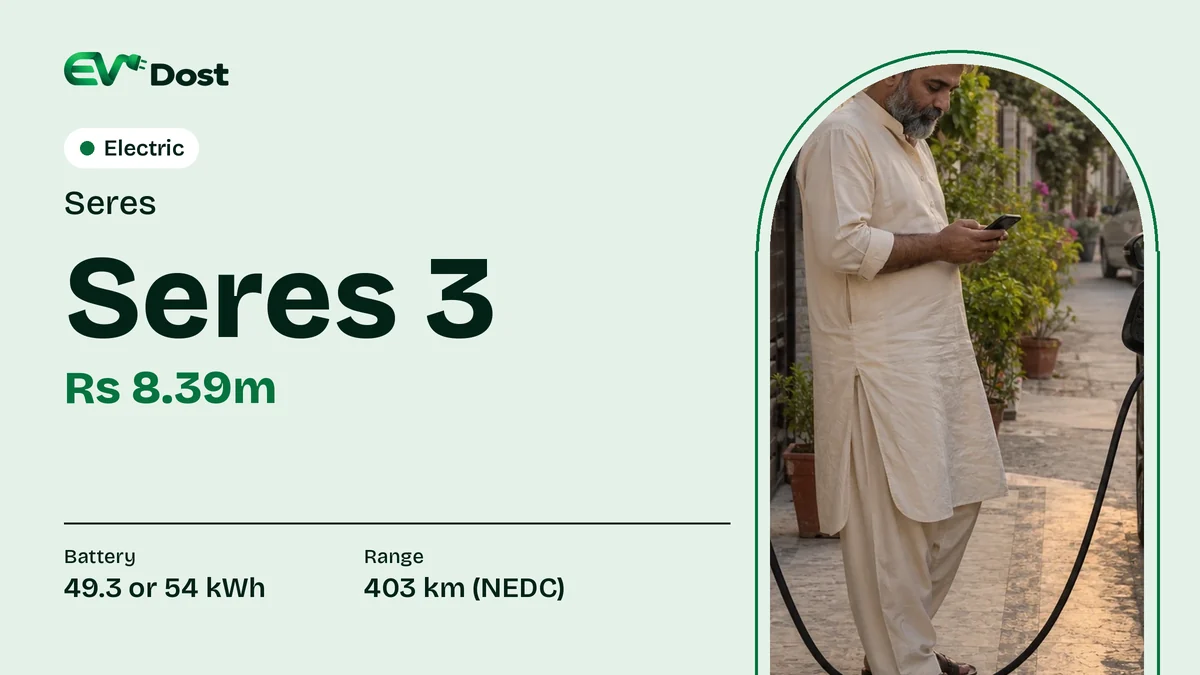
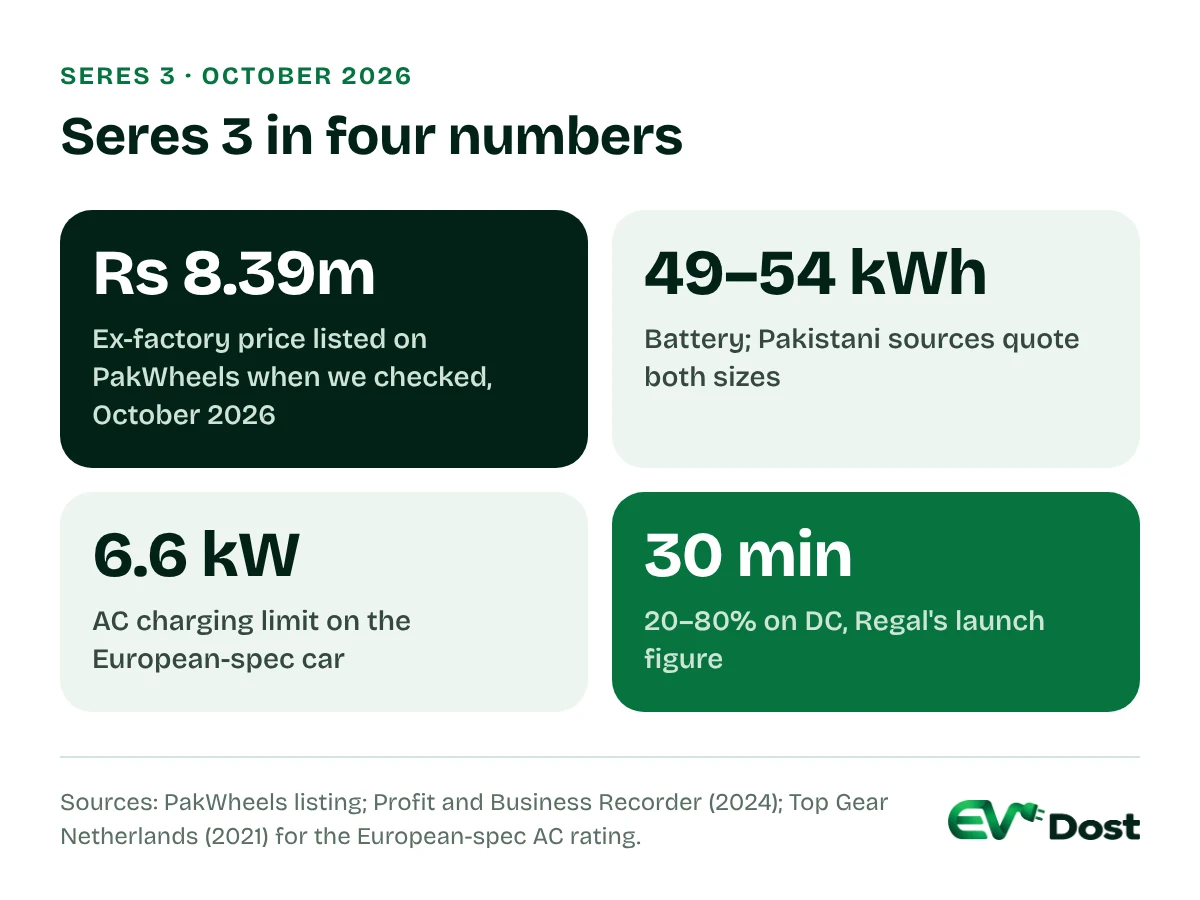
Take the price of a petrol Toyota Corolla Cross 1.8 X, add about Rs 455,000, and you can have an electric crossover of similar size, built in Lahore. That's the pitch for the Seres 3. As of October 2026, the Seres 3 price in Pakistan is Rs 8,390,000 ex-factory, the figure listed on PakWheels when we checked. That's the level Regal Automobiles cut it to from Rs 9.199 million in December 2023 (PakWheels, December 2023), and close to the Rs 8.399 million quoted when local assembly was approved in October 2024.
Regal Automobiles Industries, a joint venture of DFSK and the RP Group, assembles it at Manga Mandi on the outskirts of Lahore, and it was the first electric SUV to get an Engineering Development Board licence for local assembly (Business Recorder, October 2024). We couldn't find a 2026 news report confirming the price, so check it with a Regal dealer before you plan around it.
Since the Corolla Cross is the obvious petrol alternative, we begin with that sum.
The Corolla Cross question, in rupees per km
We use 18 kWh per 100 km on the road, close to the 17 kWh Top Gear Netherlands measured, plus 10 percent charging loss at home at Rs 55 a unit all-in (see how much it costs to charge at home). For the petrol rival we use the Corolla Cross 1.8 X at Rs 7,935,000 (PakWheels, September 2026), averaging PakWheels' 12 km/L city and 15 km/L highway figures to 13.5 km/L (PakWheels, Corolla Cross fuel average). Petrol is priced at Rs 377.71 a litre, the 24–26 October 2026 rate (Investify, October 2026), and is unlikely to stay there long.
- Seres 3 at home: about Rs 10.90 per km, or Rs 163,000 for 15,000 km a year.
- Seres 3 on public DC only: about Rs 20.70 per km.
- Corolla Cross 1.8 X: about Rs 28 per km, or Rs 420,000 a year.
That's a saving of roughly Rs 256,000 a year at 15,000 km, which covers the Rs 455,000 price gap in under two years. Our electric vs petrol cost comparison runs the same sum over five years.
Then there are the two BYDs
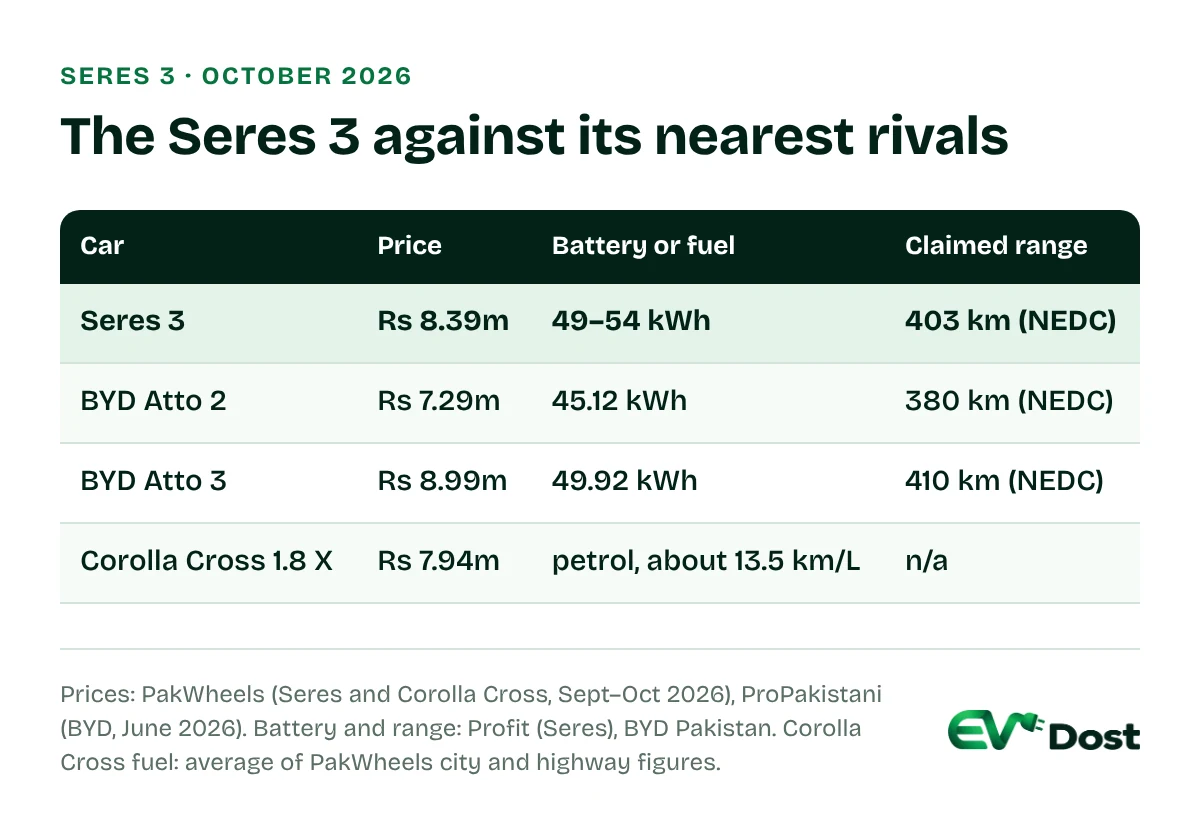
Line the Seres 3 price in Pakistan up against the wider EV price table and it lands between BYD's two smaller crossovers.
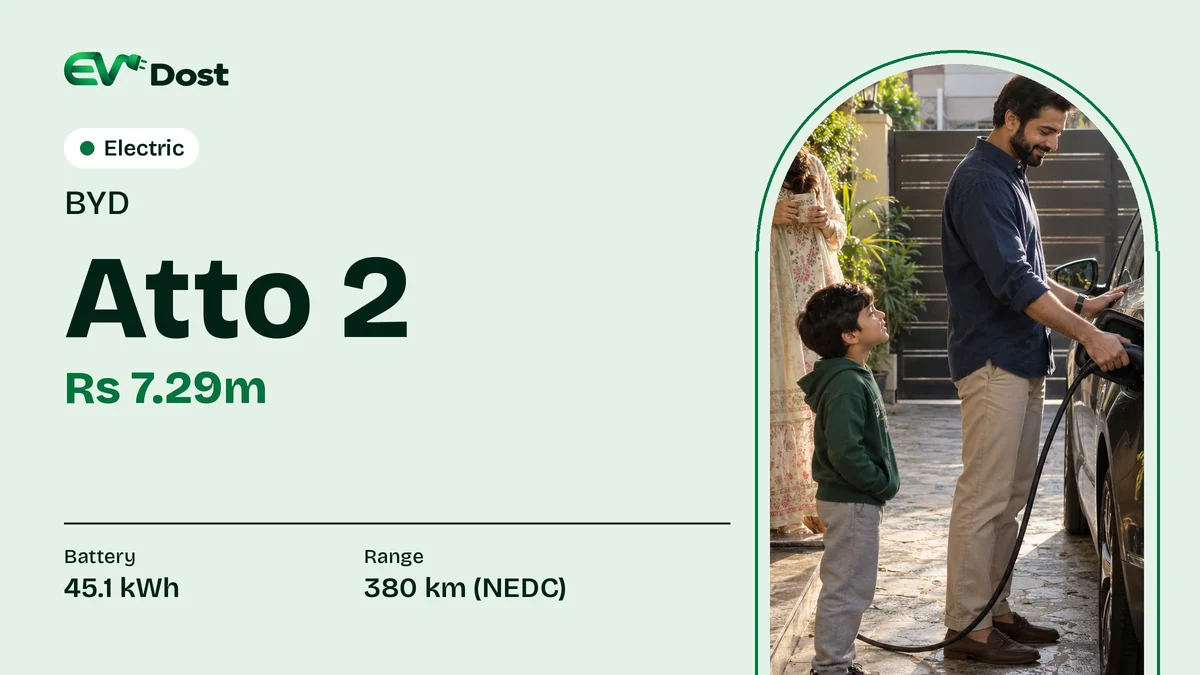
The BYD Atto 2 is about Rs 1.1 million cheaper, with a slightly smaller battery and a newer design. The BYD Atto 3 costs Rs 600,000 more and is also the more modern car. If home charging is doubtful, a range-extender like the Deepal S05 deserves a look.
Seres 3 price in Pakistan, and which battery you get
| Seres 3 EV | |
|---|---|
| Ex-factory price (October 2026 listing) | Rs 8,390,000 |
| Battery | 49.34 kWh or 54 kWh lithium-ion (see below) |
| Claimed range | 403 km (NEDC) |
| Motor | about 120 kW (161 hp), front-wheel drive |
| AC charging | 6.6 kW on the European-spec car; Pakistan figure not published |
| DC fast charging | 20–80% in about 30 minutes, CCS2 socket |
| Size | 4,385 mm long, 180 mm ground clearance, 526-litre boot |
| Airbags | six |
| Warranty | motor and battery 5 years or 150,000 km; battery extended to 8 years |
Sources: Regal's launch figures as reported by Profit (range, battery, DC time); PakWheels' model page (dimensions, socket, airbags); PakWheels' review, May 2025 (warranty, power); Top Gear Netherlands, 2021 (European AC rating).
49 or 54 kWh?
Pakistani sources quote both, and it isn't a typo. When Regal announced local assembly in October 2024, it described two versions at the same price: a "3.5" with 49 kWh and a "4.0" with 54 kWh, with pre-order customers getting the bigger battery (Profit, October 2024). The launch-day coverage then quoted 49.34 kWh, while PakWheels' current spec table says 54. Ask the dealer which pack your car carries, and get it on the invoice. The difference is worth roughly 25 km of real driving.
Range on the road, not the brochure
Regal's 403 km is an NEDC number, and NEDC flatters. In Europe the same car was rated at 329 km on WLTP (Top Gear Netherlands, 2021).
A PakWheels reviewer who drove one here put its everyday range at about 280 to 300 km on a full charge with the AC running, and only about 210 to 220 km at motorway speeds of 110 to 120 km/h, where consumption climbed to 21 to 23 kWh per 100 km (PakWheels, May 2025). Treat those as one driver's figures, not a lab test.
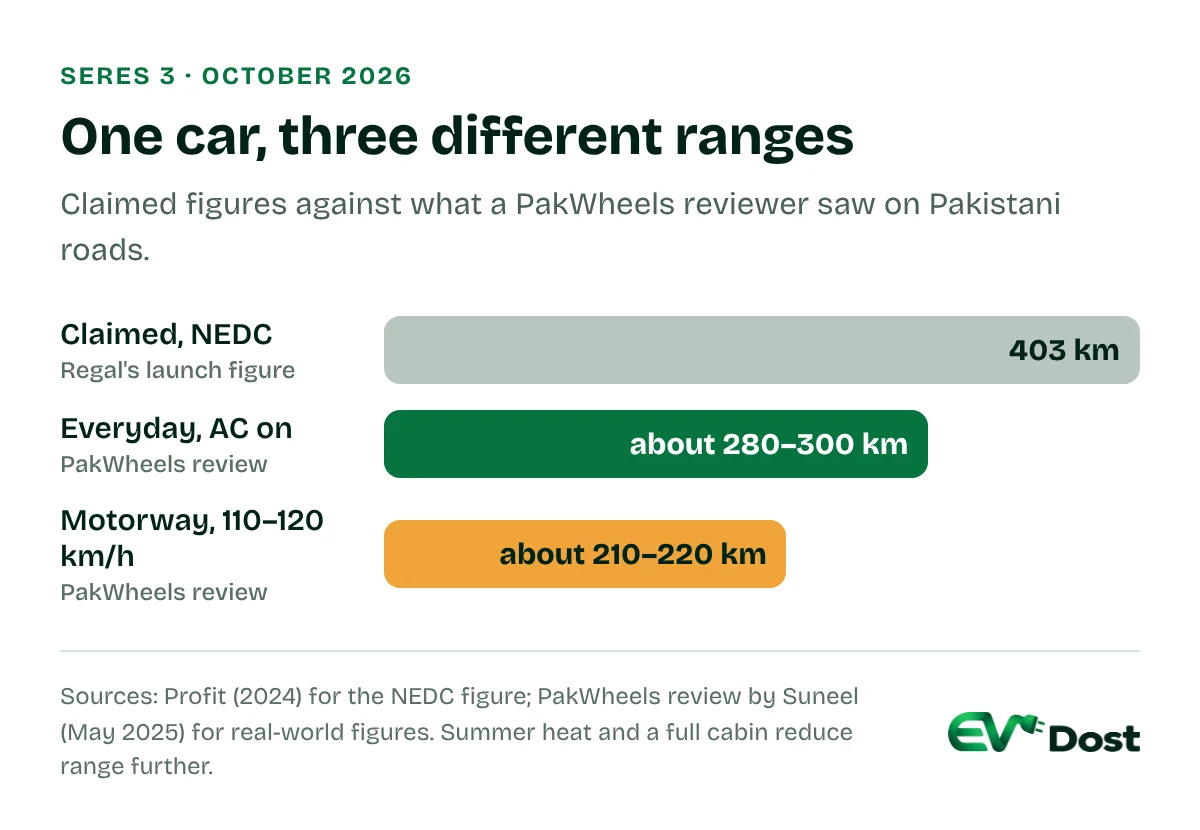
Add a Jacobabad or Multan June, four adults and the AC on full, and expect less again. Parking in shade and charging in the cooler hours helps, both of which slow battery ageing too.
The 22 kW launch charger, and why it may not help
At launch, Regal included a 22 kW charger with the car and quoted about 6 hours for a slow charge (Profit). Two things temper that.
First, a 22 kW wallbox needs a three-phase supply, which most Pakistani homes don't have. On single-phase, about 7 kW is the realistic maximum.
Second, the car itself sets the ceiling. The European-spec Seres 3 accepts 6.6 kW on AC, and Top Gear Netherlands found it drew only about 6 kW even from more powerful public units. Regal hasn't published the Pakistani car's AC rating. If it matches, a 22 kW charger fills it no faster than a 7 kW one.
On that assumption, our estimates (battery × 1.1 for losses ÷ 6.6 kW) are:
| From empty to full | 49.34 kWh | 54 kWh |
|---|---|---|
| 7 kW wallbox | about 8 h 15 min | about 9 h |
| 2.2 kW portable cable | about 24 h 45 min | about 27 h |
A full charge on a portable cable takes a whole day, so with this car, socket charging only works as a top-up. A 40 km day is about 8 units, three and a half hours on a 2.2 kW cable; anyone driving more should fit a wallbox. Sanctioned load and earthing are covered in our home charger installation guide.
Fast-charging stops on the motorway
The Seres 3 has a CCS2 socket, the standard at Pakistan's public DC chargers. Regal quotes 20 to 80 percent in about 30 minutes. In Europe, Seres claimed up to 100 kW peak but Top Gear's testers rarely saw more than about 70 kW; Pakistan-spec figures haven't been published.
A 20–80 percent stop puts in roughly 30 to 32 kWh, which costs about Rs 3,400 to Rs 3,700 at a typical Rs 115 per kWh. With about 210 km of motorway range, a Lahore to Islamabad run on the M-2 needs at least one stop. Our EV road trip guide covers planning around them.
Long trips are where EVDost fits for a car like this. If the fast charger at your planned stop is busy or down, sort host chargers nearby by distance, check the plug and power on the listing, and see the cost estimate for your model before you send a request. Find a charger on your route.
Built in Lahore, but not a new design
A lot counts in its favour. It's assembled locally, it gives you space and a big boot for the money, and the kit list runs to six airbags, a 360-degree camera and a panoramic sunroof. Add CCS2 fast charging and low running costs, and the value case is strong. Local assembly also puts it within reach of a bank loan, though, as our electric car financing guide shows, the cap on car loans leaves most of the price to find upfront.
The PakWheels reviewer found no native Android Auto or Apple CarPlay, and a stiff ride on rough motorway sections. The car was already on sale in Europe in 2021, so the design isn't new, and the battery-size confusion is a sign the paperwork needs checking.
Dealer coverage is a relative strength. Regal said in 2024 that it had 19 independent 3S dealerships (Profit, October 2024), which is better coverage than several newer EV brands. Regal's sales didn't appear in the PAMA-based monthly breakdowns we checked, so we can't say how many are on the road, and the thin used market makes resale hard to predict. Don't assume a resale value in three years.
Corolla Cross, BYD or Seres, who should pick which
We'd point a family towards the Seres 3 if they want crossover space without paying petrol prices to run it, can charge at home on a 7 kW wallbox, live within reach of a Regal dealer and keep cars for five years or more. It's a weaker pick for someone who does the M-2 every week or wants the newest tech. If home charging is doubtful, think hard before leaving the petrol Corolla Cross behind, and if a newer design matters more to you than space, start with the BYDs.
If that family sounds like yours, ask the dealer which battery your car carries and what its AC charging rating is before you sign anything.
Frequently asked questions
What is the Seres 3 price in Pakistan?
The Seres 3 costs Rs 8,390,000 ex-factory in Pakistan, as listed in October 2026, the level Regal Automobiles set when it cut the price from Rs 9.199 million in December 2023. Freight, registration and taxes are extra. Confirm the current price with a Regal dealer.
What is the real-world range of the Seres 3?
The Seres 3 is rated at 403 km on NEDC and was rated at 329 km on WLTP in Europe. A PakWheels reviewer in Pakistan put everyday range at about 280 to 300 km with the AC on, and about 210 to 220 km at motorway speeds.
How long does the Seres 3 take to charge?
The Seres 3 charges from 20 to 80 percent in about 30 minutes on a DC fast charger, according to Regal. At home, if the Pakistani car accepts 6.6 kW like the European one, a full charge takes about 8 to 9 hours on a 7 kW wallbox and a full day on a 2.2 kW portable cable.
Is the Seres 3 locally assembled?
Yes. The Seres 3 is assembled by Regal Automobiles Industries at its plant in Manga Mandi, Lahore, under an Engineering Development Board licence granted in 2024. It was the first electric SUV approved for local assembly in Pakistan.
Seres 3 or BYD Atto 2: which is better?
The BYD Atto 2 costs about Rs 1.1 million less, at Rs 7.29 million as of June 2026, and is the newer design. The Seres 3 is locally assembled and bigger, with a 526-litre boot. Choose the Atto 2 for value, the Seres 3 for space.
Sources
- PakWheels, Seres 3 EV listing (viewed October 2026): pakwheels.com
- PakWheels, Seres 3 model page: pakwheels.com
- PakWheels, Seres 3 price reduced (December 2023): pakwheels.com
- Business Recorder, Regal gets nod to assemble Seres 3 (October 2024): brecorder.com
- Profit, Regal launches Pakistan's first electric SUV (October 2024): profit.pakistantoday.com.pk
- Profit, first locally assembled Seres 3 rolled out (2024): profit.pakistantoday.com.pk
- PakWheels, Seres 3 review by Suneel (May 2025): pakwheels.com
- Top Gear Netherlands, Seres 3 review (May 2021): topgear.nl
- PakWheels, Corolla Cross price and fuel average (September 2026): price, fuel average
- Investify, petrol price from 24 October 2026: investify.pk
- ProPakistani, BYD prices after the budget (June 2026): propakistani.pk