Omoda E5 price in Pakistan, real range and charging costs (October 2026)
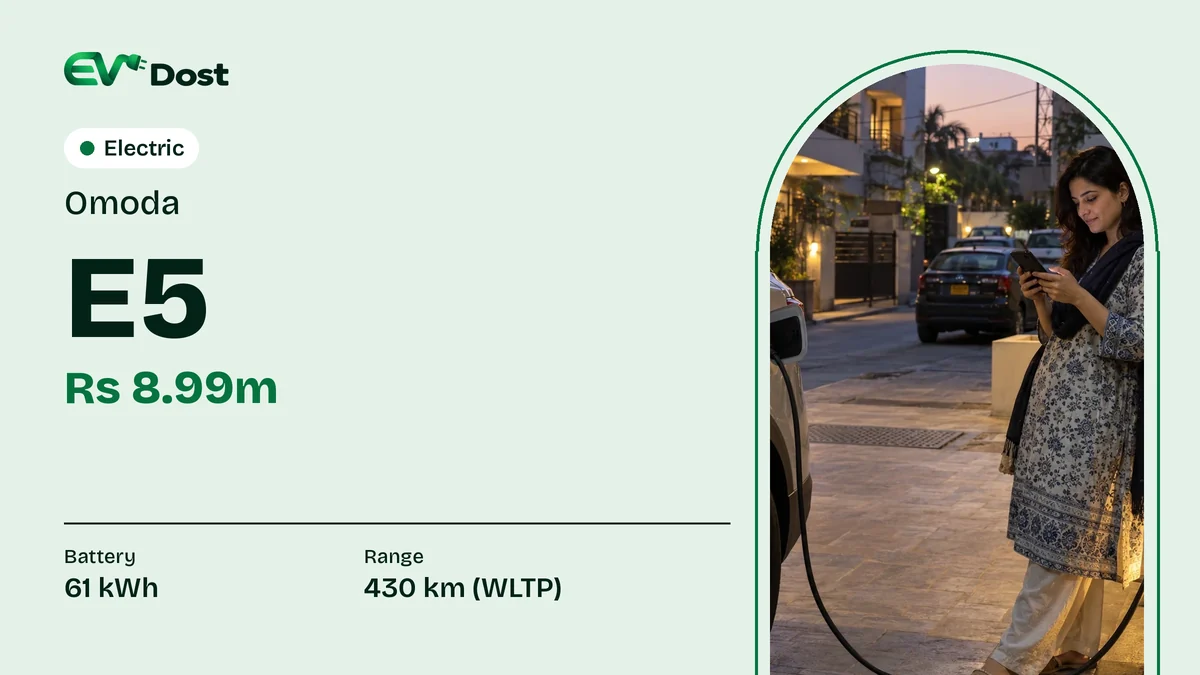
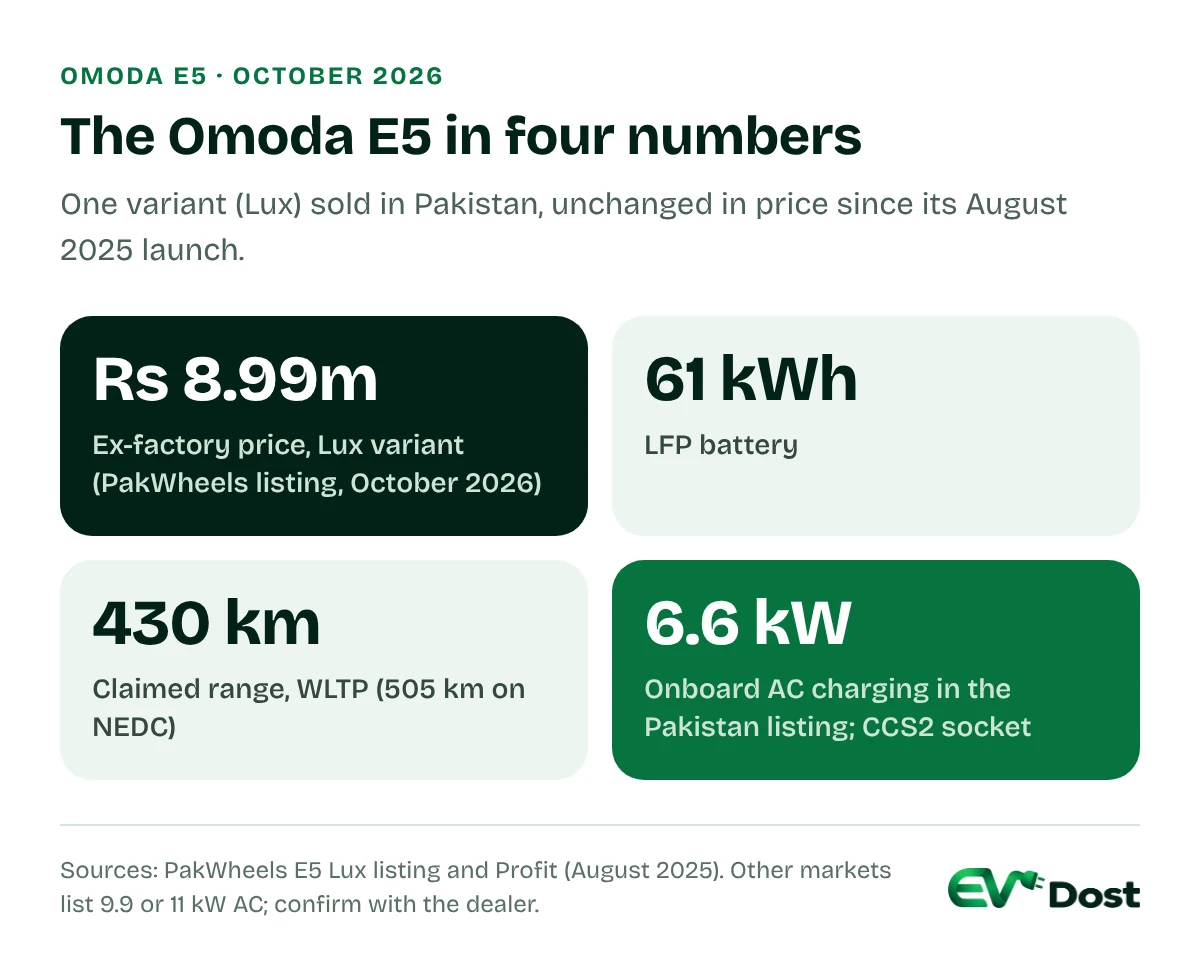
If you've been chasing EV prices that shift between one showroom visit and the next, the E5 makes a nice change. It hasn't moved since Nishat Group's NextGen Auto launched the car in August 2025, and Rs 8,990,000 was still the figure on dealer offers in August 2026 and on PakWheels in October 2026. That makes the Omoda E5 price in Pakistan unusually easy to pin down, with one variant, called Lux, at Rs 8.99 million ex-factory (Profit, August 2025; PakWheels).
That puts it at exactly the same sticker as the BYD Atto 3, with a bigger battery. Whether that makes it the better buy depends mostly on how you charge, which is what most of this page is about.
Omoda E5 price in Pakistan, one variant and its numbers
| Omoda E5 Lux | |
|---|---|
| Price | Rs 8,990,000 ex-factory (October 2026 listing) |
| Battery | 61 kWh lithium iron phosphate (LFP) |
| Claimed range | 430 km WLTP, 505 km NEDC |
| Motor | 150 kW (204 hp), 340 Nm, front-wheel drive |
| AC charging | 6.6 kW in the Pakistan listing |
| DC charging | 10–80% in about 39 minutes (Pakistan listing) |
| Socket | CCS2 |
| Battery warranty | 8 years or 160,000 km |
| Sold by | NextGen Auto (Nishat Group), Omoda & Jaecoo dealers |
| Built | Treat as imported; Nishat names only the J7 and J5 as locally assembled |
Sources: PakWheels E5 Lux listing for price, charging, socket and warranty; PakWheels, August 2025 and Profit, August 2025 for the battery, ranges and motor. When the brand talks about local assembly, it names the Jaecoo J7 PHEV and J5 HEV, not the E5 (ProPakistani, April 2026), and we found no announcement that the E5 is built here.
Will the price hold?
Nobody has announced a change to the Omoda E5 price in Pakistan. An August 2026 offer from a Rahim Yar Khan dealer put the E5 on 40 percent down with the rest in interest-free monthly instalments, "while stocks last", at the same Rs 8.99 million; it ran until 10 September 2026 (ProPakistani, August 2026). Earlier, in April 2026, a limited offer bundled a free 11 kW home charger, with no end date given (Gari.pk, April 2026). The instalment deal has closed and the charger offer may have too, so ask what's included this month. Also budget for registration and token tax, which the ex-factory price leaves out.
Charging specs that change by market
The E5's charging figures aren't the same everywhere. The Pakistani PakWheels listing gives a 6.6 kW onboard AC charger and a 39-minute 10–80% DC charge (PakWheels). Malaysia's launch spec quoted 9.9 kW AC and 80 kW DC, with 30–80% in about 30 minutes (Carlist.my), and the UK database lists 11 kW AC and up to 130 kW DC for the European car (EV Database). Same name, different hardware by market.
For most Pakistani homes, the difference matters less than it sounds. A single-phase connection tops out around 7 kW, so even a car that accepts 11 kW will charge at about 7 kW on a typical DHA or Gulberg wallbox. The free 11 kW charger in that April offer would need a three-phase supply to run at full power. Our home charger guide explains how to check your sanctioned load before you buy one.
Overnight on a wallbox
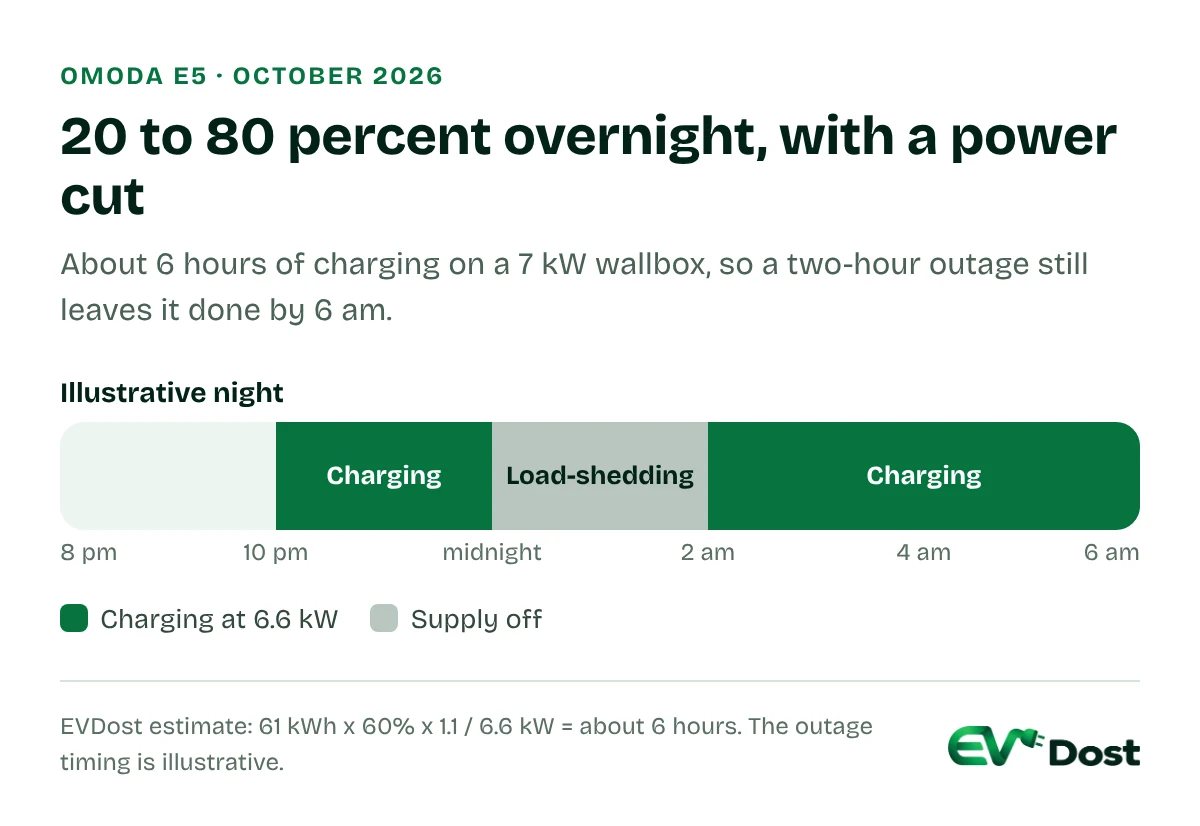
These use our usual sum (battery energy × 1.1 for charging losses ÷ the charging power) and the 6.6 kW limit from the Pakistani listing.
- The everyday 20 to 80 percent top-up takes about 6 hours on a 7 kW wallbox.
- 10 to 80 percent takes about 7 hours.
- Empty to full takes about 10 hours 10 minutes, close to the 9 hours PakWheels quotes.
- On a 2.2 kW portable cable, 20 to 80 percent takes about 18 hours, so treat the cable as a backup.
A 61 kWh battery is big for this price — good for range, slower to refill. If your car does 40 km a day, though, you're putting back only about 8 units a night, a bit over an hour on the wallbox.
No wallbox of your own? Check what's near your office or home before you commit. A search on EVDost with the E5 selected shows nearby host chargers, the hourly price each host has set and a cost estimate worked out for the E5. Check chargers near you.
Fast charging through CCS2
The E5 sold here has a CCS2 socket, which is what most public DC chargers in Pakistan use, so there's no adapter to worry about. At 39 minutes for 10–80% it's no record-breaker, but it's fine for a tea stop at Bhera on the M-2. If you're new to the plugs, our guide to them explains each one.
Range once the AC is running
The 430 km WLTP figure is the honest one to use; the 505 km NEDC number is a lab figure from an older, kinder test. Using 18 kWh per 100 km, the figure we use across our guides for a compact EV on the road, a full 61 kWh battery works out to roughly 340 km.
A Lahore June afternoon is harder. With the AC on full and the cabin baking, consumption can rise by a fifth or more, which would bring that down to something like 280 km. That 280 km is our estimate, and your driving, speed and tyres will move it either way. For daily city use none of this matters much. For a run from Lahore to Islamabad, plan one charging stop rather than hoping to make it in one go. Keeping the battery healthy in that heat is covered in our battery care guide.
Rupees per kilometre, E5 against a Jolion
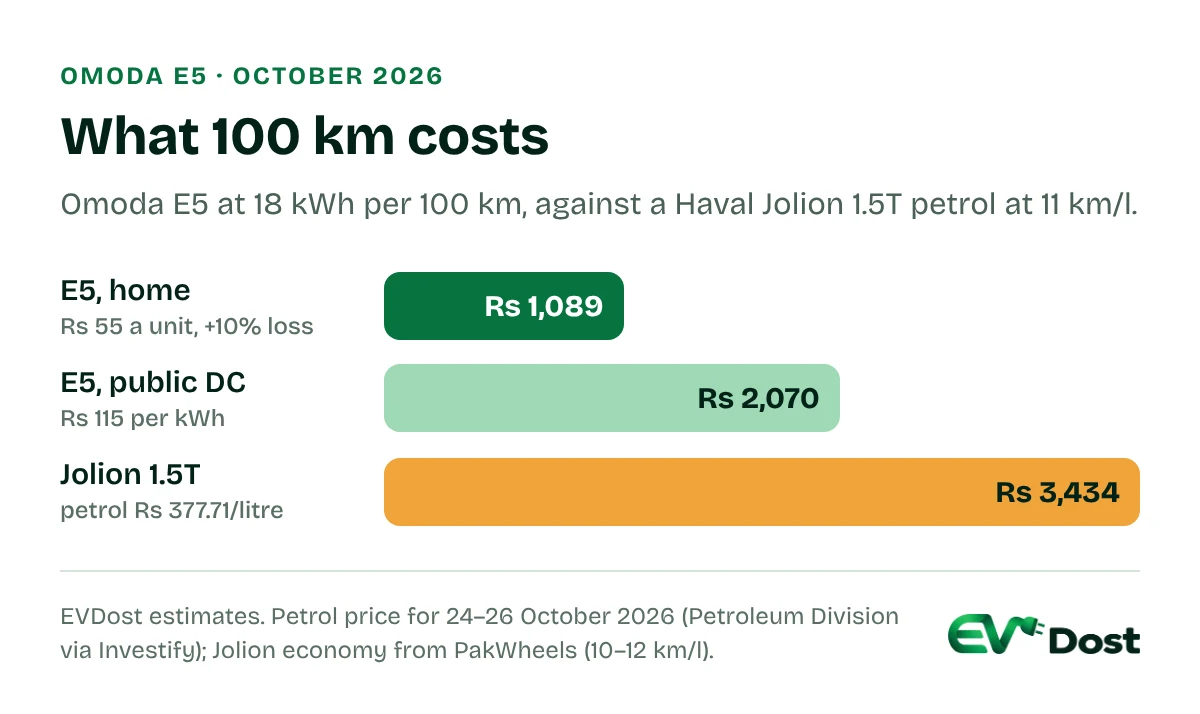
We compare the E5 with a Haval Jolion 1.5T, a petrol crossover a buyer at this budget would also look at. PakWheels gives the Jolion 10 to 12 km per litre, so we use 11 (PakWheels). The petrol price used is Rs 377.71 a litre, from a Petroleum Division notification for 24–26 October 2026 (Investify, October 2026). It may well have changed since.
- E5 charged at home, at about Rs 55 a unit all-in: about Rs 10.90 per km.
- E5 on public DC, at about Rs 115 per kWh: about Rs 20.70 per km.
- Jolion 1.5T on petrol: about Rs 34.30 per km.
Over 1,500 km a month, that's about Rs 16,300 charging at home, Rs 31,000 on public DC alone, and Rs 51,500 in petrol. The home rate and how we arrive at it are explained in our guide to charging costs.
Strengths, and the weak spots to weigh
The big plus is more battery for the money than its closest rival. At Rs 8.99 million you get 61 kWh, against the Atto 3's 49.92 kWh at the same price (BYD Pakistan). The LFP chemistry copes well with regular charging to high levels, the Pakistani listing carries an 8-year, 160,000 km battery warranty, and CCS2 comes from the factory, so it works at Pakistani public chargers. With a single variant, there's no trim maze to decode either.
The weak spots are mostly about charging and newness. AC charging is slow if the 6.6 kW figure holds, and that matters more with a big battery. Charging specs differ across markets, so get the Pakistani figure in writing. It's imported, not locally assembled, and the brand is newer here, so resale values are still unknown. Fast charging is middling for 2026.
Atto 3, J6 and the rest of the bracket
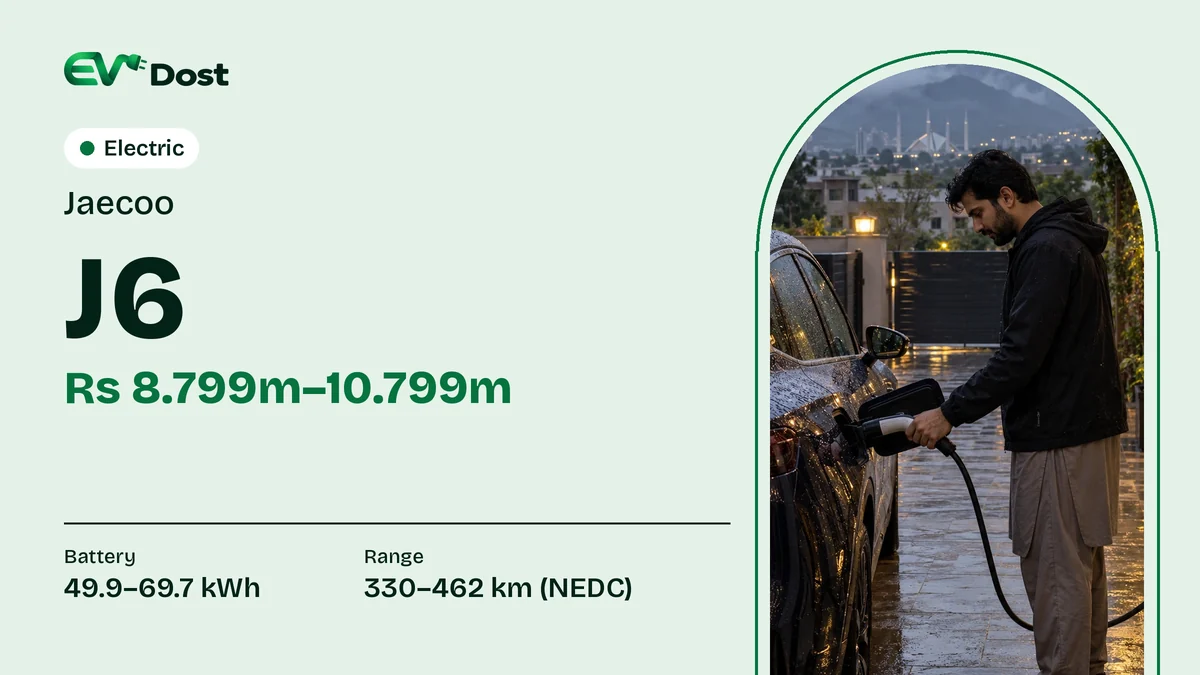
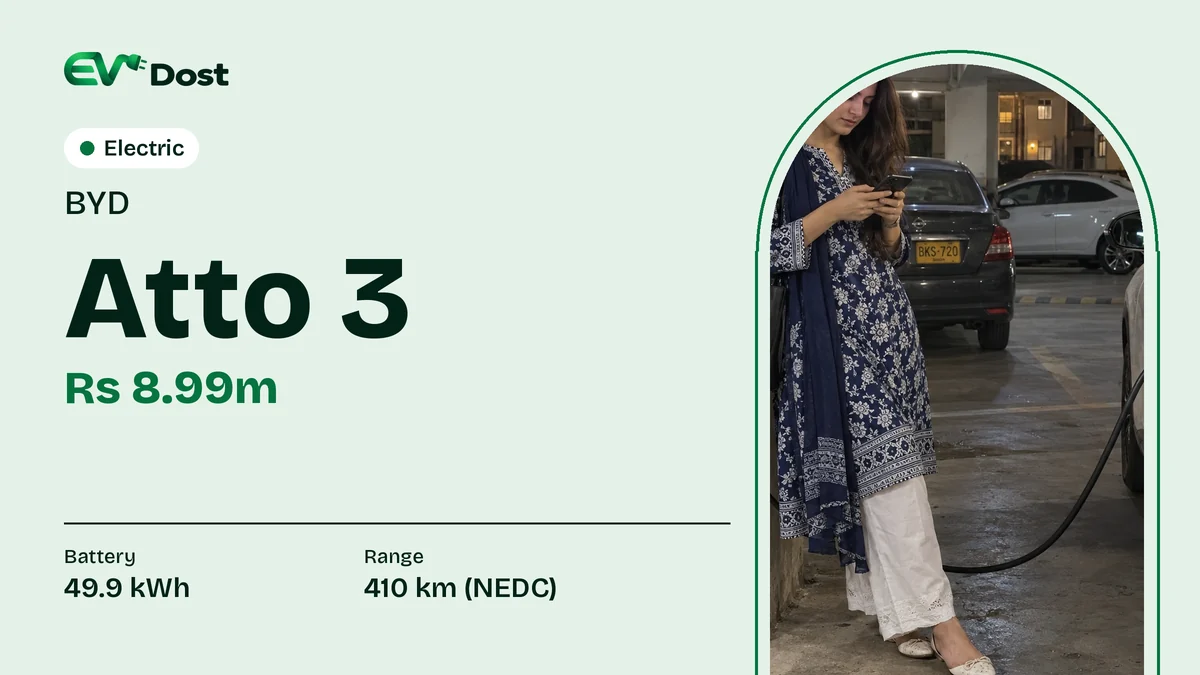
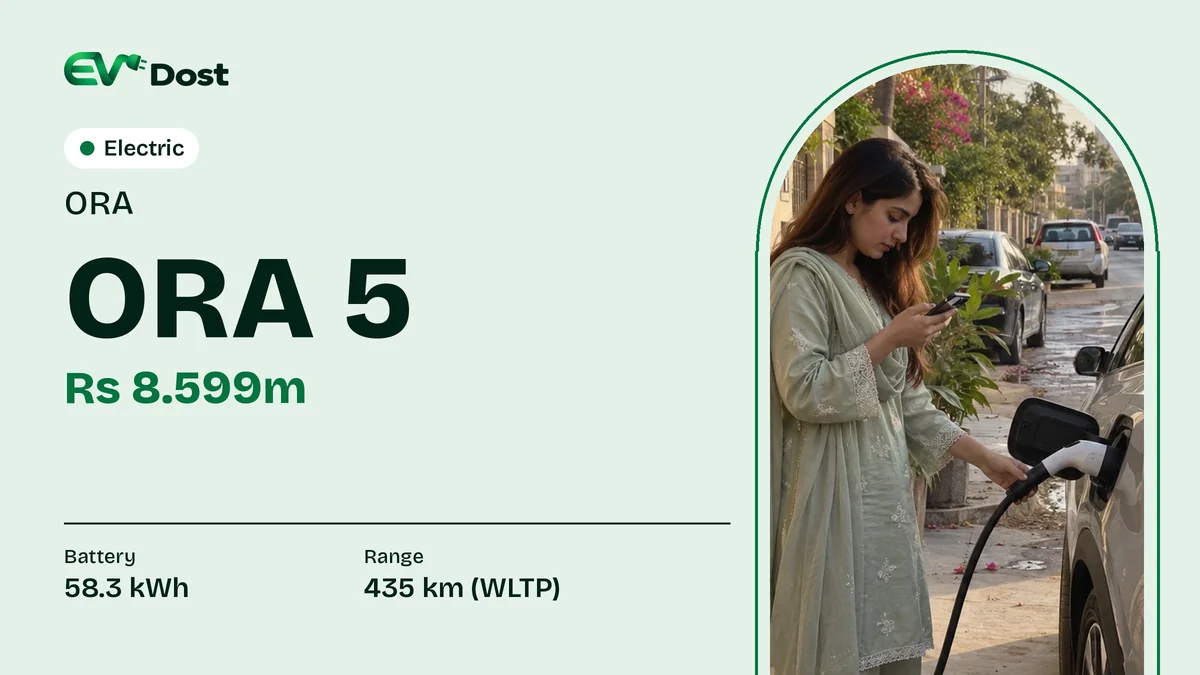
The obvious comparison is the BYD Atto 3, also Rs 8.99 million as of June 2026 (ProPakistani, June 2026). BYD has a longer track record here and a wider dealer network; the E5 has the bigger battery. Another crossover to put on the list is the ORA 5, at Rs 8,599,000 ex-factory (launch price, August 2026) with a 58.33 kWh battery (ProPakistani, August 2026). The E5's own stablemate, the Jaecoo J6, costs a little less in its 49.9 kWh form and adds rear-wheel drive and a boxier SUV body, but its range claims are on the older NEDC cycle. If your budget can stretch, the J6's 65.6 kWh version at Rs 9.899 million has the biggest claimed range of the J6 line-up, 462 km on NEDC, though that's still short of the E5's own 505 km on the same test.
Going the other way, the Seres 3 costs less and is assembled in Lahore, if local assembly matters to you. For everything else in this bracket, our electric car price list has the current figures.
The family the E5 fits
It suits a family with off-street parking and a wallbox, driving mostly in the city with the occasional motorway trip, who wants as much battery as Rs 9 million buys. It suits less well if you live in an apartment with no charger, since a big battery on slow AC is harder to keep topped up away from home.
And if a 7 kW wallbox is already fitted in your porch, the E5 slots straight into your routine.
Frequently asked questions
What is the Omoda E5 price in Pakistan?
The Omoda E5 costs Rs 8,990,000 ex-factory in Pakistan as of October 2026, for the single Lux variant. That's the same price it launched at in August 2025. Registration, token tax and any charger installation come on top.
What is the range of the Omoda E5?
The Omoda E5 has a claimed range of 430 km on the WLTP cycle (505 km on the older NEDC cycle) from its 61 kWh battery. By our estimate it's nearer 340 km in normal driving, and less in peak summer with the AC working hard.
How long does the Omoda E5 take to charge at home?
The Omoda E5 takes about 6 hours from 20 to 80 percent on a 7 kW wallbox, and about 10 hours from empty to full, by our estimate using the 6.6 kW onboard charger in the Pakistani listing as of October 2026. On a public DC charger, PakWheels lists 10–80% in about 39 minutes.
Is the Omoda E5 better than the BYD Atto 3?
The Omoda E5 gives you more battery for the same money, 61 kWh against 49.92 kWh, both at Rs 8.99 million as of mid-to-late 2026. The Atto 3 has the longer track record and wider dealer network in Pakistan. If range matters most, the E5 has the edge; if service reach matters more, look hard at BYD.
Does the Omoda E5 work with Pakistani charging stations?
The Omoda E5 works with Pakistani charging stations: the car sold here has a CCS2 socket, which is the plug most public DC chargers in Pakistan use, and it charges on Type 2 AC chargers too. No adapter is needed.
Sources
- Profit, Omoda E5 launch (August 2025): profit.pakistantoday.com.pk
- PakWheels, Omoda E5 launch (August 2025): pakwheels.com
- PakWheels, Omoda E5 Lux listing (October 2026): pakwheels.com
- ProPakistani, E5 and J6 instalment offer (August 2026): propakistani.pk
- Gari.pk, E5 limited-time offer (April 2026): gari.pk
- ProPakistani, Omoda & Jaecoo in 64 markets and local assembly (April 2026): propakistani.pk
- Carlist.my, Omoda E5 Malaysian specification: carlist.my
- EV Database, Omoda E5 (UK specification): ev-database.org
- PakWheels, Haval Jolion listing (October 2026): pakwheels.com
- Investify, petrol price 24–26 October 2026: investify.pk
- BYD Pakistan, Atto 3: byd-mega.com
- ProPakistani, BYD prices after the budget (June 2026): propakistani.pk
- ProPakistani, ORA 5 launch (August 2026): propakistani.pk