Honri VE price in Pakistan: VE 2.0 or VE 3.0?
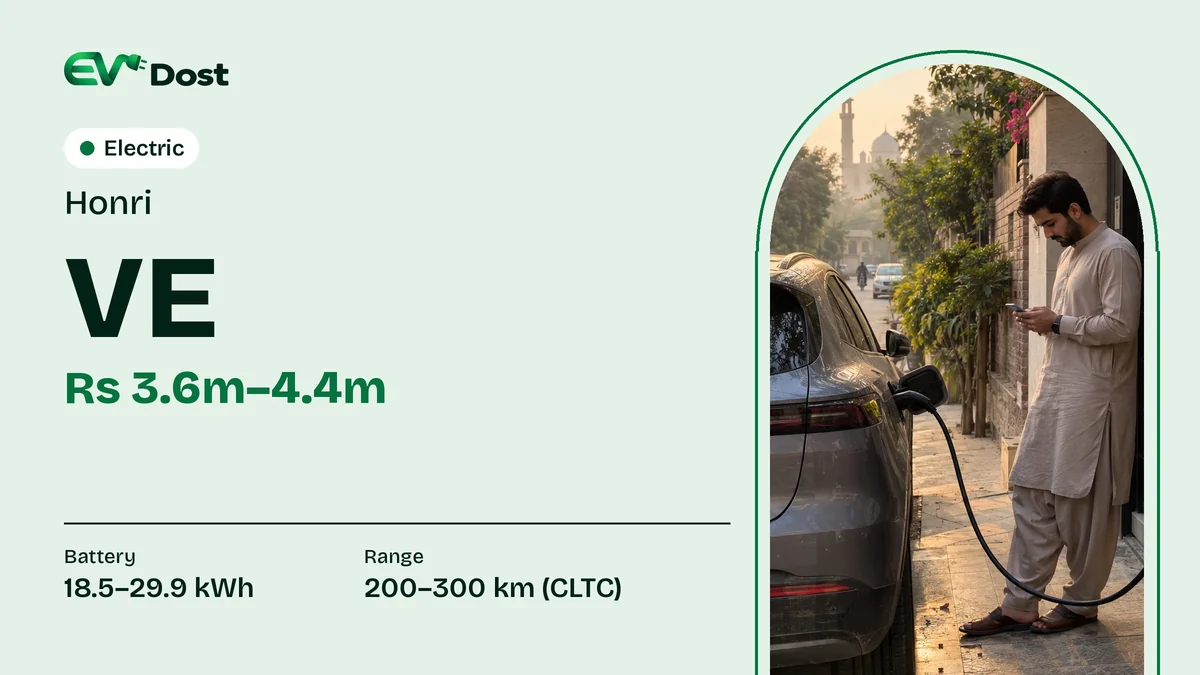
If the idea of an electric car appeals but a wallbox doesn't, the Honri VE is probably where you'll start looking. It's built in Sujawal, Sindh, by Dewan's Eco-Green Motors, and it's one of the cheapest new electric cars in Pakistan, as well as one of the few assembled here. As of September 2026, the Honri VE price in Pakistan is Rs 3,599,000 for the VE 2.0 and Rs 4,399,000 for the VE 3.0, ex-factory, according to PakWheels' September 2026 buying guide. They match the Rs 600,000 cut Dewan announced as a limited-time offer in December 2025, and listings have carried them since (BOL News, December 2025).
It is a small, tall hatchback, about 3.5 metres long, with a top speed of 100 km/h. Think school runs, office commutes and trips to the bazaar rather than the M-2. The two versions share a body but differ in ways that matter more than the badge suggests, especially once you plug in. And plugging in is the first thing to understand, because this is a car built around the wall socket.
A wall-socket car, and probably not a fast-charging one
This is where the VE suits Pakistani homes. Dewan supplies a 220V charging cable with the car and quotes about 7 hours from empty to full (PakWheels, September 2024).
That 7-hour figure deserves a closer look. For the 2.0 it fits, since 18.5 kWh through a 3.3 kW onboard charger takes a little over six hours by our sum (battery × 1.1 for losses ÷ charging power). For the 3.0, it doesn't. Putting 29.9 kWh in over 7 hours needs nearly 5 kW from the wall, more than an ordinary socket circuit is meant to supply. On a typical 2.2 kW portable cable, expect closer to 15 hours for the 3.0 from empty, and about 5 hours on a 7 kW wallbox.
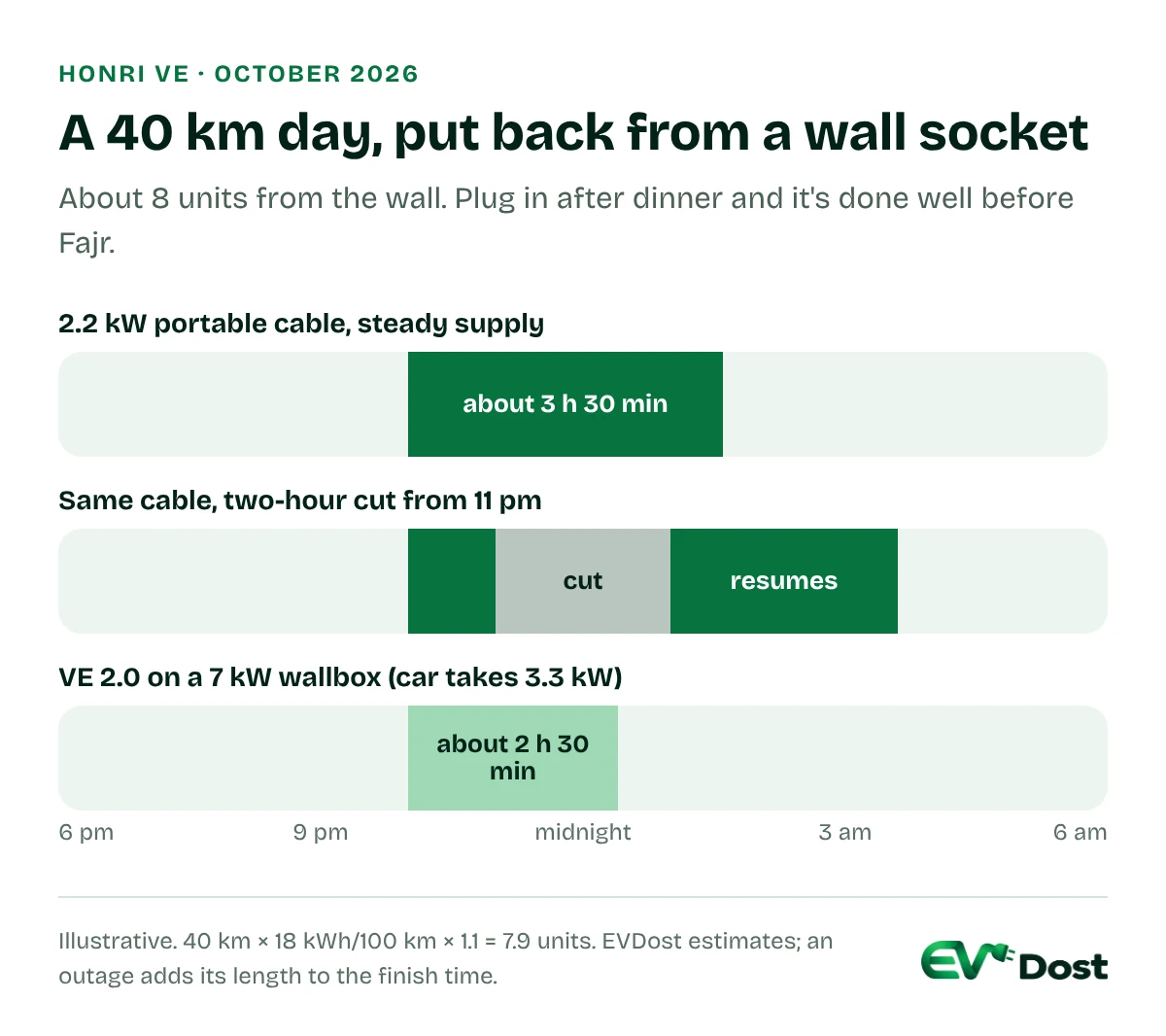
Most owners never charge from empty, though. A 40 km day needs about 8 units from the wall, which is three and a half hours on a 2.2 kW cable. Plug in after dinner and it's done before you're up, even with a two-hour load-shedding cut in the middle. Our plan for charging through load-shedding covers the worse days.
Socket charging is safe when the socket is right. The cable draws 9 or 10 amps for hours, so:
- Use a heavy-duty socket on its own circuit, checked by an electrician, with a working earth.
- Never run it through an extension board or a multi-plug.
- If the plug or socket feels hot, stop and get the wiring looked at.
Sanctioned load, earthing and when a wallbox is worth it are covered in our home charging setup guide.
And fast charging?
Don't buy a VE counting on it. PakWheels' spec page lists a 30-minute 10–80 percent DC charge for the 3.0, but the same page shows a Type 2 socket, Dewan's launch material for the 3.0 describes only AC charging, and PakWheels' own 2026 buying guide lists AC home charging only. The 2.0 shows no DC figure at all. Until a dealer shows you a CCS2 inlet on the car in front of you, treat the VE as an AC-only car. For a city car, that's less of a handicap than it sounds.
No socket of your own
If you live in a flat without a socket you can use, a slow car like this is an awkward fit. Hosts on EVDost price their chargers by the hour (how EVDost works explains the billing), so a VE 2.0 drawing 3.3 kW pays the same hourly rate as a car taking 7 kW. Sort by best price, check the cost estimate for the VE, and look up chargers close by.
Honri VE price in Pakistan, side by side
| VE 2.0 | VE 3.0 | |
|---|---|---|
| Ex-factory price (Sept 2026) | Rs 3,599,000 | Rs 4,399,000 |
| Battery | 18.5 kWh, ternary lithium | 29.9 kWh, lithium iron phosphate (LFP) |
| Claimed range | 200 km (CLTC) | 300 km (CLTC) |
| Range on WLTP, PakWheels' conversion | about 164 km | about 246 km |
| Motor | 30 kW (40 hp), 84 Nm | 35 kW (47 hp), 87 Nm |
| Onboard AC charger | 3.3 kW | 6.6 kW |
| Charging socket | Type 2 | Type 2 |
| Battery warranty | 8 years or 120,000 km | 8 years or 120,000 km |
Specs come from PakWheels' pages for the VE 2.0 and VE 3.0, and the WLTP conversions from its September 2026 guide. Prices exclude freight, registration and taxes. There's one wrinkle. PakWheels' model overview calls the 2.0's battery LFP, while its spec page and Dewan's 2024 launch material say ternary lithium. Ask the dealer which pack your car has, because LFP is generally the more tolerant chemistry in heat.
The VE 2.0 as a second car, the VE 3.0 as a main one
For most buyers the decision comes down to two numbers, battery size and the onboard charger.
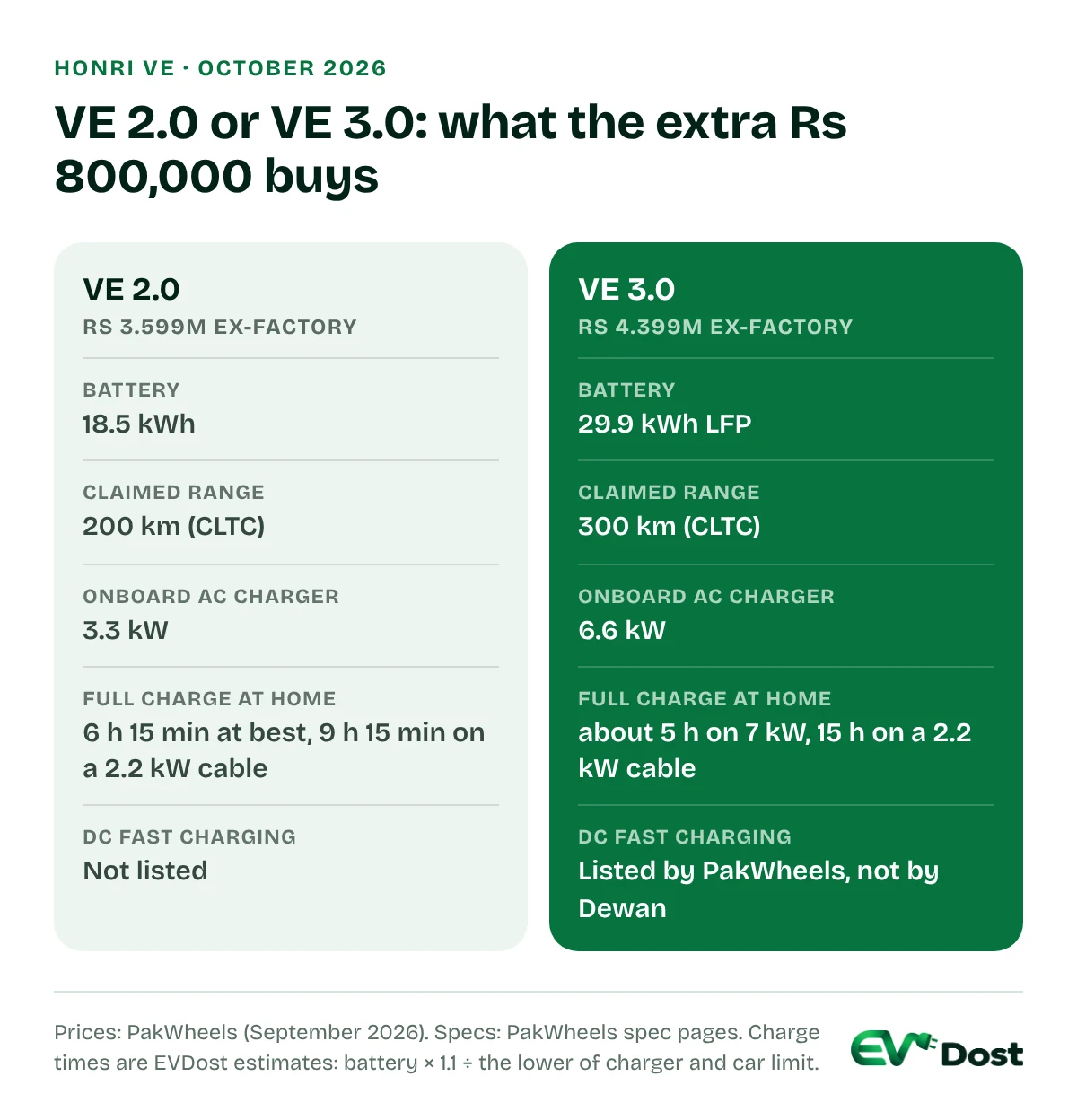
The VE 2.0 is a second car. With 18.5 kWh, one owner on PakWheels reports 175 km at most on a charge, and in a Lahore June with the AC running hard you should plan for less. Its 3.3 kW onboard charger caps a full charge at about 6 hours 15 minutes however powerful the charger on the wall is, against about 9 hours 15 minutes on a 2.2 kW portable cable. A 7 kW wallbox is wasted on this car.
The VE 3.0 costs Rs 800,000 more and gets a battery 60 percent bigger, plus a 6.6 kW onboard charger that can use a single-phase wallbox properly. That makes it the only version we'd suggest for a household's main car, or for someone in Karachi who crosses from Gulshan to Clifton and back every day.
The fuel bill next to an Alto
We run the same sums for every small EV. That means 18 kWh per 100 km on the road, 10 percent lost when charging at home and about Rs 55 a unit all-in (our charging cost guide explains the basis).
Petrol is taken at Rs 377.71 a litre, the Petroleum Division's price for 24–26 October 2026 (Investify, October 2026). Pump prices have been revised almost daily of late.
For the petrol car, we picked the Alto VXL AGS at Rs 3,326,446 (ProPakistani, July 2026), at 17 km per litre, the middle of PakWheels' 16 to 18 km/L city range (PakWheels, April 2026).
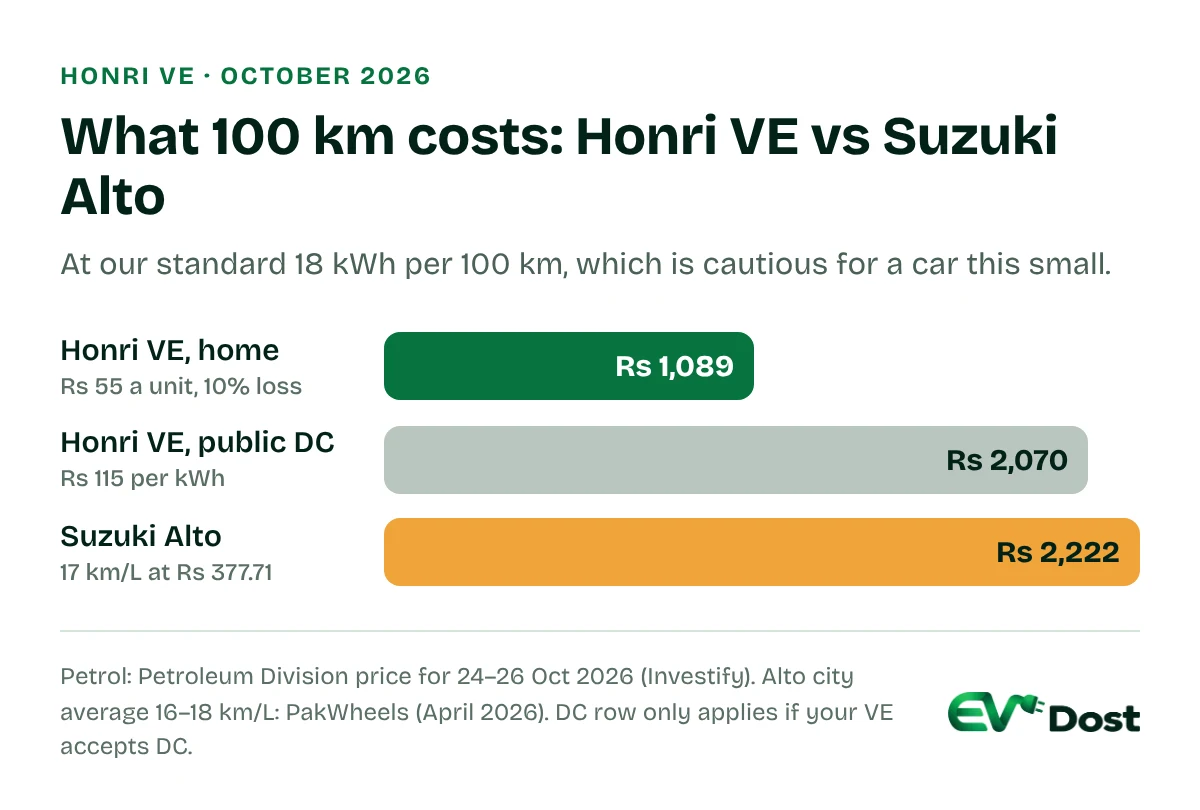
At 1,000 km a month, home charging costs about Rs 10,900 against roughly Rs 22,200 in petrol for the Alto, a saving of about Rs 11,300 a month. Our 18 kWh figure is cautious for a car this light, so your real bill will probably be lower.
Purchase price narrows the gap. The VE 2.0 costs about Rs 273,000 more than the Alto VXL AGS, which the fuel saving covers in about two years at that mileage. The VE 3.0 is about Rs 1.07 million dearer, closer to eight years of savings at 1,000 km a month. On fuel alone, then, the 2.0 pays its way quickly as a second car, while the 3.0 makes sense mainly if you drive a lot.
Low sales, and what that means for service and resale
The VE is a low-volume car. Monthly sales tables based on PAMA data show 30 sold in April 2026 (PakWheels, May 2026) and 42 in September 2026, down from 75 in August (Pakistan Observer, October 2026).
That has consequences. Mechanics outside Dewan's dealer network won't know the car, body panels may take time to arrive, and the used market is thin, so resale is hard to predict. The 8-year battery warranty helps, and local assembly means Dewan has a factory here rather than only a showroom. Before you buy, ask where the nearest service point is to your home, and how long a typical parts order takes. Our used electric car guide has more on resale risk.
Other small electric cars to look at
For a new car, the Honri VE price in Pakistan sits near the bottom of our list of every main electric car price, alongside small city cars such as the Inverex XIO and the GUGO GIGI.
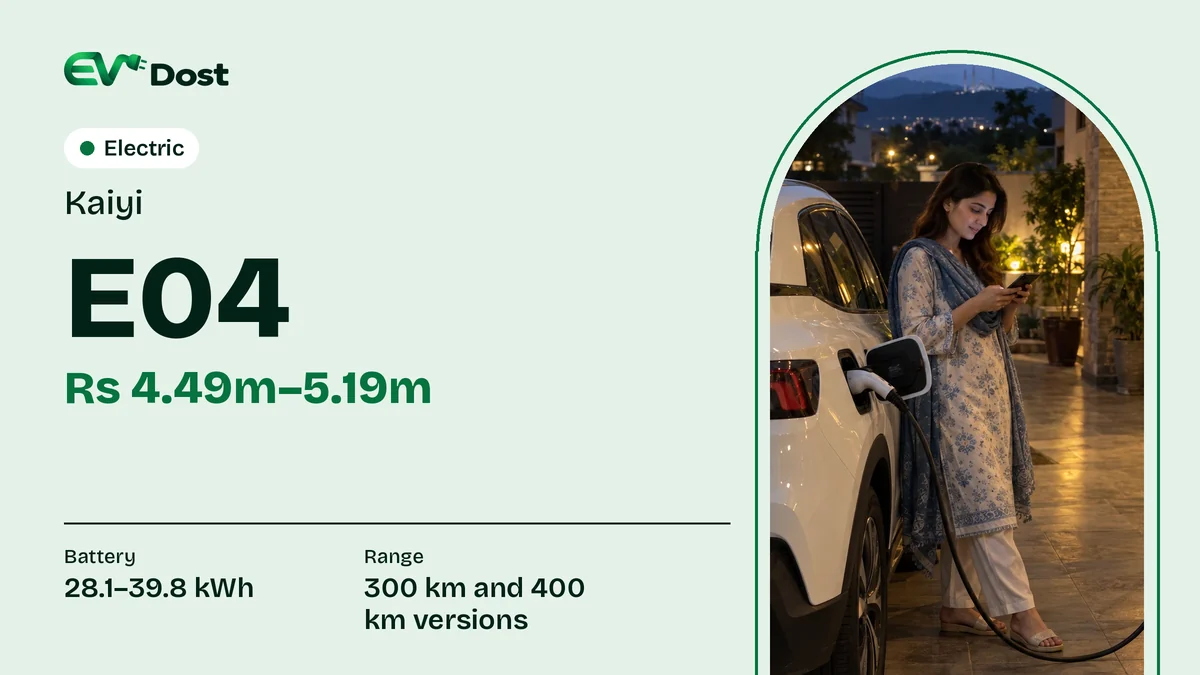
The Kaiyi E04 costs about the same as a VE 3.0, at Rs 4.49 million for the 300 km version with a 28.08 kWh battery as of October 2026 (PakWheels, October 2026), and is a bigger car with DC charging, but it comes from a brand-new distributor and is imported. Step up to around Rs 5.5 million and the Dongfeng Box Smart 330 gives you a larger battery and CCS2 fast charging.
Who each VE suits
The case for the VE is easy to make. It's one of the cheapest new EVs you can buy, it's assembled locally with an 8-year battery warranty, and it charges overnight from a proper home socket, so the 2.0 needs no wallbox at all. The tiny footprint suits old-city streets and tight parking, and PakWheels' listing shows two airbags. Local assembly also means a bank can lend on it, and our walk-through of financing an EV prices a three-year loan on the VE 3.0.
Its limits are obvious too. With a 100 km/h top speed and modest power, it isn't a motorway car. The 2.0's range gets tight once the AC is on in summer, and with DC fast charging unconfirmed, long trips are out. Low sales also mean a thin dealer and resale market.
The VE 2.0 suits a family adding a second car for school and errands, with a socket in the porch and a petrol car for trips. The VE 3.0 suits a single commuter who drives 40 to 80 km a day in the city and wants the lowest running cost from a locally built car.
Still torn between the two? Drive the 3.0 on your real commute, with the AC on, before you decide.
Frequently asked questions
What is the Honri VE price in Pakistan?
The Honri VE costs Rs 3,599,000 for the VE 2.0 and Rs 4,399,000 for the VE 3.0, ex-factory, as of September 2026. Dewan cut both by Rs 600,000 in December 2025 as a limited-time offer on limited stock, and listings have carried those prices since. Freight, registration and taxes are extra.
How far does a Honri VE go on a full battery?
The Honri VE 2.0 is rated at 200 km and the VE 3.0 at 300 km, both on China's generous CLTC cycle. PakWheels converts these to about 164 km and 246 km on WLTP, and one VE 2.0 owner reports 175 km at most. Expect less in summer with the AC on.
Can I charge the Honri VE from a normal socket at home?
Yes. The Honri VE comes with a 220V charging cable, and the VE 2.0 accepts only 3.3 kW anyway, so a wallbox saves only about three hours on a full charge. Use a heavy-duty socket on its own earthed circuit, never an extension board. A VE 3.0 takes about 15 hours from empty on a 2.2 kW cable.
Does the Honri VE support fast charging?
The Honri VE should be treated as AC-only until a dealer confirms otherwise. PakWheels lists a 30-minute DC charge for the VE 3.0, but it also lists a Type 2 socket, and Dewan's launch material mentions only AC charging. The VE 2.0 has no DC figure.
Is the Honri VE better than the Kaiyi E04?
The Honri VE is cheaper to start and locally assembled, with an 8-year battery warranty. The Kaiyi E04 is a larger car with DC charging for similar money to the VE 3.0 (Rs 4.49 million with a 28.08 kWh battery as of October 2026), but it's imported by a new distributor. Pick the VE for a short-range city car with a known local assembler.
Sources
- PakWheels, electric cars under Rs 60 lakh (September 2026): pakwheels.com
- BOL News, Honri VE price cut (December 2025): bolnews.com
- PakWheels, Honri VE 2.0 specifications: pakwheels.com
- PakWheels, Honri VE 3.0 specifications: pakwheels.com
- PakWheels, first locally assembled Honri VE (September 2024): pakwheels.com
- Investify, petrol price from 24 October 2026: investify.pk
- PakWheels, Kaiyi e-Qute 04 listing (October 2026): pakwheels.com
- ProPakistani, Kaiyi vs Alto (July 2026): propakistani.pk
- PakWheels, fuel-efficient petrol cars (April 2026): pakwheels.com
- PakWheels, car sales April 2026 (May 2026): pakwheels.com
- Pakistan Observer, car sales September 2026 (October 2026): pakobserver.net