Dongfeng Box price in Pakistan: which of the three versions to buy (October 2026)
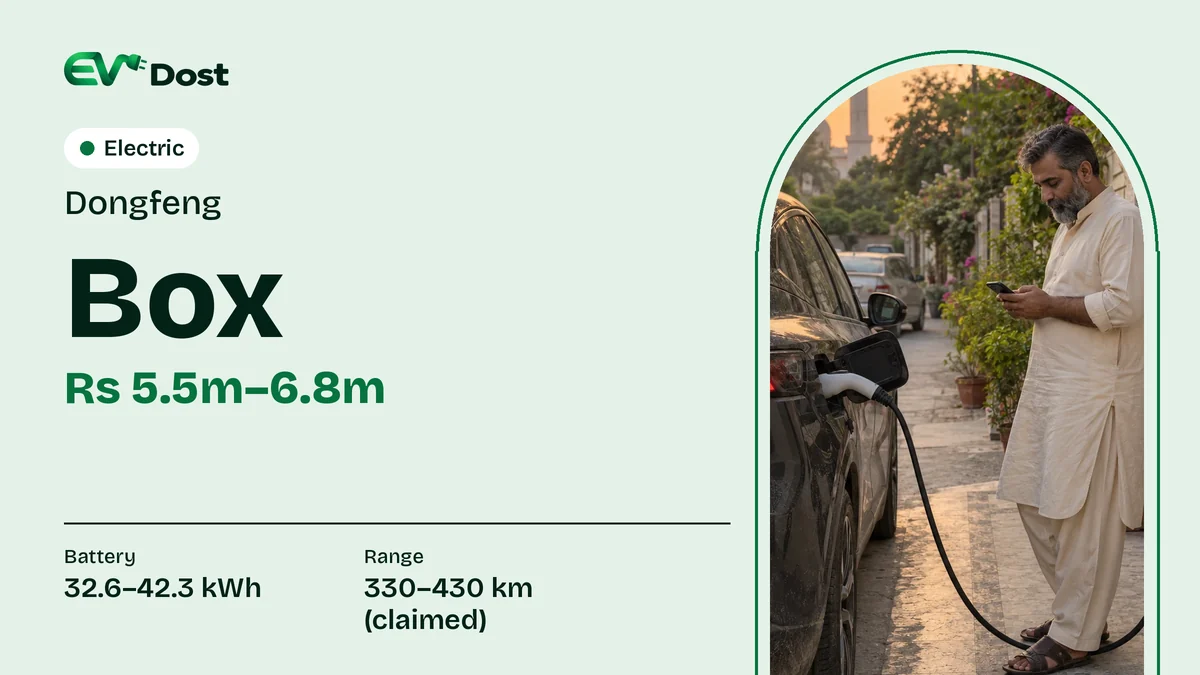
Search for the Box on a Pakistani car site and you'll find it twice, once as the Dongfeng Box and once as the GUGO Box. They're the same Chinese hatchback, sold by two different companies — and that matters more than the badge when it comes to warranty and parts. Dongfeng's representative in Pakistan has named Chawla Green Motors as its only official distributor (Profit, April 2025).
From Chawla, the Dongfeng Box price in Pakistan runs from Rs 5.5 million for the new Smart 330 to Rs 6.8 million for the Flagship 430, the prices it confirmed in April 2026 and still listed on PakWheels in October.
Dongfeng Box price in Pakistan across the three versions
| Box Smart 330 | Box Lux 430 | Box Flagship 430 | |
|---|---|---|---|
| Ex-factory price | Rs 5,500,000 | Rs 6,400,000 | Rs 6,800,000 |
| Battery | 32.56 kWh LFP | 42.3 kWh LFP | 42.3 kWh LFP |
| Claimed range | 330 km | 430 km (CLTC) | 430 km (CLTC) |
| AC charging limit | about 3.3 kW (see below) | 6.6 kW | 6.6 kW |
| DC fast charging | 10–80% in about 42 min | to 80% in about 30 min | to 80% in about 30 min |
| Battery warranty | 8 years or 200,000 km | 8 years or 200,000 km | 8 years or 200,000 km |
Prices are from ProPakistani, April 2026, matching the PakWheels listing when we checked in October 2026. Smart 330 details come from PakWheels' September 2026 guide; the 430 figures, including the 4-year or 150,000 km vehicle warranty, from Chawla's launch (Profit, April 2025). PakWheels lists a 70 kW (94 hp) motor and a 140 km/h top speed for the range.
The Box is about 4 metres long. Every version gets two airbags, ABS, stability control, tyre-pressure monitoring and a 12.8-inch screen. The Flagship adds driver aids such as automatic emergency braking and adaptive cruise control, per PakWheels.
Choose the seller before the version
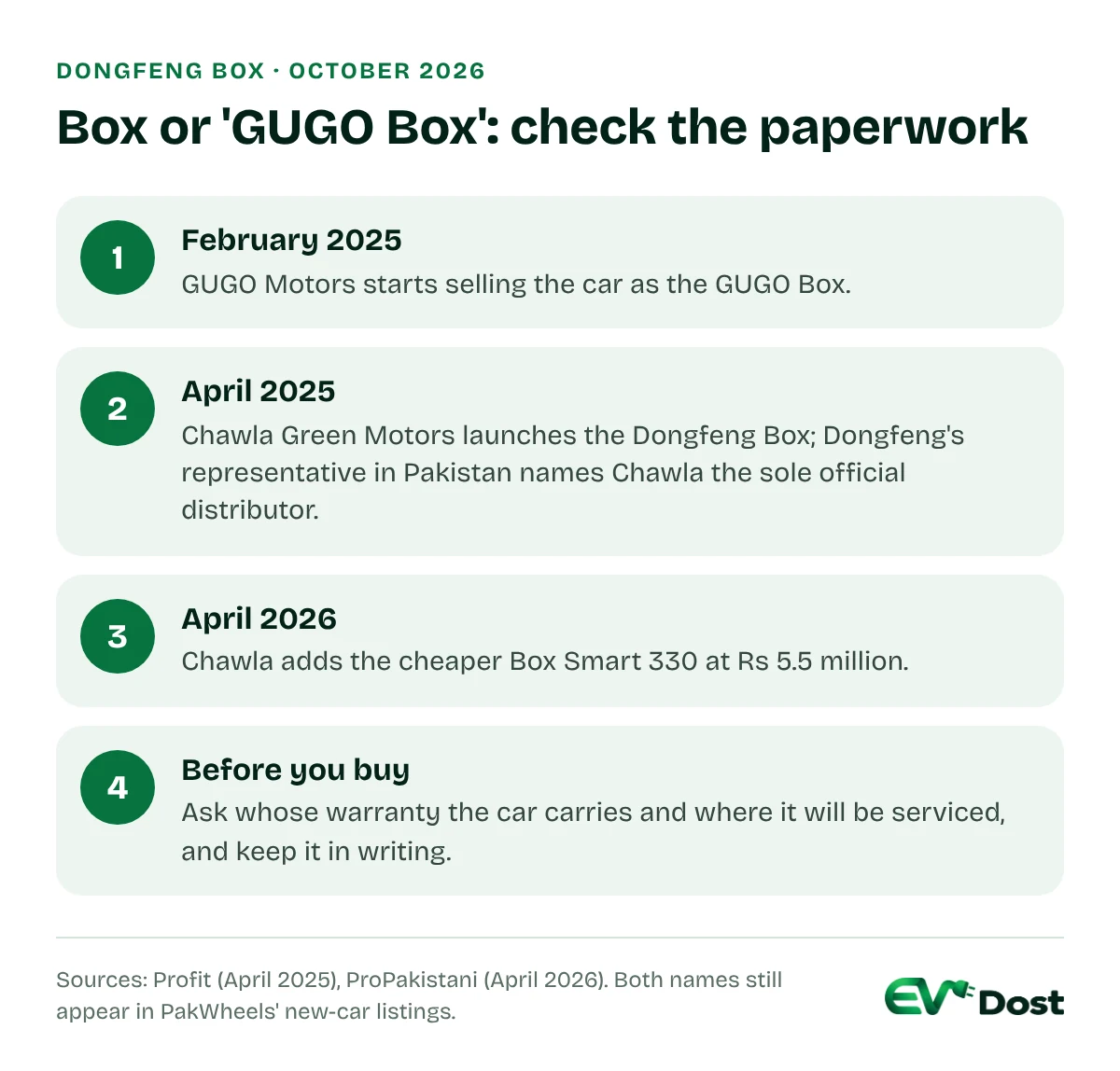
GUGO Motors started selling the Box in February 2025. About two months later, Chawla launched it as the Dongfeng Box and said it held exclusive rights. Dongfeng's representative backed Chawla and described GUGO's cars as third-party imports. GUGO, for its part, said its CEO confirmed authorisation to sell Dongfeng vehicles until October 2025 and that it would defend its position in court (Profit, April 2025). We found no later report settling it either way.
For a buyer, the practical question is which company honours the warranty, stocks parts and trains mechanics for your car. Get that in writing. We couldn't find any statement that the Box is assembled in Pakistan, so treat it as imported.
What every Box has in common
PakWheels' September 2026 guide lists CCS2 for DC on the Smart 330, which is the standard at Pakistan's public fast chargers. We found no source naming the 430's DC socket, so check the flap at the showroom; our guide to charger types in Pakistan explains the sockets. Dongfeng hasn't published a peak DC power for the Box.
The 430 km claim is on China's CLTC cycle, which is generous. PakWheels gives no cycle for the Smart 330's 330 km, but treat it as just as optimistic. In Europe, where it is sold as the Dongfeng Box (and as the Nammi Box in Norway, Finland and Switzerland), the two batteries are rated at about 230 and 310 km on WLTP (Wikipedia, Nammi 01). Each version's section below gives our own, more cautious estimate.
For a normal day, either version is fine on a socket. A 50 km day needs about 10 units from the wall, roughly four and a half hours on a 2.2 kW cable, or three hours for a Smart 330 on a wallbox, where it draws its full 3.3 kW. The socket still has to be up to it. A cable pulling 9 or 10 amps for hours on end can overheat a cheap extension board, so use a heavy-duty point on its own circuit with a tested earth. Our guide to home charger wiring explains what an electrician should check.
For the money sums, we assume 18 kWh per 100 km on the road, 10 percent charging loss at home, about Rs 55 a unit all-in (our guide to charging costs explains it) and Rs 115 per kWh on public DC.
For the petrol comparison, the Suzuki Swift GL CVT at Rs 4,605,600 (PakWheels, Swift), at 13 km/L, the middle of the 12 to 14 km/L PakWheels gives (PakWheels, April 2026). Petrol is taken at Rs 377.71 a litre, the 24–26 October 2026 price (Investify, October 2026). It has rarely held for more than a few days lately.
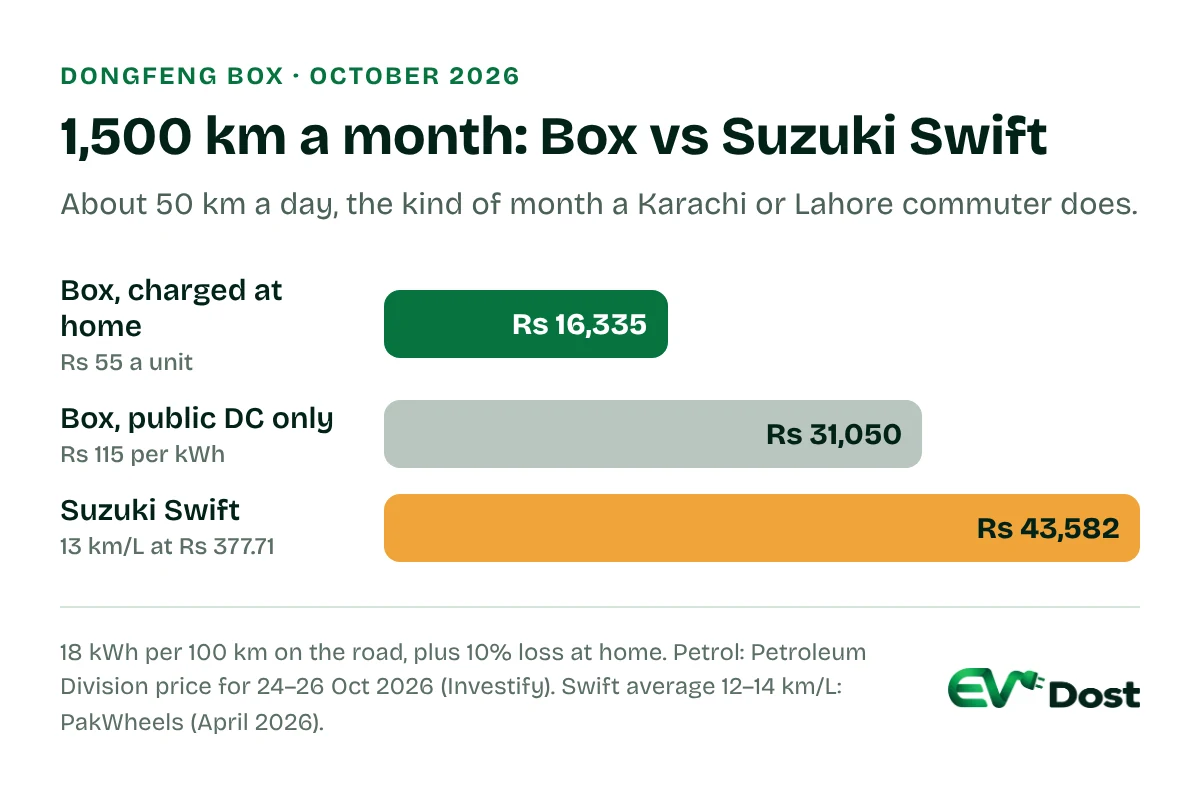
At 1,500 km a month, home charging saves about Rs 27,200 against the Swift. Charge only at public DC and the saving shrinks to about Rs 12,500 a month.
On the positive side, the 8-year, 200,000 km battery warranty is longer on distance than the Honri VE's 120,000 km, and LFP chemistry is the better choice for heat. We like that you get a 4-metre hatchback for the price of many smaller EVs, with DC fast charging on every version and a long battery warranty. Against that, the distributor dispute means buyers have to check their paperwork, parts are reportedly costly, and there's no sign of local assembly. Three ownership risks deserve a closer look.
- Parts may cost you. PakWheels' own model page lists relatively expensive body and battery parts among the cons, so ask for prices of a front bumper and a headlamp before you buy.
- The two-seller problem shows up at service time. A car bought from one seller may not be serviced by the other, so keep the warranty paperwork safe.
- Resale is a guess. Chinese EVs from newer brands have a short used-market history here, so a buyer in three years will be cautious. Factor that in if you change cars often.
The Smart 330: cheapest, and slowest at the socket
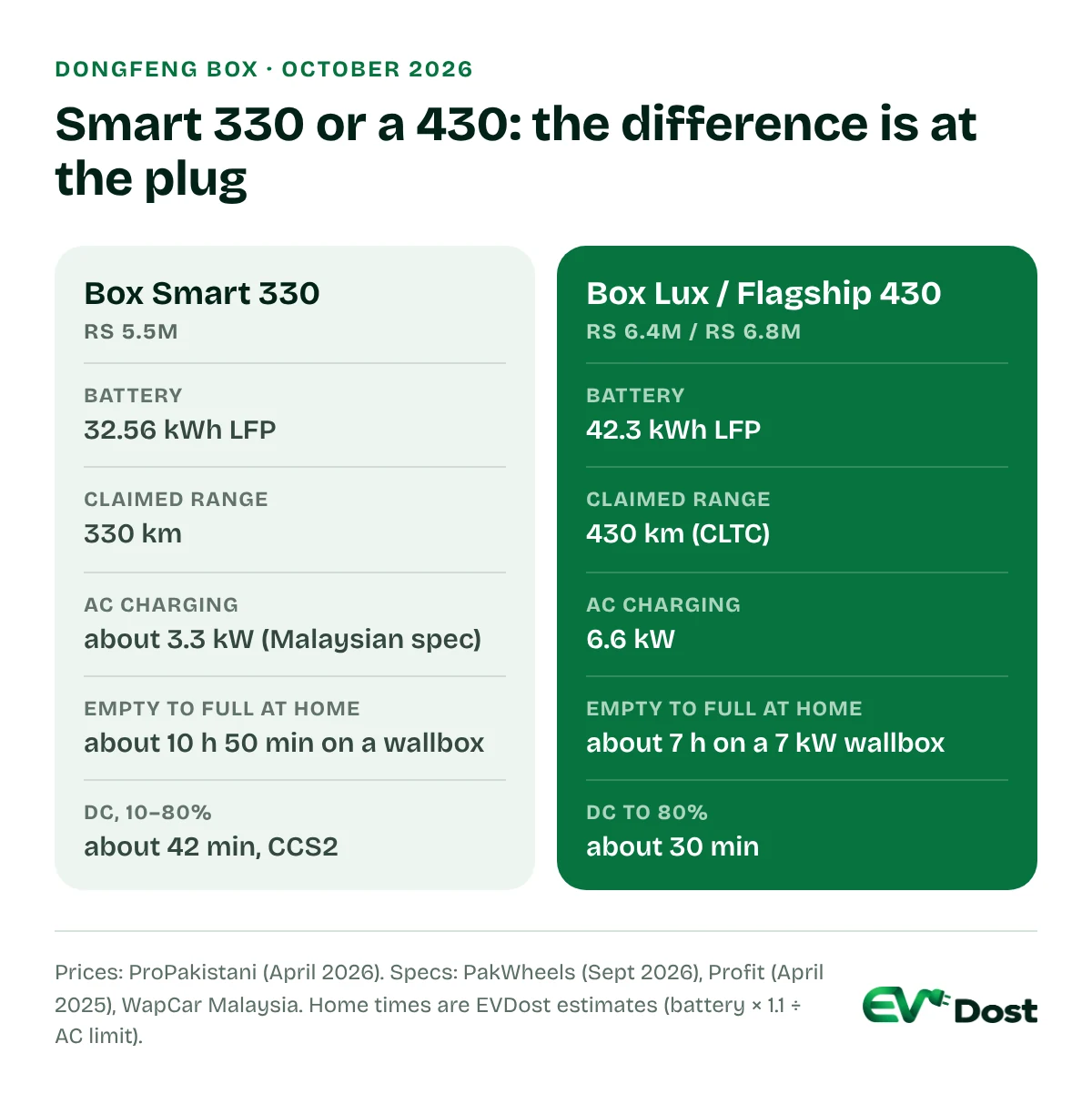
PakWheels lists a home charge of 10.5 hours from empty for the Smart 330. That fits a 3.3 kW onboard charger. In Malaysia, the smaller-battery Box (31.45 kWh there) comes with exactly that, while the 42.3 kWh car gets 6.6 kW (WapCar, Malaysia). Chawla hasn't published the Smart 330's AC rating, so ask, but plan on 3.3 kW. What we like least is the Smart 330's slow 3.3 kW AC limit (that's the Malaysian spec, unconfirmed here).
By our sum (battery × 1.1 for losses ÷ the car's AC limit):
- Smart 330 on a 7 kW wallbox: about 10 h 50 min from empty, because the car takes only 3.3 kW.
- Smart 330 on a 2.2 kW portable cable: about 16 h 15 min.
So a 7 kW wallbox is more than the Smart 330 can use; it only lifts charging from about 2.2 kW to 3.3 kW.
On DC, the Smart 330 is quoted at about 42 minutes from 10 to 80 percent. That stop costs roughly Rs 2,600 for the Smart 330 at a typical Rs 115 per kWh. At our cautious 18 kWh per 100 km, the Smart 330 is good for about 180 km. That's enough for several days of city commuting, though not for Karachi to Hyderabad and back without a top-up.
The money side is kind to it. At the home-charging saving above, the Smart 330's Rs 894,000 premium over the Swift pays back in a little under three years.
If your building's parking has no charging, the Smart 330's slow AC rate makes things harder, because an hour at someone else's charger adds only about 3 kWh. In that case, look for DC options near you, or a host on EVDost near home or work. The Smart 330 probably takes only about 3.3 kW whatever the wallbox, so sort by best price rather than chasing power, and find a charger that suits your routine. Our apartment charging guide has more ideas.
The Lux 430 and Flagship 430
The Rs 900,000 step up from the Smart 330 to the Lux 430 buys more than 100 km of claimed range. It also changes how the car charges at home.
- 430 on a 7 kW wallbox: about 7 hours.
- 430 on a 2.2 kW portable cable: about 21 hours.
With a 430, a 7 kW unit on a single-phase supply earns its keep if you drive a lot. On DC, the 430 is quoted at about 30 minutes to 80 percent, and a 10–80 percent stop costs roughly Rs 3,400. A 430 is good for about 235 km on the same basis. Real summer use in Lahore or Karachi traffic will probably land between our figure and WLTP.
The Lux 430's Rs 1.79 million premium over the Swift takes about five and a half years to pay back on the same saving. At Rs 6.8 million, the Flagship adds driver aids such as automatic emergency braking and adaptive cruise control.
Cheaper and bigger alternatives
Across our list of electric car prices, the Dongfeng Box price in Pakistan sits between the Kaiyi E04 and the BYD Atto 2.
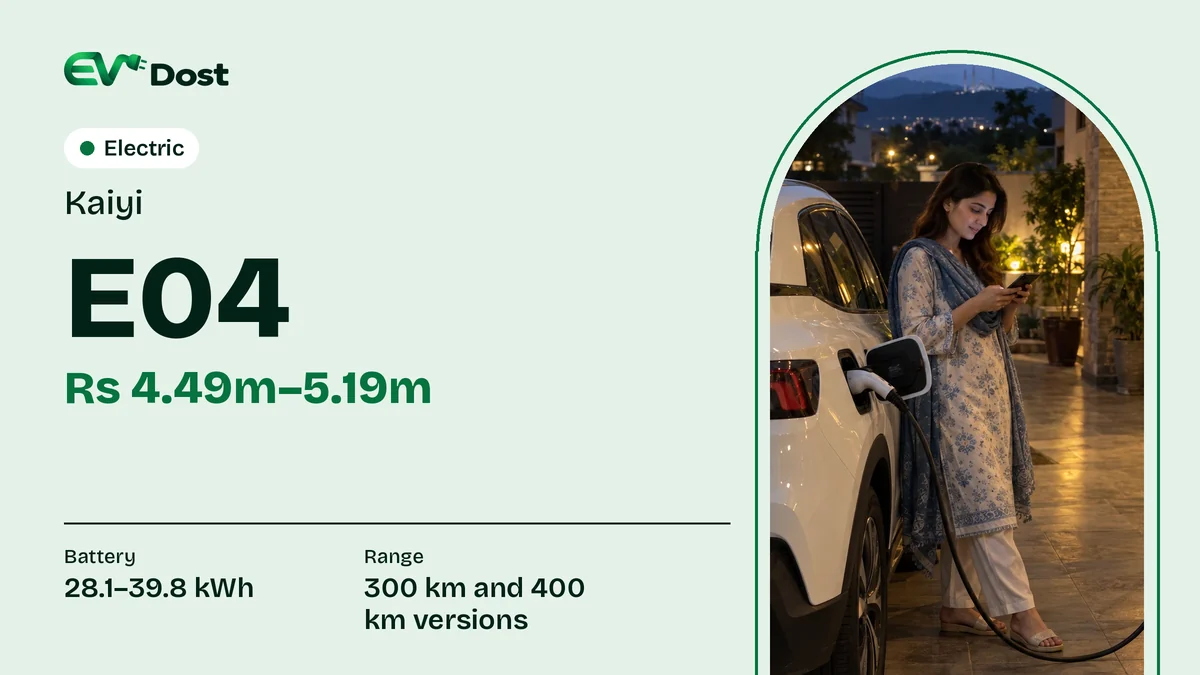
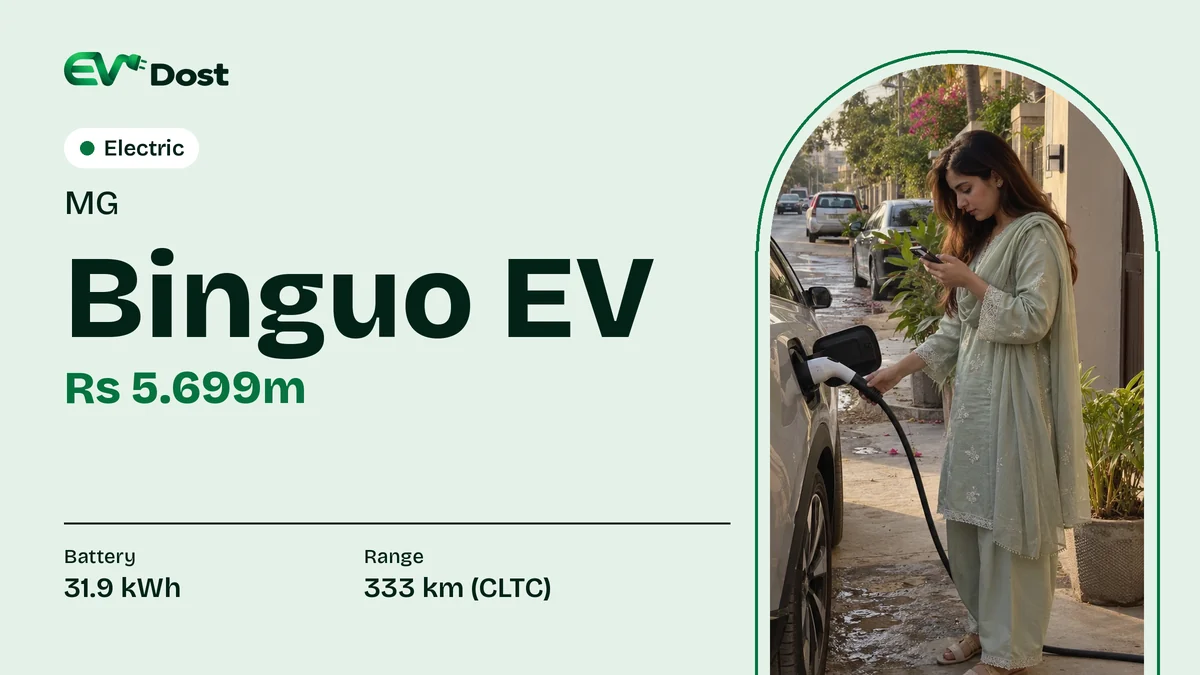
At Rs 4.49 million, the Kaiyi E04 is about a million rupees cheaper than the Smart 330 but smaller, at 3,695 mm long against the Box's roughly 4 metres, and comes from an even newer distributor. The MG Binguo EV is the closest established-brand rival on price, and the BYD Atto 2 at Rs 7.29 million is a step up in size and network.
Which Box we'd buy
The Box makes most sense for a commuter in Karachi, Lahore or Islamabad who lives near a Chawla outlet, wants a bigger hatchback than a Swift and can charge at home. We'd pick a 430 if you'll charge at home every night and drive more than 60 km a day. For shorter commutes, the Smart 330 is fine.
Whichever version you choose, settle the warranty question with the seller before you settle the price.
Frequently asked questions
What is the Dongfeng Box price in Pakistan for each version?
The Dongfeng Box costs Rs 5.5 million for the Smart 330, Rs 6.4 million for the Lux 430 and Rs 6.8 million for the Flagship 430, ex-factory, as of October 2026. These are the official distributor Chawla Green Motors' prices from April 2026.
Who is the official Dongfeng distributor in Pakistan?
Chawla Green Motors is the official Dongfeng distributor in Pakistan, according to Dongfeng's representative in the country, as reported in April 2025. GUGO Motors also sells the car as the GUGO Box and said it would defend its right to do so, so check whose warranty applies.
How long does each Dongfeng Box take to charge?
The Dongfeng Box 430 takes about 7 hours from empty on a 7 kW wallbox and reaches 80 percent in about 30 minutes on DC. The Smart 330 takes about 10.5 to 11 hours on a wallbox and about 16 hours on a 2.2 kW cable, because it appears to accept only 3.3 kW on AC, and about 42 minutes for 10 to 80 percent on DC.
How far does the Dongfeng Box go in Pakistani traffic?
The Dongfeng Box is claimed at 330 km for the Smart 330 and 430 km on the CLTC cycle for the 430, and the two batteries are rated at about 230 and 310 km on WLTP in Europe. In Pakistani summer traffic with the AC on, plan on roughly 180 to 230 km for the Smart 330 and 235 to 310 km for a 430.
Is the Dongfeng Box better than the Kaiyi E04?
The Dongfeng Box is bigger and has a longer battery warranty, but the Kaiyi E04 costs about Rs 1 million less than the cheapest Box. Both offer DC fast charging. Choose the Box for space and a distributor that has sold it here since 2025, the E04 for the lowest price.
Sources
- Profit, Box launched twice as distributors clash (April 2025): profit.pakistantoday.com.pk
- Profit, Dongfeng launches Box EV (April 2025): profit.pakistantoday.com.pk
- ProPakistani, Box Smart 330 launched (April 2026): propakistani.pk
- PakWheels, Dongfeng Box listing: pakwheels.com
- PakWheels, electric cars under Rs 60 lakh (September 2026): pakwheels.com
- WapCar, Dongfeng Box Malaysia launch: wapcar.my
- Wikipedia, Nammi 01: wikipedia.org
- PakWheels, Suzuki Swift listing: pakwheels.com
- PakWheels, fuel-efficient petrol cars (April 2026): pakwheels.com
- Investify, petrol price from 24 October 2026: investify.pk