BYD Shark 6 price in Pakistan and the real cost of running a plug-in pickup
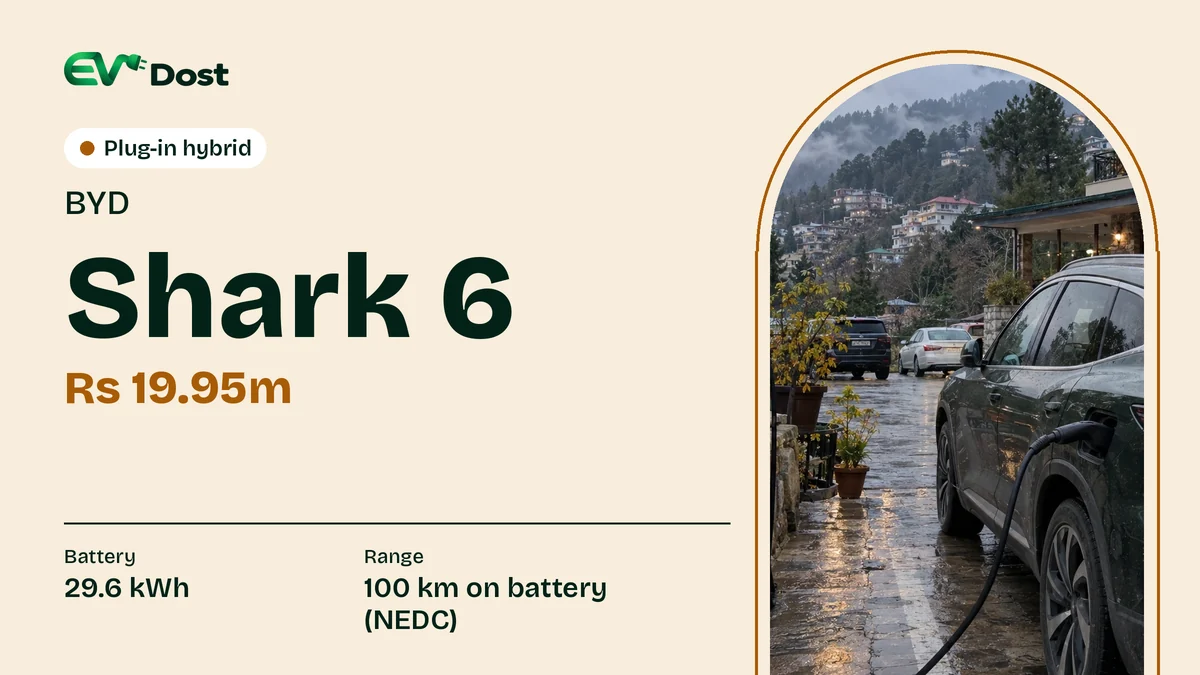
For years the double-cab decision in Pakistan was simple. You bought a Hilux Revo, or something cheaper that wasn't a Hilux. The Shark 6 changes the question. It is a full-size pickup with a 29.58 kWh battery, and for the first 70 or 80 km of most days it can run without burning a drop of fuel. The BYD Shark 6 price in Pakistan is Rs 19.95 million, which buys a lot of diesel. So does it pay back, and what does living with the plug look like?
Has the BYD Shark 6 price in Pakistan moved since launch?
No. BYD sells one version here, the Premium, imported fully built by Mega Motor Company, BYD's partner in Pakistan. It launched in Karachi on 25 July 2025 at Rs 19.95 million (Business Recorder, July 2025; CnEVPost, July 2025), and ProPakistani reported in June 2026 that it would stay the same after the 2026–27 budget (ProPakistani, June 2026). PakWheels' listing, last updated 30 June 2026, shows the same Rs 19,950,000, though its headline rounds it to Rs 2 crore (PakWheels).
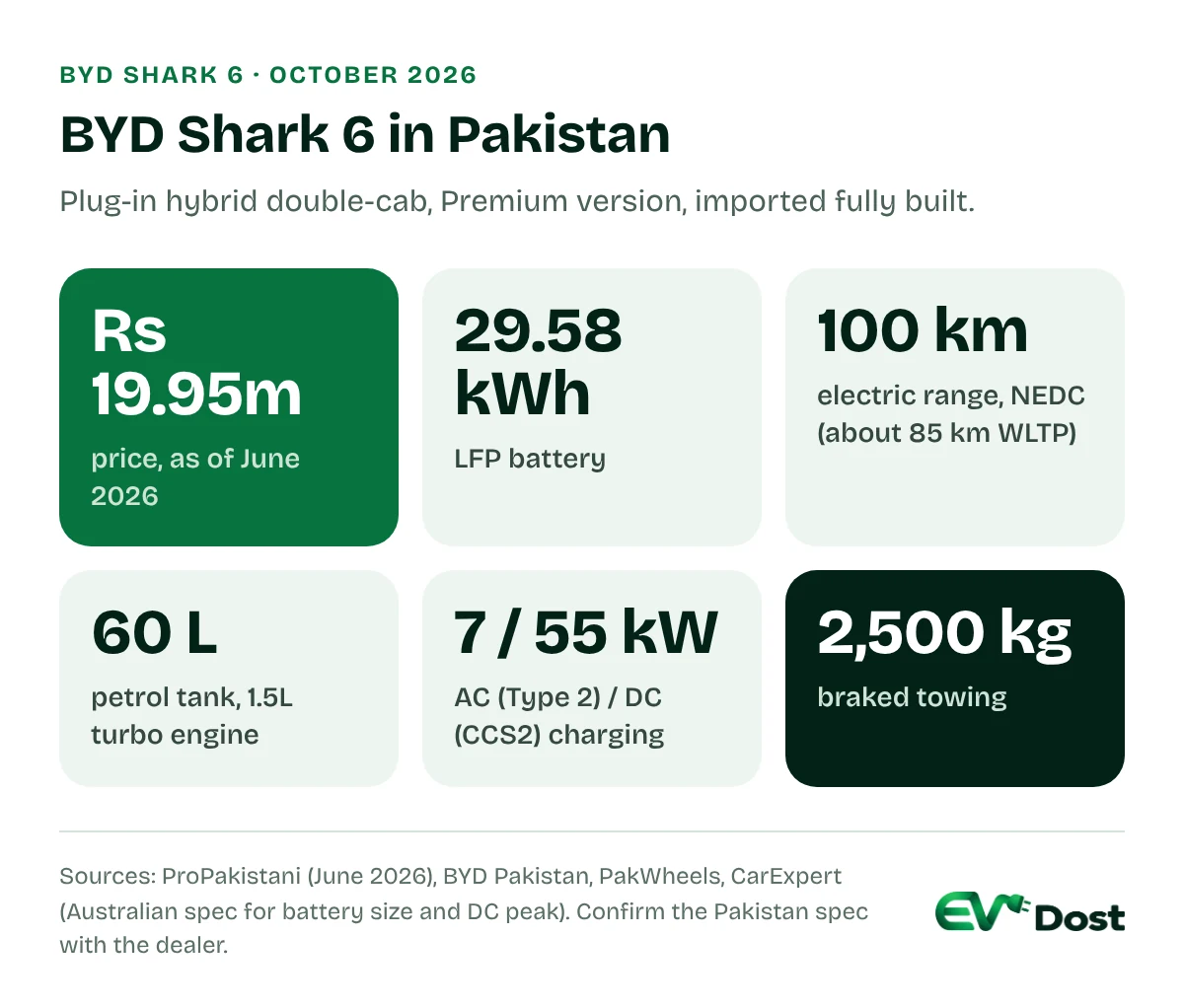
| BYD Shark 6 Premium | |
|---|---|
| Price | Rs 19.95 million (as of June 2026) |
| Battery | 29.58 kWh LFP (Blade) |
| Electric range | 100 km (NEDC), about 85 km (WLTP) |
| Fuel tank | 60 litres, 1.5-litre turbo petrol engine |
| Combined power and torque | 321 kW (BYD Pakistan quotes 436 hp), 650 Nm |
| AC charging | 7 kW onboard, Type 2 |
| DC charging | up to 55 kW, CCS2; 10–80% in about 30 min |
| Towing / payload | 2,500 kg braked / about 790 kg |
| Battery warranty | 8 years or 160,000 km (per PakWheels) |
Sources: BYD Pakistan for range, tank, power and towing; PakWheels specifications for the charge port, AC limit, fast-charge time and warranty; CarExpert for the battery size, 321 kW output, 55 kW DC peak and payload (Australian car); Wikipedia for the WLTP figure. Confirm the warranty in writing with the dealer, since BYD's Pakistan page doesn't list it.
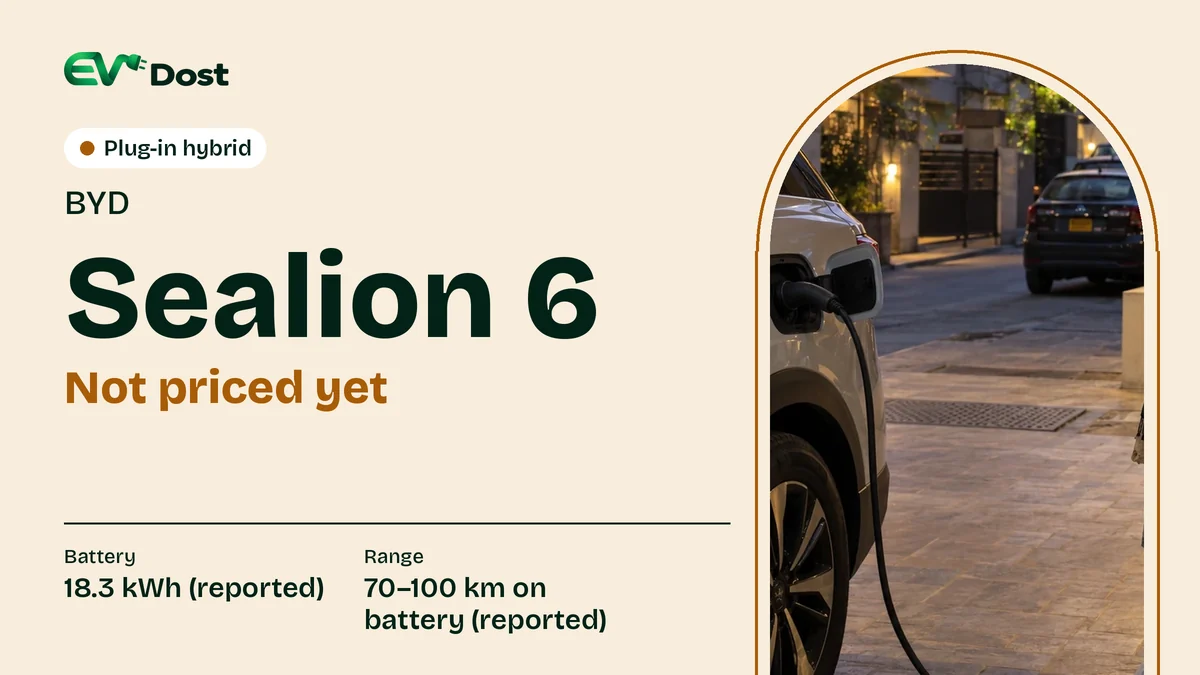
There's no local version yet, either. It's still a fully imported car. Local assembly was planned for 2026, but at the Pakistan Auto Show in September 2026, BYD and Mega Motor announced that the first locally built BYD will be the Sealion 6 plug-in hybrid instead, from the last quarter of 2026 (The Pakistan Connect, September 2026).
What happens when the battery runs flat?
The Shark is a plug-in hybrid. With charge in the battery, it drives on its two electric motors, one per axle, and the engine stays mostly off. When the battery runs down to its reserve, the 1.5-litre turbo engine starts and works with the motors, much like a conventional hybrid. It never needs charging to keep going, and there's no range anxiety on the N-5 or into Gilgit-Baltistan, because the engine carries you between fuel stops.
BYD claims 100 km of electric running on NEDC. The WLTP figure, closer to real use, is about 85 km. One owner quoted on PakWheels reports 75–85 km. On a June afternoon in Lahore, with the AC working hard and a load in the bed, plan on something like 65–75 km. That's still enough for most people's daily driving, which is the whole point.
On petrol, the Australian spec sheet lists a secondary (engine) fuel figure of 7.9 L/100 km, which we use as the flat-battery rate, or about 12.7 km/L. The PakWheels owner reports 9–10 km/L at about 110 km/h on a depleted battery. That's worse than the 12 km/L PakWheels lists for a diesel Revo, though a litre of petrol costs a little less than a litre of diesel; the sums below compare the two in rupees.
Can I charge it at home on single-phase?
Yes. At home, the Shark accepts up to 7 kW on AC through a Type 2 inlet, which matches what a single-phase house can supply. On a 7 kW wallbox, a full charge from empty takes about 4 hours 40 minutes by our sum (29.58 kWh × 1.1 ÷ 7), and the everyday 20–80 percent top-up takes under three hours. On a portable cable at about 2.2 kW, going from 20 to 100 percent takes nearly 12 hours, which still works overnight.
A full charge uses about 32.5 units, or roughly Rs 1,790. BYD ran a free 7 kW home charger offer for bookings in August 2025 (Gari.pk, August 2025); ask whether anything similar is running.
Fast charging goes through a CCS2 inlet, the standard used by most public fast chargers here, and the 55 kW peak takes 10 to 80 percent in about 30 minutes. You'll rarely need it, since the engine is your backup. If the plugs are new to you, Type 2, CCS2 and GB/T are explained here.
The Shark's natural habitat is the trip out of the city — to the village, say, or the farm. If you're staying over somewhere without a socket you can use, a few hours on a host's 7 kW wallbox refills the battery for the next day's local running. Search EVDost near where you'll sleep, sort by best price, and send a request to a host whose plug and power suit the truck. Find a charger.
Will it cost less to run than a diesel Revo?
Fuel is where the BYD Shark 6 price in Pakistan has to earn its keep. The Shark's official electric use is 21.2 kWh per 100 km (Australian ADR test, CarExpert). With about 10 percent lost while charging, that's 23.3 units from the wall. At October 2026 prices, its three ways of running stack up against a diesel Revo as follows.
- Home charging at about Rs 55 a unit all-in: about Rs 1,283 per 100 km, or Rs 12.8 a km. Our electricity cost breakdown shows how we reach Rs 55.
- Public DC at about Rs 115 per kWh: about Rs 2,438 per 100 km.
- Petrol with the battery flat, at Rs 377.71 a litre (24–26 October 2026, per a Petroleum Division notification reported by Investify): about Rs 2,984 per 100 km on the official 7.9 L/100 km, or nearer Rs 3,976 at the owner-reported 9.5 km/L.
- A Toyota Hilux Revo V automatic, on diesel at Rs 393.66 a litre and the 12 km/L average PakWheels lists (PakWheels): about Rs 3,281 per 100 km.
Both fuel prices are revised almost daily now, so read these as a late-October snapshot.
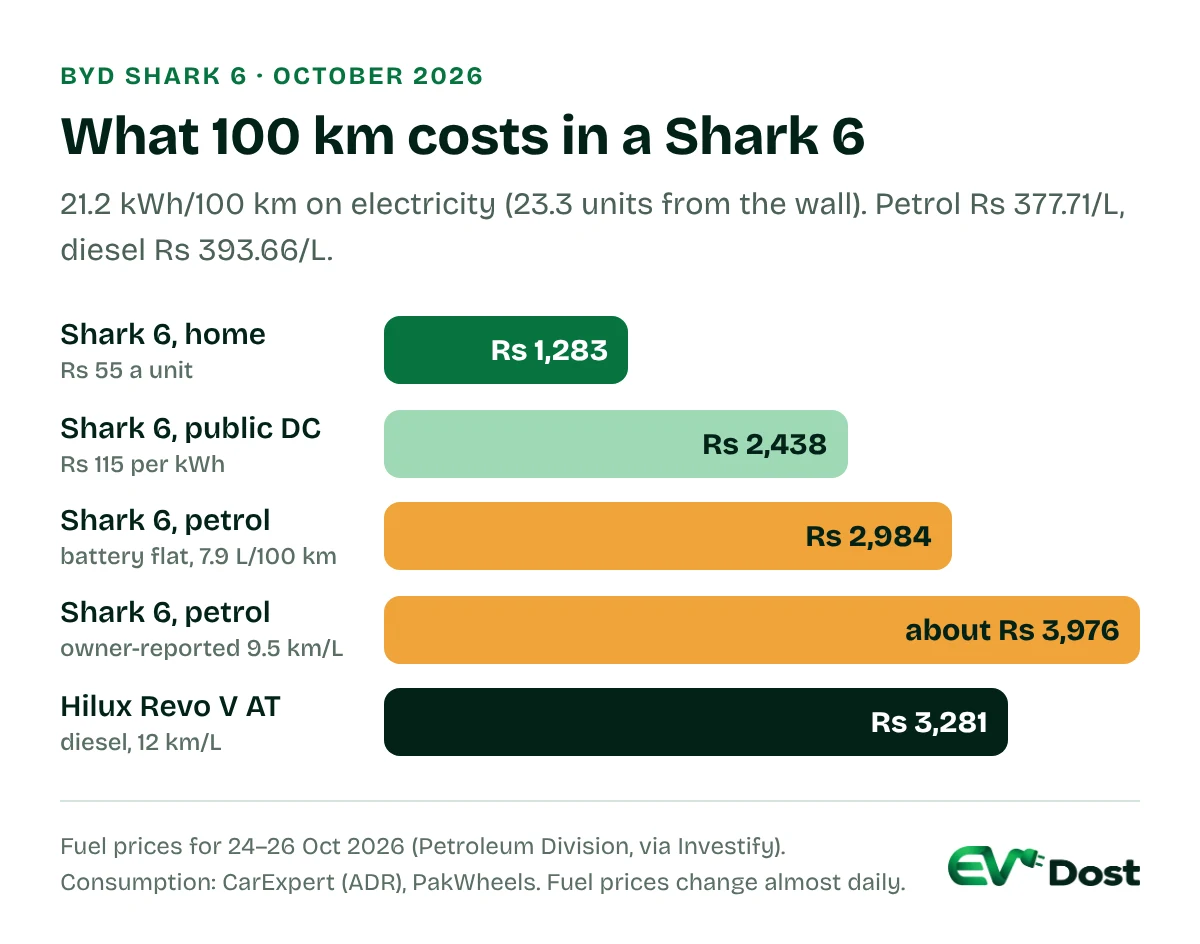
So most daily driving can be electric, at roughly Rs 13 a km charged at home. On petrol, it's thirsty. Owners report 9–10 km/L on the highway with a flat battery.
Plug-in habits
Every night you can. A PHEV's savings come entirely from the kilometres it does on stored electricity, and the battery is small enough that a night on a wallbox refills it with time to spare.
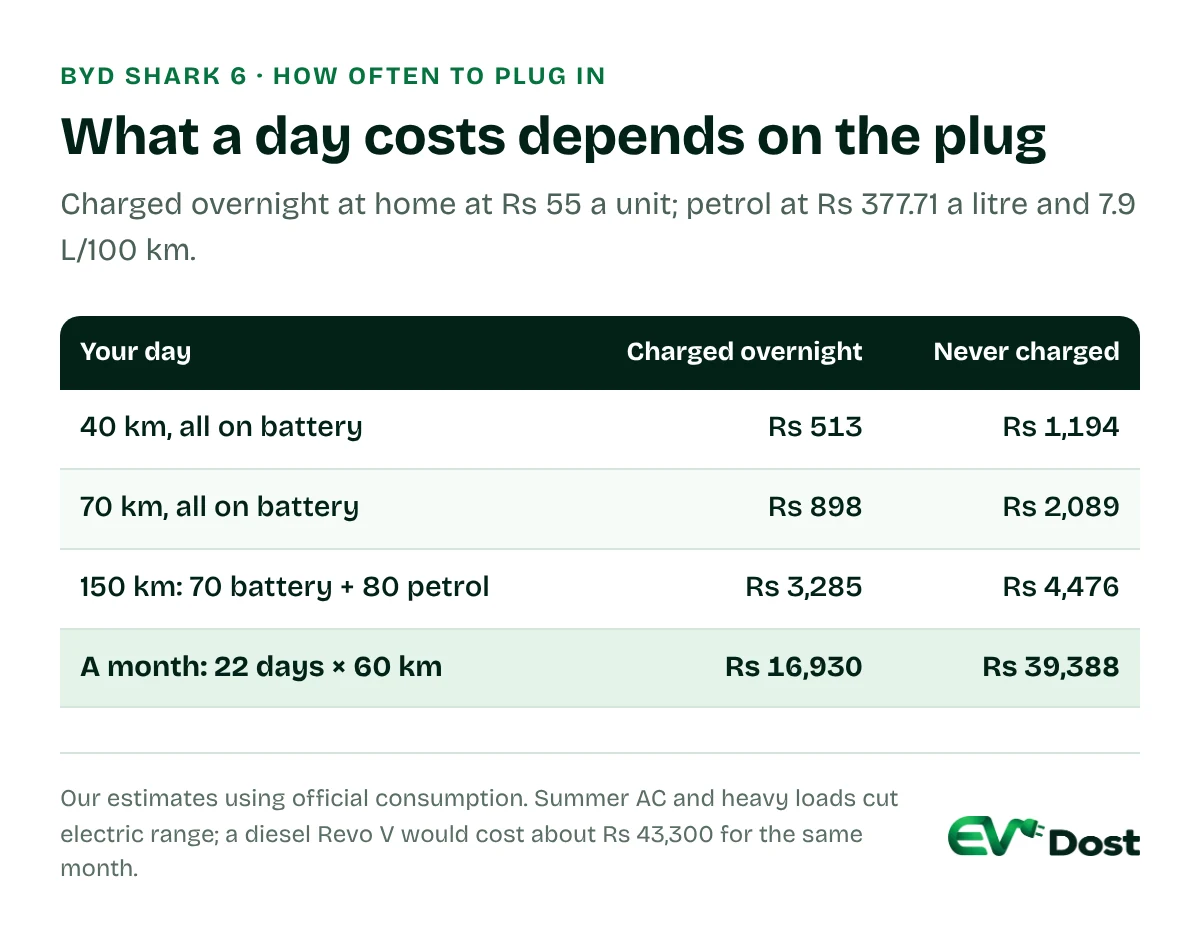
Take a working month of 22 days at 60 km a day. Charged every night, the Shark runs on about Rs 16,900 of electricity. Never charged, the same driving costs about Rs 39,400 in petrol, and a diesel Revo would burn about Rs 43,300.
That gap of roughly Rs 22,500 a month is the reason to buy a Shark. Unplugged, it's a Rs 20 million petrol truck. On a 150 km day, say a run from Lahore out to a farm past Sheikhupura and back, you'd use about 70 km of battery and 80 km of petrol, for roughly Rs 3,300 against about Rs 4,900 for the Revo.
And will it ever pay back the price gap?
Not on fuel alone. Rs 19.95 million is about Rs 5.7 million more than a Revo V automatic at Rs 14.28 million (PakWheels, April 2026). At the Rs 22,500 a month we estimate above, that difference takes over 20 years to recover through fuel alone, though resale and maintenance will move it. Toyota's resale record is far longer.
Can it still tow, carry and power a work site?
A Shark weighs about 2,710 kg empty, a good deal more than a Revo, and the battery is part of the reason. Even so, BYD rates it to tow 2,500 kg braked and the Australian spec lists a payload of about 790 kg. Ground clearance is 230 mm and wading depth 700 mm (BYD Pakistan).
It can also power things. The vehicle-to-load socket gives out up to 6.6 kW, which runs power tools on a site with no supply, or a fridge and fans during a long outage at home. Every unit you draw that way is range you won't have in the morning, so keep an eye on the gauge.
It isn't slow, either. The performance is serious, with BYD claiming 0–100 km/h in 5.7 seconds. The cab is spacious, with a 15.6-inch screen, seven airbags and, per PakWheels, a five-star ANCAP rating (an Australian test).
What else should be on the shortlist?
There's no other plug-in pickup on sale here, so the comparisons are a little lateral. Our rundown of electric car prices lists the Shark alongside the main EVs and plug-ins, and these three are the closest fits.
- The Toyota Hilux costs Rs 11.38–15.84 million from the base E to the Revo GR-S, diesel only (PakWheels, April 2026). It's cheaper to buy and dearer to run on short days, and it has proved itself in the north.
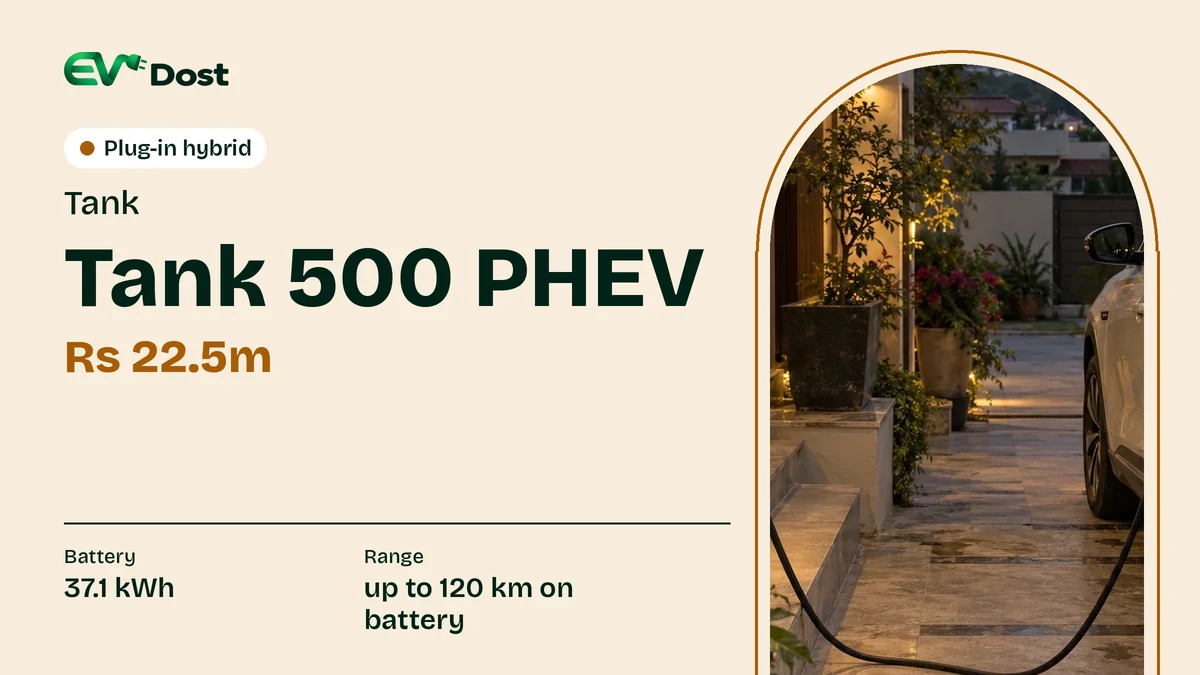
- The Tank 500 PHEV is an off-road SUV rather than a pickup, at about Rs 22.5 million (PakWheels, April 2026), with up to 120 km of claimed electric range (ProPakistani, April 2026). See our Tank 500 PHEV guide.
- The Haval H6 PHEV is a family SUV for about half the money, from Rs 10.85 million, with 106 km on NEDC (ProPakistani, September 2026). Our Haval H6 PHEV guide covers all three versions.
Who should park one in the driveway?
In our view the Shark makes most sense for someone who needs a pickup's bed or towing, drives under about 70 km on most days, can charge at home every night, and still wants to head north or to the farm without planning around chargers. A business owner who uses one for site visits around Islamabad and the occasional haul to Peshawar is the obvious match.
It suits you less if you mostly drive long distances on the motorway, can't charge where you sleep, or care most about resale. If you're still weighing a plug-in hybrid against a full EV, our PHEV vs EV comparison walks through the daily-distance test.
Frequently asked questions
What is the BYD Shark 6 price in Pakistan?
The BYD Shark 6 costs Rs 19.95 million in Pakistan as of June 2026, for the single Premium version. ProPakistani reported in June 2026 that the price would stay the same after the 2026–27 budget. PakWheels rounds it to Rs 2 crore ex-factory, so ask the dealer for the full on-road figure.
How far can the BYD Shark 6 go on electricity alone?
The BYD Shark 6 is rated at 100 km of electric range on NEDC and about 85 km on WLTP. An owner quoted on PakWheels reports 75–85 km, and summer heat with heavy AC use will cut that further. Beyond that it runs on its 60-litre petrol tank, with a combined range of up to 800 km claimed by BYD Pakistan.
How quickly can you recharge a Shark 6 at home?
The Shark 6 takes about 4 hours 40 minutes from empty on a 7 kW wallbox, by our October 2026 sums, because it accepts up to 7 kW on AC. A 20–80 percent top-up takes under three hours. On a CCS2 fast charger, PakWheels lists about 30 minutes from 10 to 80 percent.
Is the BYD Shark 6 cheaper to run than a Hilux Revo?
The BYD Shark 6 is cheaper to run than a Hilux Revo when you charge it. As of October 2026 it costs about Rs 1,283 per 100 km on home electricity against about Rs 3,281 for a diesel Revo V at 12 km/L. On petrol with a flat battery, the Shark's running cost is similar to or higher than the Revo's.
Is the Shark 6 assembled in Pakistan?
The BYD Shark 6 is not assembled in Pakistan; as of October 2026 it is imported fully built by Mega Motor Company. BYD and its partner Mega Motor have said the first locally assembled BYD will be the Sealion 6 plug-in hybrid, planned from the last quarter of 2026.
Sources
- The Pakistan Connect, Sealion 6 local assembly from Q4 2026 (September 2026): thepakistanconnect.com
- Business Recorder, Shark 6 launch (July 2025): brecorder.com
- CnEVPost, Shark 6 launch in Pakistan (July 2025): cnevpost.com
- ProPakistani, BYD prices after the budget (June 2026): propakistani.pk
- PakWheels, BYD Shark 6 listing and specifications: overview, specifications
- BYD Pakistan, Shark 6: byd-mega.com
- CarExpert, Shark 6 Premium specifications (Australia): carexpert.com.au
- Wikipedia, BYD Shark 6: en.wikipedia.org
- Investify, petrol and diesel prices from 24 October 2026: investify.pk
- PakWheels, Toyota Hilux prices (April 2026) and fuel average: prices, fuel average
- Gari.pk, Shark 6 home charger offer (August 2025): gari.pk
- PakWheels, plug-in hybrids in Pakistan (April 2026): pakwheels.com
- ProPakistani, first locally assembled Tank 500 (April 2026): propakistani.pk
- ProPakistani, Haval H6 PHEV price (September 2026): propakistani.pk