Tank 500 PHEV price in Pakistan and what Rs 22.5 million buys
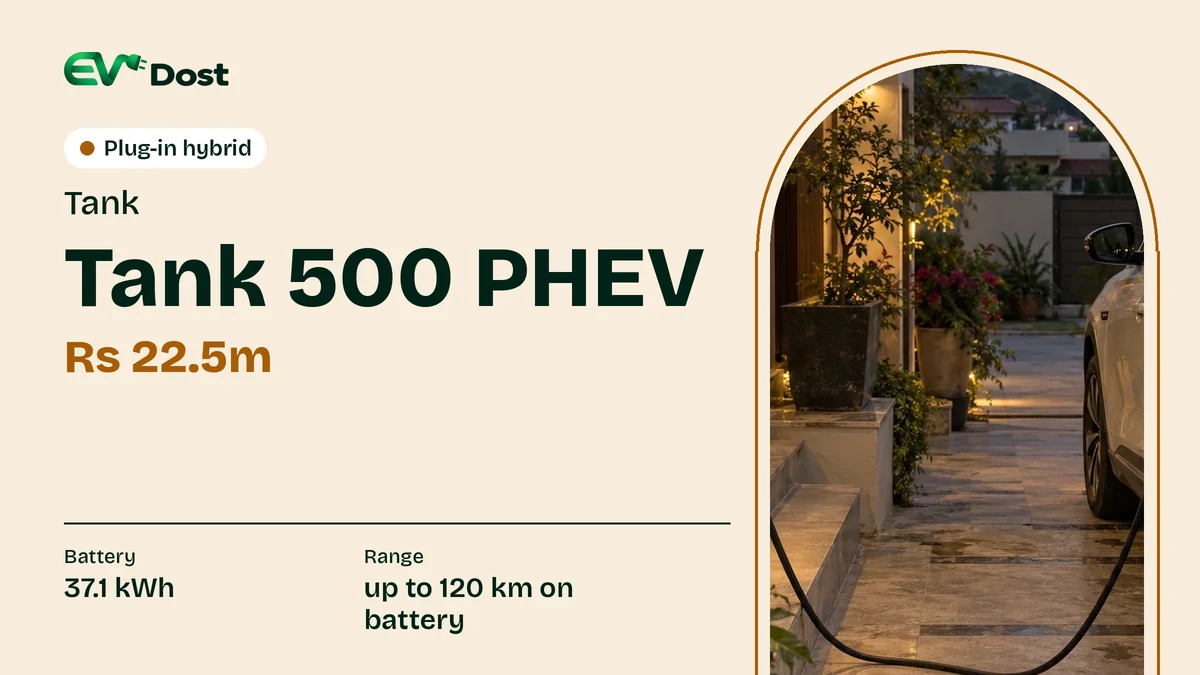
In early 2024 the Tank 500 arrived in Pakistan as an imported luxury SUV at about Rs 45 million. Two years later, Sazgar assembles it in Lahore, and the plug-in version costs half that. The Tank 500 PHEV price in Pakistan is Rs 22.5 million ex-factory, the figure GWM Pakistan announced in January 2026 and the latest official price we could find as of October 2026. The hybrid (HEV) version, which doesn't plug in, costs Rs 20.5 million.
That Rs 2 million gap buys a 37.1 kWh battery, enough for most city days on electricity, in a ladder-frame 4x4 built for towing and rough roads. Whether that's worth it depends on one thing more than any other, and that's whether you can charge it every night.
| Tank 500 HEV | Tank 500 PHEV | |
|---|---|---|
| Ex-factory price (January 2026) | Rs 20,500,000 | Rs 22,500,000 |
| Seats | 7 | 5 |
| Booking amount | Rs 3,000,000 | Rs 3,500,000 |
| Plugs in | no | yes, with a 7 kW charger included |
| Claimed electric range | none to speak of | up to 120 km |
| Delivery estimate (bookings from 27 Jan 2026) | 7–9 months | 6–8 months |
Prices, seats and booking amounts come from GWM Pakistan's January announcement as reported by PakWheels and ProPakistani (PakWheels, January 2026; ProPakistani, January 2026). PakWheels' price page still shows both figures (PakWheels, Tank 500). The delivery estimates and free charger were announced a week later (ProPakistani, January 2026), and the 120 km claim comes from GWM at the first local rollout (ProPakistani, April 2026).
Tank 500 PHEV price in Pakistan, from import to local assembly
The original Tank 500 came fully built from China in February 2024 at Rs 4.5 crore. The locally assembled CKD versions replaced it in January 2026, with bookings opening on 26 January. The next day Sazgar lengthened its delivery estimates, citing strong demand for both versions.
In April 2026 GWM and Sazgar began CKD assembly of the Tank 500 in Pakistan, and Daily Times reported that Pakistan is the first country outside China to assemble it (Daily Times, April 2026). A sponsored Business Recorder article from the same week put bookings at more than 5,000 in the first two months; that's the company's claim, not an audited figure (Business Recorder, April 2026).
One April 2026 PakWheels feature lists the PHEV at Rs 2.05 crore, which is the HEV's price (PakWheels, April 2026). Every official announcement we found says Rs 22.5 million for the PHEV. Plug-in hybrid prices have been rising this year after a sales tax increase on hybrids (Profit, July 2026), so confirm the current figure with a Haval or Tank dealer before you pay the booking. The SRO of 13 September 2026 (SRO 1525(I)/2026) brought locally made hybrids up to 2,000cc down to 18 percent (Mettis Global, September 2026), but reports split on plug-in hybrids: PakWheels said they weren't mentioned and remain at 25 percent (PakWheels, September 2026), while Daily Pakistan listed several locally assembled PHEVs as qualifying for 18 percent (Daily Pakistan, September 2026). Its list doesn't name the Tank 500, and the SRO wouldn't cover a fully built import, so ask the dealer which rate the invoice carries.
Under the body, and the blanks in the spec sheet
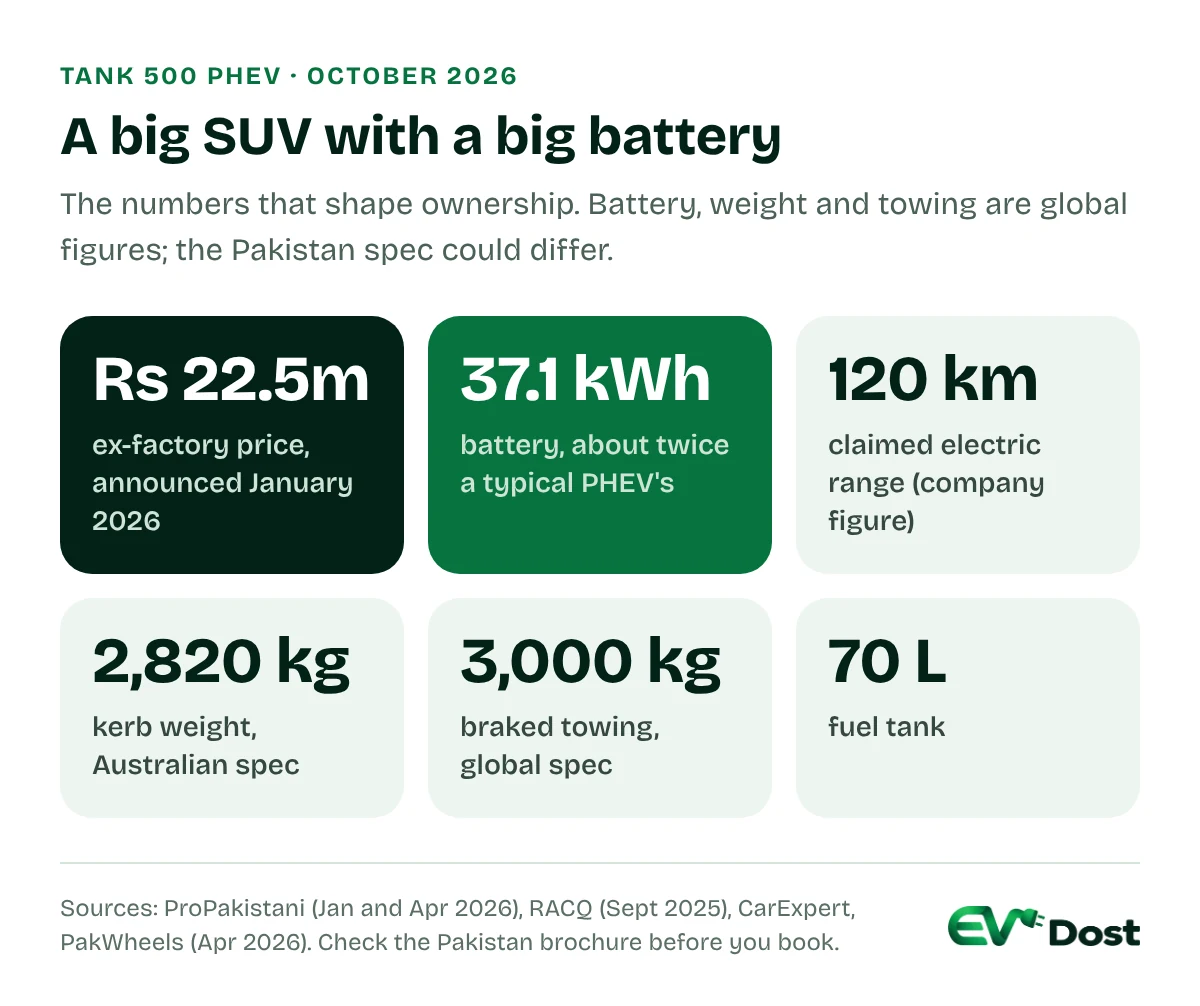
GWM Pakistan hasn't published a full Pakistani spec sheet for the PHEV, so most of what follows is the global car. The Tank 500 Hi4-T pairs a 2.0-litre turbo petrol engine (180 kW) with a 120 kW electric motor inside a nine-speed automatic, for 300 kW (402 hp) and 750 Nm, with four-wheel drive (Wikipedia). The battery is 37.1 kWh. Australia's motoring club RACQ quotes up to 120 km of electric range on NEDC and 50 kW DC charging, with 30–80% in 24 minutes (RACQ, September 2025). The Chinese-market 2026 model is listed with faster 103 kW DC charging and 110 km on the stricter WLTC cycle (CarNewsChina), so Pakistani cars could match either.
Several things remain unconfirmed for Pakistan, including the battery warranty, the onboard AC charger rating, the DC charging speed and the plug type. Australian listings show 6.6 to 7 kW on AC and a Type 2 inlet (EVSE Australia; CarExpert), and Pakistan follows the same IEC plug standards, but open the charging flap at the showroom before you assume. Our guide to EV charger types in Pakistan shows the difference between Type 2, CCS2 and GB/T.
How many km on battery before the engine wakes
PakWheels puts real-world electric range at 80–90 km. Our own estimate is about 88 km, which is the WLTC figure of 110 km less a fifth for heat, AC and stop-start traffic. Expect less on a 45°C afternoon in Multan with the cabin cooling hard, and less again at motorway speed, because this is a heavy, square SUV. Australian figures put the kerb weight at about 2,820 kg.
Still, 80-odd km covers what most families drive on a weekday: school, office, a trip to the market. After that the 2.0-litre engine takes over, and with a 70-litre tank the Tank 500 has a long reach on petrol. GWM claims about 950 km combined.
On a long trip the battery is a bonus, not a necessity, but if you're staying somewhere for a day or two it pays to top up. An evening of about three hours on a host's 7 kW wallbox puts back roughly 50 km of electric driving. Search EVDost near where you're staying, sort by nearest, and send the host a request. Check for hosts near your stay before you set off, and see our EV road trip guide for planning the route.
The wallbox that comes with it
GWM includes a 7 kW home charger with every PHEV. On a single-phase connection, which most Pakistani homes have, 7 kW is the realistic ceiling anyway, so you wouldn't gain from a bigger unit. Our sum for 20% to full is 37.1 kWh × 80% × 1.1 ÷ 7 kW, or about 4 hours 40 minutes, assuming the car accepts 7 kW. A full charge from flat takes about 6 hours, in line with the 6.5 hours RACQ quotes for home charging.
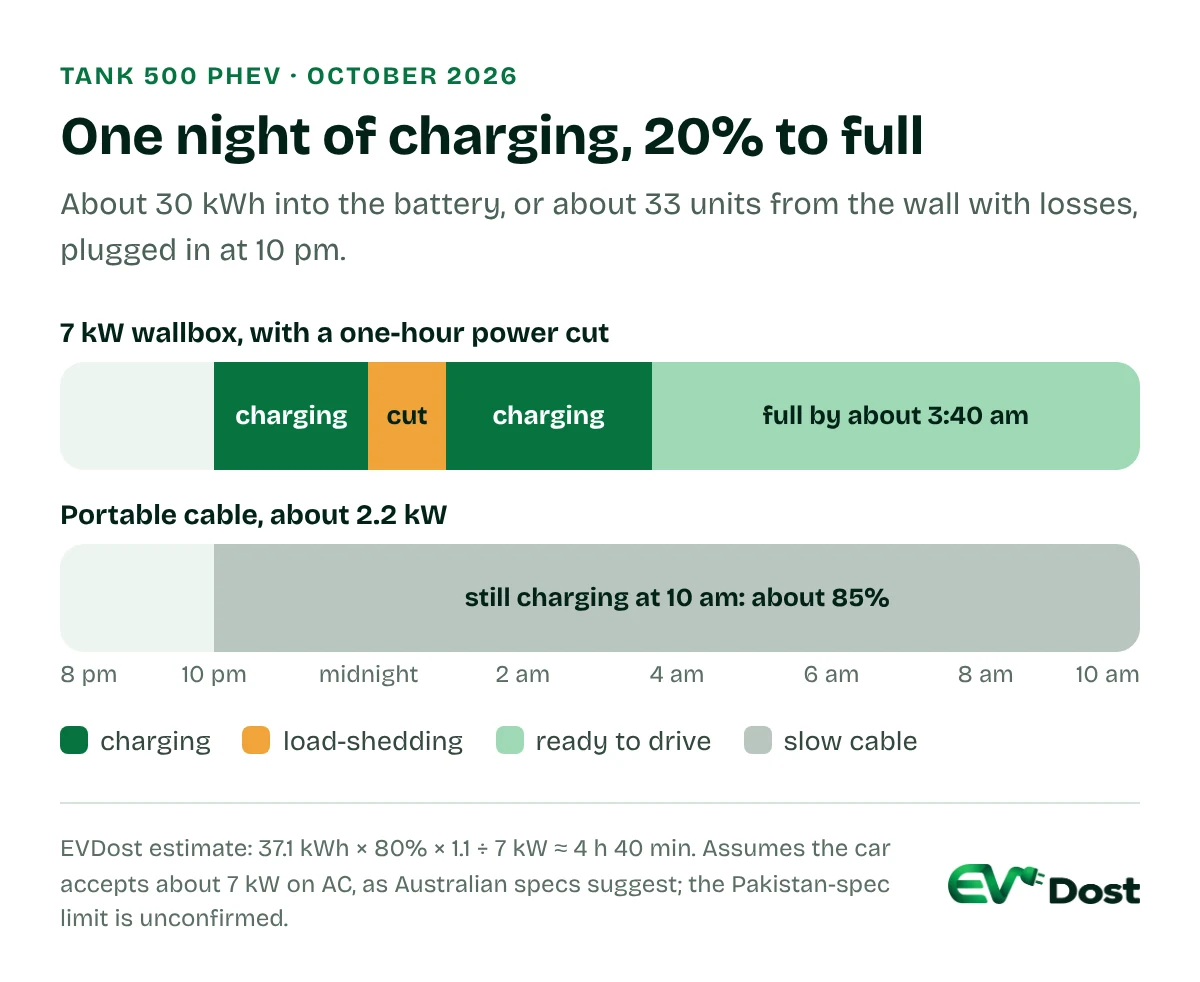
Treat the portable cable as a backup. At about 2.2 kW, it adds only about 5 km of electric driving per hour. Check your sanctioned load before the wallbox goes in; this home charger guide explains what an electrician should look at.
DC fast charging works but rarely pays on this car. At about Rs 115 per kWh, our estimate is about Rs 44 per km on electricity, more than running on petrol.
Per-km costs, plugged in, on petrol and against a Fortuner
The obvious petrol rival is the Toyota Fortuner 2.7, priced from Rs 12.4 to 14.9 million, which PakWheels rates at 8–11 km/L (PakWheels, Fortuner). We took 9 km/L. Home electricity is about Rs 55 per unit all-in, as our breakdown of EV charging costs explains, and petrol is Rs 377.71 a litre, the price for 24–26 October 2026 (Investify, October 2026). These are snapshots, since petrol has been repriced almost daily.
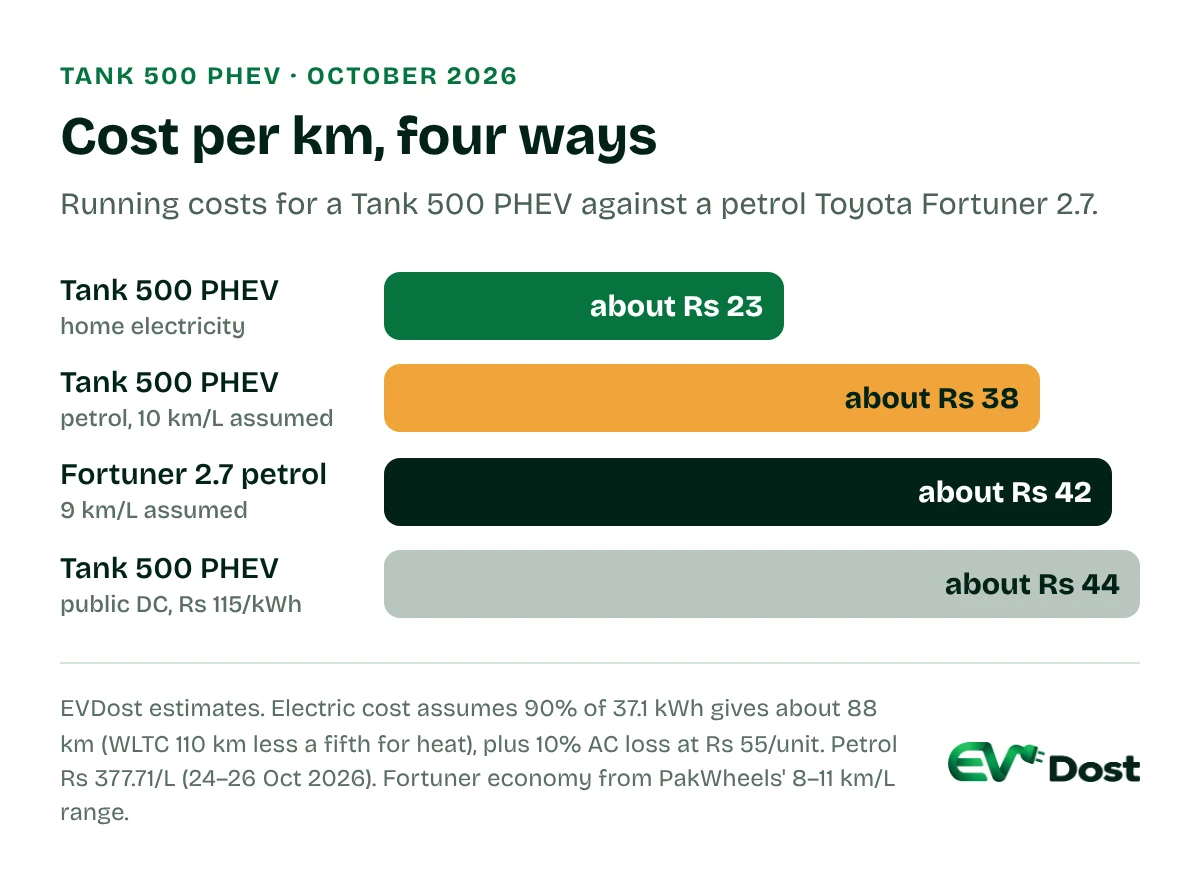
A full charge of about 37 units costs around Rs 2,020 and covers about 88 km, or roughly Rs 23 per km. GWM hasn't published a realistic petrol-mode figure for Pakistan, so we assumed 10 km/L once the battery is flat, which is about Rs 38 per km.
So a 40 km weekday costs about Rs 920 in a charged Tank 500 PHEV and about Rs 1,680 in a Fortuner. On a Lahore to Islamabad run of roughly 375 km, starting full and doing the rest on petrol, we estimate about Rs 12,900 against about Rs 15,700 for the Fortuner. The saving shrinks on long trips because most of the distance runs on petrol.
What it does well, and where it asks for patience
What it does well is uncommon at this price — a locally assembled, body-on-frame SUV with 4WD and global towing figures of 3,000 kg braked, that can still run your daily errands silently. RACQ also lists vehicle-to-load at up to 6 kW, handy for a camp or a farmhouse.
The compromises start inside. The PHEV seats five, because it gives up the HEV's third row for the battery, so big families who need seven seats should look at the HEV. Published specs are thin. We couldn't find Pakistani warranty terms, the AC limit or the DC speed, so ask for them in writing. Waits are long, too, and bookings made after 27 January were quoted six to eight months. And once the battery is flat it's heavy on petrol, as any 2.8-tonne 4x4 is.
Other big plug-ins worth a test drive
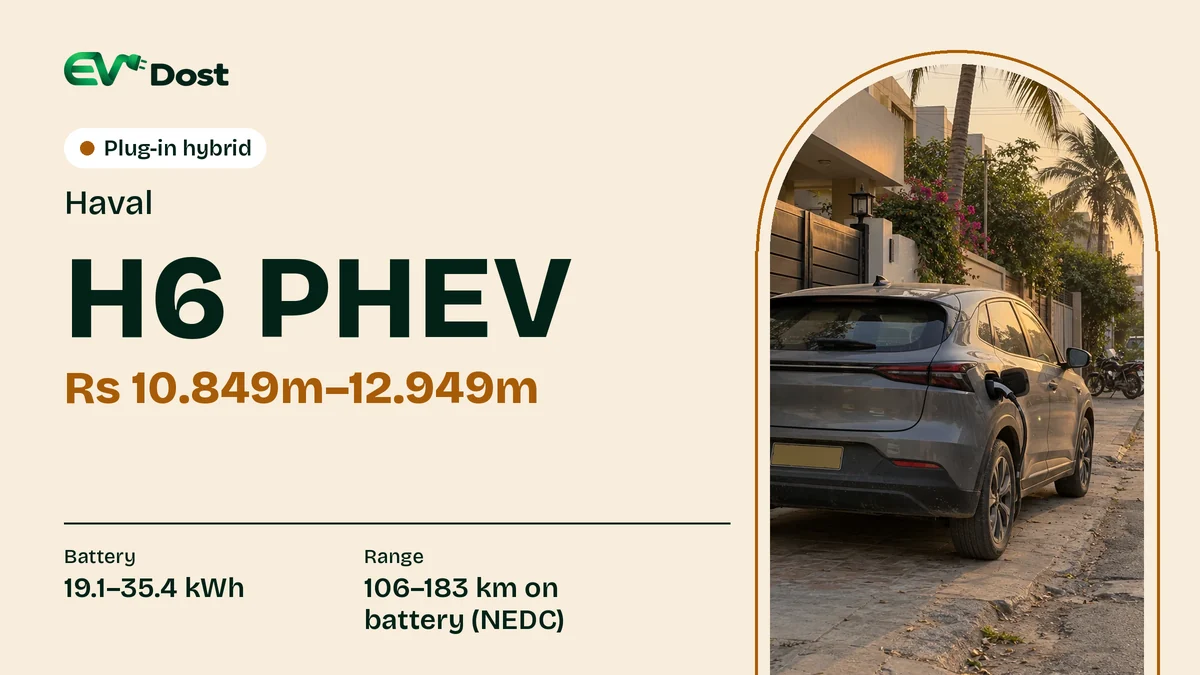
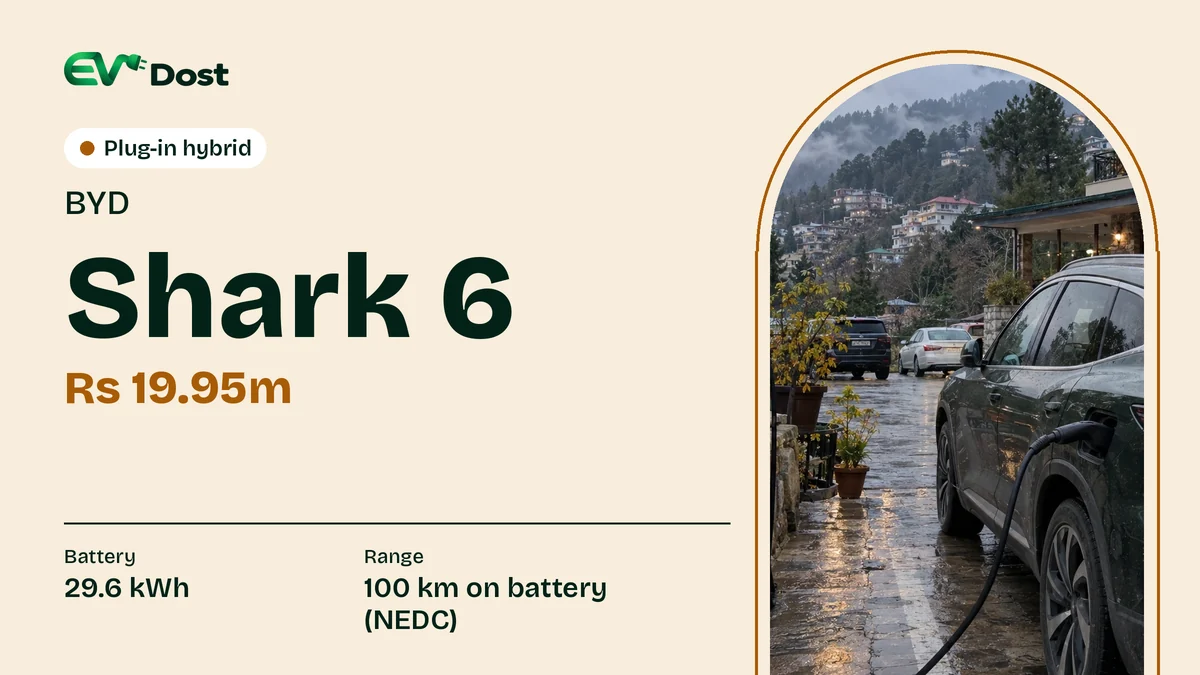
There's nothing quite like it at Rs 22.5 million, though our guide to electric car prices in Pakistan shows how wide the field has become, from small city cars to luxury SUVs. The BYD Shark 6 is the closest plug-in alternative with a ladder frame and a load bed, at Rs 19.95 million as of June 2026 (ProPakistani, June 2026). If you don't need off-road hardware, the Haval H6 PHEV from the same Sazgar showrooms costs about Rs 10 to 13 million and claims at least as much electric range, 106 to 183 km on NEDC against the Tank's 120 km claim. The petrol Fortuner is far cheaper to buy, and that gap takes many years of electric driving to recover.
The household it suits
We'd recommend the plug-in to a household with its own parking and a wallbox, a short weekday routine, and weekends that involve the Salt Range, a farmhouse road or a trailer. It suits less well someone in a flat with no charging, or a family of seven.
Get the Tank 500 PHEV price in Pakistan confirmed in writing before the booking amount leaves your account. Even PakWheels has printed the HEV's price for it once.
Frequently asked questions
What is the Tank 500 PHEV price in Pakistan?
The Tank 500 PHEV costs Rs 22,500,000 ex-factory in Pakistan, the price GWM Pakistan announced in January 2026 and the latest official figure we found as of October 2026. The booking amount was Rs 3.5 million. The non-plug-in Tank 500 HEV costs Rs 20,500,000.
How far can the Tank 500 PHEV drive on electricity?
GWM claims up to 120 km of electric range for the Tank 500 PHEV, and the Chinese-market car is rated at 110 km on WLTC. In Pakistani heat and traffic, PakWheels estimates 80–90 km, and our own estimate is about 88 km. After that the petrol engine takes over.
How long does the Tank 500 PHEV take to charge?
The Tank 500 PHEV takes about 4 hours 40 minutes from 20% to full on the 7 kW home charger GWM includes, by our October 2026 estimate, and about 6 hours from nearly empty. Australian-spec cars charge at 50 kW on DC, taking about 24 minutes from 30 to 80%; the Pakistani DC speed is unconfirmed.
Is the Tank 500 PHEV locally assembled?
The Tank 500 PHEV is locally assembled: Sazgar Engineering Works builds it from CKD kits in Pakistan, with the first local rollout announced in April 2026. Reports at the time said Pakistan was the first country outside China to assemble the PHEV version.
Should I buy the Tank 500 HEV or PHEV?
Choose the Tank 500 PHEV (Rs 22.5 million as of January 2026) if you can charge at home and most of your days are under about 80 km, since electricity costs about Rs 23 per km against roughly Rs 38 on petrol by our estimates. Choose the HEV (Rs 20.5 million) if you need seven seats or can't charge regularly.
Sources
- PakWheels, Tank 500 HEV and PHEV prices (January 2026): pakwheels.com
- ProPakistani, Tank 500 prices announced (January 2026): propakistani.pk
- PakWheels, Tank 500 price page: pakwheels.com
- ProPakistani, Tank 500 delivery change and free charger (January 2026): propakistani.pk
- ProPakistani, first locally assembled Tank 500 (April 2026): propakistani.pk
- Daily Times, Tank 500 PHEV assembly (April 2026): dailytimes.com.pk
- Business Recorder, sponsored content on Tank 500 PHEV assembly (April 2026): brecorder.com
- PakWheels, Tank 500 PHEV features (April 2026): pakwheels.com
- Wikipedia, GWM Tank 500: wikipedia.org
- RACQ, Tank 500 Hi4-T (September 2025): racq.com.au
- CarNewsChina, Tank 500 Hi4-T 2026 specifications: carnewschina.com
- EVSE Australia, Tank 500 PHEV charging: evse.com.au
- CarExpert, Tank 500 Ultra specifications: carexpert.com.au
- PakWheels, Toyota Fortuner prices and mileage (June 2026): pakwheels.com
- ProPakistani, BYD prices after the budget (June 2026): propakistani.pk
- PakWheels, hybrid prices after tax revision (September 2026): pakwheels.com
- Mettis Global, SRO 1525(I)/2026 on local hybrids (September 2026): mettisglobal.news
- Daily Pakistan, cars that qualify for the 18% hybrid rate (September 2026): dailypakistan.com.pk
- Profit, Chery PHEV price rise after sales tax change (July 2026): profit.pakistantoday.com.pk
- Investify, petrol price from 25 October 2026: investify.pk