Three-phase connection for EV chargers in Pakistan: the DISCO paperwork, costs and fixed charge
Say you've just bought an SUV with an 11 kW onboard charger. The installer has barely unrolled his tape measure when he tells you that for a 22 kW wallbox you'll need three-phase. Suddenly your week is about load extension, demand notices and whether LESCO will want to change the meter.
If you're weighing up a three-phase connection for EV chargers rated 11 or 22 kW, start with the car, before you ever speak to the DISCO. Then comes the paperwork, which is slower than most people expect but not complicated. And then there's a monthly cost that hardly anyone mentions until the first bill arrives.
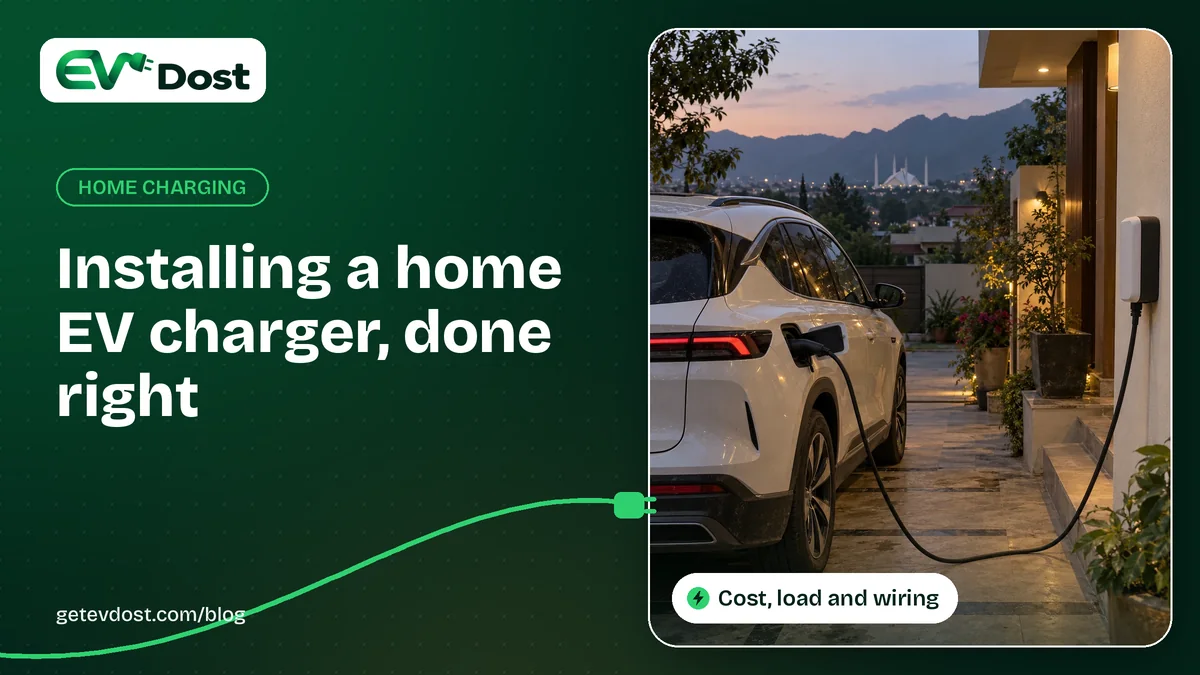
Whether you need three-phase at all is covered in our home charger installation guide. This post picks up from there, for the households that have decided they might.
Start with the car's onboard charger, not the wallbox
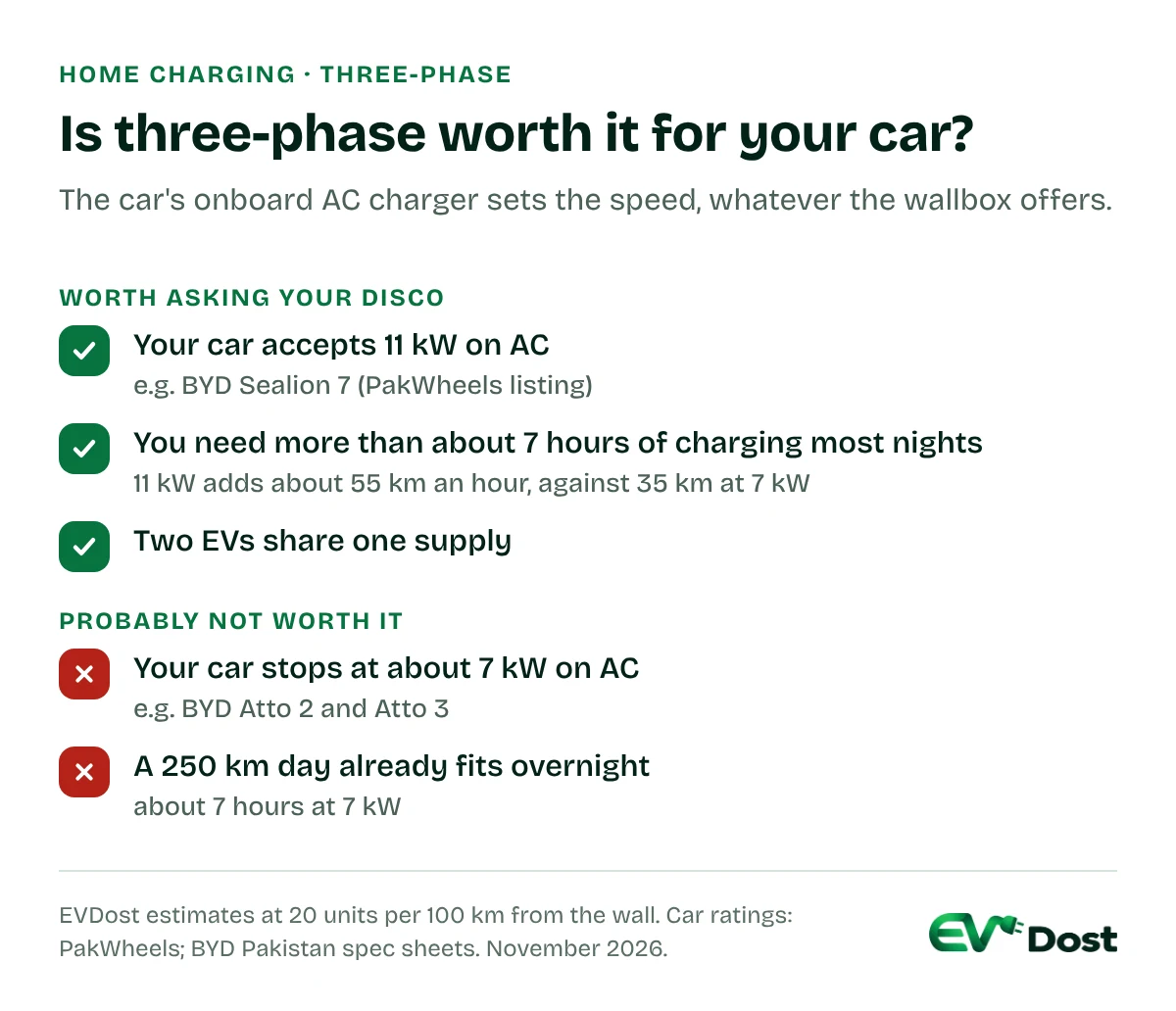
A wallbox only offers power. The car decides how much of it to take, through its onboard AC charger, and most electric cars sold in Pakistan stop at about 7 kW. BYD's Pakistani spec sheets rate both the Atto 2 and the Atto 3 at 7 kW on AC (BYD Atto 2 flyer, January 2026; BYD Atto 3 spec sheet). Plug either into a 22 kW three-phase unit and it'll still charge at about 7 kW.
A smaller group can use more. PakWheels lists an 11 kW onboard charger for the BYD Sealion 7 (PakWheels), and the XPeng G6 is rated at 11 kW on AC in its Australian specification (CarExpert). Ask the dealer to confirm the figure for the Pakistani car. For cars like these, three-phase is the only way to get the full rate at home.
What does 11 kW buy you? At about 20 units from the wall per 100 km, the figure we use across our guides, the difference looks like this.
- 7 kW, single-phase: about 35 km of range per hour plugged in.
- 11 kW, three-phase: about 55 km per hour.
- Putting back a 250 km day: roughly 7 hours at 7 kW against 4 hours 30 minutes at 11 kW.
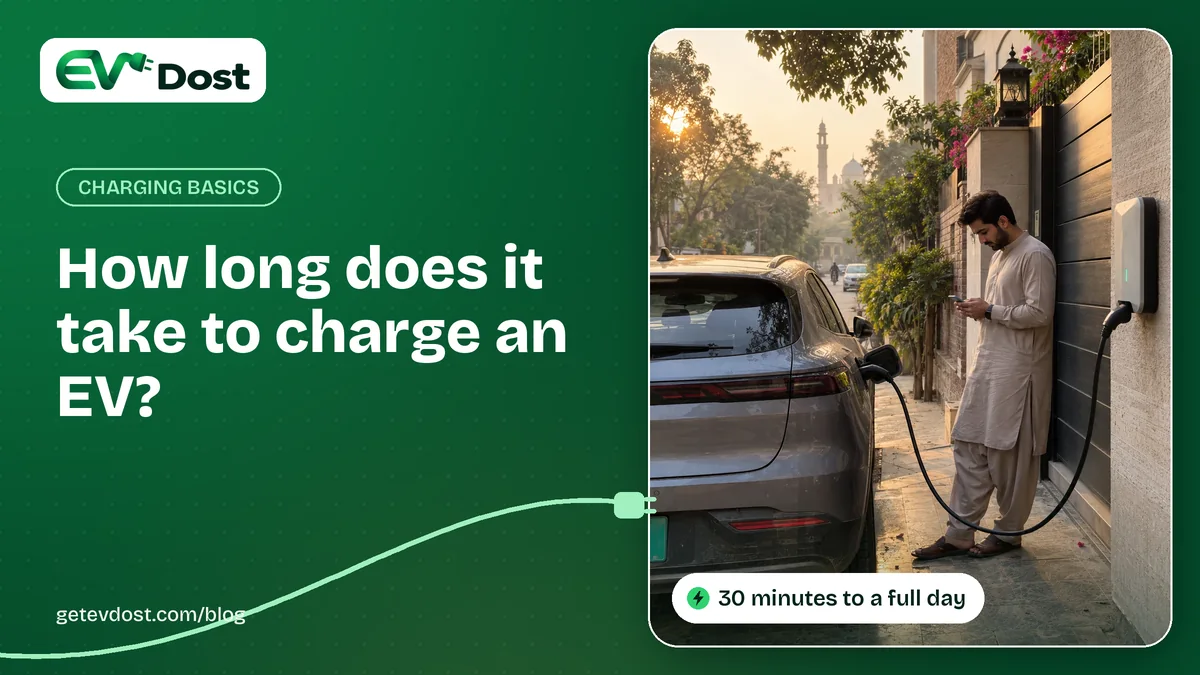
Seven hours still fits inside a night. So we'd only chase three-phase if you regularly come home late and leave early, share one car between two long commutes, or already own (or are about to buy) a second car that also accepts 11 kW. Our page on how long charging takes at 7 kW and 11 kW goes into more detail.
A 22 kW wallbox makes even less sense today. None of the cars in our Pakistani guides is rated above 11 kW on AC, so check the onboard charger rating in the spec sheet before paying extra for one.
How load extension works with your DISCO
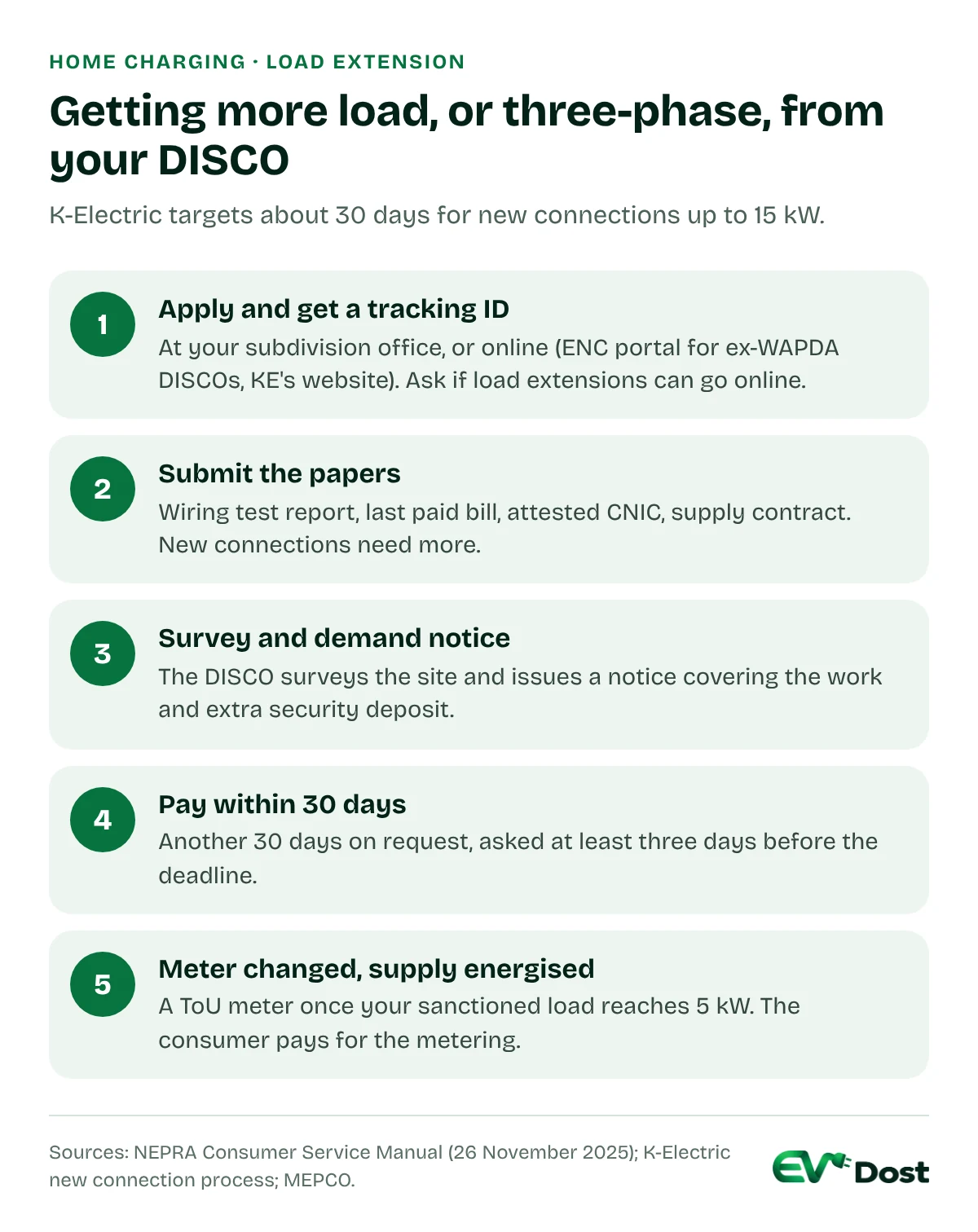
In DISCO terms, you're asking for an extension of load, and if the new load needs it, a change from a single-phase to a three-phase meter. NEPRA's Consumer Service Manual, in the version issued on 26 November 2025, lays out the procedure every ex-WAPDA company follows (NEPRA, November 2025).
Applying
You can apply in person at your subdivision office, and new connections can also be applied for online; ask your DISCO whether it takes load extensions online too. The ex-WAPDA companies take connection applications through PITC's ENC portal (ProPakistani, October 2020) at enc.com.pk, which MEPCO, for example, points customers to (MEPCO), and LESCO accepts online forms there before asking for a hard copy at the office (Daily Pakistan, December 2025). Either way you should get a tracking ID.
K-Electric customers in Karachi apply on KE's own website instead, and get a case ID by SMS (K-Electric).
The papers
For an extension of load, the manual's list is shorter than for a brand-new connection (NEPRA, November 2025):
- A wiring test report from an authorised contractor or the Electric Inspector
- A copy of your last paid bill, with no arrears or instalments pending
- An attested copy of your CNIC
- Your existing power supply contract
You'll also pay any capital cost that applies and top up your security deposit to the current rate. The ownership proof, Rs 50 stamp-paper affidavit and witness's CNIC are for new connections, so expect to need them if you're applying for a fresh three-phase connection instead. K-Electric's checklist for new connections asks for that affidavit on Rs 200 stamp paper, attested by a notary or oath commissioner.
Demand notice, payment and the meter
After a site survey, the DISCO sends a demand notice covering the connection work and any extra security deposit. You get 30 days to pay, and another 30 if you ask at least three days before the deadline. Once it's paid, the work is scheduled and the meter is changed. Under the same manual, the consumer pays for the metering installation.
How long it takes
K-Electric publishes a target of 30 days for new connections up to 15 kW, split into 4 days to survey, 6 for the estimate, 11 for material and 9 for installation, and says a new connection can be as quick as 15 days when everything is in order (K-Electric). Its sheet lists load extension as a request type but gives no separate timing, so we've used the new-connection figures as a rough guide. NEPRA's manual sets its own step-by-step timetable in an annexure we couldn't open, so treat a month as the plan and be pleasantly surprised if it's faster.
What a three-phase connection for EV chargers costs
Nobody publishes a single price for going three-phase, because the demand notice depends on the cable, the meter and the work on your street. These are the pieces we could pin down.
- Security deposit. The average rates IESCO lists for all DISCOs are Rs 1,220 per kW for urban homes and Rs 610 per kW for rural ones (IESCO). Taking an urban house from 5 kW to 12 kW adds about Rs 8,540. DISCOs asked NEPRA in January 2025 for a steep rise in these deposits, and NEPRA put the decision off pending an audit (Dawn, January 2025; Profit, February 2025). We found no later decision.
- The three-phase meter and connection. LESCO raised its demand notice fee for a new three-phase meter connection from Rs 33,500 to Rs 63,450 from 1 July 2024 (ARY News, June 2024). That's the latest figure we could find. The report covers new connections, and we couldn't confirm what LESCO charges to convert an existing single-phase connection; other DISCOs set their own.
- Material and labour. NEPRA's manual lets DISCOs charge the actual material cost plus 12 percent store handling and 8 percent for installation, all collected through the demand notice.
Add your own side of the job, a three-phase distribution board, the cable run and the wallbox, which an electrician quotes separately. Put together, if that fee applies, a LESCO customer moving from 5 to 12 kW on three-phase is looking at roughly Rs 72,000 for the three-phase fee and the extra deposit alone, before anything else the survey adds and before the house wiring.
The time-of-use tariff, and the fixed charge that follows you
Once your sanctioned load reaches 5 kW, you're moved to the residential time-of-use tariff, A-1(b). The manual says that when the load on a single-phase meter approaches 5 kW, the DISCO should issue a notice to extend the load and then fit a ToU meter.
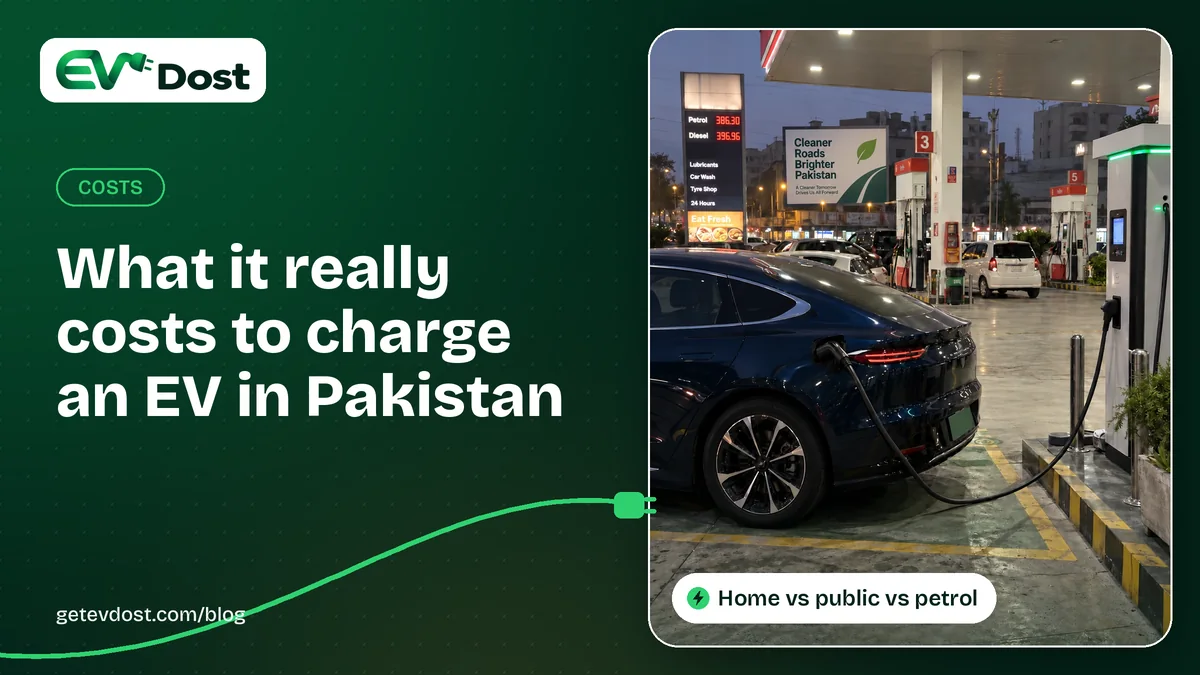
The per-unit part works in an EV owner's favour. IESCO's tariff guide, under the February 2026 notification, lists Rs 46.85 per unit at peak and Rs 34.53 off-peak, before taxes and surcharges (IESCO). Putting 50 units into a car overnight then costs about Rs 1,727 at the off-peak base rate against Rs 2,343 at peak, roughly a quarter less. Your DISCO sets the evening peak window, so charge after it ends.
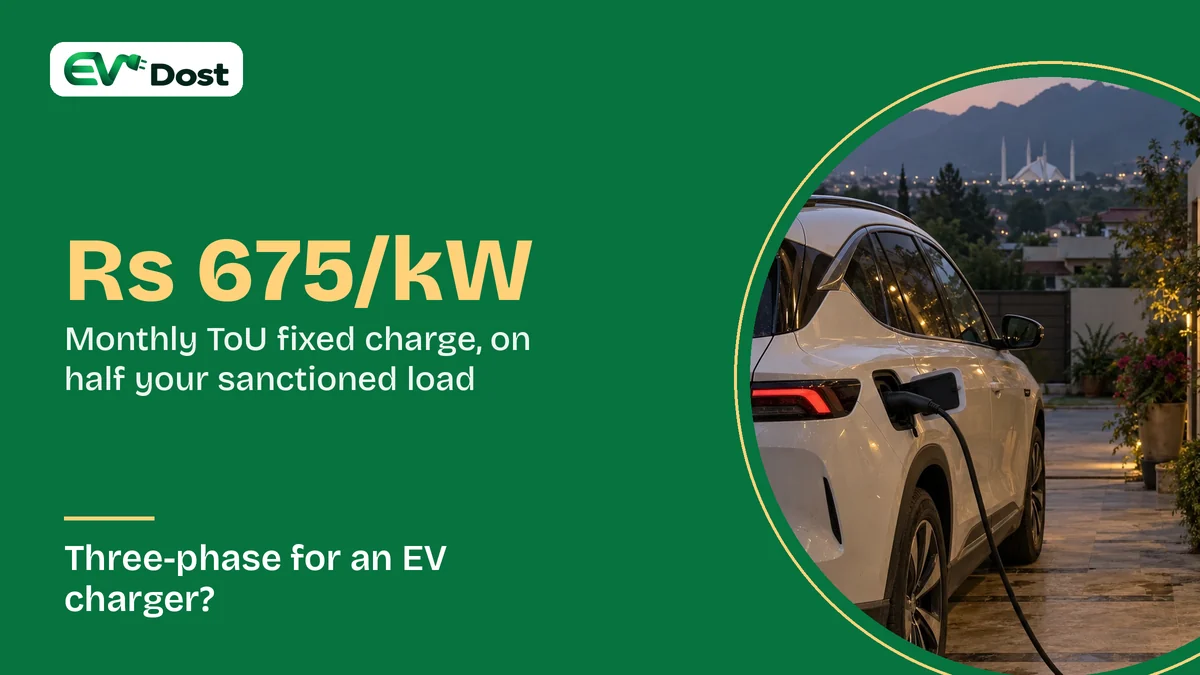
The fixed charge is where three-phase households get caught out. On A-1(b), IESCO's guide lists Rs 675 per kW a month, charged on half the sanctioned load or on the maximum demand your meter records, whichever is higher. A 12 kW sanctioned load costs about Rs 4,050 a month on the half-load basis, before GST. But run an 11 kW wallbox while two air conditioners are on, and the meter could log 13 kW or so. That alone would make the fixed charge about Rs 8,775 for the month.
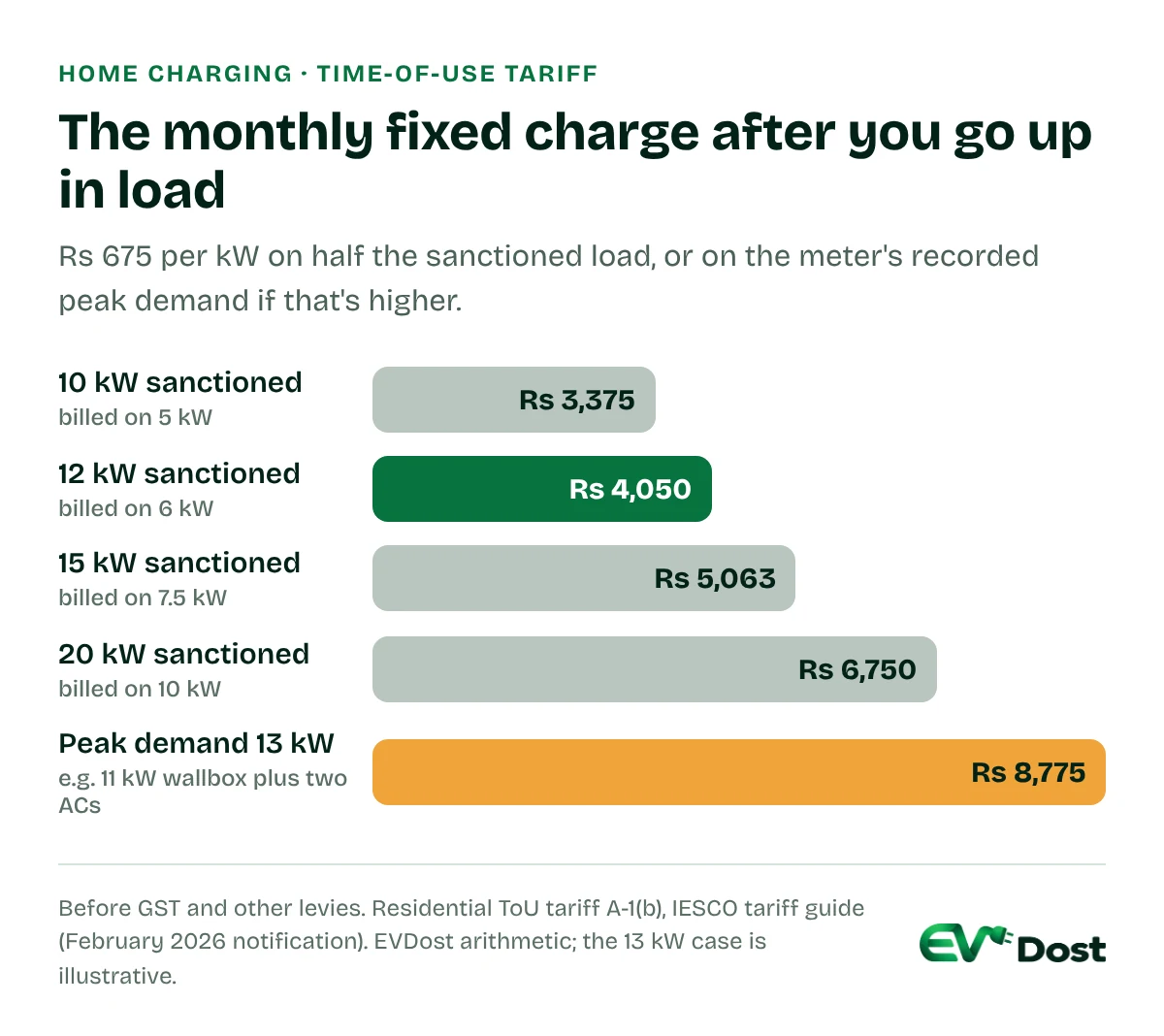
So don't ask for more load than you need, and set the wallbox to charge late, when the house is quiet. Many wallboxes let you cap the charging current, so check yours. A cap of 8 or 9 kW on summer nights, when the ACs are running, still beats single-phase and keeps the recorded peak lower. To see what the fixed charge does per kilometre, divide the extra monthly amount by the kilometres you drive and add it to the per-km figure from our cost-per-km working.
If three-phase isn't worth it for you
Plenty of owners will run the numbers and stay put. That's a perfectly good outcome. A 7 kW single-phase wallbox refills an ordinary day's driving overnight for almost every car on sale here. Rooftop solar can carry some of the charging on days the car stays home, as our solar charging guide explains.
For the odd day you need a faster top-up, someone else's charger can do the job. EVDost listings show each charger's plug type and power, so an 11 kW or 22 kW AC unit is easy to spot. Send a request, and if the host accepts within the 15-minute window, you charge and then pay them yourself. EVDost takes no commission for now. Browse nearby chargers and their power ratings while the DISCO works through your file.
Our view, as of November 2026, is that a three-phase connection for EV chargers at home earns its keep for a fairly small group. That means owners of 11 kW cars with long, tight daily schedules, and two-EV households. Everyone else gets more from a well-installed 7 kW wallbox, a sensible sanctioned load and a timer set for after the peak.
Frequently asked questions
How long does a load extension take in Pakistan?
A load extension in Pakistan takes about a month as a working plan, as of November 2026. K-Electric's published target for a new connection up to 15 kW is 30 days, split between survey, estimate, material and installation, or as quick as 15 days if the paperwork is complete; it gives no separate figure for load extensions. Ex-WAPDA DISCOs follow NEPRA's Consumer Service Manual.
How much security deposit does a DISCO charge per kW?
DISCOs charge a security deposit of Rs 1,220 per kW for urban homes and Rs 610 per kW for rural homes, according to the average rates IESCO lists for all DISCOs as of November 2026. Extending an urban home from 5 kW to 12 kW adds about Rs 8,540. A proposed increase has been pending with NEPRA since early 2025.
Can I apply for a three-phase connection online?
A new three-phase connection can be applied for online in Pakistan as of November 2026, but ask your DISCO whether it takes load extensions online too. NEPRA's Consumer Service Manual lets you apply in person or online, the ex-WAPDA DISCOs take online connection applications through PITC's ENC portal at enc.com.pk, and K-Electric customers apply on KE's website. You get a tracking ID, but LESCO still asks for a hard copy at the office, and any DISCO may ask to see original documents before the supply is energised.
Which electric cars can use an 11 kW home charger?
The BYD Sealion 7 accepts 11 kW on AC according to its PakWheels listing as of November 2026, and the XPeng G6 is rated at 11 kW in its Australian specification. Both charge faster on a three-phase 11 kW wallbox. Many other EVs sold in Pakistan, including the BYD Atto 2 and Atto 3, stop at 7 kW.
What does a time-of-use meter change on my bill?
A time-of-use meter puts a home with a sanctioned load of 5 kW or more on the A-1(b) tariff. IESCO lists Rs 34.53 per unit off-peak and Rs 46.85 at peak before taxes (February 2026), plus a fixed charge of Rs 675 per kW a month on half the sanctioned load or the recorded peak demand, whichever is higher.
Sources
- NEPRA, Consumer Service Manual revised 2025 (26 November 2025): nepra.org.pk
- K-Electric, new connection process below 80 kW: ke.com.pk
- MEPCO, ease of doing business and ENC portal: mepco.com.pk
- ProPakistani, PITC ENC portal for online connections (October 2020): propakistani.pk
- Daily Pakistan, LESCO online applications (December 2025): dailypakistan.com.pk
- IESCO, security deposit rates: iesco.com.pk
- IESCO, tariff guide (February 2026 notification): iesco.com.pk
- Dawn, proposed security deposit increase (January 2025): dawn.com
- Profit, NEPRA defers security deposit decision (February 2025): profit.pakistantoday.com.pk
- ARY News, LESCO three-phase demand notice fee (June 2024): arynews.tv
- PakWheels, BYD Sealion 7 specifications: pakwheels.com
- CarExpert, XPeng G6 specifications (Australia): carexpert.com.au
- BYD Pakistan, Atto 2 flyer (January 2026): PDF
- BYD Pakistan, Atto 3 spec sheet: PDF