Hybrid vs electric car in Pakistan: which one makes sense after 2026's tax swings?
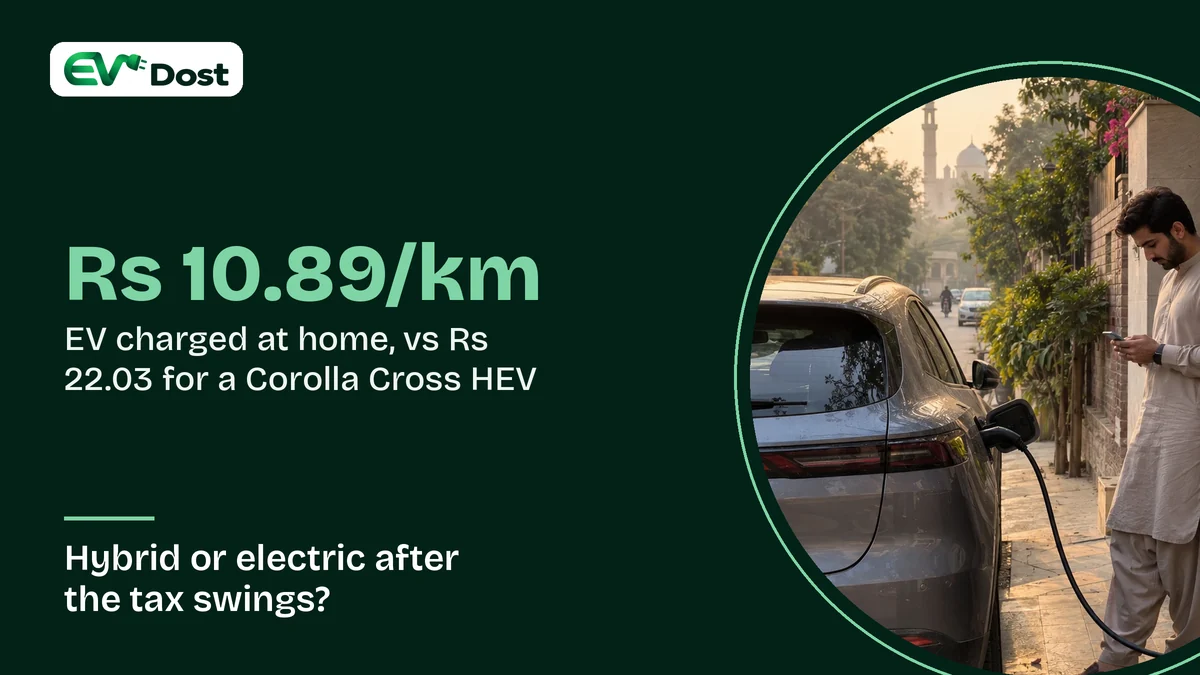
A year ago, a family with about Rs 9 million for a crossover had an easy default. Buy the Corolla Cross hybrid, enjoy the fuel average, and never think about a plug. Then the hybrid tax break lapsed, prices jumped by about Rs 1.3 million in July, and they came partly back down in September.
The result is a strange one. As of November 2026, the base Corolla Cross HEV costs Rs 309,000 more than a BYD Atto 3, a full electric car. So the question of hybrid vs electric car in Pakistan has changed shape. It's no longer "pay extra for the EV to save on fuel". For a lot of buyers, the EV is now the cheaper car to buy as well as to run, and the hybrid has to win on other grounds.
This comparison is about self-charging hybrids (HEVs), the kind with a small battery you never plug in. Plug-in hybrids are a different animal, and our PHEV vs EV comparison covers them.
What each one costs to buy today
| Car | Type | Price (Rs) | Fuel or energy use |
|---|---|---|---|
| MG4 EV Urban | Electric | 6,949,000 | 18 kWh/100 km (our planning figure) |
| Seres 3 | Electric | 8,390,000 | 18 kWh/100 km |
| BYD Atto 3 Advance | Electric | 8,990,000 | 18 kWh/100 km |
| Toyota Corolla Cross 1.8 HEV | Hybrid | 9,299,000 | about 17 km/L |
| Honda HR-V e:HEV | Hybrid | 9,299,000 | about 21.5 km/L (PakWheels listing) |
| Toyota Corolla Cross 1.8 HEV X | Hybrid | 9,729,000 | about 16 km/L |
| MG HS Hybrid+ | Hybrid | 9,999,000 | no Pakistani figure found |
| Haval H6 HEV | Hybrid | 11,523,015 | about 16.5 km/L |
All prices are ex-factory. The hybrids are from PakWheels listings opened on 4 November 2026 (Corolla Cross, updated 25 September; HR-V e:HEV; H6 HEV), and the MG from its September price notice (PakWheels, September 2026). Fuel averages are PakWheels' figures, averaging city and highway (Corolla Cross, H6). The HR-V's 20–23 km/L looks generous next to the Corolla Cross, and Honda's own claim at launch was 25 km/L (PakWheels, July 2025), so treat it as a best case. The EV prices match our guides to the MG4 EV, the Seres 3 and the BYD Atto 3, and we confirmed the Seres 3 and Atto 3 figures on PakWheels (Seres 3, Atto 3) on the same day.
The EVs' 18 kWh per 100 km is the planning number we use for compact EVs across the site, not a manufacturer's claim.
How hybrid taxes moved this year
Most of what happened to hybrid prices in 2026 came from tax, not from the carmakers.
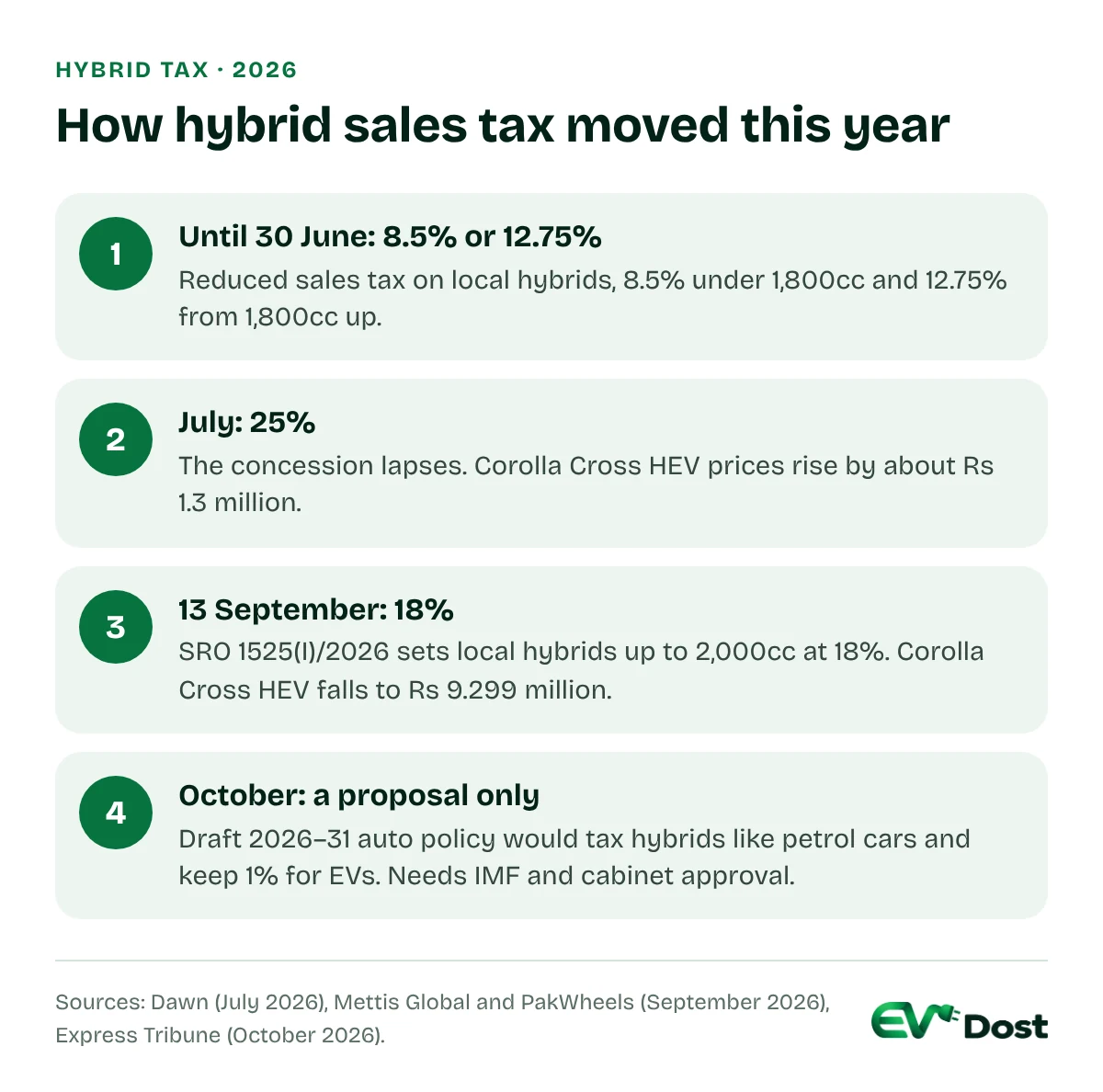
Until 30 June 2026, locally made hybrids paid a reduced sales tax, 8.5 percent under 1,800cc and 12.75 percent from 1,800cc up. That concession expired and hybrids moved to 25 percent in the FY27 budget (PakWheels, September 2026; Dawn, July 2026). Toyota raised the two Corolla Cross HEVs by Rs 1.31 to 1.36 million and Honda the HR-V e:HEV by Rs 1.37 million (Dawn, July 2026). Some other assemblers reportedly paused invoicing and deliveries.
On 13 September, SRO 1525(I)/2026 took locally manufactured hybrids up to 2,000cc out of the 25 percent band, leaving them at the standard 18 percent (Mettis Global, September 2026). Reports don't agree on plug-in hybrids. PakWheels said the SRO doesn't mention them and that they remain at 25 percent (PakWheels, September 2026), but Daily Pakistan listed locally assembled PHEVs such as the Haval H6 PHEV and MG HS PHEV among the cars on 18 percent (Daily Pakistan, September 2026). Toyota cut the Corolla Cross HEV to Rs 9.299 million, and Honda cut the HR-V e:HEV to Rs 9.299 million with effect from 25 September. MG went the other way and raised the HS Hybrid+ by Rs 500,000, while Haval's hybrid prices stayed put, with Sazgar absorbing the tax difference for now, PakWheels reported (PakWheels, September 2026).
Full EVs sit in a different place. An FBR explanation of the Finance Act, reported by PakWheels, says the 1 percent sales tax for specified EVs runs until 30 June 2027 (PakWheels, October 2026).
And there's more change on the way, possibly. The draft auto policy for 2026–31, which the Prime Minister approved in October, would keep 1 percent for battery EVs and treat hybrids the same as ordinary petrol cars for duties and taxes. It still needs IMF and cabinet approval and then a bill in parliament, so it's a proposal, not law (Express Tribune, October 2026).
For a buyer, the two paths look different. If you want a hybrid, today's 18 percent price is known and the next change could go either way. If you want an EV, the 1 percent rate is in place until mid-2027. Neither is a reason to rush, but we wouldn't sit on a decision for months waiting for hybrids to get cheaper.
Hybrid vs electric car in Pakistan: the cost per kilometre
The two types part company on running cost. With petrol at Rs 374.51 a litre from 3 November 2026 (Investify, November 2026), and prices revised almost daily, this is what each kilometre costs. We charge the EV at about Rs 55 a unit at home, with 10 percent lost from the wall, and at about Rs 115 per kWh on a typical public DC charger. It's the same working we use for every car.
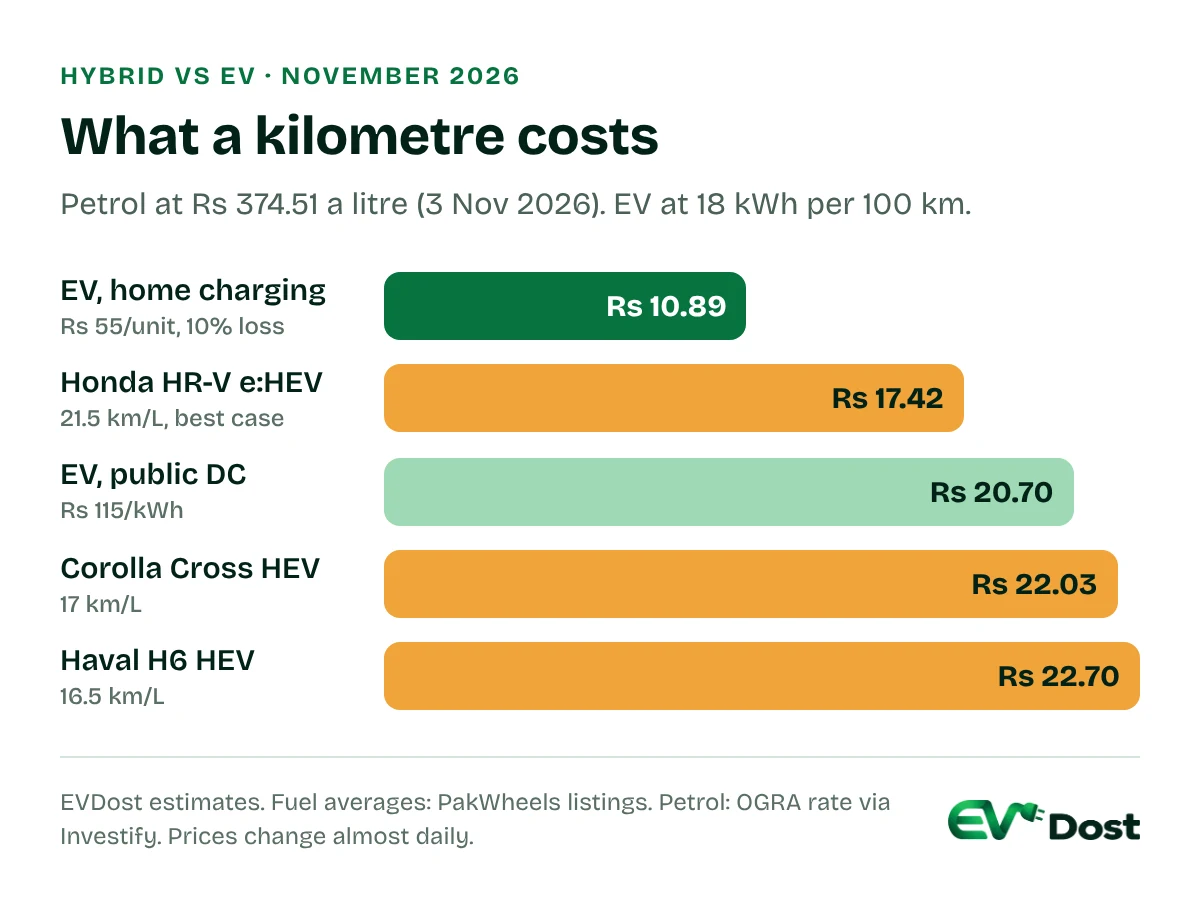
At 1,500 km a month, a fairly normal family figure, the EV charged at home costs about Rs 16,300. The Corolla Cross HEV costs about Rs 33,000, the H6 HEV about Rs 34,000 and the HR-V e:HEV about Rs 26,100. Over five years and 75,000 km, the home-charged EV spends about Rs 817,000 on electricity against about Rs 1.65 million in petrol for the Corolla Cross.
Look at the middle of the chart, though. An EV charged only on public DC costs about Rs 20.70 a km, which is more than the HR-V's best-case figure and only a little under the Corolla Cross. That one comparison decides this whole question for many buyers. The saving comes from charging at home or at work. Take that away and a good hybrid runs about as cheaply as an EV, without the planning.
Add the purchase price and the five-year sums look like this, before insurance, servicing and resale:
- BYD Atto 3, home charging: about Rs 9.81 million
- Seres 3, home charging: about Rs 9.21 million
- Honda HR-V e:HEV: about Rs 10.61 million
- Toyota Corolla Cross HEV: about Rs 10.95 million
Servicing, batteries and resale
A hybrid still has a full petrol engine, so it still needs oil changes, filters, spark plugs and the rest of a normal service schedule, even if the engine works a little less hard. A full EV has none of that. Its routine servicing is mostly tyres, brakes, coolant and the cabin filter.
Both carry a battery warranty, and the EVs' run at least as long. The Corolla Cross hybrid battery is covered for 6 years or 160,000 km (PakWheels, November 2024), the HR-V e:HEV's for 6 years or 150,000 km, and the H6 HEV's for 8 years or 160,000 km, according to their PakWheels listings. The Atto 3's battery is covered for 8 years, as our Atto 3 guide explains, along with a mismatch in the mileage BYD prints.
On resale, the hybrid has the edge. Toyota and Honda have decades of used-market history here, and we'd expect a Corolla Cross to find a buyer quickly. EVs don't have that yet, and even PakWheels lists immature resale demand among the Atto 3's weak points on its model page (PakWheels). We can't put a number on the difference, because there isn't enough Pakistani data, but if you change cars every three years, it matters.
Charging access decides it
For most families, the hybrid vs electric car in Pakistan decision comes down to where the car sleeps at night. Everything above assumes the EV owner has somewhere reliable to charge. Public charging is still thin. Officials told a National Assembly committee in June 2026 that more than 100 stations had been licensed across the whole country (APP, June 2026), which isn't many for a country this size.
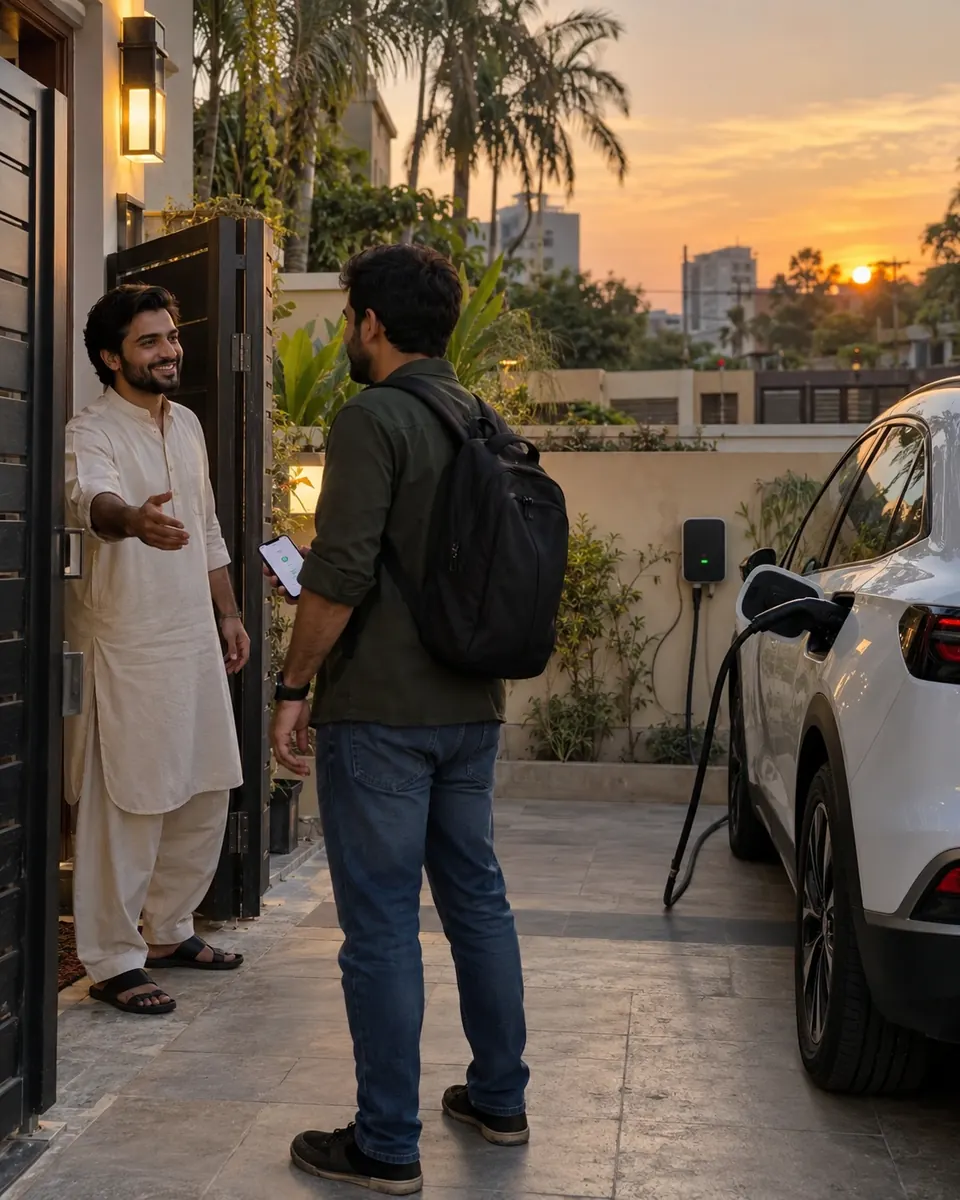
If you live in a house with a driveway and a decent sanctioned load, home charging is easy and the EV's running cost advantage is yours. If you live in a flat in Clifton or Gulberg with no socket of your own, the sums tilt back toward the hybrid unless there's a charger you can use within easy reach of home or work. EVDost can help with that part. Hosts list their wallboxes with an hourly price, and the map also shows some fuel-station and mall chargers run by operators, with directions, which you pay at the site. Open the EVDost charger map and look around your own streets before you decide.
Matching the car to your life
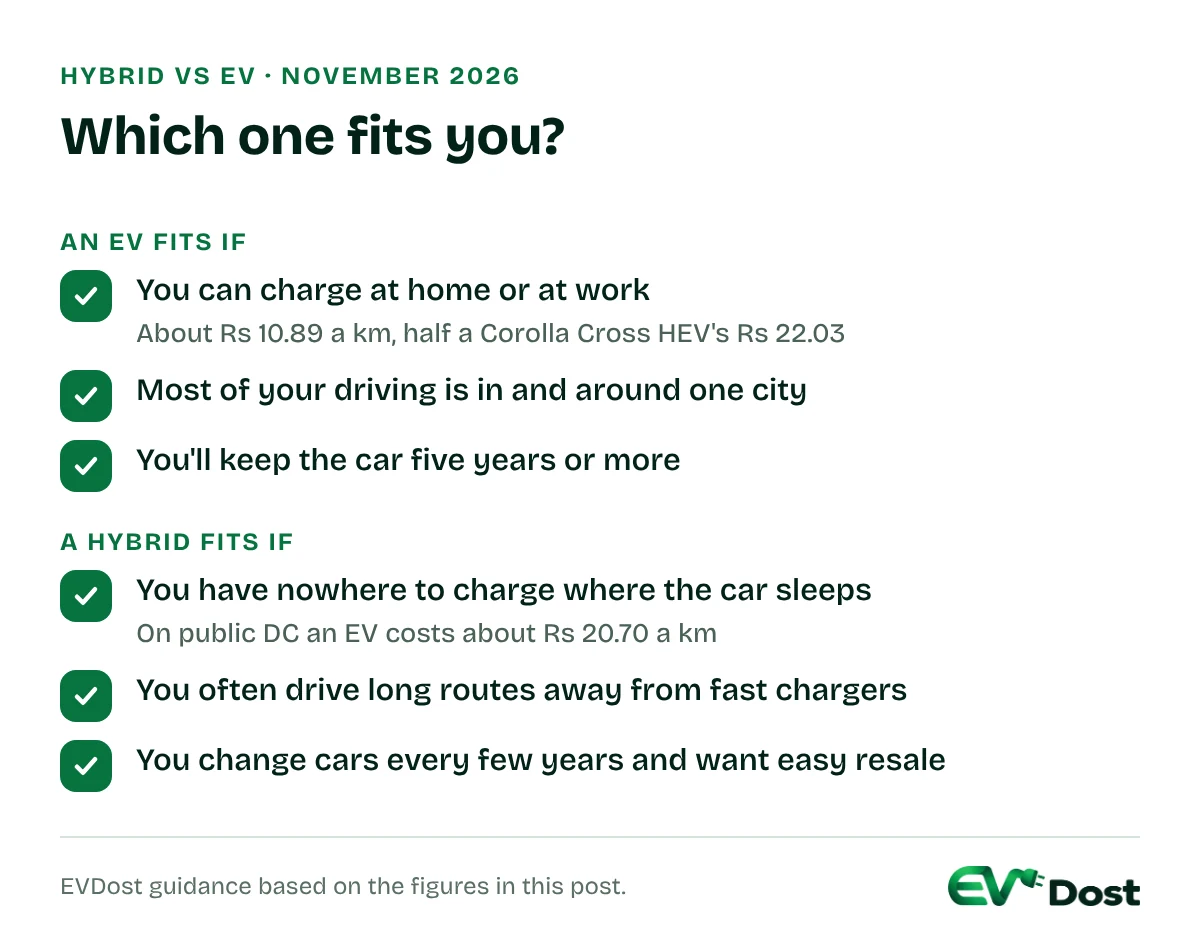
Pick a full EV if you can charge at home or at work, most of your driving is in and around one city, and you'll keep the car for five years or more. On today's prices you'll probably pay less up front and roughly 40 to 50 percent less per km, depending on the hybrid.
Pick a hybrid if you can't charge where the car sleeps, you drive long routes where fast chargers are rare, or you change cars often and want a predictable resale. The HR-V e:HEV and the Corolla Cross HEV are the two we'd look at first, at the same Rs 9.299 million.
Think about a plug-in hybrid if you can charge at home but regularly drive far beyond the city. That's the middle ground, and it has its own trade-offs.
We'd add one thing. A hybrid's selling point used to be "most of the saving, none of the hassle". At November 2026 prices it's more like "less of the saving, none of the hassle, and you pay more for the car". If you can plug in at home, that's a harder deal to justify than it was a year ago. If you can't, the hybrid is still the easier car to live with.
Frequently asked questions
Is a hybrid or an electric car cheaper to run in Pakistan?
An electric car charged at home is cheaper to run, at about Rs 10.89 per km as of November 2026, against about Rs 17 to 23 per km for popular hybrids with petrol at Rs 374.51 a litre. On public DC chargers at about Rs 115 per kWh, an EV costs about Rs 20.70 per km, close to a hybrid.
What sales tax do hybrid cars pay in Pakistan now?
Locally manufactured hybrid cars up to 2,000cc pay the standard 18 percent sales tax in Pakistan, under SRO 1525(I)/2026 of 13 September 2026, though reports differ on plug-in hybrids: PakWheels said they remain at 25 percent, while Daily Pakistan listed qualifying local ones at 18 percent. The earlier reduced rates of 8.5 and 12.75 percent ended on 30 June 2026, and hybrids paid 25 percent from July until the September change.
Is the Corolla Cross hybrid more expensive than the BYD Atto 3?
The Toyota Corolla Cross 1.8 HEV costs Rs 9,299,000 ex-factory as of November 2026, about Rs 309,000 more than the BYD Atto 3 Advance at Rs 8,990,000. Before the hybrid tax concession ended in June 2026, the Corolla Cross HEV was the cheaper of the two.
How long is the battery warranty on a hybrid in Pakistan?
Hybrid battery warranties in Pakistan run 6 to 8 years as of November 2026. PakWheels lists 6 years or 160,000 km for the Corolla Cross hybrid, 6 years or 150,000 km for the HR-V e:HEV and 8 years or 160,000 km for the Haval H6 HEV.
Should I buy a hybrid if I can't charge at home?
A hybrid is usually the better buy if you can't charge at home or work. An EV charged only on public DC at about Rs 115 per kWh costs about Rs 20.70 per km in November 2026, roughly what a Corolla Cross HEV costs in petrol, and you'd also have to plan every charge.
Sources
- Investify, petrol price from 3 November 2026: investify.pk
- PakWheels, Corolla Cross prices (updated 25 September 2026) and fuel average: prices, fuel average
- PakWheels, Honda HR-V e:HEV listing (opened November 2026): pakwheels.com
- PakWheels, Haval H6 HEV listing and fuel average (opened November 2026): listing, fuel average
- PakWheels, hybrid prices after the tax revision (September 2026): pakwheels.com
- PakWheels, HR-V e:HEV first look (July 2025): pakwheels.com
- PakWheels, Seres 3 and BYD Atto 3 listings (opened November 2026): Seres 3, Atto 3 Advance, Atto 3 overview
- Dawn, hybrid price rises after the GST change (July 2026): dawn.com
- Mettis Global, SRO 1525(I)/2026 on local hybrids (September 2026): mettisglobal.news
- Daily Pakistan, cars that qualify for the 18% hybrid rate (September 2026): dailypakistan.com.pk
- PakWheels, draft auto policy and FBR explanation on EV sales tax (October 2026): pakwheels.com
- Express Tribune, PM approves draft auto policy tax rates (October 2026): tribune.com.pk
- PakWheels, Corolla Cross hybrid battery warranty (November 2024): pakwheels.com
- APP, licensed charging stations (June 2026): app.com.pk