How to use an EV fast charger in Pakistan, step by step
The first time you pull onto a forecourt with a fast charger, there's a funny moment where you and the pump attendant look at each other, each hoping the other knows what happens next. Usually neither of you is sure.
That's no reflection on you. Pakistan's public charging is young, every operator does things a little differently, and almost none of them write the process down. So this is the guide we wish we'd had, on how to use an EV fast charger here, from the call you make before leaving home to the moment you hang the cable back up.
Find one that's working before you set off
A charger on a map tells you it was installed once. It doesn't tell you it works today, that it's open at 10 p.m., or that the bay isn't full of someone's parked Corolla.
So ring the site. Fuel station chargers usually have staff, and BYD's charging page, which presents HUBCO Green as its fast-charging partner, says its public stations are staffed by trained personnel (BYD Pakistan). Ask whether the unit is working, which plugs it has and what it costs. Some operators have their own apps too. Go Green Avenue runs a GO GREEN EV app (Go Green Avenue), PSO links an EV station locator from its charging page (PSO), and Tesla Industries publishes the EVX Charger app for its stations (App Store).
In the capital, our Islamabad and Rawalpindi charger list shows how patchy published details are, even for the best-known sites.
Check the plug before anything else
Almost every new EV sold officially in Pakistan fast charges through CCS2, and so do most public DC units. Two other plugs turn up, though. Cars imported privately from China often have a separate GB/T DC socket, and older Japanese imports such as early Leafs use CHAdeMO. Neither fits a CCS2 gun.
Open your charging flap before you go anywhere and take a photo of it. When you ring the operator, ask for the plug by name. Our plain guide to CCS2, GB/T and CHAdeMO shows what each looks like and which cars use which.
How to use an EV fast charger once you're there
Park so the cable reaches your port without stretching, and switch the car off. Some cars hold the connector while the car is locked; one BYD Atto 3 quick-start guide notes that the charger can't be removed while the car is locked (Sixt Australia, 2023). Know how yours behaves.
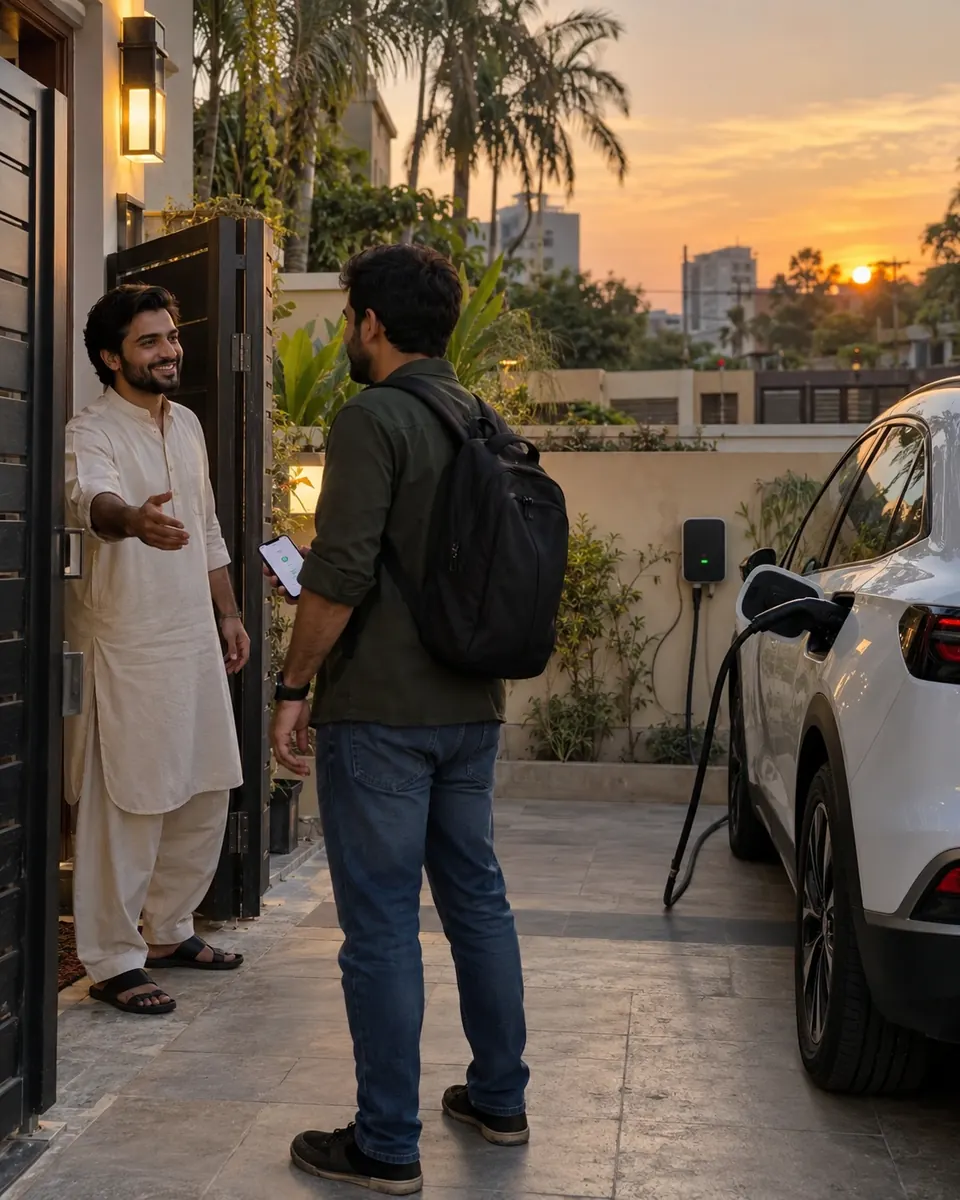
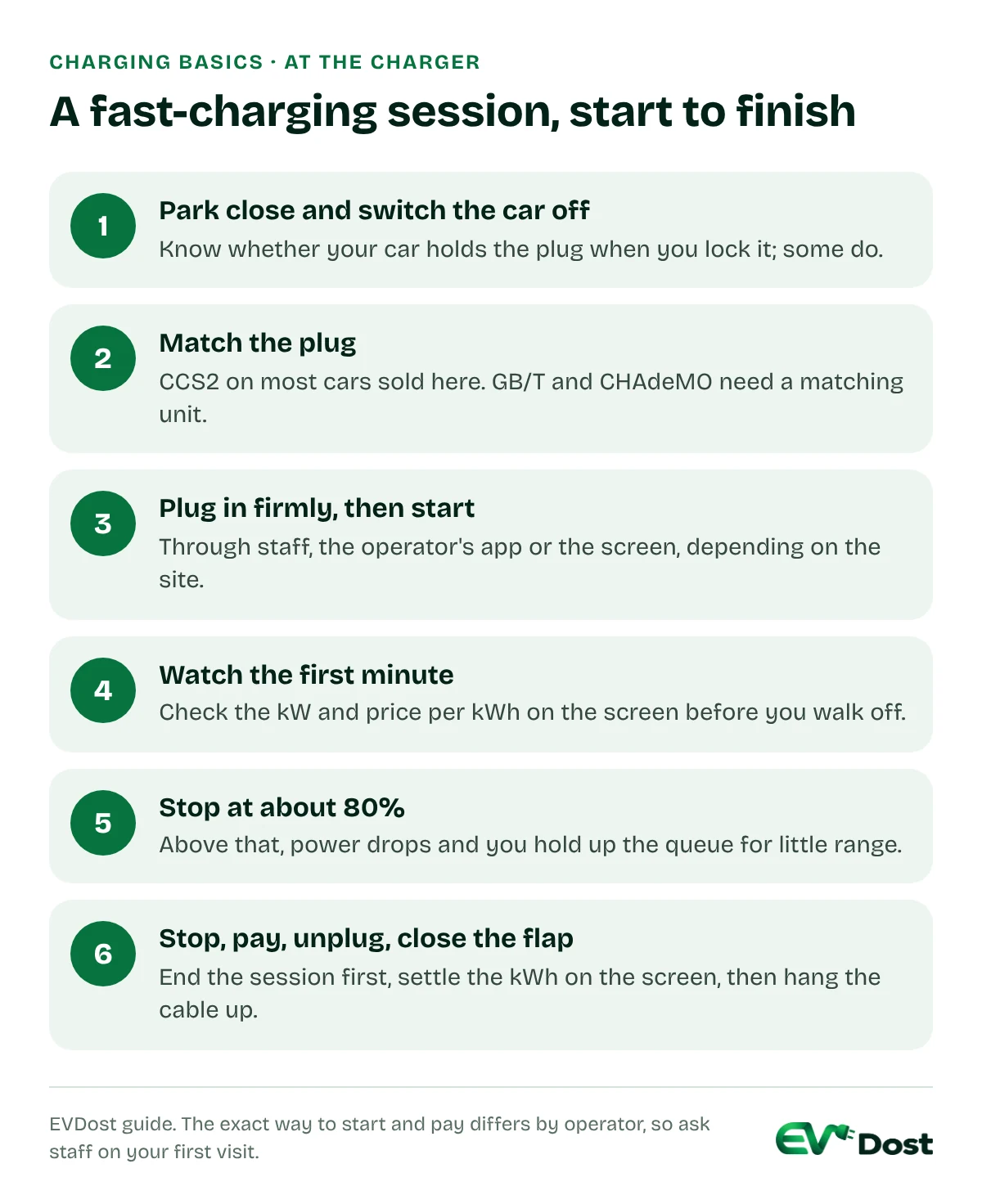
Lift the gun off the cabinet, open your car's dust caps, and push the plug in firmly until it seats. Then start the session. Exactly how varies, and this is the part operators publish least.
| Operator | What its own pages say about starting and paying | What we'd do |
|---|---|---|
| HUBCO Green (with PSO, Attock and BYD) | BYD says its public stations are staffed by trained personnel; no payment method published | Ask the attendant on your first visit |
| Go Green Avenue | Names its GO GREEN EV app and a call button for each site | Call first and ask whether you need the app |
| PSO | Links an EV station locator; no payment details | Ask the forecourt staff |
| Shell Recharge | Pakistan page names its rapid chargers but not how to pay | Ask at the site |
Abroad, drivers often tap an RFID card or scan a QR code to start; the Atto 3 guide above tells Australian renters to tap a card or fob at the charger. We couldn't find a Pakistani operator that publishes either method for its public chargers, so don't assume your card or app from elsewhere will work.
Once it starts, stay for the first minute. The screen should show power in kW climbing and energy in kWh counting up. If you see the price per kWh there, check it matches what you were told on the phone.
Paying for what went in
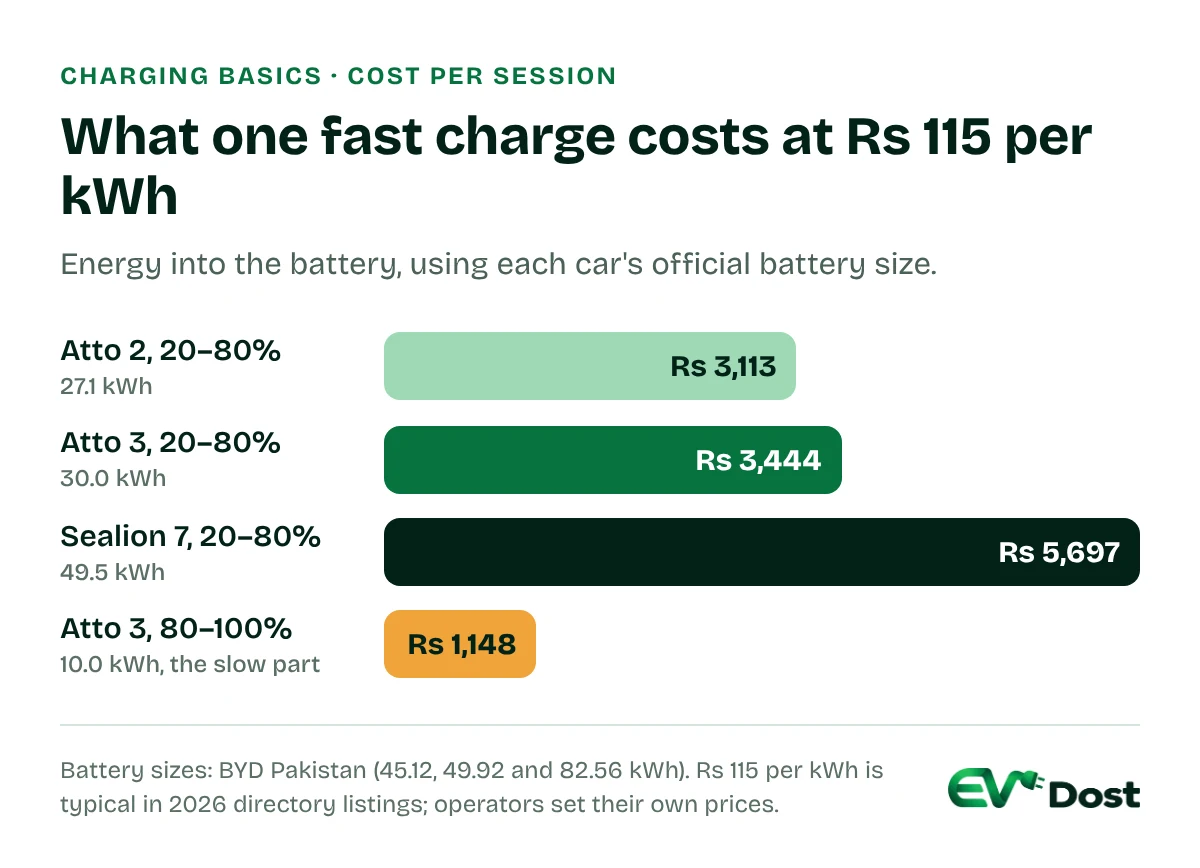
Fast chargers in Pakistan usually price by the kWh delivered. The typical rate in 2026 directory listings is about Rs 115 per kWh, with operators anywhere from roughly Rs 70 to Rs 200 (how we use that figure). Because you're paying for energy that goes straight into the battery, you don't add the 10 percent charging loss you'd allow for at home.
For a BYD Atto 3, with its 49.92 kWh battery (BYD Pakistan), a 20 to 80 percent charge puts in about 30 kWh and costs about Rs 3,444 at Rs 115. A BYD Sealion 7, with 82.56 kWh (BYD Pakistan), costs about Rs 5,697 for the same stretch. Take a photo of the screen at the end and ask for a receipt. If the kWh on the receipt doesn't match the screen, now is the time to say so.
Why we unplug at 80 percent
Up to roughly 80 percent, a fast charger pushes a steady current into the battery. After that it switches to holding the voltage, the current falls away, and the car slows down to avoid damaging the cells (Cars24, June 2026). The last 20 percent can take as long as the first half of the session (Paua, January 2026).
BYD, for its part, quotes its Pakistani cars at 30 to 80 percent "within 30 mins" (BYD Pakistan) rather than giving a time to full. On a motorway stop, getting back on the road at 80 and stopping again later is almost always quicker. Our guide to charging times shows the curve.
There's a courtesy side too. With so few DC units in most cities, the driver behind you may have been waiting twenty minutes. Move the car as soon as you're done, and never unplug someone else's car, even if their screen says finished. Find the attendant instead.
Staying safe at the charger
DC chargers carry a lot of power, so a few habits are worth keeping every time.
- Look at the cable and gun before you pick them up. Skip a unit with cracked insulation, bent pins or tape wrapped round anything.
- Never force a plug. If it doesn't slide in, it's the wrong one or something is damaged.
- Keep the plug dry when you're connecting in the rain, and don't leave the gun lying in a puddle. Our notes on charging in the rain go further.
- Stay near the car. A forecourt is a busy place, and you want to be around if the session stops early or someone needs the bay.
- Always end the session before you pull the plug out.
When the session fails
It happens. Sometimes the cause is small, such as a plug that isn't fully seated, a charge limit in the car that's already been reached, or one faulty side of a shared cabinet. Work through the list below before you give up, and note the unit number and any error code for the operator.
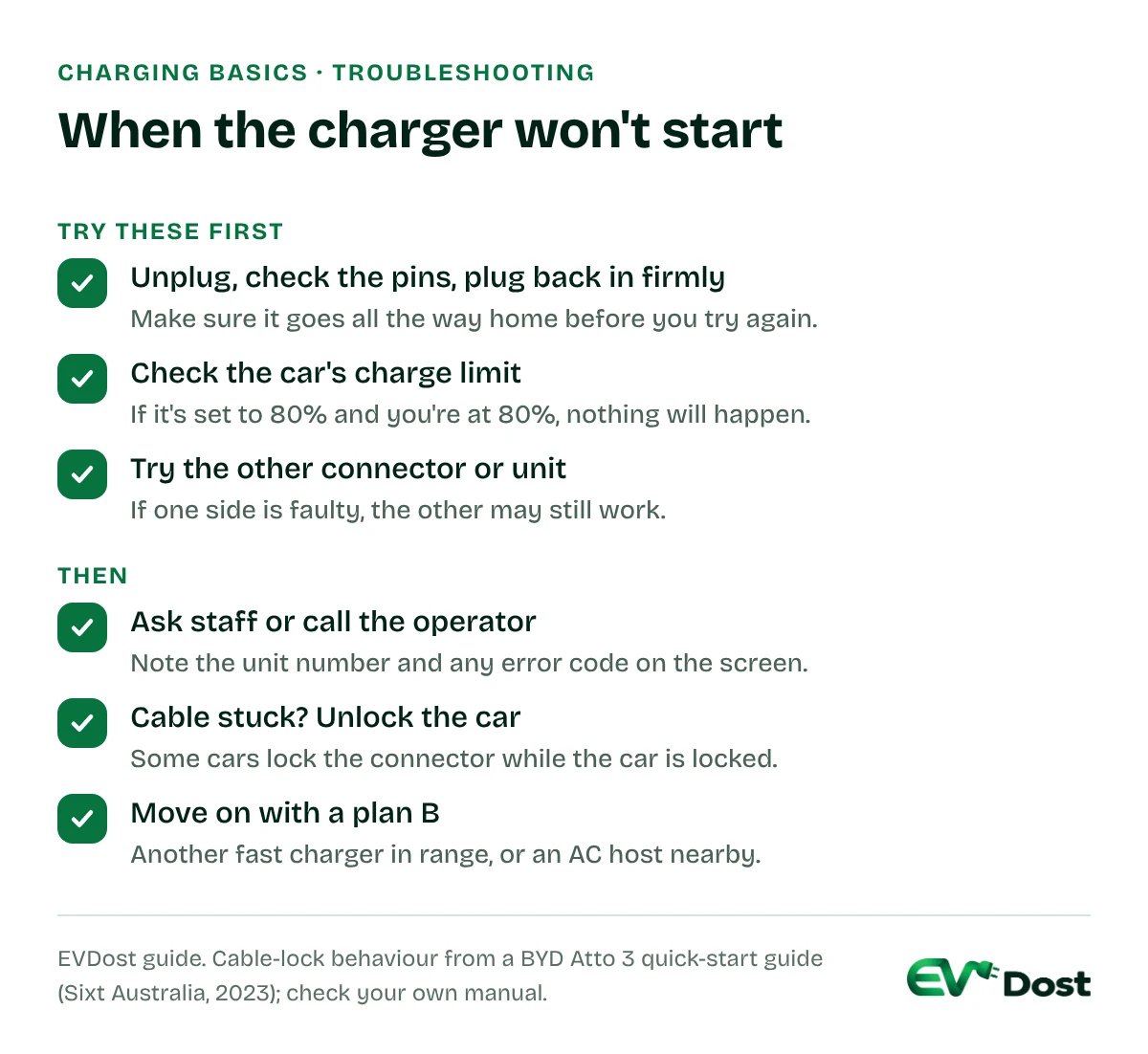
If the charger is simply down, you need a plan B within your remaining range. Sometimes that's another fast charger. Often it's a slower AC unit nearby that gets you enough to go on. EVDost hosts list home and business chargers with their plug type and power, and you can send a request to any that's open now. Give the host up to 15 minutes to accept, charge, then pay them for the 10-minute blocks you used, by Raast, JazzCash, Easypaisa or bank transfer, whichever they've set up. Look for an AC host within range before you're down to single digits.
Learning to use an EV fast charger takes a session or two, and then it's routine. Call ahead, match the plug, watch the first minute, leave at 80, and keep the attendant's number in your phone. That's most of it.
Frequently asked questions
How do I start a fast-charging session in Pakistan?
Plug the charger's gun firmly into your car's CCS2 port, then start the session the way that site works, which as of November 2026 usually means asking the attendant, using the operator's app or following the charger's screen. Pakistani operators rarely publish their method, so ask on your first visit.
How much does a single fast-charging session cost in Pakistan?
A 20 to 80 percent session on a BYD Atto 3 costs about Rs 3,444 at Rs 115 per kWh, the typical 2026 directory rate. Operators set their own prices between roughly Rs 70 and Rs 200 per kWh, so the same charge could cost about Rs 2,100 to Rs 6,000.
Do I need an operator app to fast charge in Pakistan?
You don't always need an operator app to fast charge in Pakistan. As of November 2026, BYD says the public stations on its HUBCO Green network are staffed by trained personnel, while Go Green Avenue and Tesla Industries (EVX) have their own apps. Call the site first and ask whether you need one.
What should I do if a fast charger won't start or release the cable?
Re-seat the plug, check your car's charge limit and try the other connector first. If the cable won't come out, open the car's locks, since some models hold the connector while locked. If nothing works, call the operator with the unit number and head for a plan B within range.
Should I stay with my car while it fast charges?
Stay near your car while it fast charges. BYD quotes about 30 minutes from 30 to 80 percent for its Pakistani models, and staying close lets you stop at 80, deal with a session that ends early and free the bay for the next driver as soon as you're done.
Sources
- BYD Pakistan, charging guide: byd-mega.com
- BYD Pakistan model pages: Atto 2, Atto 3, Sealion 7
- Go Green Avenue, home page and app: gogreenavenue.com
- Go Green Avenue, charger locations: gogreenavenue.com
- PSO, electric vehicle charger: psopk.com
- APP, PSO, BYD and HUBCO Green motorway charging station (June 2025): app.com.pk
- Profit, Attock Petroleum partners with HUBCO Green (April 2025): profit.pakistantoday.com.pk
- Shell Pakistan, Shell Recharge: shell.com.pk
- EVX Charger app, Tesla Industries: apps.apple.com
- Sixt Australia, BYD Atto 3 quick-start guide (2023): sixt.com.au
- Cars24, why EV charging slows after 80 percent (June 2026): cars24.com.au
- Paua, why EV charging slows down after 80 percent (January 2026): paua.com