Will electric cars cost more? The 1% EV sales tax in Pakistan and the IMF
Inside the Rs 8.99 million price of a BYD Atto 3 sits about Rs 89,000 of sales tax, if the car is taxed at 1 percent. At the standard 18 percent, that slice would be closer to Rs 1.6 million. That gap is what the IMF and Islamabad have been arguing about since May, and it's why the EV sales tax in Pakistan keeps turning up in the business pages.
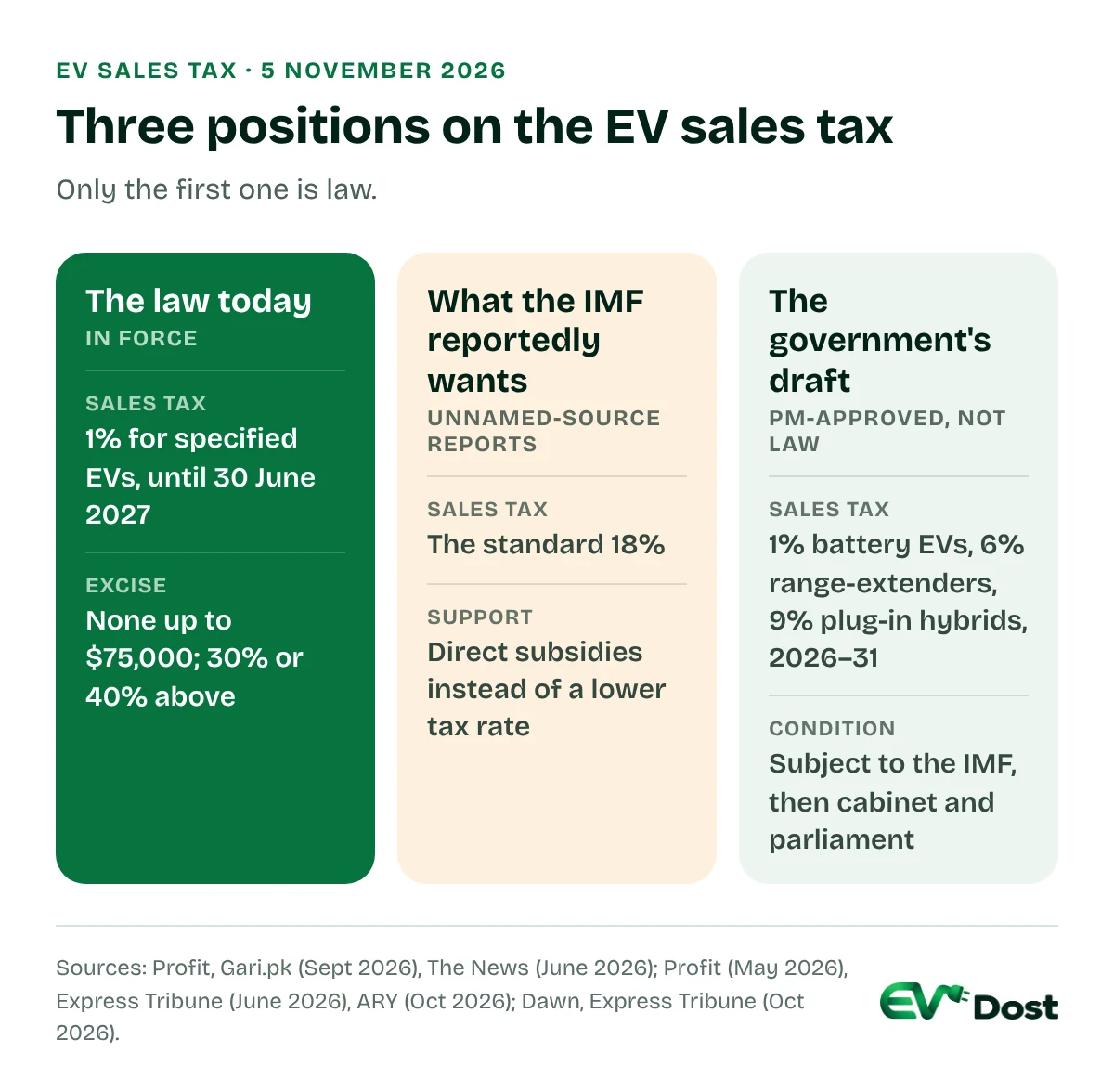
As of 5 November 2026, nothing has changed for buyers. The reduced rate is law until 30 June 2027. The IMF's reported demands come from unnamed sources, and the government's counter-offer sits in a draft policy that hasn't passed. We take each in turn, then put rupees on a higher rate.
The EV sales tax in Pakistan under current law
Budget 2026–27 kept the reduced rate. A move to 18 percent was floated before the budget but "did not materialise", and the 1 percent stayed in the Eighth Schedule for locally made EVs (Profit, June 2026).
FBR's budget instructions in September extended the 1 percent regime for specified EVs to 30 June 2027, now also covering fully built electric trucks and buses, and kept CKD kits for specified EVs exempt until the same date (Profit, September 2026; Gari.pk, September 2026). EV-specific CKD parts also pay 1 percent customs duty until 30 June 2027 (Profit, June 2026).
Imported EVs carry a separate federal excise duty: none up to $75,000, 30 percent from $75,000 to $110,000, and 40 percent above that, as approved by the National Assembly's finance committee in June and confirmed in FBR's September instructions (The News, June 2026; Profit, September 2026).
Which cars count as "specified" is less clear than it should be. Pre-budget reports put the limit at locally assembled EVs with batteries up to 50 kWh for cars and SUVs and 150 kWh for light commercial vehicles (Profit, June 2026), and Daily Pakistan repeated the 50 kWh figure in October. We couldn't find the FBR document itself, and we couldn't confirm the sales tax rate now charged on imported, fully built EVs. So a car with a bigger battery, or one that arrives fully built, may not be on 1 percent at all.
What the IMF has asked for, and how we know
Every report of the IMF's position rests on unnamed sources. There is no IMF document or on-record IMF statement saying it in public.
- May. A visiting IMF mission proposed 18 percent sales tax on EVs, and the industries ministry opposed it, proposing 1 percent on all new energy vehicles (Profit, May 2026).
- June. The IMF did not accept the 1 percent proposal and wanted the standard rate, with any support given as direct subsidies instead (Express Tribune, June 2026).
- October. ARY reported that the IMF wanted the concession ended, describing EVs as a luxury and the lower rate as discriminatory (ARY News, October 2026). Daily Pakistan carried a similar report (Daily Pakistan, October 2026).
On 8 October, Pakistan and the IMF reached a staff-level agreement on the fourth review of the loan programme, worth about $1.2 billion subject to Board approval. The statement doesn't mention EVs or the auto policy (APP, October 2026).
Two more claims are weaker still. ARY reported on 7 October that Pakistan and the IMF had "agreed" a 25 percent sales tax on EVs above $75,000 (ARY News, October 2026). We found no other outlet carrying it, and it doesn't match the October draft. ARY also reported, again from unnamed sources, that sales tax on EV charging stations could rise from 1 to 18 percent (ARY News, October 2026). We couldn't find the legal basis for a 1 percent rate on charging, so treat that one as unconfirmed.
The "luxury" label has its critics. In August, an analyst at Chase Securities told Arab News that the EV concessions mostly benefit cars worth Rs 10 million or more (Arab News, August 2026). Cheaper locally assembled EVs such as the Honri VE would be caught too, as the sums below show.
The government's counter: 1, 6 and 9 percent
On 20 October, the Prime Minister approved the final draft of the Auto Policy 2026–31. It sets sales tax at 1 percent for battery EVs, 6 percent for range-extenders and 9 percent for plug-in hybrids for the life of the policy (Dawn, October 2026). Several outlets reported this as Pakistan rejecting the IMF's 18 percent. Express Tribune's report is more careful. It says the 1 percent would cover local and imported battery EVs, and that the PM agreed to it "subject to the IMF's approval" (Express Tribune, October 2026). We found no minister quoted on the record rejecting the IMF.
ARY, citing official documents, reported that the 1 percent would apply to EVs valued up to $75,000, and, citing sources, that keeping it would mean Rs 85 billion in relief. It also reported that the tax measures may come through a mini-budget (ARY News, October 2026). In early November, officials told a Senate committee the draft was going to the Finance Ministry and then the IMF (Minute Mirror, November 2026). Where the rest of the policy stands is covered in our explainer on the Auto Policy 2026–31.
What 18 percent would do to the price: an illustration
To put rupees on it, we took each car's list price, assumed it already includes 1 percent sales tax, and worked out the taxable value (price ÷ 1.01). The price at 18 percent is that value × 1.18, which works out about 16.8 percent above today's sticker price.
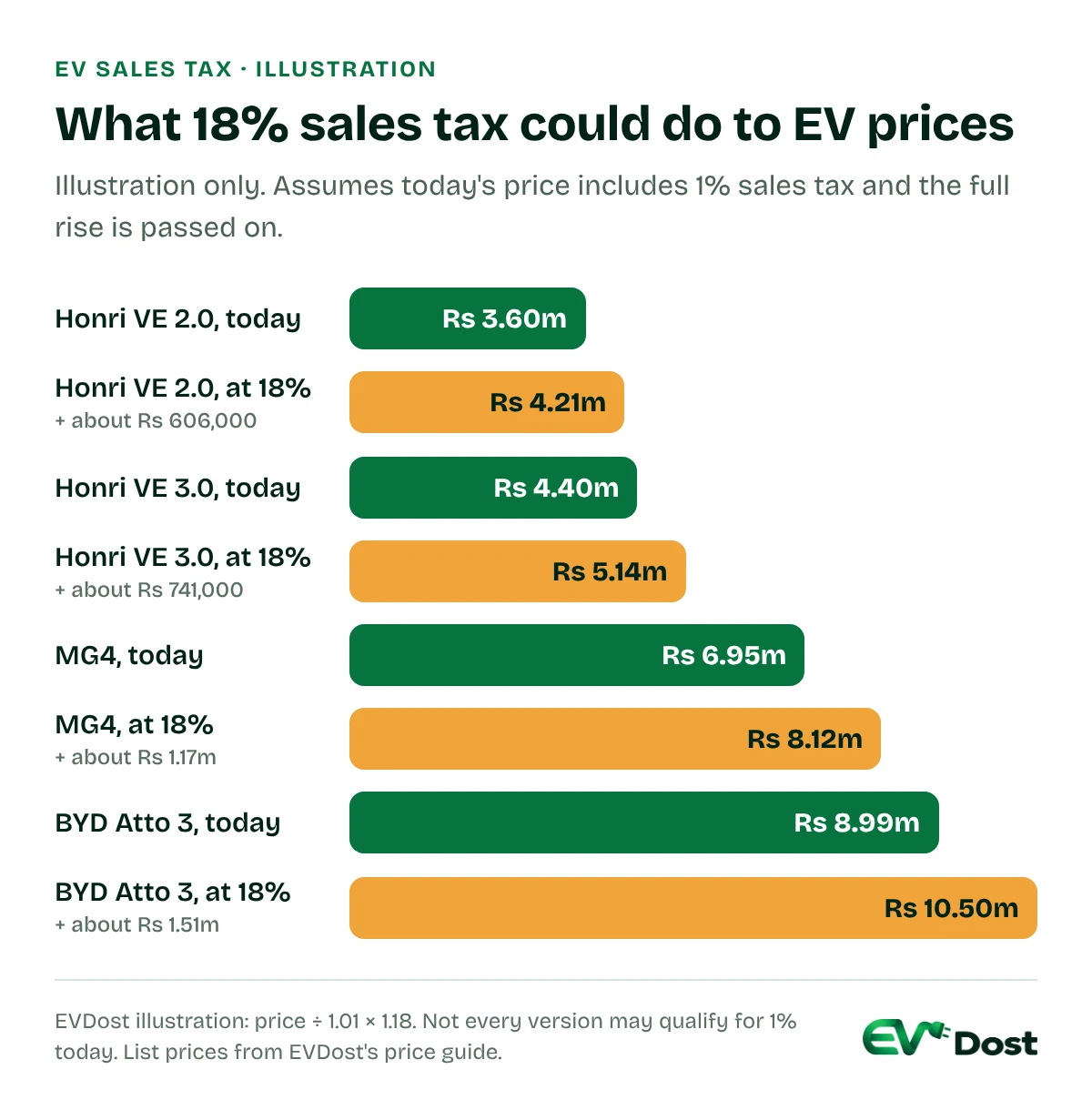
On those assumptions, the increase comes to about Rs 606,000 on a Honri VE 2.0, Rs 741,000 on a Honri VE 3.0, Rs 1.17 million on an MG4 EV Urban and Rs 1.51 million on a BYD Atto 3. Prices are taken from the EV prices we track model by model.
Read it with three caveats.
- The real tax base is smaller. Sales tax is charged on the ex-factory or import value, not the full showroom price with dealer margin and other levies, so the true rise would be somewhat lower.
- Not every version qualifies for 1 percent today. The Honri VE is assembled here. We haven't confirmed which rate the MG4 and Atto 3 invoices carry, and if a version is imported or its battery is over 50 kWh, this illustration doesn't apply to it.
- Makers don't always pass on a tax change in full. When local hybrids moved to 18 percent in September (Business Recorder, September 2026), brands didn't all reprice the same way, as our hybrid-or-EV breakdown shows.
You may have seen the round figure of Rs 100,000 at 1 percent against Rs 1.8 million at 18 percent on a Rs 10 million car. That treats Rs 10 million as the value before tax. On a Rs 10 million price that already includes 1 percent, the difference is about Rs 1.68 million.
Under the government's draft, a battery EV stays at 1 percent, so nothing changes.
Before you pay a booking amount
- Ask the dealer what rate is on the invoice. If it isn't 1 percent, the IMF argument may not affect your car at all.
- Get the booking terms in writing. Ask who pays if the tax changes between booking and delivery.
- Watch for a finance bill or mini-budget. A rate change needs legislation or an SRO, and a news report alone changes nothing.
- Remember the date. Even without any IMF deal, today's 1 percent runs out on 30 June 2027 unless the next budget renews it.
- Run the charging numbers too. Tax is paid once, charging every week. If you'll rely on shared chargers, EVDost sorts nearby hosts by best price and shows a cost estimate for the model you pick.
For the wider background, the NEV policy's targets and levies are set out separately.
Frequently asked questions
Until when does the 1% EV sales tax apply in Pakistan?
The 1 percent sales tax on specified electric vehicles in Pakistan runs until 30 June 2027, under Budget 2026–27 and FBR's budget instructions reported by Profit and Gari.pk in September 2026. Reports put eligibility at locally assembled EVs with batteries up to 50 kWh for cars and SUVs, but we couldn't find the FBR document itself.
Has the IMF asked Pakistan to tax electric cars at 18%?
The IMF has reportedly asked Pakistan to tax EVs at the standard 18 percent, according to reports in May, June and October 2026 that cite unnamed sources. No IMF document says so publicly, and the IMF's staff-level agreement statement of 8 October 2026 doesn't mention EVs.
How much would 18% sales tax add to an electric car's price?
An 18 percent sales tax would add about 16.8 percent to the price of an EV now taxed at 1 percent, on EVDost's November 2026 illustration. That is about Rs 1.51 million on a Rs 8.99 million BYD Atto 3 and Rs 741,000 on a Rs 4.4 million Honri VE 3.0, if the car is on 1 percent today and the full rise is passed on.
Will range-extenders and plug-in hybrids pay 6% and 9% sales tax?
The 6 percent rate for range-extenders and 9 percent for plug-in hybrids are proposals in the draft Auto Policy 2026–31, which the Prime Minister approved on 20 October 2026. As of 5 November 2026 they are not law, and the draft still has to go to the IMF, the federal cabinet and parliament. What locally made plug-in hybrids up to 2,000cc pay today is itself disputed, 25 percent according to PakWheels and 18 percent according to Daily Pakistan, so 9 percent would be a cut for them either way.
Should I buy an EV now before the sales tax goes up?
The EV sales tax in Pakistan is 1 percent under current law, a rate set to run until 30 June 2027, and no change has been legislated as of 5 November 2026. A rise would need a finance bill or SRO. If you're buying anyway, check the rate on your invoice and get in writing who pays if tax changes before delivery.
Sources
- Profit, Budget 2026–27 auto sector breakdown (June 2026): profit.pakistantoday.com.pk
- Profit, FBR extends EV tax relief to June 2027 (September 2026): profit.pakistantoday.com.pk
- Gari.pk, FBR confirms EV tax relief until June 2027 (September 2026): gari.pk
- The News, excise duty on imported EVs (June 2026): thenews.pk
- Profit, pre-budget EV and hybrid tax proposals (June 2026): profit.pakistantoday.com.pk
- Profit, Pakistan proposes 1% GST on EVs, opposes IMF's 18% (May 2026): profit.pakistantoday.com.pk
- Express Tribune, IMF disagrees with 1% NEV sales tax (June 2026): tribune.com.pk
- ARY News, IMF calls for end to EV sales tax concession (October 2026): arynews.tv
- Daily Pakistan, IMF pushes for 18% GST on EVs (October 2026): dailypakistan.com.pk
- ARY News, IMF asks Pakistan to end concessional rate on EVs (October 2026): arynews.tv
- ARY News, IMF-Pakistan talks enter final stage (October 2026): arynews.tv
- APP, IMF staff-level agreement (October 2026): app.com.pk
- Arab News, auto policy and EV concessions (August 2026): arabnews.com
- Dawn, PM approves draft auto policy (October 2026): dawn.com
- Express Tribune, PM okays 1% sales tax on battery EVs (October 2026): tribune.com.pk
- ARY News, likely mini-budget for auto policy tax measures (October 2026): arynews.tv
- Minute Mirror, Senate Industries committee (November 2026): minutemirror.com.pk
- PakWheels, hybrid prices after tax revision (September 2026): pakwheels.com
- Daily Pakistan, cars that qualify for the 18% hybrid rate (September 2026): dailypakistan.com.pk
- Business Recorder, hybrid sales tax cut to 18% (September 2026): brecorder.com