Auto Policy 2026–31: where Pakistan's new car policy stands, and what it means if you're buying
Prime Minister Shehbaz Sharif approved the final draft of the Automotive Industry Development and Export Policy 2026–31 on 20 October. Headlines such as "Pakistan approves auto policy 2026–31" made it sound as if the rules for buying a car had changed. They hadn't. As of 5 November 2026, the draft still has to clear the IMF, the federal cabinet and parliament, and no part of it is in force.
That matters if you're about to pay a booking amount on an EV, a hybrid or a petrol car. The draft would change sales tax, duties, car loans and levies over five years, but today's invoice is still set by the old rules.
Where the auto policy 2026–31 stands on 5 November 2026
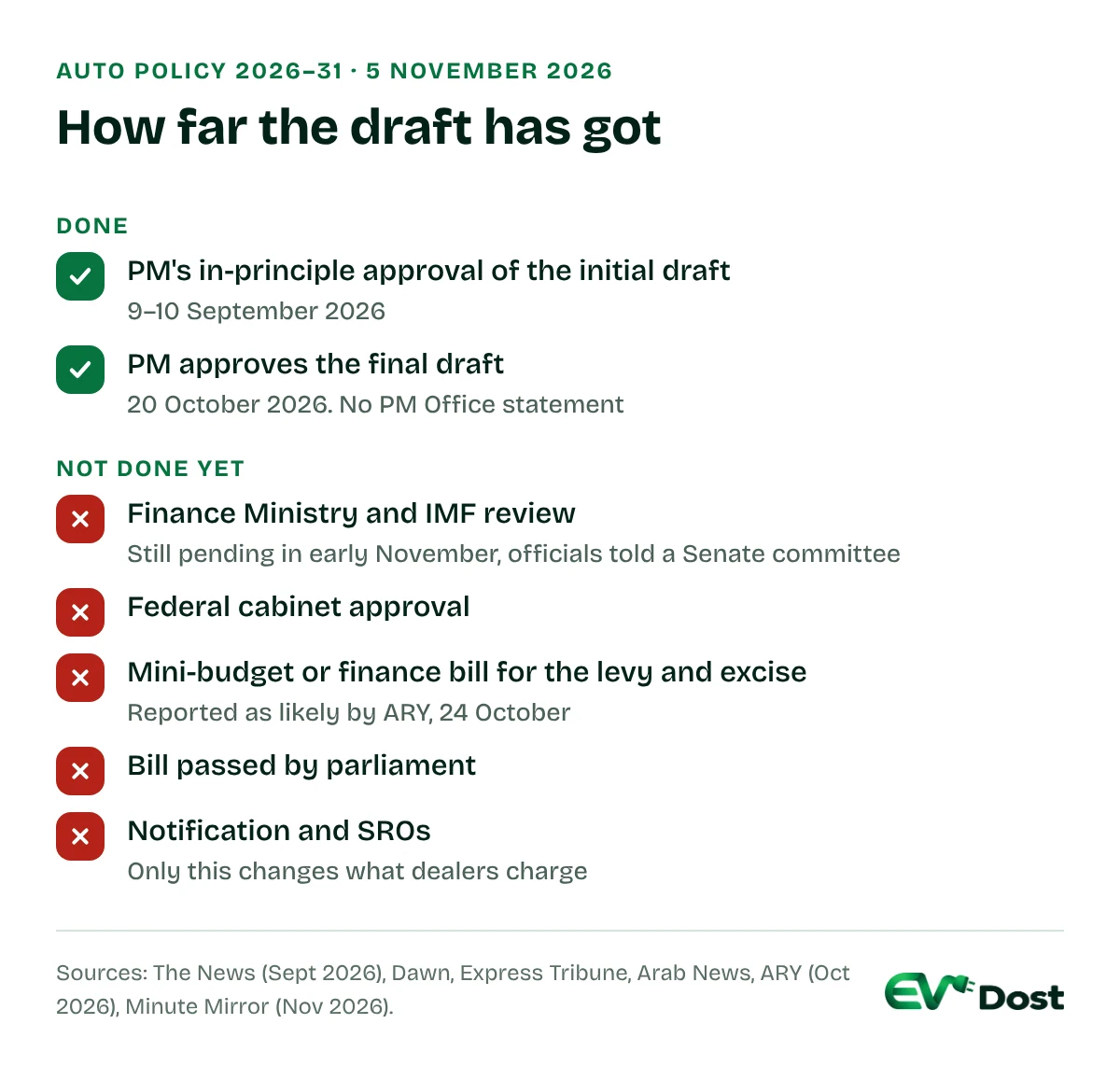
The Prime Minister approved the final draft on Tuesday 20 October. The PM Office put out no official statement, and the details reached the press through government sources (Dawn, October 2026). Express Tribune reported that the draft would now go to the IMF, and that after the IMF and the cabinet it would go to parliament as a bill (Express Tribune, October 2026). On 23 October, Arab News quoted the Engineering Development Board's chief as saying the draft would go to the IMF for review "in a few days", and reported that it still needed cabinet approval (Arab News, October 2026).
The latest hard reporting is from the Senate Standing Committee on Industries in early November. Officials told senators the draft would be sent to the Finance Ministry and then shared with the IMF, and the committee heard that the policy was still awaiting final approval (Minute Mirror, November 2026). We found no report of cabinet or ECC approval, an IMF sign-off, a notification or a bill.
So "approved" in the October headlines (Dunya News, October 2026; ARY News, October 2026) means one thing only, that the Prime Minister signed off on a draft. Meanwhile the old 2021–26 policy expired on 30 June 2026 with no successor in place (Arab News, August 2026).
How it got here, month by month
The policy is months late, mostly because of a running argument with the IMF over tax.
- 22 April. The IMF would vet the draft before the cabinet saw it (Express Tribune, April 2026).
- 20 June. The IMF did not accept the industries ministry's proposed 1 percent sales tax on new energy vehicles and wanted the standard rate, with any help given as direct subsidies (Express Tribune, June 2026).
- 23 July. A Senate committee heard that hybrid and plug-in hybrid production had stopped for 22 days because there was no tariff structure in place (Business Recorder, July 2026).
- 9–10 September. The PM gave in-principle approval to an initial draft (The News, September 2026).
- 2 October. Talks with the IMF on the policy remained inconclusive, ARY reported, citing sources (ARY News, October 2026).
- 8 October. Pakistan and the IMF reached a staff-level agreement on the wider loan programme. The statement doesn't mention the auto policy or EVs (APP, October 2026).
- 20 October. The PM approved the final draft.
What the draft proposes
Everything below is a proposal in the PM-approved draft, as reported by the press. None of it applies today, and the outlets don't always agree on the details.
Sales tax and excise
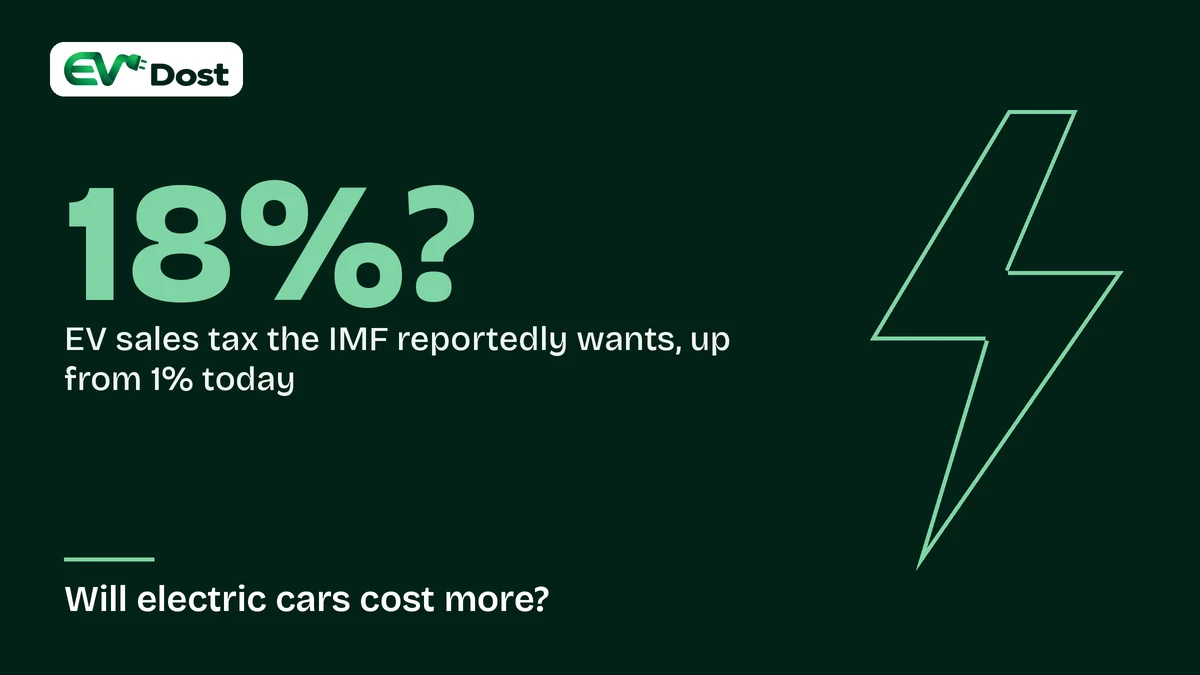
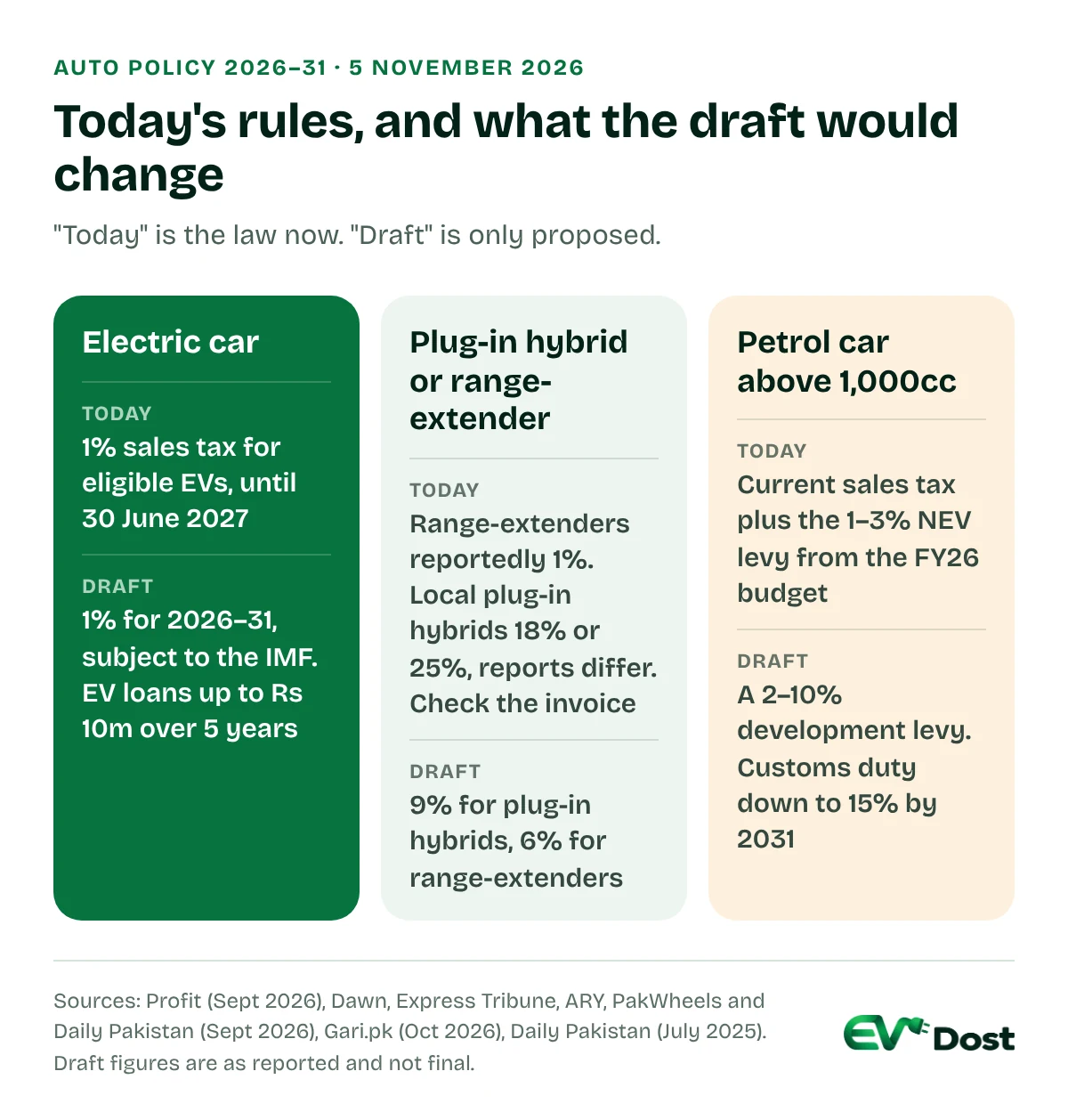
The headline for EV buyers is that the draft keeps 1 percent sales tax on battery EVs for the life of the policy, for both locally assembled and imported cars, and sets 6 percent for range-extenders and 9 percent for plug-in hybrids. Express Tribune reported that the PM agreed to the 1 percent "subject to the IMF's approval" (Express Tribune, October 2026). ARY, citing official documents, reported that the 1 percent would cover EVs valued up to $75,000 (ARY News, October 2026). The IMF's position, and what a move to 18 percent would do to prices, is the subject of our companion piece on the EV sales tax in Pakistan and the IMF.
Dawn reported a 10 percent federal excise duty on EVs above $75,000 (Dawn, October 2026). Today's excise on those cars is already 30 or 40 percent (Profit, September 2026; The News, June 2026), and none of the reports says whether the 10 percent would replace it or come on top.
Duties and tariffs
Express Tribune reported customs duty on petrol cars and SUVs falling to 15 percent by 2031, with no additional or regulatory duty, and fully built electric four-wheelers also at 15 percent (Express Tribune, October 2026). The same report lists "passenger vehicles" among NEVs at 1 percent customs, so that part is unclear. An earlier September version, reported by The News, listed much higher customs duties for fully built cars, between 35 and 115 percent by engine size, by 2030–31. We can't reconcile the two, so treat the slab-by-slab picture as unsettled.
Small EVs priced below $15,000 (about Rs 4.2 million) would get a lower tariff for the first two years. Only Express Tribune gives the rate, 5 percent.
A levy on bigger petrol cars
The October draft adds an Automotive Development Levy on vehicles above 1,000cc, expected to raise over Rs 232 billion over five years to pay for export incentives and industrial upgrading (Dawn, October 2026). Express Tribune put it at 2 to 10 percent; ARY at 2 percent for 1,001 to 2,000cc and 10 percent above. ARY also reported that the government is likely to bring a mini-budget or finance bill for the levy and the excise changes (ARY News, October 2026). The reports don't say how it would sit alongside the 1 to 3 percent NEV levy from the FY26 budget (Daily Pakistan, July 2025), which our piece on the NEV levy and the wider NEV policy covers.
Financing
The draft would lift the financing limit for EVs from Rs 3 million to Rs 10 million and stretch the loan period from three to five years (Dawn, October 2026). The September version had seven years. Until the State Bank changes its rules, banks work to the old limits, as our guide to EV car loans explains.
Exports and local parts
The draft sets an export target of about $6 billion over five years, pays an incentive of 5 percent of export value plus 10 percent on growth, and can cancel a maker's certificate after two years of missed targets. Makers that miss local parts targets could lose incentives (Dawn, October 2026). For a buyer, the effect is indirect at best.
Used cars are a separate decision
The September draft's used-car rules have been overtaken. The Commerce Ministry told FBR that the five-year age limit on commercial used-vehicle imports no longer applies after 30 June 2026 (ARY News, October 2026), under decisions Daily Pakistan said were approved by the ECC and the federal cabinet. The extra 40 percent duty on those imports was cut to 30 percent in June's tariff plan (Business Recorder, June 2026) and is set to fall by 10 points a year until 2029–30 (Daily Pakistan, October 2026). That is tariff policy, not the auto policy.
What changes if you buy a car this month
Nothing in the draft changes your invoice yet. What it changes is the risk of waiting.
An electric car
Eligible EVs already pay 1 percent sales tax until 30 June 2027 under the current budget (Profit, September 2026), so the draft would mostly extend what exists. The danger runs the other way. If the IMF prevails, a future finance bill could raise the rate. Our running list of EV prices has the main models.
A hybrid or plug-in hybrid
Locally made hybrids up to 2,000cc moved to 18 percent sales tax in September under SRO 1525(I)/2026 (Business Recorder, September 2026). Range-extenders are reported to pay the 1 percent EV rate today (Gari.pk, October 2026), so the draft's 6 percent would be a rise for them. Plug-in hybrids aren't on 1 percent, and reports disagree on what locally made ones up to 2,000cc pay now: PakWheels says 25 percent (PakWheels, September 2026), while Daily Pakistan and Gari.pk put them at 18 percent (Daily Pakistan, September 2026; Gari.pk, October 2026). Either way the draft's 9 percent would be a cut for them, so check which rate your invoice carries. The 9 percent for plug-in hybrids and 6 percent for range-extenders are proposals, and those rates have shifted between drafts. Our hybrid vs electric comparison shows how much this year's tax changes moved prices.
A petrol car
If you're buying above 1,000cc, the proposed levy is the item to watch, because it would need a finance bill and ARY reported a mini-budget is likely. Under 1,000cc, the levy as reported wouldn't apply.
Signs the draft is becoming law
Look for these four signals.
- An IMF response to the final draft, or EV and auto language in the IMF's staff report for the fourth review.
- Federal cabinet approval, which officials have described as close since August.
- A mini-budget or finance bill carrying the levy and excise changes.
- SROs and an SBP circular. Without them, dealers and banks keep working to today's rules.
Over five years, running costs will matter more than any of this. If you're leaning towards an EV and can't charge at home, pick your model in EVDost to see which host chargers are nearest and what a charge would cost before you commit.
Frequently asked questions
Is the auto policy 2026–31 in force?
The Auto Policy 2026–31 is not in force as of 5 November 2026. Prime Minister Shehbaz Sharif approved the final draft on 20 October 2026, but it still needs IMF review, federal cabinet approval and a bill in parliament, according to Express Tribune. We found no notification or SRO.
What sales tax does the draft auto policy propose for electric cars and hybrids?
Pakistan's draft auto policy proposes sales tax of 1 percent on battery EVs, 6 percent on range-extenders and 9 percent on plug-in hybrids for 2026–31, as Dawn and Express Tribune reported on 21 October 2026. Express Tribune said the 1 percent is subject to the IMF's approval. These are proposals, not law.
Will the new auto policy make petrol cars more expensive?
Petrol cars above 1,000cc would carry a new Automotive Development Levy under Pakistan's draft auto policy, expected to raise over Rs 232 billion over five years, Dawn reported in October 2026. Express Tribune put the rate at 2 to 10 percent. It would need a finance bill, and we found no report of one being tabled as of 5 November 2026.
What has to happen before the auto policy 2026–31 takes effect?
The new auto policy has no start date as of 5 November 2026, and it has several steps left to clear. Officials told a Senate committee in early November that the draft would go to the Finance Ministry and then the IMF, and after that it needs the cabinet and parliament. ARY reported in October that the tax measures may come through a mini-budget.
Is the five-year age limit on used car imports gone?
The five-year age limit on commercial used-vehicle imports no longer applies after 30 June 2026, according to a Commerce Ministry letter to FBR reported by ARY on 30 October 2026. Daily Pakistan reported it as an ECC and cabinet decision, separate from the auto policy. The extra duty on these imports was cut from 40 to 30 percent in June 2026.
Sources
- Dawn, PM approves draft auto policy (October 2026): dawn.com
- Express Tribune, PM okays 1% sales tax on battery EVs (October 2026): tribune.com.pk
- Arab News, auto policy savings and next steps (October 2026): arabnews.pk
- Minute Mirror, Senate Industries committee (November 2026): minutemirror.com.pk
- Dunya News, auto policy 2026–31 (October 2026): dunyanews.tv
- ARY News, new auto policy and the IMF proposal (October 2026): arynews.tv
- ARY News, likely mini-budget for auto policy taxes (October 2026): arynews.tv
- ARY News, IMF talks on auto policy inconclusive (October 2026): arynews.tv
- Arab News, auto policy nears approval (August 2026): arabnews.com
- Express Tribune, IMF to vet auto policy (April 2026): tribune.com.pk
- Express Tribune, IMF disagrees with 1% NEV sales tax (June 2026): tribune.com.pk
- Business Recorder, Senate committee on auto policy (July 2026): brecorder.com
- The News, PM's in-principle approval (September 2026): thenews.pk
- APP, IMF staff-level agreement (October 2026): app.com.pk
- ARY News, used-car age limit lifted (October 2026): arynews.tv
- Daily Pakistan, used-car age limit and duty (October 2026): dailypakistan.com.pk
- Profit, FBR extends EV tax relief to June 2027 (September 2026): profit.pakistantoday.com.pk
- The News, excise duty on imported EVs (June 2026): thenews.pk
- Daily Pakistan, NEV levy on petrol and diesel cars (July 2025): dailypakistan.com.pk
- Business Recorder, second phase of tariff cuts (June 2026): brecorder.com
- PakWheels, hybrid prices after tax revision (September 2026): pakwheels.com
- Daily Pakistan, cars that qualify for the 18% hybrid rate (September 2026): dailypakistan.com.pk
- Gari.pk, current and proposed GST rates on cars (October 2026): gari.pk
- Business Recorder, hybrid sales tax cut to 18% (September 2026): brecorder.com