Electric car token tax in Pakistan, and what registration really costs in each province
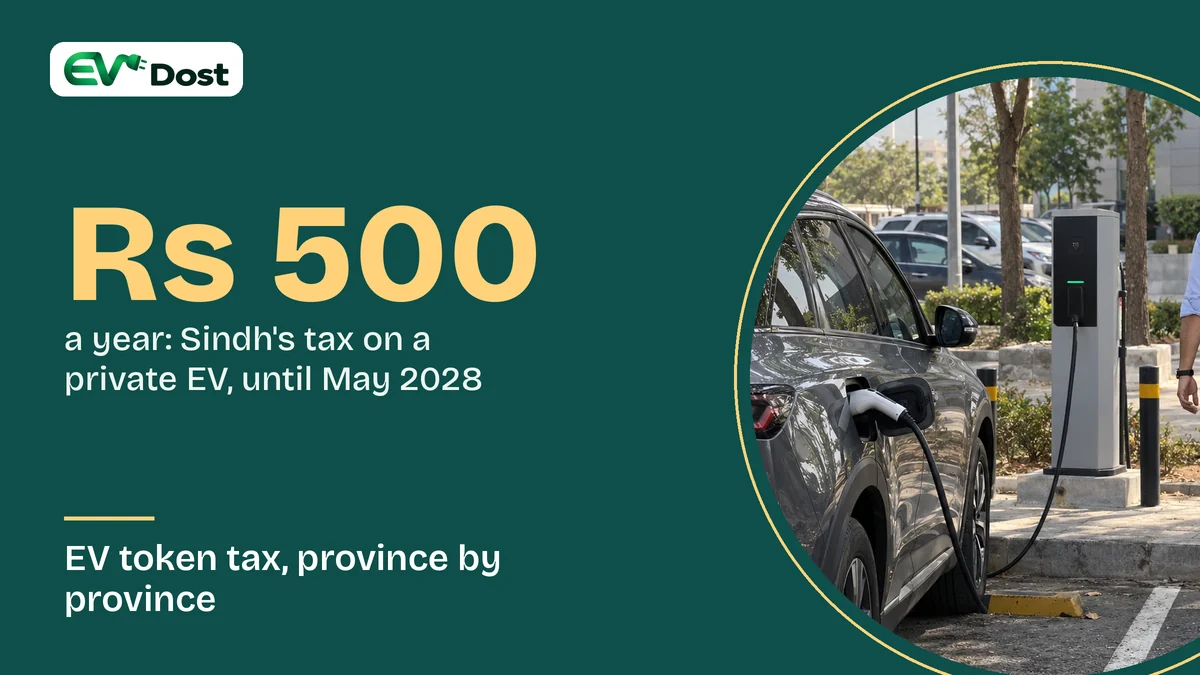
Two cousins buying the same electric SUV this month, one in Karachi and one in Lahore, would find almost nothing on the excise side matches when they compared notes over WhatsApp. One pays a flat Rs 1,000 to register and Rs 500 a year after that. The other gets a 95 percent discount on a fee charged as a percentage of the car's price. Then both meet an income tax line at registration that runs into six figures.
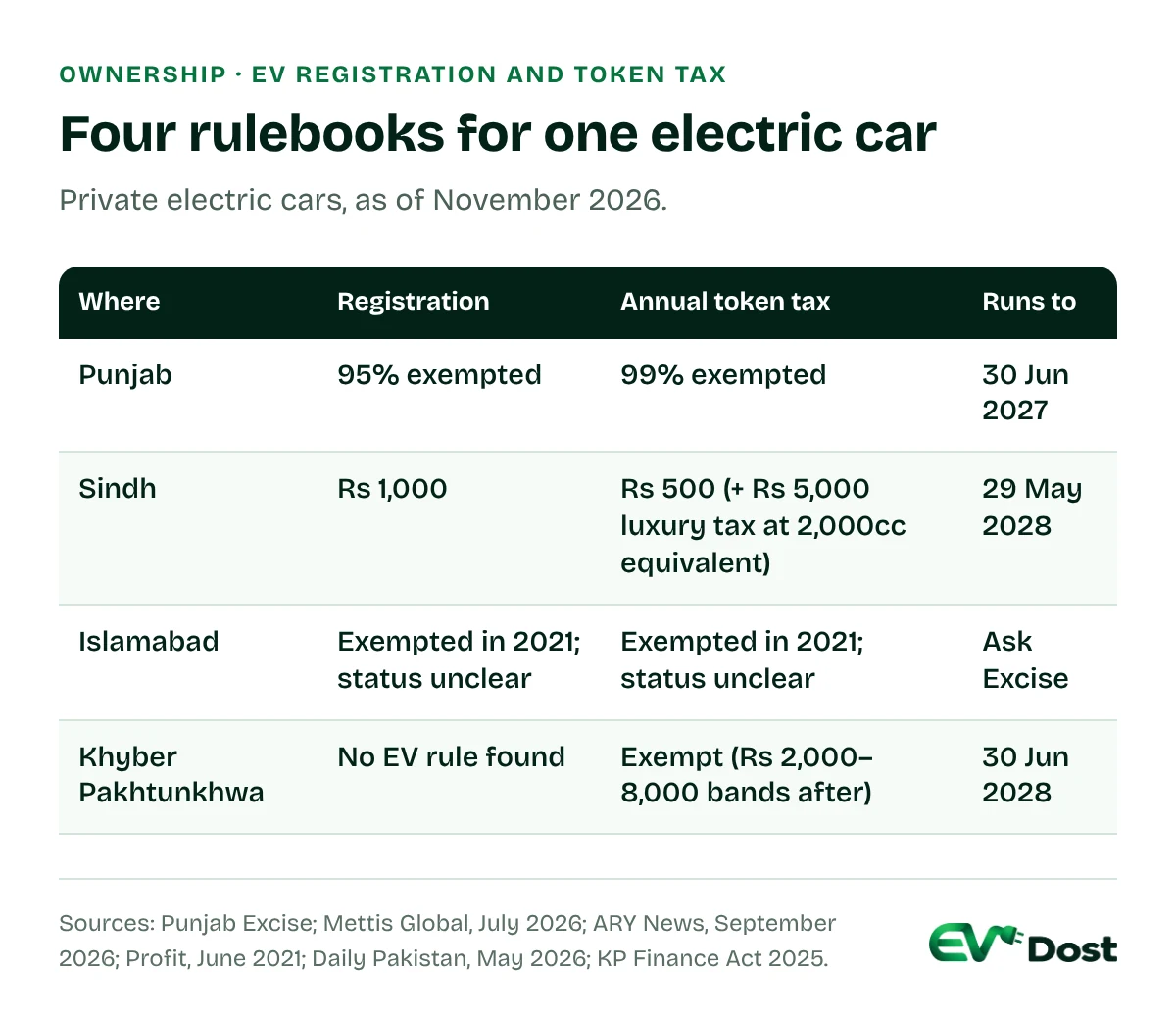
Every province sets its own registration fees and annual motor vehicle tax, so the electric car token tax in Pakistan depends on the province where you register, and EVs get a different break in each one. The income tax collected alongside them is federal and treats an expensive EV much like a petrol car. Below is where things stand as of November 2026, for Punjab, Sindh, Islamabad and Khyber Pakhtunkhwa.
The electric car token tax in Pakistan, from Lahore to Peshawar
Punjab
Punjab doesn't make EVs free. It discounts them heavily. The Excise department's motor vehicle tax page says 95 percent of the registration fee and 99 percent of motor vehicle tax are exempted for electric vehicles (Punjab Excise). The 99 percent figure was proposed in this year's Punjab budget as a rise from 95 percent (Profit, June 2026). It was then notified by the Excise department for 1 July 2026 to 30 June 2027, leaving vehicles that pay tax as a lump sum outside it (Mettis Global, July 2026).
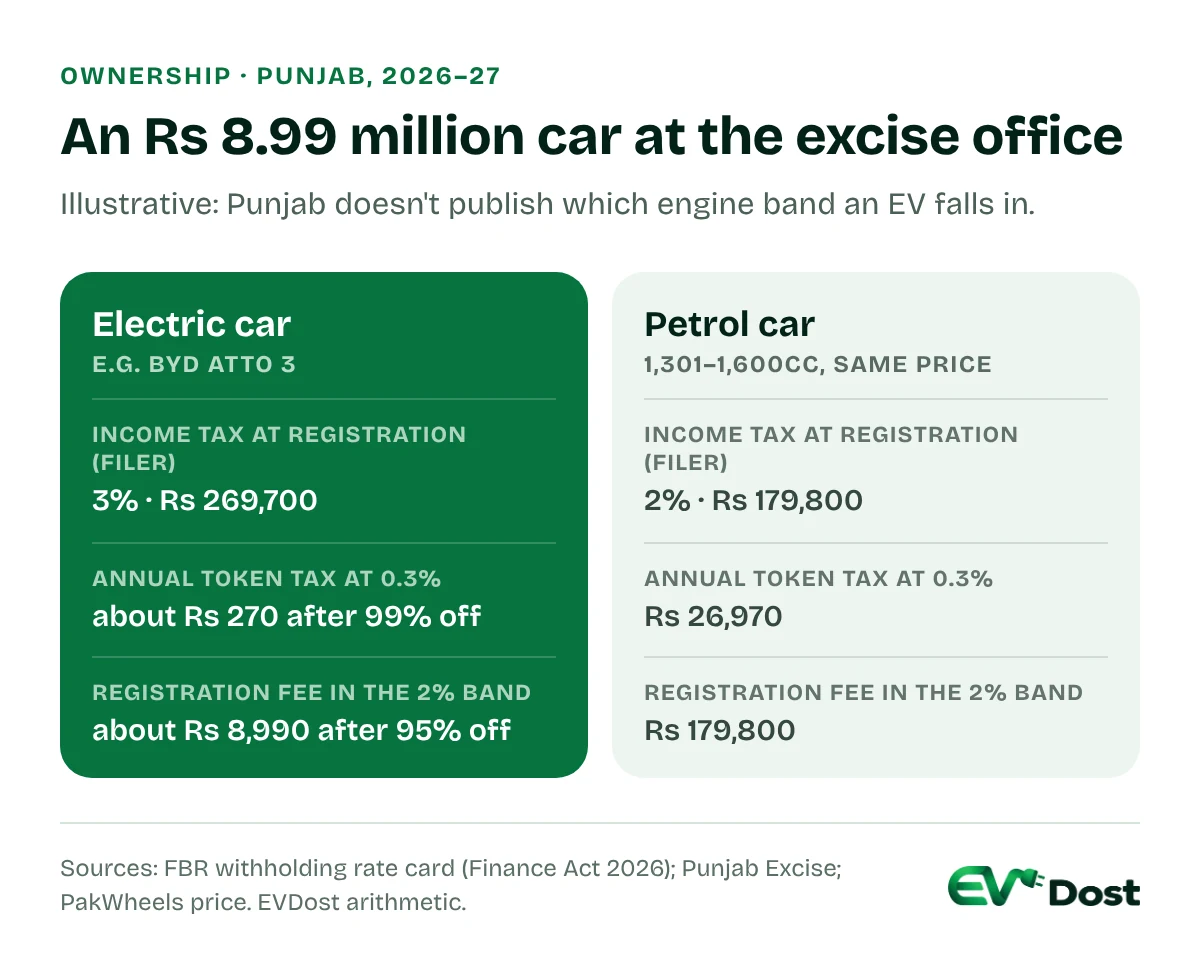
What the 1 percent works out to depends on the band your car lands in. Punjab's 2026–27 rates charge most private cars a percentage of the invoice price, 0.3 percent between 1,001 and 2,000cc and 0.4 percent above that (Punjab Excise; Profit, June 2026). For an Rs 8.99 million car such as the BYD Atto 3 (PakWheels), that's Rs 26,970 or Rs 35,960 a year at full rate. One percent of either is under Rs 400.
The registration fee works the same way. Punjab Excise lists new-registration fees of 1, 2 and 4 percent by engine size, charged on the vehicle's value according to PakWheels' summary of the 2024 rates (PakWheels, June 2024), so an EV pays 5 percent of whichever applies. On that Rs 8.99 million car, that's somewhere between about Rs 4,500 and Rs 18,000.
Punjab EVs also get green number plates, under a policy the province introduced in June 2025 (BOL News, June 2025).
Sindh
Sindh keeps it simple with flat fees. The provincial cabinet extended its EV package on 1 September 2026 for two more years, covering 30 May 2026 to 29 May 2028 (ARY News, September 2026). Under it:
- registration costs Rs 1,000 for a non-commercial EV
- annual motor vehicle tax is Rs 500
- EVs "equivalent to 2,000cc and above" pay a Rs 5,000 luxury tax
- late registration draws a Rs 1,000 penalty
- electric motorcycles pay a one-off Rs 500 lifetime tax
PakWheels and Energy Update reported the same figures (PakWheels, September 2026; Energy Update, September 2026).
Islamabad (ICT)
Islamabad is the murkiest of the four. In June 2021 Profit reported that the Interior Ministry had notified an exemption from the registration fee and motor vehicle tax for electric vehicles, four-wheelers included, with no end date given (Profit, June 2021). The report didn't name a territory. We read it as covering Islamabad, whose excise office falls under the Interior Ministry. Yet in May 2026, reports on the new NEV policy described free registration and token tax exemption for NEVs in Islamabad as something the draft policy would bring (Daily Pakistan, May 2026). We couldn't confirm which reading the Islamabad Excise counter applies today, so ask before you pay.
Two things are certain. Since April 2025, EVs pay a transfer fee in Islamabad of Rs 2,500, Rs 5,500 or Rs 10,000 in three bands (Profit, April 2025). And from 1 July 2026, the Finance Act 2026 moved most Islamabad cars to a token tax of 0.25 or 0.35 percent of invoice value (TechJuice, June 2026). None of the reports we read said how EVs fit into that new schedule.
Khyber Pakhtunkhwa
KP put EVs into its law with their own bands. The schedule to the KP Finance Act 2025 sets annual rates for electric four-wheelers of Rs 2,000 to Rs 8,000 across five bands, then adds a note that all electric four-wheelers are exempt from token tax until 30 June 2028 (KP Finance Act 2025; Express Tribune, July 2025). So for now, a private EV in Peshawar pays no annual token tax. We didn't find an EV-specific registration fee rule for KP.
When the form asks for cc and your car has none
Most of Pakistan's vehicle tax tables were written around engine size, and an electric motor doesn't have one. Each authority fills that gap differently, which is why two identical cars can land in different bands.
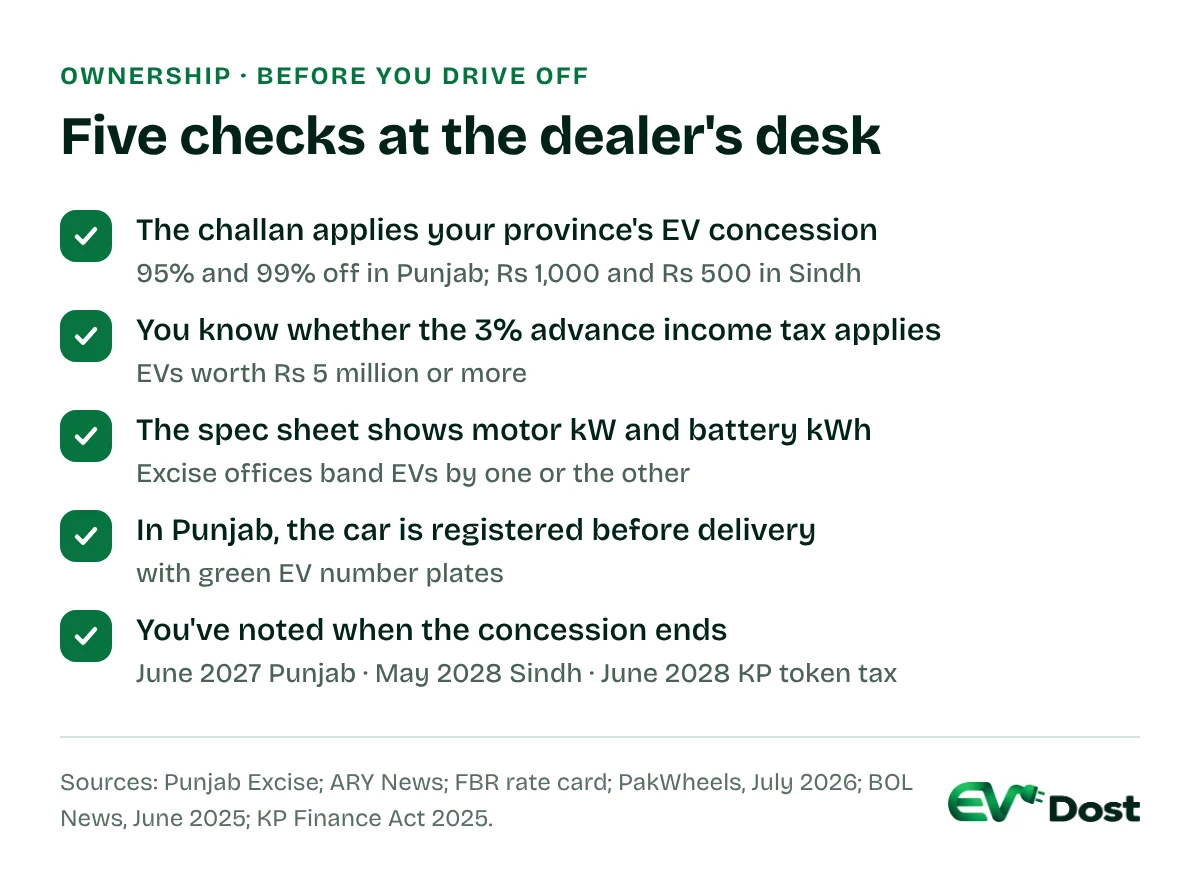
- KP bands its EVs by what the schedule calls "kWh Motor Power", from up to 50 to above 124. That mixes a battery unit (kWh) with a motor measure (power, normally kW), so ask the excise office which figure on your papers it reads.
- Sindh charges its luxury tax on EVs "equivalent to 2,000cc and above", but none of the reports we read explain how a motor's rating converts to cc.
- Islamabad's EV transfer-fee bands were reported in kW by Profit and in kWh by the Express Tribune (Express Tribune, April 2025), with cut-offs at 50 and 100.
- Punjab doesn't publish a mapping on its tax page. With 99 percent off, the band matters far less there than the income tax does.
- The FBR sidesteps the problem by using price, as the next section explains.
In practice, carry the dealer's spec sheet showing both the motor power in kW and the battery size in kWh. Whoever is filling in your challan will want one of them.
The federal tax that doesn't shrink for EVs
Provincial discounts don't touch income tax. When you register a car, the excise office also collects advance income tax under section 231B of the Income Tax Ordinance, and the FBR's rate card, updated to the Finance Act 2026, has a line for vehicles where engine capacity doesn't apply. If the car is worth Rs 5 million or more, the rate is 3 percent of its value (FBR rate card, 2026). This line dates back to the 2023 budget (Profit, July 2023).
On the Rs 8.99 million Atto 3, that's Rs 269,700 for a taxpayer on the active list. A petrol car at the same price with a 1,301–1,600cc engine pays 2 percent, about Rs 179,800. So at this price the EV pays more income tax at registration, which surprises a lot of buyers. The card lists no rate for EVs under Rs 5 million. It also doesn't spell out a non-filer rate for the EV line, though for petrol cars non-filers pay three times as much.
The card also sets a fixed Rs 20,000 on later sales of an EV worth Rs 5 million or more, falling by 10 percent for each year since first registration. Buying second-hand? Our used EV buying guide covers what else to check.
Sales tax is a separate matter, paid on the purchase price rather than at the excise office. Certain locally assembled EVs with batteries up to 50 kWh pay 1 percent until 30 June 2027, though the IMF has pushed for the full 18 percent and no decision had been reported as of October (Daily Pakistan, October 2026). Our explainer on the NEV policy tracks that and the other federal measures.
Registering the car, and paying the tax every year
Punjab. New cars bought with a Punjab CNIC are now meant to be registered by the dealership before delivery. The Excise department told manufacturers in July 2026 that vehicles must be registered before they're handed over, through 102 dealers licensed under its Dealer Vehicle Registration System, which charge Rs 2,000 per registration (PakWheels, July 2026). Afterwards you can download an e-registration card from the Excise website (ARY News, September 2024) and pay the yearly tax on the ePay Punjab app.
Sindh. Registration is still done through the Excise department. Annual tax can be paid on the Sindh Excise tax portal at taxportal.excise.gos.pk.
Islamabad. Token tax can be paid through the PAK App, which generates a PSID you then pay from your mobile banking app. Online payment works only for smart-card registration books (PakWheels, July 2026). PakWheels' round-up also lists the ONE App and the City Islamabad app.
Khyber Pakhtunkhwa. The Dastak platform handles registration, tax payments and universal number plates online (Express Tribune, February 2025).
The payment channels for Punjab, Sindh, Islamabad and KP are from PakWheels' July 2026 round-up (PakWheels, July 2026).
Once the plates are on, the next question is where to plug in. Hosts on EVDost list home and business chargers at an hourly price, billed in 10-minute blocks, and you can sort them by best price or nearest. Open the map and check your area.
What could change before your next renewal
Most EV concessions on the electric car token tax in Pakistan come with an end date. Punjab's 99 percent runs to 30 June 2027, Sindh's flat fees to 29 May 2028 and KP's token tax exemption to 30 June 2028. Islamabad's position may be settled by the new NEV and auto policies, which were still short of final approval in October. And the federal 1 percent sales tax is under pressure from the IMF. If you're comparing an EV with a petrol car on total cost, as our electric vs petrol cost guide does, treat the token tax savings as real but temporary.
Three things before you pay. Budget for the income tax, since that's the big number. Check that the EV concession appears on the challan before you pay it. And put a reminder in your phone for the month your province's discount is due to expire.
Frequently asked questions
What is the token tax on an electric car in Punjab?
Electric cars in Punjab pay 1 percent of the normal motor vehicle tax, after a 99 percent exemption notified for 1 July 2026 to 30 June 2027. Since most cars there are taxed at 0.3 or 0.4 percent of invoice price, an Rs 8.99 million EV pays roughly Rs 270 to Rs 360 a year. Punjab also exempts 95 percent of the registration fee.
How much does it cost to register an EV in Sindh?
Registering a non-commercial electric car in Sindh costs Rs 1,000, with Rs 500 a year in motor vehicle tax, under a package the Sindh cabinet extended on 1 September 2026 for 30 May 2026 to 29 May 2028. EVs equivalent to 2,000cc or more also pay a Rs 5,000 luxury tax.
Do electric cars pay income tax at registration in Pakistan?
Electric cars worth Rs 5 million or more pay 3 percent of their value as advance income tax at registration under section 231B, according to the FBR rate card updated to the Finance Act 2026. On an Rs 8.99 million EV that's Rs 269,700 for an active taxpayer, more than a same-price 1.5-litre petrol car pays.
Are electric cars exempt from token tax in Islamabad?
Electric cars in Islamabad may already be exempt from the registration fee and motor vehicle tax, under an Interior Ministry notification Profit reported in June 2021. But May 2026 reports described that exemption as part of the draft NEV policy, so it's unclear what the Excise office applies as of November 2026. Ask at the counter before you pay.
Do EVs pay token tax in Khyber Pakhtunkhwa?
Electric cars in Khyber Pakhtunkhwa pay no token tax until 30 June 2028. The KP Finance Act 2025 sets annual rates of Rs 2,000 to Rs 8,000 for electric four-wheelers by power band, but exempts all electric four-wheelers from token tax until that date.
Sources
- Punjab Excise, motor vehicle tax and EV exemptions: excise.punjab.gov.pk
- PakWheels, Punjab registration fee rates (June 2024): pakwheels.com
- Profit, Punjab Finance Bill 2026–27 token tax and EV concession (June 2026): profit.pakistantoday.com.pk
- Profit, Islamabad token tax and Punjab's approved rates (June 2026): profit.pakistantoday.com.pk
- Mettis Global, Punjab 99% EV tax exemption notified (July 2026): mettisglobal.news
- BOL News, Punjab EV number plates (June 2025): bolnews.com
- PakWheels, BYD Atto 3 Advance price: pakwheels.com
- ARY News, Sindh EV tax relief (September 2026): arynews.tv
- PakWheels, Sindh EV relief until 2028 (September 2026): pakwheels.com
- Energy Update, Sindh cabinet EV incentives (September 2026): energyupdate.com.pk
- Profit, EV registration fee and motor vehicle tax exemption notified (June 2021): profit.pakistantoday.com.pk
- Daily Pakistan, planned NEV exemptions (May 2026): dailypakistan.com.pk
- Profit, Islamabad EV transfer fees (April 2025): profit.pakistantoday.com.pk
- Express Tribune, EV transfer fees (April 2025): tribune.com.pk
- TechJuice, Finance Act 2026 token tax rates (June 2026): techjuice.pk
- Government of Khyber Pakhtunkhwa, Finance Act 2025: kpcode.kp.gov.pk
- Express Tribune, KP Finance Act 2025 (July 2025): tribune.com.pk
- FBR, withholding income tax rate card (Finance Act 2026): fbr.gov.pk
- Profit, advance tax on EV registration (July 2023): profit.pakistantoday.com.pk
- Daily Pakistan, IMF and the 1% EV sales tax (October 2026): dailypakistan.com.pk
- PakWheels, Punjab registration before delivery (July 2026): pakwheels.com
- ARY News, Punjab e-registration card (September 2024): arynews.tv
- PakWheels, paying Islamabad token tax online (July 2026): pakwheels.com
- PakWheels, paying token tax online by province (July 2026): pakwheels.com
- Express Tribune, KP Dastak online vehicle services (February 2025): tribune.com.pk