Petrol price in Pakistan today, and why it now changes every day
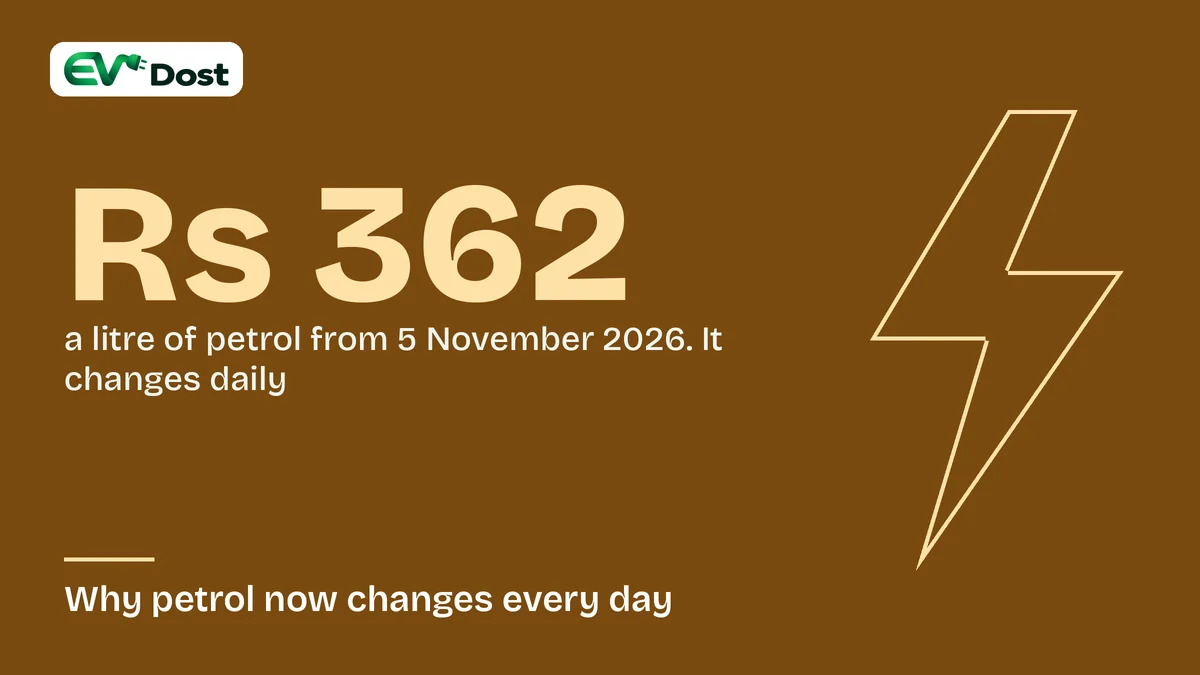
Petrol in Pakistan costs Rs 362.00 a litre from 5 November 2026, under a notification the Oil and Gas Regulatory Authority (OGRA) issued on 4 November (Dawn, November 2026; Business Recorder, November 2026). It was Rs 369.06 on 4 November and Rs 374.51 on 3 November (Business Recorder, November 2026; APP, November 2026).
Since July, OGRA has set the price of petrol almost every working day, so the petrol price in Pakistan today is a number with a shelf life of about 24 hours. Fill up on a Tuesday and again on Thursday, and you may pay two different prices. By the time you read this, it has probably moved again. So this post is about the system behind the number, how tonight's price gets worked out, and what the swings mean if you're weighing petrol against an electric car.
Petrol price in Pakistan today, after three cuts in a row
Petrol fell by Rs 3.40 from 3 November, Rs 5.45 from 4 November and Rs 7.06 from 5 November, three cuts worth Rs 15.91 together. Diesel fell to Rs 387.81. The 6 November price hadn't been announced when we published on the afternoon of 5 November, so check tonight's notification before you rely on these figures.
From fortnightly to weekly to daily
After the war on Iran began on 28 February, fortnightly price reviews went weekly in early March (Dawn, August 2026; Dawn, October 2026), and petrol hit about Rs 458 a litre on 3 April, the year's peak (Dawn, April 2026).
On 17 July, Petroleum Minister Ali Pervaiz Malik announced, alongside Information Minister Attaullah Tarar, that OGRA would set prices every day (Aaj News, July 2026; Daily Pakistan, July 2026). The reasons given were faster pass-through of world oil prices, a published formula, and a first step towards deregulation. The government also urged people to switch to EVs and electric motorcycles.
The start date depends on how you count. The first price under the new system, Rs 316.15, took effect on Saturday 18 July and ran to Monday 20 July (ARY News, July 2026). The first weekday revision took effect on 21 July, at Rs 315.80 (ARY News, July 2026), and a Dawn op-ed says the government moved to daily adjustments as of 21 July (Dawn, August 2026). All three dates turn up in the press.
Pump owners threatened a nationwide strike, then postponed it on 22 July after talks with the minister. The minister told them OGRA would publish each price with its breakdown in English and Urdu (Arab News, July 2026).
How OGRA works out each night's price
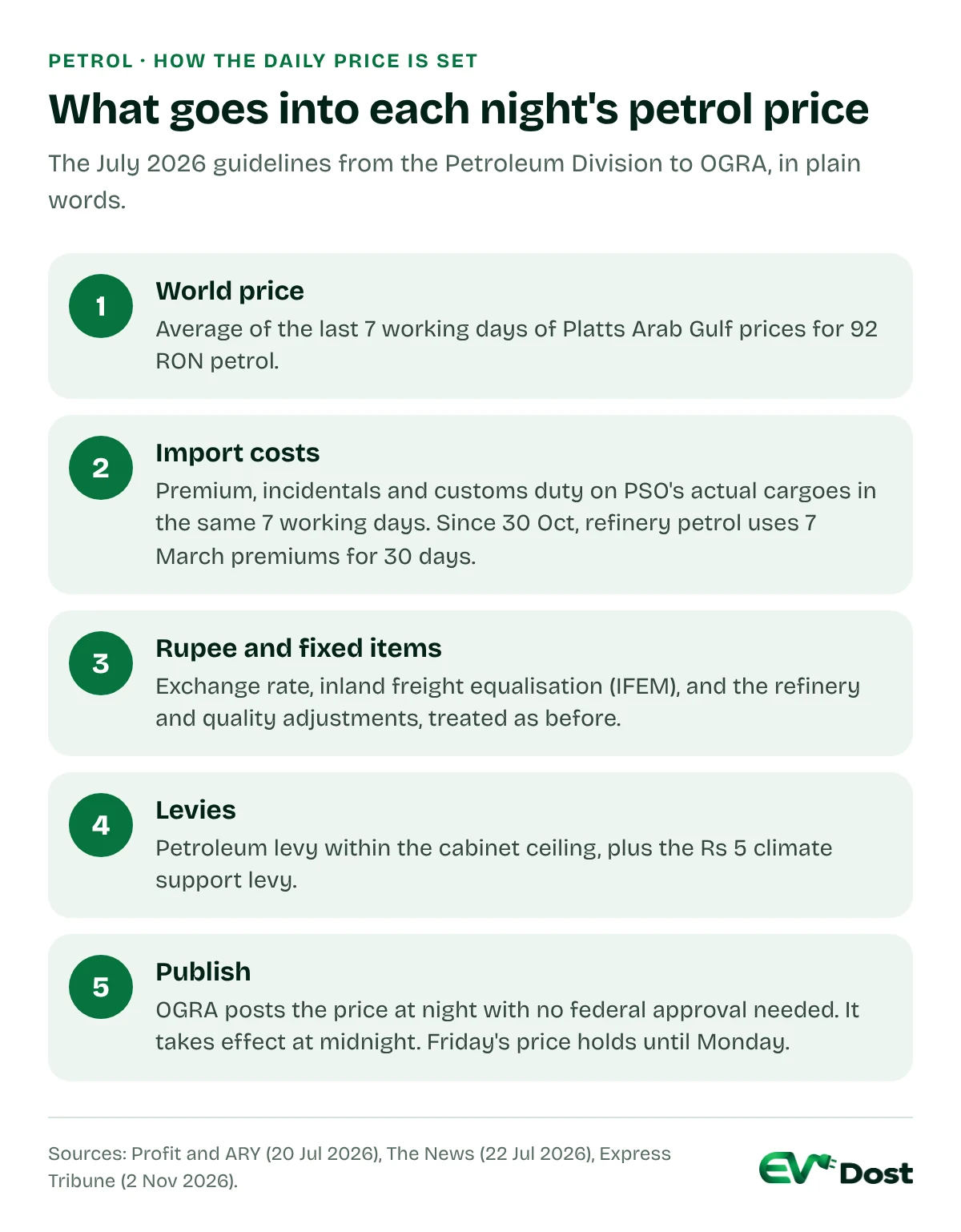
The Petroleum Division's guidelines to OGRA, reported by Profit on 20 July, come down to a few rules (Profit, July 2026).
- The world price is a rolling average. OGRA takes the last seven working days of Platts Arab Gulf assessments for 92 RON petrol. A bad day on world markets feeds in over a week, not overnight.
- Import costs follow PSO's real cargoes. Premium, incidentals and customs duty are averaged over PSO's cargoes in the same seven working days, with fallbacks if none arrived.
- The rupee still matters. Exchange-rate adjustment, inland freight equalisation and the refinery and quality adjustments work as before.
- Levies have a ceiling. The petroleum levy can't go above the cabinet-approved ceiling, and mid-year changes need the Finance Division's consent.
- No sign-off needed. OGRA publishes without prior approval from the federal government or the Prime Minister.
- Weekends are frozen. Prices don't change on Saturday or Sunday (ARY News, July 2026). In practice Friday night's price holds through Monday, as the first one did from 18 to 20 July, and Monday night's applies from Tuesday. New rates take effect at midnight (The News, July 2026).
The levies inside a litre
From 2 July the climate support levy doubled to Rs 5 a litre, and the petroleum levy on petrol was cut by Rs 2.50 to Rs 64.14 so pump prices stayed put (Profit, July 2026; The News, July 2026). ARY's breakdown a few days later split the levies differently, so treat that figure with care.
We couldn't find a per-litre petroleum levy for November. The latest total is Dawn's, roughly Rs 114 a litre in taxes and duties in late September and early October (Dawn, September 2026; Dawn, October 2026). ARY reported general sales tax on petrol at zero in July (ARY News, July 2026), a single 2026 source.
The 30 October refinery change
On 30 October the federal cabinet changed how locally refined petrol is priced. For 30 days, refineries must use premium, incidentals and customs duty frozen at pre-war 7 March levels. The gap between the import price and that lower figure goes to the government as petroleum levy, with the benefit meant to reach drivers at the pump. Prices announced on 30 October were the first under the new formula, Express Tribune reported (Express Tribune, November 2026). No report we read gives the dates of the 30-day window.
Refiners told Arab News the change could cost them up to Rs 49 a litre and puts a roughly $6 billion upgrade plan at risk; the Petroleum Division didn't respond (Arab News, November 2026). At a press conference on 2 November, the minister said petrol could fall by about Rs 15 under the new formula if refineries cooperated (Minute Mirror, November 2026). The cuts that followed came to Rs 15.91, but linking the two is our reading, not anything an outlet confirmed.
Four months of daily prices
On 30 June petrol was Rs 299.50 (Business Recorder, June 2026; Dawn gave Rs 299.78). It dipped to the period's low of Rs 297.53 from 4 July (Profit, July 2026), climbed through August and surged in September, with Rs 12.90 added in one night from 8 September, according to ProPakistani's revision table (ProPakistani, October 2026).
The high under daily pricing came on 9 October, Rs 398.96 (Dawn, October 2026). Since then it has mostly eased, to Rs 381.14 from 20 October (APP, October 2026) and Rs 377.91 at the end of the month (Business Recorder, October 2026).
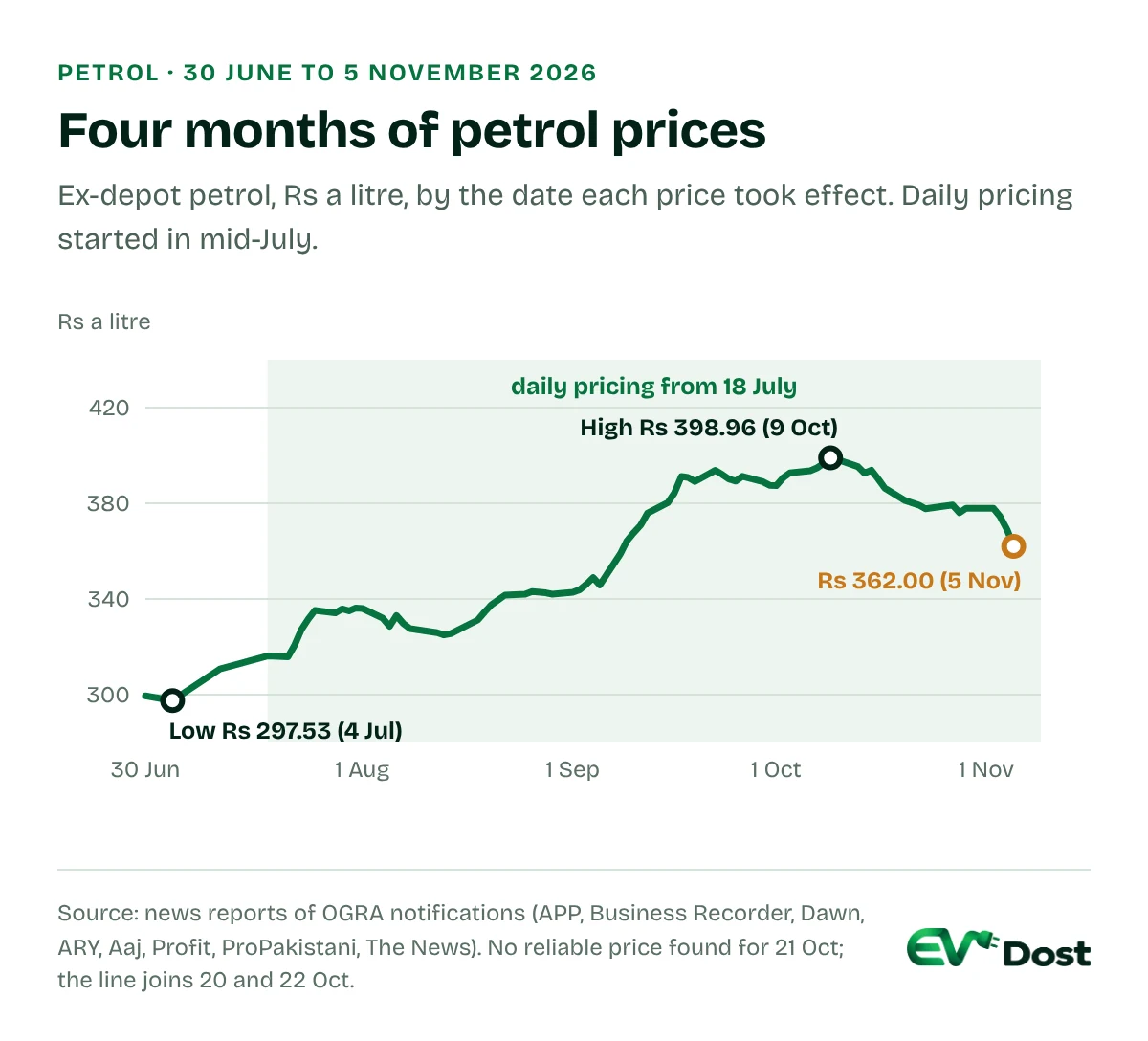
Petrol is Rs 62.50 a litre dearer than on 30 June, up about 21 percent, but Rs 36.96 below the October high. The daily system doesn't set the direction; world prices, the rupee and levies do. It changes the rhythm.
On 13 September the Prime Minister also announced Rs 100 a litre off for two- and three-wheelers (up to 20 litres a month) and vehicles up to 800cc (up to 30 litres) (Dawn, September 2026).
What each price means per kilometre
Using the per-kilometre sums we run for every EV, take a petrol car averaging 13.5 km a litre and an EV charged at home at Rs 55 a unit all-in, using 18 kWh per 100 km plus 10 percent charging loss. That gives the EV Rs 10.89 a km, whatever OGRA does tonight.
| Petrol price | Petrol, Rs per km | EV at home, Rs per km | 1,000 km: petrol vs EV |
|---|---|---|---|
| Rs 362.00 (5 Nov) | 26.81 | 10.89 | Rs 26,815 vs Rs 10,890 |
| Rs 369.06 (4 Nov) | 27.34 | 10.89 | Rs 27,338 vs Rs 10,890 |
| Rs 374.51 (3 Nov) | 27.74 | 10.89 | Rs 27,741 vs Rs 10,890 |
| Rs 398.96 (9 Oct high) | 29.55 | 10.89 | Rs 29,553 vs Rs 10,890 |
| Rs 297.53 (4 Jul low) | 22.04 | 10.89 | Rs 22,039 vs Rs 10,890 |
Even at the July low, petrol cost about twice as much per kilometre. At today's price, the EV only loses if your electricity costs about Rs 135 a unit. A public DC fast charger at around Rs 115 per kWh, the typical figure in our breakdown of charging costs, works out to about Rs 21 a km, still below petrol. Purchase price and five-year totals are in our full electric-versus-petrol sums.
The other difference is predictability, since your electricity tariff doesn't reset overnight. If you drive an EV but have no charger at home, you can find a charger that's open now on EVDost, where hosts set an hourly price you can compare before you go.
How to check the price before you fill up
- Look late in the evening. OGRA's notification comes at night and takes effect at midnight.
- Remember Friday. Friday night's price runs through Monday.
- Use a major outlet. APP, Business Recorder, Dawn and Aaj usually report each notification with the old and new price. OGRA publishes on its website too, though we couldn't open its price page when writing this.
- Check the effective date, not the headline date. A story dated 4 November often gives the price for 5 November.
We track the bigger moves, and the policy stories that change what electric cars cost, in our monthly EV news roundup.
Frequently asked questions
What is the petrol price in Pakistan today?
Petrol costs Rs 362.00 a litre in Pakistan from 5 November 2026, according to OGRA's notification as reported by Dawn and Business Recorder, after Rs 369.06 on 4 November and Rs 374.51 on 3 November. OGRA revises it almost every working day, so check the latest notification.
When did Pakistan start daily petrol pricing?
Pakistan's daily petrol pricing was announced on 17 July 2026. The first price under the new system, Rs 316.15 a litre, took effect on 18 July, and the first weekday revision on 21 July. Outlets date the start to each of those days.
Why doesn't the petrol price change on weekends?
Petrol prices in Pakistan stay fixed on Saturdays and Sundays under the July 2026 guidelines to OGRA. In practice Friday night's price applies from Saturday to Monday, and Monday night's notification applies from Tuesday.
How much tax is in a litre of petrol in Pakistan?
Taxes and duties came to roughly Rs 114 on a litre of petrol in late September and early October 2026, as reported by Dawn, including the Rs 5 climate support levy in force since 2 July. We couldn't find a published per-litre petroleum levy for November.
At what electricity price does an EV stop being cheaper than petrol?
An EV charged at home stays cheaper per kilometre than a 13.5 km/litre petrol car up to about Rs 135 a unit, with petrol at Rs 362.00 from 5 November 2026. At Rs 55 a unit, the EV costs about Rs 10.89 a km against Rs 26.81 for petrol.
Sources
- Dawn, petrol price from 5 November 2026: dawn.com
- Business Recorder, petrol price from 5 November 2026: brecorder.com
- Business Recorder, petrol price from 4 November 2026: brecorder.com
- APP, petrol price from 3 November 2026: app.com.pk
- Express Tribune, revised petrol formula (November 2026): tribune.com.pk
- Arab News, refineries on the new petrol formula (November 2026): arabnews.pk
- Minute Mirror, minister on a Rs 15 cut (November 2026): minutemirror.com.pk
- Business Recorder, petrol price from 29 October 2026: brecorder.com
- APP, petrol price from 20 October 2026: app.com.pk
- ProPakistani, daily revision table (October 2026): propakistani.pk
- Dawn, petrol price from 9 October and the 28 February start of the war (October 2026): dawn.com
- Dawn, relief scheme and taxes per litre (September 2026): dawn.com
- Dawn, Afia Malik on daily pricing (August 2026): dawn.com
- Arab News, dealers postpone strike (July 2026): arabnews.pk
- The News, editorial on the new fuel regime (July 2026): thenews.pk
- Profit, how the revised mechanism works (July 2026): profit.pakistantoday.com.pk
- ARY News, guidelines to OGRA (July 2026): arynews.tv
- ARY News, petrol price for 21 July 2026: arynews.tv
- ARY News, first daily price, 18 July 2026: arynews.tv
- Aaj News, daily pricing announced (July 2026): english.aaj.tv
- Daily Pakistan, OGRA to set prices daily (July 2026): dailypakistan.com.pk
- ARY News, petrol price build-up and taxes (July 2026): arynews.tv
- Profit, petrol price from 4 July 2026: profit.pakistantoday.com.pk
- Profit, fuel levies recast (July 2026): profit.pakistantoday.com.pk
- The News, Rs 2.50 shifted to climate levy (July 2026): thenews.pk
- Business Recorder, petrol price set on 19 June 2026 and still in force on 30 June: brecorder.com
- Dawn, petrol at Rs 458 (April 2026): dawn.com